
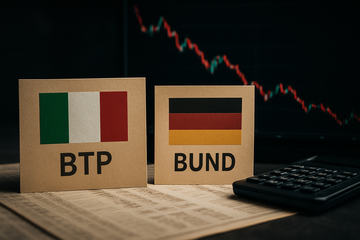
10-year BTP yield (Oct 2, 2026)
4.69%
Little changed intraday after touching 4.72% Oct 1; highest since Nov 2023
10-year German Bund yield (Oct 2, 2026)
3.41%
Down more than 10 bps on the day as Bunds rallied
BTP-Bund 10y spread (Oct 2, 2026)
~127 bps
Widest since June 2025; up from 92.9 bps on Sep 23
10-year French OAT yield (Oct 1, 2026)
4.95%
Highest since June 2002; OAT-Bund spread above 130 bps — widest since 2012
UBS 10-year Treasury observation (Oct 1, 2026)
5.30%
Highest since 2007; seventh consecutive sell-off session
Italy 2027 budget deficit plan (Oct 2, 2026)
3.4% of GDP
Up from <3% in 2026; first rise in three years, complicating the fiscal story
The trade
UBS opened a relative-value short on Italy, not a directional rates call
On CNBC's Squawk Box Europe on Oct 2, 2026, UBS Investment Bank's head of European rates strategy Reinout de Bock said he had closed a short on French OATs vs Bunds and opened a fresh short on Italian 10-year BTPs vs 10-year Bunds. He framed the swap as a rotation, not a new regime call: bunds are the safest asset in the region, and the next pressure point is Italy, where fiscal dynamics have only just begun to deteriorate as global yields reprice higher.
The trade is a relative-value spread fade: long Bunds, short BTPs, sized to collect the carry plus spread-widening gains. It is small and tactical in the context of UBS's overall book, but the timing matters. On the morning of Oct 2, the 10-year BTP traded at roughly 4.69% and the 10-year Bund at 3.41%, putting the spread at around 127 bps — its widest reading since June 2025, after compressing to 92.9 bps on Sep 23.
Why Italy, why now
Italy became the next pressure point as France led the way
The European leg of the 2026 bond rout has been led by France, not Italy. France's 10-year OAT hit 4.95% on Oct 1, its highest level since June 2002, and the OAT-Bund spread pushed above 130 bps for the first time since the 2012 eurozone sovereign-debt crisis. UBS had positioned for that move with its French short; once it worked, de Bock closed it and rotated into Italy — the same playbook, applied to a name that hadn't yet moved.
- ECB raised the deposit facility rate to 2.50% on Sep 16, 2026, a second 25 bp hike; money markets imply 2.81% by year-end and 3.42% by end-2027, with the ECB moving against the bond rout rather than into it
- Italy confirmed on Oct 2 that its 2026 deficit will fall below 3% of GDP for the first time since 2019, but the 2027 deficit will rise back to 3.4% as the government prepares Meloni's last pre-election budget
- Brent crude has stayed around $100/bbl through Q3 as the Middle East conflict drags on, keeping inflation risk premium embedded in long-end yields across the curve
- Hyperscaler AI capex has pushed US Treasury refunding needs higher, lifting the term premium and pulling global long yields higher with it
Italy's underlying story is not a crisis — debt-to-GDP is still on a slow grind lower — but the path is now visibly reversing. The October plan raises 2026 GDP growth to 1.0% (from a prior 0.6%) and 2027 to 0.8% (from 0.6%), which is helpful, but the deficit trajectory is what the bond market prices. A widening BTP-Bund spread is the mechanical symptom of that trade-off.
BTP-Bund 10y spread, late Sep to Oct 2, 2026 (basis points)
Spread blew out of a 92.9 bps summer low in eight trading sessions as UBS rotated from its French short into Italy.
Unit: basis points
Sep 23, 2026
Late-summer low; tightest of the squeeze
92.9
Sep 30, 2026
First close above 100 bps since June 2025
102.9
Oct 1, 2026
Spread past 118 bps intraday
118
Oct 2, 2026 midday
Level UBS cited when opening the short
127
The contradiction that isn't
Why UBS can run a bearish Italy trade and a bullish 8,100 S&P call at the same time
The same week, UBS Global Wealth Management was reiterating a year-end 2026 S&P 500 target of 8,100 (raised from 7,900 on Aug 21) and a mid-2027 target of 8,400 (raised from 8,200), backed by 2026 S&P EPS of $350 and 2027 EPS of $400. The Wealth Management house view, written in mid-September, was that 'the equity bull market can survive higher interest rates, supported by robust and broadening earnings growth.' The Investment Bank's rates desk is making a different bet on the same rate environment. The two views do not clash — they share an assumption that long yields stay higher.
UBS's wealth side treats higher yields as a manageable drag because earnings breadth is widening beyond the AI trade. The rates side treats higher yields as the dominant force in European fixed income, where duration alone cannot offset the fiscal and political risk premia rebuilding inside the BTP curve. Equities win by out-earning the rate headwind; Italian sovereigns lose because the issuer cannot.
| House view | Most recent call | Vehicle / unit | Direction |
|---|---|---|---|
| S&P 500 year-end 2026 | 8,100 (raised from 7,900, Aug 21, 2026) | UBS Global Wealth Management | Bullish |
| S&P 500 mid-2027 | 8,400 (raised from 8,200, Aug 21, 2026) | UBS Global Wealth Management | Bullish |
| 2026 S&P EPS | $350 (prior $305) | UBS Global Wealth Management | Bullish |
| 2027 S&P EPS | $400 (prior $370) | UBS Global Wealth Management | Bullish |
| 10-year BTP vs Bund | Short BTP, long Bund, opened Oct 2, 2026 | UBS Investment Bank rates desk | Bearish Italy |
| French OAT vs Bund | Closed prior short on Oct 2, 2026 | UBS Investment Bank rates desk | Trade closed |
| Italian sovereigns | 'Attractive risk-reward' long held through 2018 trade; rotation only | UBS Investment Bank rates desk | Rotating |
| Quality bonds, short/medium maturity | 'Appealing risk-return', May 18, 2026 daily | UBS Chief Investment Office | Constructive |
| US equities vs higher yields | 'Most exposed' developed market if yields rise further, Sep 9, 2026 | UBS HOLT (Michel Lerner) | Cautious on US valuations |
The other side of the book
What's on the other side: Italian bank balance sheets and the bunds rally
Every short has a counterparty. In a BTP-Bund spread trade, the natural losers are the holders of long-dated Italian sovereign debt — and the biggest holders of that debt are Italian banks. Italian lenders carry the largest sovereign-bond stack relative to capital in the eurozone, and a persistent widening of the spread flows directly into their mark-to-market reserves and regulatory capital ratios. The trade UBS opened is, mechanically, a bet against those books.
- UniCredit and Intesa Sanpaolo hold several hundred billion euros of Italian sovereign bonds between them; their H1 2026 results benefited from a compressed BTP-Bund spread, with Intesa Sanpaolo booking €5.6B of H1 net income on net interest income of €3,844m in Q2 alone
- Spread widening of the magnitude UBS is targeting would feed unrealized losses into banks' available-for-sale portfolios and could reignite the 'doom loop' between Italian sovereigns and bank solvency ratios — a dynamic that has been dormant since 2025
- Deutsche Bank is exposed on both sides: it benefits from Bund outperformance as a German balance sheet, but carries legacy Italian and peripheral sovereign holdings that get marked down as spreads widen
- BNP Paribas is the cleanest short on the French side: with the OAT-Bund spread already above 130 bps, the trade UBS closed is consistent with the view that French risk has already paid out and the marginal new short lives in Italy
On the long side of the trade sit the Bund holders — primarily German and northern European insurers and pension funds. They have been rewarded all year as the spread compressed, and they will be rewarded again if UBS's call plays out. The Bund itself is also doing the Fed's job for the ECB: 10-year Bunds at 3.41% are now pricing in more tightening than the deposit rate implies, which means any dovish surprise from Frankfurt lands disproportionately on the long end.
What's next
Catalysts, horizons, and the call nobody is making
Three near-term catalysts will decide whether UBS's short holds. The Italian 2027 budget bill is due in parliament later this month; if the deficit forecast of 3.4% of GDP widens further, the spread move will accelerate. The ECB meets on Oct 28-29, and the deposit rate is now the key marginal driver — a hawkish hold will reinforce the trade, while a hint of pause would compress spreads again. Italy also opens its BTP Valore retail issuance window on Oct 19-23, a real-time gauge of domestic demand for sovereign paper.
- Days to weeks: ECB meeting Oct 28-29, Italy's 2027 budget draft, Treasury refunding announcements — the spread is event-driven and reacts to every data print
- Months: the 'higher for longer' Fed/ECB path currently in money markets can compress if US growth cracks or Brent breaks below $90/bbl — that would unwind the spread trade as fast as it was put on
- 1–3 years: the structural question is whether Italy's debt-to-GDP, forecast by the European Commission at ~138% by end-2026, can resume its downward path once the 2027 budget cycle ends — if not, the BTP-Bund spread mean reverts wider and UBS's short becomes the consensus rather than the contrarian
Stocks the trade actually touches
- Investment Bank rates desk earns directly if the BTP-Bund short pays out — a tight, tactical P&L line, not a franchise mover
- Wealth Management's $3B buyback, launched Jul 29, 2026, signals UBS thinks the equity story survives even if the rates story doesn't — buyback completion expected through mid-2027
- Two-quarter net income of $5.84B in H1 2026 and RoCET1 of 15.4% give UBS enough cushion to hold the trade through mark-to-market drawdowns if spreads initially tighten
- Italy's largest BTP holder by capital ratio; a 30 bp widening on a stack of several hundred billion euros flows directly into unrealized losses on available-for-sale portfolios
- H1 2026 record net income benefited from compressed BTP-Bund spreads — the very compression UBS is now betting reverses
- Days: any further BTP-Bund widening hits the mark-to-market book; 1–3 years: if Italy's debt/GDP ratio stops falling, UniCredit's sovereign-link re-rating resumes
- Italian sovereign-bond portfolio marks down at the same pace as UniCredit's — €5.6B H1 2026 net income sets the bar UBS's trade bets will fall against
- Higher domestic funding costs at the sovereign level flow through to corporate and mortgage spreads in Italy, compressing NII into 2027
- Q2 2026 net interest income of €3,844m (+5.7% Q/Q) is the read-through line to watch at the next print if the BTP-Bund trade works
- German balance sheet gains from Bund outperformance as the long leg of the trade, with eurozone rates volatility broadly supportive of the Fixed Income & Currencies franchise
- Residual Italian and peripheral sovereign exposure marks down in parallel with UniCredit and Intesa, though smaller in absolute terms
- Days: trading desks benefit from widening vol; 1–3 years: net direction depends on whether Germany itself absorbs any fiscal loosening from the new Merz coalition
- France is the largest single sovereign exposure in BNP's banking book, and UBS just closed its French short — suggesting the French leg of the trade has paid out and the next move is in Italy
- Watch the Oct 28-29 ECB meeting and the French 2027 budget package (€54B adjustment) for the catalyst BNP's bond portfolio is most sensitive to
- If UBS is right that France stabilizes and Italy catches up, BNP's French holdings are defended at the cost of new Italian sovereign mark-downs