
The Distribution War Quietly Left the App Store
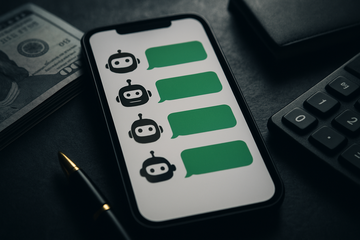
For two years, the consumer AI contest has been fought over app stores, browsers, and chat surfaces. As of October 3, the field has moved. Lauren Forristal's TechCrunch roundup, All the AI agents that can live in your text messages, catalogs at least seven production agents—Caddy, Instinct, Poke, Fambot, Ohai, Lindy, and Martin—that you summon by sending a text to a phone number. No app to download. No URL to remember. The interface is the inbox you already have.
AI agents now living in text threads
7+
In TechCrunch's Oct 3, 2026 catalog (Caddy, Instinct, Poke, Fambot, Ohai, Lindy, Martin)
Instinct valuation jump
4x in 33 days
$2.5B → $10B after $1B Series C, Sept 28, 2026 (Sequoia, Benchmark, Coatue)
Photon developer sign-ups
40,000+
10x revenue growth in four months, <3% churn (Oct 1, 2026 seed round)
WhatsApp monthly active users
3.3B
Largest messaging app globally, per Demandsage/Infobip, Jan 2026
Why the Inbox Wins—And Why It Was Inevitable
- Install friction collapses to zero: a phone number is the only address, so onboarding a new agent is faster than downloading a 200MB app.
- Reach extends to the 3.3 billion WhatsApp users, the 1+ billion Apple iMessage users in North America, and the ~1 billion Android Google Messages RCS users—a combined footprint that dwarfs any single AI lab's first-party app.
- Memory and permissions inherit from a thread the user already trusts: text conversations carry context, contacts, and calendar data without a separate permissions dance.
- Carriers, CPaaS APIs, and platform owners each see a piece of every message, so monetization is layered rather than winner-take-all.
The migration did not begin with any single announcement. Apple approved Poke as the first AI agent on its Messages for Business platform in June. OpenAI shipped a ChatGPT Apple Messages plugin for macOS on August 20 that lets ChatGPT read, search, and send iMessage, SMS, and RCS threads. Meta opened its WhatsApp Business Platform to third-party coding agents through a Model Context Protocol server on September 15. And Apple introduced the agentic Siri AI on September 14, with explicit hooks into Messages, Reminders, and Mail.
The Per-Message Economics That Decide Who Gets Paid
Text-message resident agents do not monetize through a one-time download or a 30% app-store cut. They monetize through the message itself. Meta has now published three distinct per-message price points that any WhatsApp-resident agent must pay into the platform owner—plus the CPaaS middleware that delivered it.
| Charge | Rate | Effective date | Notes |
|---|---|---|---|
| Meta Business Agent (AI replies) | $2.00 per 1M tokens (~4–5¢ per message) | Aug 1, 2026 | Tokens bundle AI inference + delivery; billed to the business sending replies via Meta Business Agent. |
| Service messages (incl. third-party AI) | $0.0060 per message after 1,000 free per number/month | Oct 1, 2026 | First 1,000 service messages per business phone number each month are free; usage above that pays Meta directly. |
| Twilio CPaaS layer (WhatsApp) | $0.005 per message (inbound or outbound) | Feb 2026 | Twilio platform fee stacked on top of Meta's per-message fees. |
| Marketing messages (North America) | $0.0250 per message | Jul 1, 2026 | Benchmark for comparison; utility/authentication run $0.0034 in North America. |
Upstream and Downstream: Who Routes, Who Bills, Who Loses
- Upstream model providers — OpenAI, Anthropic, and xAI all run private; their models sit behind every agent in the TechCrunch catalog. None own a default messaging surface.
- CPaaS middleware — Twilio, Infobip, MessageOS, and Clerk Chat sit between the lab and the platform; they earn $0.005 per WhatsApp message and a parallel fee on SMS/RCS, making them volume beneficiaries regardless of which agent wins.
- Messaging platforms — Apple's iMessage and Messages for Business, Meta's WhatsApp and Messenger, and Alphabet's RCS on Android are the new app stores. Each collects a per-message toll and gates third-party agents.
- Carriers — AT&T, Verizon, and T-Mobile terminate SMS/RCS traffic but no longer set consumer pricing. Their latent power is direct carrier billing—the same infrastructure that once monetized premium SMS—which would let a telco charge an AI agent subscription directly to a phone bill.
- Consumer endpoints — WhatsApp's 3.3 billion MAU, Apple Messages' billion-plus iPhone base, and Google Messages' RCS users on Android define the total addressable surface.
The supply chain has shifted from a single chokepoint (Apple/Google app stores) to a layered rail. Twilio reported Q2 2026 revenue of $1.50 billion, up 22% year-over-year on a reported basis and 17% organically—its fastest growth in 19 quarters—with management crediting AI-driven messaging volume, per its August 6 earnings release. That is the clearest public-market read on what text-message resident agents mean for the middle of the stack: more messages, more tolls, more margin.
Which AI Lab Actually Wins the Inbox?
Four private labs are racing for the inbox seat. Their positioning diverges sharply once you map each to a default messaging surface.
| Lab | Native messaging surface | Gating risk | Monetization posture |
|---|---|---|---|
| OpenAI | Apple Messages plugin (Aug 20, 2026); Apple Intelligence / Siri extension | Apple controls the iMessage surface and decides which extensions ship | Agentic commerce + Sign in with ChatGPT; paying Apple toll via Messages for Business |
| Meta (Llama / Meta AI) | WhatsApp, Messenger, Instagram DMs—its own rails | EU interim measures order (June 9, 2026) forced free rival access; Meta Business Agent charges $2/1M tokens to itself and rivals | Owns the platform; competes as both gatekeeper and resident agent |
| Anthropic | No native rail; reaches WhatsApp via third-party MCP servers (Claude Sonnet 5) | Dependent on Meta's per-message pricing for any WhatsApp reach | Sells tokens to integrators (Photon, Poke, Lindy) who pay the toll |
| xAI / Grok | X DMs and Grok Bot on iOS/Android; no native iMessage or WhatsApp seat | No first-party messaging rail; lives inside the X platform and Elon Musk's app ecosystem | Subscription-only via SuperGrok and X Premium |
The Gatekeeper Question: Apple and Meta vs. The Telcos
Every previous AI distribution wave asked which app store would host the assistant. This one asks who collects when an agent texts a user. There are three plausible answers—and the answer will be different in 2027 than in 2030.
- Platform owners (Apple, Meta): the most likely near-term winner. Apple charges for Messages for Business seat licenses and per-message Media Services fees; Meta's $2-per-million-token Business Agent rate and $0.0060 service-message fee stack on every WhatsApp-resident reply. Both have already begun billing.
- Carriers (AT&T, Verizon, T-Mobile): the latent dark horse. Direct carrier billing—the same plumbing that powered premium-rate SMS in the 2000s—lets a telco charge an AI subscription to the phone bill with zero app store and zero credit card. Twilio's $1.5B quarter suggests the message volume is there; the carrier billing integration is not yet.
- The labs themselves (OpenAI, Anthropic, xAI): the least likely winner on revenue, but the most likely winner on consumer mindshare. Whoever holds the default inbox seat keeps the user relationship even if the platform owner and the carrier skim the message.
Horizons: What Moves in Days, What Reshapes in Years
Short-term (days–quarters), the data tells investors to watch three triggers. Meta's October 1 service-message pricing switch is the first material event: any agent that relied on free service-message tiers must now absorb $0.0060 per reply or move off WhatsApp Business. The EU's interim measures—forcing Meta to restore free WhatsApp API access to rival AI assistants after the March 2026 policy reversal—create a two-tier world where EU users get free agent replies and the rest of the world pays Meta. And Twilio's Q3 2026 print, due in early November, will be the first read on whether the Q2 22% growth was an AI-agent pull-forward or a sustainable step-up.
Long-term (1–3 years), the structural implication is the unbundling of the AI app. If agents live in the inbox, the chat surface stops being a moat. Apple's bet is that the iPhone + iMessage + Apple Intelligence stack is the only rail users will not abandon; that bet looks stronger on August 20 (when the ChatGPT plugin landed) than it did a year ago. Meta's bet is that owning WhatsApp lets it both rent seats to agents and compete as one. The risk for Meta is regulatory: a final EU ruling against the WhatsApp paywall would force the company to absorb per-message fees it currently collects, compressing the WhatsApp unit economics. Alphabet's RCS bet is the wild card—if RCS becomes the default Android text standard and Gemini sits natively inside Google Messages, Android gets a third inbox seat that no analyst is currently pricing in.
The synthesis: the consumer AI distribution war did not end with a winner. It ended with a new rail. Whoever owns the inbox—Apple, Meta, or eventually Alphabet—now collects a per-message tax on every AI agent reply, and the CPaaS layer beneath them (Twilio) captures a parallel volume-driven fee. The labs themselves win mindshare, not margin. The carriers (AT&T, Verizon, T-Mobile) have not yet decided whether to opt in through direct carrier billing—but if they do, they become the only party that can monetize an AI agent subscription to a phone without an app store, a credit card, or even a smartphone upgrade.
Investable names tied to the text-message distribution shift
- Owns WhatsApp's 3.3B-user rail and collects the $2-per-million-token Business Agent fee plus $0.0060 per service message after Oct 1, 2026—every text-message resident agent pays Meta.
- Instinct's $10B Series C and Photon's 40,000-developer base both ride on Meta's rail, expanding the platform's per-message take.
- EU interim measures (June 9, 2026) cap the upside: Meta must keep rival AI chatbots on WhatsApp free in Europe, forcing it to absorb the toll it charges elsewhere.
- iMessage + Messages for Business + Apple Intelligence give Apple three toll seats at once: device, extension, and seat license.
- The Aug 20 ChatGPT Apple Messages plugin and the Sept 14 Siri AI launch position Apple as the only platform owner that can grant—not rent—an inbox seat to a frontier lab.
- Long-term: if Agents migrate off standalone apps into Messages threads, Apple's Services revenue (FY2025: $96B run-rate on TTM data) gets a new per-message leg.
- RCS on Google Messages is the third inbox seat behind iMessage and WhatsApp; Gemini integration could make it the default Android agent rail, but no public launch yet.
- Alphabet's $445B TTM revenue base makes any RCS-driven per-message uplift a rounding error near-term—stock moves on cloud and search, not on messaging economics.
- Key catalyst: any first-party Gemini-in-Google-Messages launch would re-rate RCS as a third major agent surface alongside iMessage and WhatsApp.
- Q2 2026 revenue $1.50B (+22% YoY) was its fastest growth in 19 quarters, with management attributing the lift to AI-agent messaging volume—direct read-through from text-resident agents.
- Twilio earns $0.005 per WhatsApp message plus SMS/RCS volume, so it benefits regardless of which platform or which lab wins the consumer seat.
- Forward PE 43.7x and EV/EBITDA 86x price in continued growth; any deceleration in agent-driven message volume in Q3 would compress the multiple quickly.
- Microsoft Teams + Copilot are an enterprise inbox seat, not a consumer one; the text-message distribution war is happening outside Teams' footprint.
- Indirect upside: Microsoft holds a major stake in OpenAI and benefits from any ChatGPT seat rent Apple or Meta collect on its models.
- Near-term stock driver remains Azure growth and Copilot enterprise adoption; consumer SMS agent revenue is too small to move the needle on a $4T+ market cap.
- Carriers have latent direct-carrier-billing infrastructure from the premium-SMS era; if a telco monetizes AI agent subscriptions to phone bills, T-Mobile is the most likely US first mover given its RCS posture.
- AT&T is sunsetting its own Advanced Messaging RCS in July 2026, leaving T-Mobile and Verizon as the principal US RCS rails.
- Stock catalyst: any carrier-billed AI agent subscription pilot or partnership announcement would re-rate the messaging line of the wireless business.
- AT&T is sunsetting its Advanced Messaging RCS in July 2026 and ceding that rail to Google Messages—narrowing its direct role in the agent distribution chain.
- Direct carrier billing remains a long-dated optionality; a phone-billed AI subscription would lever AT&T's 133,000 employees and 70M+ postpaid subscriber base.
- Market cap $167B and 4.6% dividend yield make AT&T a sentiment-and-yield play, not a high-beta name on messaging volume.
- Verizon and T-Mobile are the remaining Tier-1 US RCS rails after AT&T's July 2026 sunset, giving them residual SMS/RCS termination economics.
- Direct carrier billing for AI agents is a multi-year optionality, not a 2026 revenue line; the stock moves on wireless ARPU and capex, not on messaging tolls.
- Watch for any FiOS or wireless bundle that packages an AI agent subscription as a carrier-billed add-on—first such product would re-rate the messaging economics.