
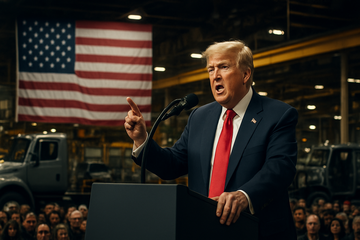
The Ultimatum, In Trump's Own Words
Speaking at Butler High School in Vandalia, Ohio, on Oct. 3, 2026, President Trump turned a midterm rally into a reshoring notice. Quoted by the Korea Herald and other outlets, he gave foreign companies "a little window of about a year and a half" to build US plants, then laid out the tariff range: "If they don't do that, we charge them a tariff of 150, 200, 250, 300%." He named South Korea, China, Japan, and Canada as the countries that "used tariffs against the United States for a long time" and added, "In the end they're all building here."
- Countries named explicitly: South Korea, China, Japan, Canada.
- Window: ~18 months; tariff range: 150%–300%, per Trump speech, Oct. 3, 2026.
- Stated rationale: foreign firms "used tariffs" against the US for decades.
- Setting: 1,400 layoffs at the former Navistar truck plant in Springfield, Ohio, took effect three days before the rally.
Why Ohio, Why Now
The stage was set 72 hours earlier. On Sept. 30–Oct. 1, International Motors — successor to Navistar — laid off nearly 1,400 workers at its Springfield, Ohio assembly plant after selling the facility to Canadian defense maker Roshel. The AP and PBS both reported the layoffs; Reuters framed it as a political problem for Trump days before a critical Senate rally. "A gut punch in Ohio," the AP wrote, "erasing roughly a year" of gains at the plant since the 2024 election.
Trump's solution: turn Ohio into the showcase for forced reshoring. Within two days of the layoffs, two companies announced new Ohio plants — Honda on Sept. 24 with a $2.5B hybrid-vehicle assembly site, and Bayer AG on Oct. 2 with a $2.2B pharmaceutical plant in New Albany. Trump's rally script named Stellantis and Bayer by name as proof that his tariffs are working. The 18-month ultimatum is the rule that codifies what those announcements demonstrate.
Springfield truck-plant layoffs
1,400
Effective Oct. 1, 2026; WARN notice filed July 29, 2026.
Honda Ohio hybrid plant
$2.5B
Announced Sept. 24, 2026; production targeted 2030.
Bayer New Albany, OH plant
$2.2B
Announced Oct. 2, 2026; pharmaceutical manufacturing site.
Trump tariff ultimatum
150%–300%
Range for foreign firms without a US plant; 18-month window from Oct. 3, 2026.
Korea Already Has $350B on the Table — and an Active Dispute
South Korea is the country with the most US capex already announced — and the most immediate friction. Under a July 2025 trade deal, Seoul lowered its tariff rate on Korean goods from 25% to 15% in exchange for a $350B investment commitment: $150B earmarked for shipbuilding cooperation and $200B for strategic sectors. That pledge formalized what Trump described in Ohio as Korean "investment flowing here." On Sept. 21, 2026, Seoul confirmed its first project under the pact.
But on Oct. 2, 2026 — one day before the rally — Trump publicly raised Korean tariffs back to 25% over a dispute about a $54B Alaska LNG deal Seoul refuses to sign in its current form. Bloomberg and CNN reported Trump saying he "did not jump the gun," while a Korean industry-ministry official told AP the announcement "went far beyond what was agreed." With the chip side of the relationship already complicated by a 25% Section 232 semiconductor tariff that took effect Jan. 15, 2026 (and could rise to 100% for firms without US investment), the Oct. 3 ultimatum functions as a third lever on the same Korean accounts: shipbuilding via the $350B pact, chips via Section 232, and now consumer-goods tariffs via the 18-month build clock.
| Lever | Mechanism | Current rate | Trigger / status |
|---|---|---|---|
| Section 301 reciprocal | Goods import duty | 15% | Cut from 25% in July 2025; Trump raised back to 25% Oct. 2, 2026 over Alaska LNG. |
| Section 232 semiconductors | Advanced chip import duty | 25% | In force since Jan. 15, 2026; up to 100% possible without US investment. |
| 18-month ultimatum | Plant-or-pay cliff | 150%–300% | Unveiled Oct. 3, 2026; ~April 2028 deadline for new US plants. |
| $350B investment pact | Capex commitment | n/a | $150B shipbuilding + $200B strategic; first project confirmed Sept. 21, 2026. |
Honda and Bayer Are the Proof of Concept — the Rest Must Match
Honda's announcement predates Trump's speech by nine days, and Bayer's by one. That timing is the article. Both companies chose Ohio, both used the same word ("build"), and both framed their US investment as the answer to tariff pressure — Bayer explicitly cited the "tariff backdrop" in its Oct. 2 statement. Bloomberg, reporting from the rally, noted Trump "cited pledges by Stellantis NV, Electra.aero Inc. and Bayer AG" as evidence his policy is working.
The math for foreign firms now is simple: a $2–3B Ohio plant is roughly the cost of paying 150–300% tariffs for a single year on a meaningful US import volume. For Honda, which already runs Marysville and East Liberty in Ohio, a $2.5B eighth North American plant is incremental capex against existing US manufacturing revenue of more than $22.5B (TTM). For Bayer AG, whose crop-science and pharma units both face Trump tariffs, a $2.2B Ohio pharma site hedges the Section 232 100% patented-drug tariff that took effect under Proclamation 11020. Both cases argue the same way: build in Ohio, get a tariff exemption; wait, and pay a rate that makes imports unsellable.
Recent foreign-investor plant pledges cited at the Vandalia rally
USD billions; Trump named Stellantis, Electra.aero and Bayer at the Oct. 3 rally and highlighted Honda's announcement
Unit: USD billion
Honda (Ohio hybrid plant)
Announced Sept. 24, 2026; ops 2030
2.5
Bayer (New Albany pharma)
Announced Oct. 2, 2026
2.2
Stellantis (US pledge)
Cited at rally; details not specified
1
The Supply-Chain Math: Chips, Cars, Pharma
Three industries account for nearly every named target. Each faces a different deadline and a different public commitment. Chips: the Section 232 25% tariff on advanced semiconductors has been live since Jan. 15, 2026, and applies to memory chips from SK Hynix and Samsung Electronics. The White House has signaled it could rise to 100% for firms without US investment — which is why SK Hynix broke ground Aug. 27, 2026 on a $4B HBM packaging facility in West Lafayette, Indiana (mass production targeted for late 2029), and why Samsung is rushing the $17B Taylor, Texas fab into operation by the end of 2026. Both moves pre-empt the new 300% cliff.
Cars: the 15% reciprocal rate already applies to Hyundai Motor, Kia, Honda and Toyota imports. Hyundai moved first in March 2025 by committing an additional $21B through 2028, then in August 2025 raised it to $26B and is now considering lifting its Georgia Metaplant to 800,000 vehicles a year by 2028. The Oct. 3 ultimatum is targeted precisely at Japanese and Korean OEMs still importing the majority of US-sold vehicles. Pharma: Section 232's 100% patented-drug tariff (Proclamation 11020) makes Bayer AG's $2.2B New Albany plant a near-mandatory hedge — Bayer's pharma segment runs a 13% operating margin on $20B-ish in annual sales, and a doubled US cost basis is structurally unsustainable without local production.
| Company | US capex status | Exposure to 300% ultimatum | Public posture |
|---|---|---|---|
| Honda (Japan) | $2.5B Ohio hybrid plant, ops 2030 | Already compliant — proof of concept | Announced Sept. 24, 2026 |
| Toyota (Japan) | Existing footprint; no new US plant announcement since speech | Moderate — needs incremental commitment to match Honda | No public response as of Oct. 4 |
| Hyundai Motor (Korea) | $26B US investment through 2028; Georgia Metaplant scaling to 800K vehicles | Compliant — but Alaska LNG dispute threatens the 15% rate | CEO José Muñoz: $26B commitment, Aug. 2025 |
| Kia (Korea) | Producing at Hyundai's Georgia plant since mid-2026 | Compliant via Hyundai parent | Hybrid production launched at HMGMA |
| Samsung Electronics (Korea) | $17B Taylor, TX fab; ~$55B total Texas investment; ops end of 2026 | Compliant — but 25% Section 232 chip tariff still applies to imports | Confirmed ops 2026, July 30, 2026 |
| SK Hynix (Korea) | $4B West Lafayette, IN HBM packaging; groundbreaking Aug. 27, 2026 | Compliant on packaging; memory fabs still Korea-based | CEO Noh-Jung Kwak: HBM production from late 2029 |
| Bayer AG (Germany) | $2.2B New Albany, OH pharma site | Compliant — pharma tariff at 100% Section 232 makes US build mandatory | Announced Oct. 2, 2026 |
| Chinese OEMs | No public US plant announcements in scope | Highest exposure — 150–300% rate would make imports unsellable | No named response as of Oct. 4 |
The 18-Month Clock and the Korea-LNG Wild Card
Eighteen months is a deliberately short window. A greenfield auto plant takes 30–36 months from groundbreaking to first vehicle; a semiconductor fab runs 24–36 months; a pharma plant typically needs 36–48 months for FDA inspection. The clock favors firms that have already broken ground — which is exactly why Trump's rally language said "they're all building here," past tense, as a description of a process already in motion. New entrants, especially Chinese OEMs without US real estate, have no realistic path to compliance before the deadline.
The other variable is the Korea–US LNG dispute, which is the most immediate test of whether the ultimatum is real. On Oct. 2, Trump raised Korea's rate from 15% back to 25% after Seoul refused to sign the $54B Alaska LNG deal in its announced form. If he walks that back, the ultimatum reads as bargaining theater. If he holds the line through November — and uses the 18-month clock as a parallel pressure tool — Korean exports become a live test case. Hyundai Motor and Kia are already largely compliant on capex; the LNG dispute is the variable that determines whether the 15% rate survives or the 25% rate sticks.
What the Trade Looks Like Across Horizons
Short term (days to quarters): the asymmetry is the trade. Honda is the most-direct beneficiary — it just set the template everyone else has to match, and its Sept. 24 announcement positions it as the "good student" of the new policy. Bayer AG is the European analog: by committing $2.2B one day before the speech, it has bought what looks like a multi-year tariff exemption on patented pharma. Hyundai Motor and SK Hynix are the Korean names that have already moved capex to the US; the trade is whether their existing premium widens or compresses as the ultimatum goes from rhetoric to written rule.
Long term (one to three years): the structural implication is a forced capex migration that locks foreign firms into US supply chains. By 2028, the named Korean firms will have committed roughly $30B+ of US capex on chips and autos, Honda will have its eighth North American plant running, and the European pharma response will be measured in single-site US plants. The holdouts — primarily Chinese OEMs and smaller Japanese suppliers — face either an uncompetitive 150–300% US import cost or capitulation. The main risk to the thesis is a Trump reversal or a court ruling (Section 301 authority was challenged at the Supreme Court in February 2026); a successful legal challenge would unwind the entire architecture, but no ruling has stuck yet.
- Compliance buys tariff relief; non-compliance imports at 150–300% — the most direct economic signal in two decades of US trade policy.
- Honda's Sept. 24 announcement is now the template. Expect copycat pledges from Toyota within one to two quarters.
- Korea's $350B pact + chip capex = largely compliant; the LNG dispute is the binary near-term catalyst.
- Chinese OEMs face the highest cost of capitulation — no real estate, no labor footprint, no political alignment.
Investable names from the Oct. 3 ultimatum
- Sept. 24, 2026 $2.5B Ohio hybrid plant sets the template every other foreign OEM must now match — Honda buys tariff immunity first.
- TTM revenue $22.5B with negative net margin; the $2.5B plant commits ~11% of one-year sales to insulate US sales from 150–300% tariffs.
- EV pivot is being paused in favor of hybrid lines, a Trump-aligned product mix that maps to the Ohio plant's hybrid-only output.
- Near-term catalyst: peers forced to match — Toyota announcement likely within 1–2 quarters.
- $2.2B New Albany pharma plant (Oct. 2, 2026) is a near-mandatory hedge against the 100% Section 232 patented-drug tariff — Bayer AG is the most-direct European pharma beneficiary.
- Pharma segment operating margin is 13.7% on revenue of ~$20B; doubling the US cost basis without local production would compress pharma margins below breakeven.
- CEO Bill Anderson explicitly cited the tariff backdrop; the build is a defensive necessity, not optional capex.
- ADR trades at 0.97x sales vs. US pharma peers at 3–5x — rerating optionality if the New Albany site ships by 2028.
- $26B US investment through 2028 — already 2.4x Honda's just-announced commitment and ~1.4x the size of Honda's new Ohio plant — making Hyundai the largest Asian auto capex in the US.
- Georgia Metaplant expansion to 800K vehicles by 2028 insulates the US sales mix from 150–300% tariffs.
- Alaska LNG dispute is the live risk: a sustained 25% reciprocal rate vs. the current 15% would compress Korean auto margins by ~10% of US-shipped revenue.
- ADR HYMLF offers US-listed exposure; KRX-listed shares are the cleaner hedge.
- $4B West Lafayette, Indiana HBM packaging plant broke ground Aug. 27, 2026 — full compliance on the advanced-packaging side of the Section 232 chip regime.
- Mass production targeted late 2029 — late enough that the 18-month ultimatum (deadline ~April 2028) is moot, but early enough to keep HBM sales immune to a 100% Section 232 chip tariff.
- Korean parent still manufactures DRAM/NAND in Korea, where 25% Section 232 chip tariffs remain the binding constraint on US-bound memory.
- Largest pure-play HBM supplier to Nvidia — US packaging builds in the geopolitical hedge the customer base is now demanding.
- $17B Taylor, Texas fab operationally targeted end of 2026 — the most-advanced non-Taiwanese US chip build currently in execution.
- Combined Texas investment ~$55B including a second fab by 2030, comfortably larger than the new ultimatum's implied threshold.
- Memory chip exposure still carries the 25% Section 232 tariff on imports — local production doesn't eliminate the duty but moves it from a 25% import penalty to a 25% domestic tax base.
- Sector-leading 32% return on equity, KRW 1.81 quadrillion market cap — biggest US capex commitment of any Korean conglomerate.
- No new US plant announcement since the Oct. 3 rally — but with $22.5B+ in US revenue and existing Kentucky/Texas factories, Toyota is structurally less exposed than smaller Japanese OEMs.
- At PE 8.1x, the stock is already pricing in a margin-compression scenario; incremental US capex would re-rate the multiple.
- Trump's ultimatum names Japan explicitly — expect a Toyota plant announcement within 1–2 quarters, mirroring Honda.
- Toyota's lower exposure to advanced chips (relative to SK Hynix/Samsung) limits the Section 232 chip-tariff drag, making the auto side the binding constraint.