
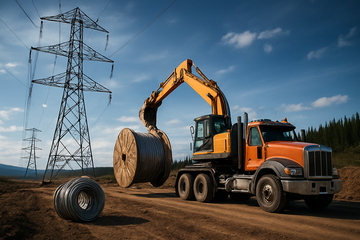
The Energy Department announced on Oct. 5, 2026 that it will deploy up to $150 million of Defense Production Act (DPA) funding for the Alaska Energy Authority's Beluga–Healy Transmission Project — a planned 223-mile, $418 million high-voltage line linking the Beluga power station on Alaska's southern coast to Healy in the state's interior. The funding mechanism, not the dollar amount, is the story: the DPA is the same Cold War–era authority now being used to fast-track grid equipment after five Presidential Determinations issued on April 20, 2026. Vice President JD Vance announced the package at a Monday rally in Fairbanks, 29 days before the midterm elections, in support of Republican Sen. Dan Sullivan, who is locked in a toss-up race with former Rep. Mary Peltola. A Sept. 24–Oct. 1 New York Times/Siena poll had Peltola leading 50%–43%, and the Cook Political Report rates the seat a toss-up — meaning the Alaska Senate race could decide which party controls the chamber and therefore which direction federal transmission spending flows from here.
The Project: A Second Railbelt Backbone
Alaska's Railbelt grid stretches from Homer through Anchorage to Fairbanks and serves roughly 75% of the state's ~735,000 residents, but it has only one intertie between Southcentral and Interior — the existing Alaska Intertie. The Beluga–Healy line adds a second high-voltage path, paralleling an earlier 240-mile HVDC concept AEA described in its 2026 Statewide Railbelt Energy Vision. The corridor it strengthens is precisely the one Mat-Su Valley developers are trying to convert into an industrial park with data centers, a project the Alaska Department of Commerce began planning in July 2026.
| Item | Detail |
|---|---|
| Sponsor | Alaska Energy Authority (AEA) |
| Total project cost | $418 million |
| Federal DPA funding | Up to $150 million |
| Non-federal funding | $268 million |
| Length | 223 miles of new high-voltage transmission |
| Endpoints | Beluga power station (Southcentral coast) to Healy (Interior) |
| Population served | ~75% of Alaska's ~735,000 residents (Railbelt) |
| Announcement date | Oct. 5, 2026 |
| DPA authority | Presidential Determination 2026-10 (issued Apr. 20, 2026) |
Why the DPA Matters More Than the Dollar Amount
The Defense Production Act is a national-emergency procurement statute, and President Trump's April 20, 2026 package of five Presidential Determinations — including PD 2026-10 on \"Grid Infrastructure, Equipment and Supply Chain Capacity\" — explicitly classifies transformers, high-voltage transmission, substations, and protective relay systems as \"essential to the national defense.\" That classification lets the Department of Energy deploy Title III incentives (loans, loan guarantees, purchase commitments, cost-sharing) without the statutory prerequisites DPA Section 303 normally requires. In practical terms, the federal share of Beluga–Healy is no longer a competitive grant that lives or dies on a bureaucratic scoring sheet; it is money that flows because the President has declared the line strategically necessary.
US interconnection-queue capacity, end-2025
~2,060 GW
Active generation and storage awaiting grid connection, per Lawrence Berkeley National Lab
PJM queue, April 2026
811 projects / 220 GW
PJM Interconnection, first cohort under FERC Order 2023 reform
US data-center electricity use, 2024
192 TWh
~4.7% of US electricity, per US Data Center Tracker
Data-center share of US power, 2035E
8.6%
BloombergNEF projection, more than double today's share
The Supply Chain That Already Won the Bid
A $418M Alaska line is too small to move a major contractor's annual numbers, but it sits on top of a backlog explosion that already exists. Quanta Services — through its Anchorage-based subsidiary Northern Powerline Constructors — owns the most direct Alaska buildout footprint. The parent reported $9.56B of Q2 FY2026 revenue and a record total backlog of $53.4B on July 30, 2026, with management raising full-year guidance across every key metric. GE Vernova, the dominant Western HVDC and grid-equipment supplier, ended Q2 FY2026 with a $176B total backlog, an $41B Electrification equipment backlog, and year-to-date data-center orders exceeding $5B.
Q2 FY2026 backlog vs. market cap — US grid contractors and equipment suppliers
Backlog is company-disclosed in Q2 FY2026 earnings releases; market cap is as of Oct. 5, 2026.
Unit: $B
GE Vernova (GEV)
Total backlog, $B
176
Quanta Services (PWR)
Total backlog, $B
53.4
GE Vernova Electrification
Equipment backlog, $B
41
Eaton (ETN)
Backlog proxy from TTM revenue, $B
30
Component suppliers are the second-order beneficiaries. Eaton signed an agreement in September 2026 to acquire COL Group to expand data-center and utility electrical manufacturing capacity, and operates in grid automation and T&D switching gear. Hubbell supplies insulators, arresters, and connectors that go onto every transmission structure — products whose lead times have stretched from weeks to multiple quarters across the industry. MasTec, more diversified across communications, pipeline, and clean-energy infrastructure, has less direct Alaska exposure but participates in power-delivery buildouts nationwide.
The Politics: A $418M Line Tied to a Senate Seat
Vice President Vance's Fairbanks rally is hosted by Trump 47 Committee — the joint fundraising vehicle that connects Save America to the RNC. The Alaska Senate race sits on the same list of five to seven seats Democrats need to flip to retake the chamber; a Sullivan loss would also matter because Sullivan, a senior member of the Armed Services Committee, has been the lead Senate advocate for the $54B Alaska LNG pipeline project with South Korea — a figure Trump announced in the Oval Office on Oct. 1, 2026, and that South Korea's industry minister publicly disputed within hours.
- Sept. 24–Oct. 1 NYT/Siena poll: Peltola 50%, Sullivan 43% (margin of error ~±4 pts)
- Cook Political Report: Alaska Senate moved from Lean Republican to Toss-up in July 2026
- Decision Desk HQ: ~60% probability of a Peltola flip, per The Hill
- Peltola was the only Democrat on the Alaska ballot after the Aug. 18 top-four primary
Short-Term: Who Moves First
The news is small relative to the contractors' existing backlog — Quanta's $53.4B book alone is roughly 127× the size of the entire Beluga–Healy project — so this is a sentiment event, not a fundamentals event. Expect a marginal bid on Monday for Quanta Services, MasTec, GE Vernova, Eaton, and Hubbell as investors re-mark the optionality on additional DPA-tagged grid line items. The bigger near-term catalyst is whether DOE identifies additional projects under the April 20 PDs; the White House signaled grid equipment, transformers, pipelines, and LNG systems as the priority sectors but had not, as of late April 2026, named specific projects beyond Beluga–Healy.
Long-Term: A New AI Siting Geography
Alaska's data-center inventory today is small — 8 operating and 8 proposed sites, with one sizable colocation facility in Anchorage and no major hyperscale presence. The state economic-development agency has been pushing a 30-square-mile Mat-Su industrial park with data centers and a freight hub since July 2026, and power availability has been the binding constraint. A second Railbelt backbone, plus the Korea/Alaska LNG project once its gas actually flows, gives a hyperscaler a credible cold-climate, low-land-cost, low-pue alternative to Phoenix or Loudoun County — exactly the kind of geography the AI power-constraint stack has been pushing operators to find.
On a 1–3 year horizon, the more durable read is that federal transmission spending is becoming a permitting instrument: rather than subsidizing generation and waiting for FERC-ordered interconnection studies, the executive branch can now label a line defense-critical and route DPA funding around the queue. That changes who captures the AI buildout margin. Equipment makers (GE Vernova, Eaton, Hubbell) capture it first because every line — DPA-tagged or not — runs through their order books; specialty contractors (Quanta Services, MasTec) capture it next, with Alaska-exposed players earning a regional premium. The risk is that a Democratic Senate, working with a Sullivan-less Alaska delegation, narrows the DPA's grid remit in2027.
What This Is Not
Two caveats that matter for the trade. First, the Korea deal is not yet a deal: South Korea's industry minister publicly stated on Sept. 30–Oct. 1, 2026 that his government had not agreed to invest $54B in the Alaska LNG pipeline — and Trump separately asserted on Oct. 2, 2026 that the US–Korea trade package includes an $8.4B oil-recovery project that Korean media reported was not part of the agreement. The transmission line is funded by an existing DPA authority and an existing AEA sponsor, so it does not depend on Korean money — but the broader Alaska energy narrative does. Second, this is a 223-mile line at $418M, not a 2,000-mile interregional backbone; contractor revenue recognition is a small line item even if it is symbolic.
Investable takeaways
- Q2 FY2026 Electrification equipment backlog of $41B (+69% YoY) already monetizes any DPA-tagged line, so the Alaska news confirms rather than drives the order book.
- Year-to-date data-center orders above $5B make GEV the cleanest grid-equipment read on the AI-siting thesis, with HVDC and large transformers the highest-margin exposures.
- Risk: a Peltola Senate win and a 2027 Democratic chair rotation could narrow DPA's grid remit, slowing new-project awards into 2028.
- Northern Powerline Constructors, Quanta's Anchorage-based subsidiary, is the only top-tier US transmission contractor with resident Alaska crews, making PWR the marginal beneficiary if AEA expands the program.
- Q2 FY2026 total backlog of $53.4B and revenue of $9.56B (+41% YoY) already absorb Beluga–Healy with little P&L impact; the catalyst is the next DPA-tagged project list.
- Watch the second-half-2026 backlog mix disclosure — if Alaska-region share ticks up, it is direct evidence of the federal steer working.
- Power-delivery and clean-energy segments capture any uptick in transmission awards, but MTZ has no disclosed Alaska footprint, so it lags PWR on geography.
- Q2 FY2026 free-cash-flow yield turned slightly negative, suggesting MTZ is investing aggressively — a positive for revenue, a watch item for the multiple.
- The stock works if DPA-tagged projects scale across the Lower48, not just in Alaska; MTZ is a derivative play on the thesis.
- September 2026 agreement to acquire COL Group expands data-center and utility electrical manufacturing capacity at exactly the moment grid component lead times are stretching.
- Grid automation, switchgear, and T&D components benefit from every transmission line regardless of whether the federal share was DPA-funded or not.
- Valuation risk: TTM EV/Sales of ~6.3 already prices in significant electrification growth, so the next leg needs earnings beats, not just backlog growth.
- Insulators, arresters, and connectors go onto every transmission structure, making HUBB a near-pure play on line-mile construction regardless of sponsor.
- The catalyst is lead-time normalization: HUBB benefits if the industry can finally break the multi-quarter backlog on grid hardware.
- Watch the Q3 FY2026 release for transmission-segment order growth — if it re-accelerates above 20%, the thesis is confirmed.