
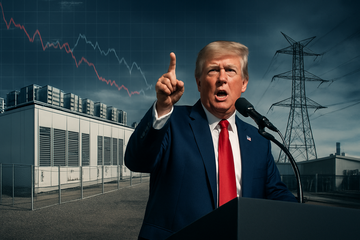
The headline from the weekend reads as if President Trump invented a new federal tax penalty for towns that block data centers. He didn't. The exact phrases — 'backwards and poor,' 'far lower taxes,' 'let Data Reign' — are recycled from a January 13, 2026 Truth Social post and an August 31, 2026 follow-up, restated on October 3, 2026 at a Vandalia, Ohio rally. What changed over the Oct. 3–4 weekend was the venue (a midterm-eve rally in a state whose senator is fighting for his seat), not the policy. The real story is the federal machinery Trump already has — and how investors should price a world in which every local permit vote is now a federal election.
Local moratoriums tracked (Sep 14, 2026)
399
across 44 states, per Interconnected Capital moratorium tracker
States with active ban or moratorium bills
14
per NCSL 2026 legislative roundup
Projects halted in Q1 2026 alone
75+
~$130B of capex blocked — nearly matching all of 2025 (Data Center Watch, Aug. 2026)
Top-5 hyperscaler 2026 capex (combined)
~$725B
Amazon ~$200B, Microsoft ~$190B, Alphabet $175–185B, Meta $115–135B, Oracle undisclosed
The Threat Has No New Statute — Just an Eight-Month Messaging Run
President Trump on August 31, 2026 wrote on Truth Social that 'the only reason that communities throughout the U.S.A. should not want Data Centers is if they want to end up being backwards and poor,' and that towns that accept them will get 'far lower taxes and jobs all over the place, let Data Reign.' The post was the second installment of a message first posted on January 13, 2026. At a Vandalia, Ohio rally on October 3, 2026 — staged to boost Sen. Jon Husted in a tight race against former Sen. Sherrod Brown — Trump added in-person volume, telling Ohioans there is 'so much money to be made' and warning that if the U.S. turns away data centers 'they'll go to China.'
The carrots Trump is dangling, however, do have statutory roots. Cooperating towns can offer property-tax abatements, and any qualifying data center sited in a rural opportunity zone can claim the new federal Qualified Rural Opportunity Fund (QROF) benefits created by the One Big Beautiful Bill Act (OBBBA) of July 2025. The Joint Committee on Taxation scores that rural opportunity-zone expansion at $40.9 billion in foregone federal revenue over the next decade.
Two Federal Levers Already Exist — And They Are the Real Story
Two federal tools were put in place before the messaging campaign started, and they are what give the threat teeth.
- Executive Order 14318, 'Accelerating Federal Permitting of Data Center Infrastructure,' signed July 23, 2025, fast-tracks NEPA review and FAST-41 transparency for any 'Data Center Project' adding more than 100 MW of new electric load or 'Covered Component' capital expenditures of $500 million or more. The Secretary of Commerce is directed to provide 'financial support,' explicitly including loans, loan guarantees, grants, tax incentives, and offtake agreements.
- The One Big Beautiful Bill Act of July 2025 made Opportunity Zones permanent and created a new rural-track Qualified Rural Opportunity Fund. The Joint Committee on Taxation puts the rural-track cost at $40.9 billion over ten years; WIRED-cited Searchlight research identified more than 100 rural data centers that could newly qualify under the expanded program.
- The March 4, 2026 Ratepayer Protection Pledge — a voluntary White House compact under which hyperscalers including Amazon, Microsoft, Alphabet, and Meta Platforms agreed to 'build, bring, or buy' all the energy their data centers consume — preempts the most common local objection (rate hikes) and so removes a key excuse for moratoriums.
Local Opposition Is the Bottleneck — and It Is Already Significant
Trump's pressure campaign responds to a real and growing pushback. According to a Newsweek tally published August 31, 2026, more than 500 U.S. localities have stalled data center development, and Data Center Watch reports roughly $130 billion of projects were halted in the first quarter of 2026 alone — nearly matching the total blocked in all of 2025. The Interconnected Capital US Data Center Moratorium Tracker counted 399 active local moratoriums across 44 states as of September 14, 2026, with the National Conference of State Legislatures tracking 14 states considering outright bans.
| Indicator | Latest reading | Source |
|---|---|---|
| Local moratoriums tracked | 399 across 44 states | Interconnected Capital, Sep 14, 2026 |
| States with active ban or moratorium bills | 14 | NCSL, 2026 legislative roundup |
| Projects halted in Q1 2026 | ~75 projects, ~$130B capex | Data Center Watch, via Newsweek Aug 31, 2026 |
| States that repealed data-center tax breaks (May–Aug 2026) | Maine, Minnesota, Nebraska | Bisnow, Oct 4, 2026 |
| Americans opposing a new data center in their area | 71% (Gallup, Mar 2026) | Newsweek, Aug 31, 2026 |
| Americans who say a local DC would raise their power bill | 62% (Economist/YouGov, Aug 2026) | Newsweek, Aug 31, 2026 |
Voters in Trump states are not on board. An Economist/YouGov poll conducted August 21–24, 2026 found 47% of 2024 Trump voters opposed a new data center in their community, versus 35% who supported one. Even Vice President JD Vance has publicly said '99 percent of the backlash' is driven by higher utility bills — a constituency the Ratepayer Protection Pledge is designed to neutralize. The political calculation Trump is making in Ohio is that the 'tax revenue + jobs' argument can outweigh the 'electricity rates' argument in a midterm with affordability on the ballot.
The Supply Chain Reads the Pressure Differently From Each Link
Federal pressure to override local moratoriums is asymmetric in its effects. It accelerates the upstream bottleneck for colocation real estate investment trusts (REITs), power generators, and cooling/infrastructure suppliers — but it does not eliminate the downstream state-level pushback that the September 16, 2026 House Democratic bill (and the September 30, 2026 57–43 Senate block of the bipartisan Ratepayer Protection Act) is still pressing.
Upstream beneficiaries — the data center real estate owners — are the cleanest read. Equinix reported TTM revenue of $9.9 billion with Q3 2025 record annualized gross bookings of $394 million, up 25% year-over-year and 14% sequentially, and raised full-year 2025 AFFO-per-share guidance to a range of $37.95–$38.77. Digital Realty Trust operates 309 data centers with roughly 3.0 GW of IT capacity plus another 6.3 GW of buildable capacity held for future development — a pipeline that is highly sensitive to whether local permits arrive on schedule.
Power supply is the next most-exposed layer. Constellation Energy carries 32.4 GW of generating capacity and holds a 20-year power purchase agreement with Microsoft to restart the 835 MW Three Mile Island Unit 1 (the 'Crane Clean Energy Center'), plus a 20-year, 1,100 MW deal with Meta Platforms. Vistra operates 38.7 GW of capacity, with the bulk in ERCOT (Texas) where the AI buildout is concentrated. Both names are insulated from local opposition by the long-term PPA structure — a model that is being copied as the Ratepayer Protection Pledge spreads. Vertiv, headquartered in Westerville, Ohio — the same state where Trump rallied — booked $11.5 billion in trailing-twelve-month revenue from power management and thermal solutions, with Q2 2026 revenue growth of 24%.
Hyperscalers face a more nuanced read. Microsoft's fiscal-year 2026 revenue of $331.8 billion was up 17.8% year-over-year, and its calendar-year 2026 capex guidance is roughly $190 billion, with most of the spend earmarked for AI data centers and GPUs. Amazon guided to about $200 billion in 2026 capex. Alphabet is targeting $175–185 billion and Meta Platforms $115–135 billion. For these names, federal pressure that breaks local permitting bottlenecks is unambiguously bullish on time-to-revenue, but each dollar of tax-break subsidy Trump offers to cooperating towns is also a dollar the hyperscalers do not have to negotiate locally. The OBBBA's rural QROF and EO 14318's federal financial support effectively co-fund the capex.
Downstream, NVIDIA's fiscal 2026 revenue of $215.9 billion (up 65.5%) means the chip cycle still hinges on whether hyperscalers can keep turning AI capex into deployed capacity on schedule. Local-permit slippage is a direct tax on the GPU deployment timeline. The cleanest beneficiaries of federal preemption are REITs and power generators; the cleanest victims of local opposition are the same REITs and power generators — but the asymmetry now tilts in their favor because the federal government has named the opposition as the enemy.
Where the $725B hyperscaler capex lands in the supply chain
2026 calendar-year capex guidance from the top five U.S. hyperscalers (USD billions)
Unit: USD billions
Amazon
200
Microsoft
190
Alphabet (midpoint)
180
Meta (midpoint)
125
Other top-5
30
Why the Revenue Stakes Matter: Virginia Is the Template
The argument Trump is selling to Ohio voters — lower taxes and jobs — is not hypothetical. It is the lived experience of Loudoun and Prince William Counties in Virginia, the largest data-center market in the world. Prince William County's data-center tax revenue grew 2,475% between 2015 and 2025, from $6.5 million to $166.4 million. Mecklenburg County, Virginia — where a proposed 100 MW AI data center would pay an estimated $56.1 million per year in property and personal-property taxes — already derives roughly 39% of its FY 2026 county budget ($1.2 billion) from data centers.
The other side of the ledger is the tax abatement. Good Jobs First tallied Virginia's FY 2025 data-center tax abatement at $1.6 billion per year — up from $18.3 million in 2018, a 4,636% rise — and projects $866.7 million of annual losses by 2030. So the carrot Trump is offering is real but conditional: towns that host data centers trade some near-term property-tax revenue for capex, jobs, and the federal tax breaks that come with rural siting. The towns that refuse lose all three.
Short-Term Catalysts (Days to Quarters)
- Hyperscaler Q3 2026 earnings (late October through early November) will be the next real catalyst — management commentary on permitting delays and ratepayer-protection compliance will move the stocks more than the political rhetoric.
- The November 2026 midterms. With Ohio already framed as a referendum on data centers, every state-level legislative session in 2027 will face the same pressure. Town council votes scheduled for Q4 2026 in Arizona, Illinois, Massachusetts, and New York are the nearest-term permit events to watch.
- House Democrats' September 16, 2026 bill to strip federal tax incentives from data centers (bonus depreciation, Opportunity Zone benefits) is the principal downside scenario for the OBBBA rural fund — it would unwind the carrot Trump is holding out.
Long-Term Implications (1–3 Years)
If the political pressure holds, every local permit vote becomes a federal election — which means AI capex risk becomes less about zoning and more about voter sentiment in towns hosting 100 MW+ AI projects. That shifts the discount rate applied to long-dated REIT buildouts (faster permitting, lower risk premium) and to long-dated hyperscaler revenue tied to those buildouts. It also raises the stakes on the November 2026 midterms: an administration change could leave the EO 14318 framework in place but withdraw the political cover, exposing hyperscaler capex to a renewed round of state-level tax-break rollbacks (the Maine/Minnesota/Nebraska model).
Structurally, the federal package rewards scale and rural siting in roughly equal measure. The 100 MW / $500M EO 14318 threshold is the dividing line — projects below it remain pure local fights, while projects above it inherit a federal coordination layer that includes loans, grants, tax incentives, and FAST-41 transparency. Equinix's $15 billion-plus xScale joint venture, expanded in October 2024, sits squarely on the qualifying side of that line. So do most Microsoft, Amazon, Alphabet, and Meta Platforms hyperscale campuses. The bipartisan Ratepayer Protection Act passed the House 417–3 in September 2026, and although it was blocked in the Senate, its model is already baked into voluntary hyperscaler behavior via the White House pledge — meaning the ratepayer issue is being defused without legislation.
Stocks with direct read-throughs to the federal pressure campaign
- Q3 2025 record annualized gross bookings of $394M (+25% YoY, +14% sequentially) and FY 2025 AFFO/share guidance of $37.95–$38.77 reward a faster-permitting backdrop.
- The $15B-plus xScale joint venture with GIC and CPP Investments targets hyperscale tenants that sit on the EO 14318 100 MW / $500M qualifying threshold.
- Federal preemption of local moratoriums cuts months off the build cycle for the >6.3 GW of buildable IT capacity already in DLR's portfolio and the xScale pipeline.
- Over 1–3 years, the largest risk is local opposition in densely permitted metros; the federal lever cuts that tail risk more than it changes the base case.
- 309 operating data centers with 3.0 GW of IT capacity plus 6.3 GW of buildable capacity convert federal permit acceleration into bookings.
- Trailing-twelve-month revenue of $6.76 billion (Q2 2026 +29.9% YoY) is already growing, but forward capex deployment is gated by local permits — the federal lever unlocks the next leg.
- Hyperscaler concentration in northern Virginia (Loudoun/Prince William) makes the company the cleanest play on federal preemption of state-level tax-break rollbacks.
- Watch for management commentary on permit timelines in Q3 2026 earnings (October/November 2026) as the single biggest catalyst over the next 90 days.
- FY 2026 revenue of $331.8B (+17.8% YoY) and net income of $133.7B underwrite a calendar-2026 capex guide of ~$190B, with most spend earmarked for AI data centers.
- The 20-year Constellation PPA restarting the 835 MW Three Mile Island Unit 1 locks in carbon-free capacity independent of local political cycles.
- Federal pressure that breaks local permit bottlenecks shortens the AI-revenue loop between capex deployment and Azure monetization (run rate already at $37B as of mid-2026).
- Long-term, Microsoft's scale lets it absorb OBBBA rural tax breaks and EO 14318 federal financial support — a structural advantage versus smaller neoclouds.
- FY 2026 revenue of $215.9B (+65.5% YoY) is gated by hyperscaler deployment timelines; every month of permitting slippage delays GPU pull-through.
- Federal preemption of the 399 local moratoriums tracked as of September 14, 2026 preserves the FY 2027 ramp the buy-side is underwriting.
- Backlog and inventory dynamics remain the binding constraint — if permitting clears, NVIDIA is the second-derivative beneficiary behind hyperscaler capex itself.
- Long-term, the rural OBBBA carve-out means new data center sites that benefit federal tax breaks still need NVIDIA silicon, leaving the supply chain unchanged.
- 32.4 GW of generating capacity, anchored by 20-year PPAs with Microsoft (835 MW TMI Unit 1) and Meta (1,100 MW), insulates revenue from local opposition.
- A $1B federal loan for the Three Mile Island restart (closed November 2025) extends the federal subsidy layer beneath hyperscaler demand.
- Federal pressure on towns to approve data centers tightens the long-term PPA market in which Constellation Energy is the dominant nuclear counterparty.
- Long-term risk is the political turnover in 2028 — an administration change could slow new federal loan guarantees, but existing 20-year PPAs are already contracted.
- 38.7 GW of generating capacity with a heavy ERCOT/Texas tilt aligns with the rural siting sweet spot that OBBBA's QROF program rewards.
- Texas Governor Greg Abbott's statewide pause to write data-center standards (water, electricity demand, consumer costs, local community approval) is the policy variable to watch — Vistra is the largest in-state generator.
- Trailing-twelve-month revenue of $19.2B and EBITDA margin of 40.6% flow through to data-center-driven PPA pricing.
- Long-term, Vistra's retail arm (TXU Energy et al.) faces rate-base risk if AI buildout lifts wholesale prices — a partial offset to the IPP upside.
- Westerville, Ohio headquarters — the same state where Trump rallied on October 3, 2026 — gives Vertiv a front-row seat on data-center permitting politics.
- Trailing-twelve-month revenue of $11.5B with Q2 2026 revenue growth of +24.1% and EPS growth of +53% tracks AI data-center power and cooling demand.
- Federal EO 14318 explicitly names 'transformers/switchgear' and thermal management as Covered Components, funneling qualifying projects toward Vertiv's product line.
- Long-term, the company's $5B+ U.S. backlog and rapid facility expansion in Ohio and Texas position it for the same federal-permit acceleration that benefits EQIX and DLR.
- Trailing-twelve-month revenue of $71.8B with capex/revenue at 105% concentrates Oracle in the highest-leverage point of the AI capex stack.
- Oracle's cloud-infrastructure buildout (multi-billion-dollar data center campuses) is a primary candidate for EO 14318 federal financial support given the 100 MW / $500M threshold.
- Federal preemption of local moratoriums removes the single biggest project-finance risk for Oracle's OCI multi-gigawatt pipeline.
- Long-term, Oracle's debt load (net debt/EBITDA 3.17x) makes the federal tax-break carrot disproportionately valuable relative to less-levered peers.