
AirTrunk incremental Japan capex (Oct 7, 2026)
$1.0B
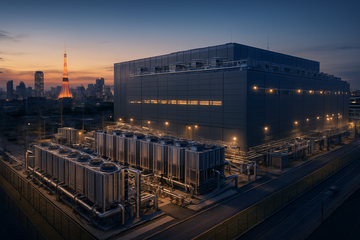
Liquid-cooling retrofit at TOK1, Inzai, Chiba Prefecture
TOK1 scalable IT capacity
300+ MW
13.25-hectare, seven-building Inzai campus
AirTrunk Japan platform at full build-out
~530 MW
TOK1 + TOK2 + OSK1 + OSK2 across Tokyo and Osaka
TOK1 green loan (Mar 10, 2026)
$1.24B
Japan's largest single data center financing; 12 banks led by SMBC and MUFG
AirTrunk Japan investment plan through 2030
$8B
JPY ~1.2T, announced Dec 17, 2025
Japan data center market, 2026 → 2031 CAGR
20.4%
$12.76B (2025) → $38.91B (2031) per Arizton
Why $1B on Liquid Cooling, Why Inzai, Why Now
AirTrunk's October 7, 2026 announcement is the smallest headline number in the deal stack but the most consequential. The $1 billion is incremental — it sits on top of the $1.24 billion green loan that closed on March 10, 2026 for the same campus and the $8 billion Japan program announced in December 2025 — and it is earmarked for one specific thing: deploying liquid cooling at TOK1 so the Inzai site can host AI workloads rather than only general-purpose cloud. CEO Robin Khuda was explicit that TOK1 will likely be the first Japan campus to run large-scale AI compute.
Khuda's framing for the geographic shift is unusually direct: customers are rotating to Japan from a North Asian perspective because AI infrastructure will get harder to deploy in the US and is already hard in Europe, leaving Asia — and Japan specifically, given stable power and rule-of-law — as the default landing zone. That argument reframes a $1 billion campus retrofit into a capital-allocation statement about where AI training and inference capacity will physically sit in the second half of the decade.
The Deal Stack: $8B Program, $1.24B Loan, $1B Retrofit
Read as one capital plan, the three announcements describe an integrated APAC AI build rather than three separate events. The $8 billion Japan program (December 2025) committed AirTrunk to four campuses — TOK1 and TOK2 in greater Tokyo, OSK1 and OSK2 in Osaka — for ~530 MW of total capacity. The $1.24B green loan in March refinanced existing TOK1 facilities and funded the next phases, with SMBC, MUFG, Crédit Agricole CIB and Société Générale acting as global coordinators alongside eight other mandated lead arrangers. The October $1 billion is the AI-specific retrofit that lets all of that pre-funded power be monetized at AI economics rather than cloud rates.
| Date | Amount | Purpose | Geography |
|---|---|---|---|
| Dec 17, 2025 | $8B (JPY 1.2T) | Four-campus platform plan | Japan (TOK1, TOK2, OSK1, OSK2) |
| Mar 10, 2026 | $1.24B green loan | Refinance + expand TOK1 | Inzai, Chiba |
| Jun 19, 2025 | Phase groundbreaking | 40+ MW TOK1 phase | Inzai, Chiba |
| Oct 7, 2026 | $1.0B | Liquid-cooling retrofit for AI | Inzai, Chiba (TOK1) |
| By full build-out | ~530 MW | Aggregate Japan capacity | Tokyo + Osaka |
The pattern matters more than any single figure. AirTrunk is not raising money for greenfield construction; it is converting power it has already secured into AI-grade capacity, which is the highest-return use of land, substation access, and bank lines in Tokyo's Inzai cluster. The campus was originally designed for general cloud — the retrofit re-prices that power at AI rates.
Upstream Supply Chain: Who Sells Into TOK1
AirTrunk's Japan build is unusually vertically aligned at the construction layer. Daiwa House Industry — the ¥4 trillion Japanese conglomerate — sits simultaneously as general contractor and equity stakeholder on both TOK1 and TOK2, an arrangement that ties the supplier's margin to the operator's exit. Daiwa House's DPDC Inzai Park, on the same Inzai cluster as TOK1, plans 14 data center buildings on a ~270,000 m² site with a dedicated 1,000 MW ultrahigh-voltage substation — meaning AirTrunk and Daiwa House share both a substation and a contractor relationship in the same industrial corridor. For Daiwa House, the data center business is now a formally tracked segment; the group launched a Data Center Business Division in April FY2026.
- Daiwa House Industry — general contractor and equity partner on TOK1/TOK2; DPDC Inzai Park adds 14 buildings and a 1,000 MW substation on the same Inzai cluster.
- Power infrastructure: Tokyo Electric Power Company Holdings serves the Tokyo region; Kansai Electric (unlisted for inclusion here) serves the Osaka OSK1/OSK2 campuses — both utilities are direct beneficiaries of every new MW AirTrunk energizes.
- Liquid-cooling stack: Vertiv (CDUs, manifolds, coolant distribution) and Eaton (Boyd Thermal, chip-to-ambient) are the most exposed global liquid-cooling vendors — Vertiv revenue rose from $8.0B (FY2024) to $11.5B (TTM), reflecting the same AI-cooling demand wave.
- Switchgear, transformers, and high-voltage distribution: Hitachi competes for the heavy electrical scope that comes with a 300+ MW campus, including Hitachi Energy's HVDC and substation packages.
Liquid-cooling vendor revenue, FY2023–TTM
Both vendors compounded at high-teens to twenty-percent rates through the AI cooling cycle
Unit: $B
Vertiv FY2023
$B revenue
6.9
Vertiv FY2024
8
Vertiv FY2025
10.2
Vertiv TTM
11.5
Eaton FY2023
23.2
Eaton FY2024
24.9
Eaton FY2025
27.5
Eaton TTM
30
The capital structure underneath the build — 12 mandated lead arrangers including SMBC, MUFG, Crédit Agricole CIB, Société Générale, BNP Paribas, Mizuho, Natixis, OCBC, UOB, DBS, E.SUN, and Chiba Bank — is itself the supply chain. The green loan was structured as sustainability-linked, which lowers the all-in cost for the operator and ties Daiwa House, the utilities, and the cooling vendors to verifiable emissions and efficiency KPIs. Any vendor that wants a piece of TOK1 has to clear those terms.
Downstream: Hyperscaler Tenants and the GPU Offshoring Thesis
AirTrunk does not publicly name its hyperscaler tenants, but the customer set is well understood: the platform was built for the cloud and content customers who already run Amazon's AWS Tokyo, Microsoft's Azure Japan, Alphabet's Google Cloud Tokyo, and Meta's APAC workloads. The October announcement is the first explicit confirmation that AI workloads — almost certainly NVIDIA-powered — will land in that tenant base at Inzai. Khuda's North Asia framing suggests Chinese hyperscalers rotating around geopolitics are unlikely to be the customer set; the demand is from US and Korean hyperscalers needing an APAC AI region that is politically and physically dependable.
The numbers behind that claim are visible in NVIDIA's own top line. TTM revenue through early October 2026 reached $303 billion — more than four times the $60.9 billion NVIDIA booked in fiscal 2024 — which means the company now sells a GPU rack every few seconds and hyperscalers have an inventory problem as much as a demand problem. Tokyo gives those hyperscalers a politically uncontroversial site to absorb the next wave of GPUs without adding to Virginia or Phoenix power queues. AirTrunk's $1 billion retrofit is sized to that wave.
Competitive Backdrop: How TOK1 Stacks Up Against Listed Peers
AirTrunk is private, but its three global comparables are not. Equinix ended the latest reported period with about $9.83B in TTM revenue and operates more than 260 IBX data centers globally, including a meaningful Tokyo footprint in Inzai and Otemachi. Digital Realty reported TTM revenue of $6.85B across 309 data centers and roughly 3.0 GW of operating IT capacity plus another 6.3 GW of buildable capacity. Both trade at enterprise-value-to-EBITDA multiples in the high-20s — DLR at 24.8x TTM and EQIX at 28.0x — and both have been adding capacity in Tokyo, but neither has matched AirTrunk's vertical concentration in Japan or its equity-aligned construction partnership with a domestic contractor.
| Company | TTM revenue | Operating capacity | EV/EBITDA (TTM) |
|---|---|---|---|
| Equinix (EQIX) | $9.83B | 260+ IBX data centers globally | 28.0x |
| Digital Realty (DLR) | $6.85B | ~3.0 GW operating, 6.3 GW buildable | 24.8x |
| AirTrunk (private) | Not disclosed | ~1.4 GW Australia + 530 MW Japan planned | n/a |
The private-market comparables tell the rest of the story. Blackstone and CPP Investments closed the A$24 billion (~US$16.1 billion) acquisition of AirTrunk in December 2024, valuing the platform at roughly the same per-MW level as the listed REITs but with far higher growth optionality because of the Japan, India, and Malaysia pipelines. AirTrunk has since committed to a $30 billion, 5 GW plan in India by 2030 and a $8 billion Japan program — the kind of multi-region APAC build-out that EQIX and DLR cannot match inside their own balance sheets without dilution. Inside Blackstone, the data center vertical is now a primary revenue driver: TTM revenue of $16.04B is up roughly 41% from $11.37B in fiscal 2024, and the AirTrunk consolidation is one of the largest individual contributors.
Horizons: What Moves in Quarters and What Compounds Over Years
- Near-term (days–quarters): the Inzai liquid-cooling build will pull in CDUs, manifolds, and chip-to-ambient components from Vertiv, Eaton, and Boyd Thermal — order-flow and earnings commentary around Q4 2026 and FY2027 capex calls become the cleanest read on whether AI colo demand is converting to equipment revenue. The OSK2 first phase (28 MW, online early 2028 per Baxtel) is the next construction catalyst in Japan.
- Medium-term (12–24 months): TOK1's AI go-live is the proof point. If TOK1 fills at AI lease rates — meaningfully above the $200–$250/kW/month range that has anchored hyperscale cloud deals — the $1B retrofit creates a template that Equinix and Digital Realty will be pressured to replicate in Inzai and Saitama, lifting Japanese construction names like Daiwa House and the Tokyo-area REITs.
- Long-term (1–3 years): the strategic question is whether Japan becomes a permanent AI hyperscale region or a transitional one. Two forces argue for permanence — power availability (Inzai already has a 1,000 MW substation on the same corridor) and political stability — and one argues against: GPU power density is rising faster than grid build-out, so even Japan will hit ceilings by 2028–2029 unless new nuclear or offshore wind clears.
Synthesis: Where the Thesis Lives and Where It Could Break
Stripped to its load-bearing claim, the AirTrunk Japan investment says this: APAC AI infrastructure is being routed through Japan because the US will not permit it and Europe cannot power it, and the operator best positioned to capture that flow already holds the land, the power, the bank lines, and a contractor with skin in the game. The investable expression is layered — Blackstone at the asset-management layer, Daiwa House Industry at the construction layer, Vertiv and Eaton at the cooling layer, Tokyo Electric Power at the power layer, and Hitachi at the heavy-electrical layer.
What is fact vs. inference vs. speculation: it is fact that AirTrunk announced the $1 billion on October 7, 2026 (Reuters, AirTrunk), that Daiwa House is general contractor and equity partner (AirTrunk and Daiwa House), and that Vertiv and Eaton revenue has compounded with AI cooling demand (10-Ks). It is inference that the retrofit will lift Japanese hyperscale lease rates to AI economics — that depends on tenant mix and utilization that AirTrunk does not disclose. It is speculation that Japan becomes a permanent APAC AI hub rather than a transitional one — that hinges on grid additions and regulatory posture over 2027–2029 that are not yet visible.
Related stocks
- TTM revenue of $16.04B is up ~41% from $11.37B in FY2024, with the AirTrunk consolidation now visibly driving the data-center line — the $1B Japan retrofit extends the runway through 2028.
- AirTrunk platform now spans 20 sites across six APAC countries with ~3 GW of operating and planned capacity, a multi-region pipeline no listed REIT can match.
- A successful Japan AI-build validates the A$24B AirTrunk purchase price (closed Dec 2024) and supports Blackstone's stated $2T global data-center capex thesis from the 2024 deal announcement.
- FY2024→FY2025 revenue jumped from $8.01B to $10.23B (+27.7%) and TTM has reached $11.48B — a $1B liquid-cooling retrofit at TOK1 directly feeds this order book.
- Vertiv's coolant distribution units and manifolds are the most-cited components in the AI retrofits that hyperscale Japan will require over the next 24 months.
- Catalyst risk: if TOK1 timelines slip into 2028, FY2027 revenue growth re-rates lower — watch the Q4 2026 capex call for order-book confirmation.
- Eaton's Boyd Thermal unit is one of two global suppliers of chip-to-ambient liquid cooling, and FY2025 revenue of $27.45B (+10.3% YoY) shows the data-center electrical scope is already accretive.
- The $1B Japan retrofit on top of $8B program capex pulls Eaton's switchgear, UPS, and thermal management into Tokyo over a multi-year window.
- Eaton has broader power-management exposure than Vertiv, so it benefits even if TOK1's AI retrofit underperforms — but the upside is smaller per dollar.
- Daiwa House is both general contractor and equity stakeholder on TOK1 and TOK2 — a dual exposure that captures construction margin and any future AirTrunk monetization.
- The DPDC Inzai Park (270,000 m², 14 buildings, 1,000 MW substation) puts Daiwa House on the same industrial corridor as TOK1, positioning it as the default Japanese DC GC.
- Group net sales of ¥4.03T for the first nine months of FY ending March 2026 (+2.0% YoY) understate the optionality — data centers are now a formally tracked Business Division launched in April FY2026.
- Every MW AirTrunk energizes at TOK1 and TOK2 flows through the Tokyo grid — TEPCO is the structural beneficiary of the Inzai cluster's growth.
- Counter-pressure: TEPCO's market cap of ~¥840B and YTD share-price decline of -20.7% reflect the utility's broader nuclear-decommissioning and regulatory overhang, not the data-center tailwind.
- Long-term upside depends on whether TEPCO can deliver dedicated high-voltage capacity to Inzai at AI-grade reliability — a 1,000 MW substation on the same corridor (DPDC Inzai Park) is the test case.
- Hitachi Energy's HVDC and substation packages are the default heavy-electrical scope for 300+ MW campuses, putting Hitachi on every TOK1 phase tender.
- Hitachi's broader IT services and rail exposure dilute the data-center leverage — incremental revenue from AirTrunk Japan is a single-digit-percent tailwind at most.
- Watch Hitachi Energy's order growth in FY2026 and FY2027 as the cleanest read on whether Japan hyperscale build-out is accelerating or plateauing.
- Equinix's TTM revenue of $9.83B and EV/EBITDA of 28.0x set the bar AirTrunk must clear on AI-grade lease rates — a successful TOK1 monetization would force EQIX to reprice Tokyo colo.
- EQIX has a real Inzai and Otemachi footprint but no Japanese contractor-equity partnership equivalent to Daiwa House, so its marginal cost of new Tokyo MW is higher.
- Catalyst: EQIX Q3 2026 Tokyo capacity disclosures — if EQIX reports Tokyo pricing up >10% YoY, the thesis that AirTrunk is resetting Japan rents is confirmed.
- Digital Realty's 3.0 GW of operating IT capacity and 6.3 GW buildable give it scale AirTrunk lacks, but DLR has limited Japan concentration — the Tokyo data-center question is mostly an incremental, not core, revenue driver.
- EV/EBITDA of 24.8x and a forward P/E of 66x leave little margin for execution error on its Japan build-out; AirTrunk's faster Tokyo cadence is a competitive negative for DLR.
- Catalyst: DLR's Q4 2026 Tokyo occupancy and pricing disclosures are the cleanest comparison to AirTrunk's TOK1 monetization.