
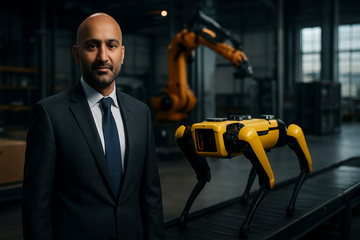
Boston Dynamics on Oct. 6 named Rohit Prasad — Amazon's former senior vice president and head scientist for Alexa and Artificial General Intelligence — as its next CEO, effective Oct. 7. He takes over from interim CEO Amanda McMaster, who ran the company after Robert Playter stepped down on Feb. 27, 2026 after 30 years at the firm. The appointment lands three months after Hyundai Motor Group completed its $325 million buyout of SoftBank's remaining ~9.65% stake, taking ownership of Boston Dynamics to 100%, and just weeks after Hyundai confirmed that [a 2027 Boston Dynamics IPO is
The Hire Reframes Boston Dynamics From a Hardware Lab Into a Foundation-Model Platform
Hyundai Motor Vice Chair and Boston Dynamics Board Chair Jaehoon Chang framed the appointment in a single phrase: Hyundai's manufacturing and mobility footprint is the foundation to scale \"Physical AI.\" That word — and Prasad's resume — is the story. He spent 12 years at Amazon, built the Alexa consumer service to hundreds of millions of households, then led the team that created Amazon's Nova foundation model family. Before Amazon he spent nearly 14 years at Raytheon BBN Technologies leading machine-learning research for U.S. government work.
- Prasad's only robotic experience is the kind most AI leaders acquire second-hand: voice and language models that must run cheaply enough to deploy to a billion devices.
- He replaces a 30-year Boston Dynamics veteran; this is the first leadership change since Hyundai Motor Group took 80% control in 2021 for $1.1 billion, and it comes after Playter was unable to deliver a path to public markets.
- Hyundai Motor Group is telegraphing that the bottleneck at Boston Dynamics is no longer mechatronics — Atlas lifts 110 pounds and reaches 7.5 feet — but the software layer that turns a robot into a product.
The 2028 IPO Math Just Got a Voice-First Twist
A September 2026 Reuters exclusive quoted a Hyundai executive saying a Boston Dynamics IPO is \"unlikely\" in 2027 and that it \"won't be easy.\" Meritz Securities now penciled the listing into 2029 or 2030. IBK Securities projects a ₩141 trillion valuation by 2030 — roughly 4.7x Boston Dynamics' ~₩30 trillion mark from a year ago — on the assumption the company generates ₩11 trillion in annual revenue. Samsung Securities sees the float-valued anywhere between ₩50 trillion and ₩100 trillion. The spread between those two ends of the range is the IPO math problem.
Hyundai Glovis filing: 2025 loss
₩528.4B (~$391M)
Disclosed in Hyundai Glovis 086280.KS filing, Sept 2026
Cumulative losses 2021–2025
~₩1.7T (~$1.26B)
Per Hyundai Glovis filing, Sept 2026
IBK target valuation 2030
₩141T
IBK Securities, Aug 2026; assumes ₩11T 2030 revenue
Samsung Securities range
₩50T–100T
Samsung Securities valuation range
Meritz IPO timing
2029–2030
Meritz Securities, Sept 2026
Prasad's Nova background is the lever that could move those numbers. A foundation-model-anchored robot stack is what investors price as software, not hardware — and software earns the multiples that make a ₩141 trillion 2030 valuation look rational rather than heroic. The Amazon comparison is direct: Alexa generated no profit on its own but underpinned the Devices and Services line that made AWS-adjacent services valuable. The equivalent at Boston Dynamics would be a foundation-model layer that lets Hyundai Motor sell Atlas intelligence to factories, warehouses and third parties — not just robots.
Boston Dynamics net loss trajectory, ₩ billions
From a 2021 base of ₩197B, losses roughly tripled to ₩528.4B by 2025 as production scaled.
Unit: ₩ billions
2021
197
2023
335
2025
528.4
The Supply Chain Around Atlas Just Got Louder
Boston Dynamics opened the Robotics Metaplant Application Center (RMAC) inside Hyundai Motor's Metaplant America campus outside Savannah, Georgia in September 2026 — the training ground where Atlas will learn parts sequencing before deployment begins in 2028. The site will expand to roughly ten times its current size in 2027 and reach component assembly by 2030. The bigger number sits behind that site: a 30,000-robot annual U.S. production facility Hyundai has committed to, with 25,000 of those units flowing into Hyundai and Kia plants and 5,000 sold externally. That plan moves the supply chain from bespoke builds (Atlas is currently made at a rate of roughly 4 units per month) into something resembling a consumer-electronics ramp.
- Upstream — compute and foundation models: NVIDIA is the implicit silicon partner as Atlas scales to thousands of units and the brain moves from bespoke control policies to foundation-model inference.
- Upstream — Korean robot ecosystem: HD Hyundai Robotics (the Korea-listed industrial-robot maker that is preparing its own IPO at a 6–7 trillion won target) sits inside the same Hyundai value-chain pitch and competes for the same industrial-robot dollars.
- Downstream — the captive customer: Hyundai Motor itself is the first and largest buyer, deploying Atlas at HMGMA starting in 2028; Kia Corporation plants are the second.
- Downstream — capital markets: Hyundai Mobis and Hyundai Glovis are the two minority holders (Glovis at ~11%) whose future exit windows depend directly on whether Prasad can make the foundation-model bet work.
The Read-Through to Hyundai Motor's Own Earnings
Hyundai Motor reported Q2 2026 revenue of ₩49.2 trillion (+1.9% YoY) but operating profit of just ₩2.85 trillion — a 20.8% decline from a year earlier on weaker sales and higher costs. That margin pressure is the backdrop for the Boston Dynamics bet: vehicle profitability is tightening, and the robotics subsidiary is the long-duration growth story management needs to keep the multiple from compressing further.
| Metric | Q2 2026 | Q2 2025 | YoY change |
|---|---|---|---|
| Revenue | ₩49.2T | ₩48.3T | +1.9% |
| Operating profit | ₩2.85T | ₩3.60T | -20.8% |
| Net profit | ₩2.89T | ₩3.25T | -11.2% |
| EPS | ₩9,616 | ₩11,518 | -16.5% |
Prasad now owns the answer to a binary question for Hyundai Motor investors: does Boston Dynamics ship a foundation-model-anchored robot stack by 2028 that earns software multiples, or does Hyundai keep absorbing cumulative losses that are already running at roughly 1% of the parent's market cap of ₩69 trillion? The hire is the most consequential bet the group has placed on a non-auto growth driver this decade.
Short-Term vs. Long-Term: What Moves First
In the next 60 days, the market will read the appointment as a signal — Hyundai Motor shares have already moved 5.9% on leadership news at Boston Dynamics once this year, and analysts will reprice the 2028 IPO optionality. The harder test is in the 12-to-36-month window: by Q4 2027, RMAC must have expanded to ten times its current footprint and Atlas must show it can run foundation-model policies on a factory floor — not in a viral demo video. If those milestones slip, the 2029–2030 Meritz window slides further and the ₩141 trillion IBK number collapses toward the ₩50 trillion floor.
- Near-term catalyst (days–quarters): the next Hyundai Motor earnings release (Oct. 23, 2026 per analyst calendar) and any commentary on Boston Dynamics burn will move the parent's stock; a Q3 update from RMAC on Atlas production rate versus the 4-units-per-month baseline is the cleanest signal.
- Long-term milestone (1–3 years): whether Atlas reaches the parts-sequencing deployment at HMGMA in 2028 on schedule — and whether the foundation-model stack is a product Boston Dynamics can license, not just a feature it can demo.
- Long-term risk: Tesla Optimus, Figure AI (valued at $39 billion in its May 2026 Series C), and Apptronik ($5.5 billion) are all racing the same factory-floor timeline; a Boston Dynamics slip hands the first-mover narrative to a competitor and crushes the IPO valuation thesis.
Stocks that move with the Boston Dynamics leadership change
- Direct parent (100% owner); Q2 2026 op profit fell 20.8% to ₩2.85T, so Boston Dynamics is the offsetting growth story management has to sell.
- Stock moved 5.9% on Playter's February exit; the Prasad hire triggers another repricing of the 2028 IPO optionality, but Boston Dynamics losses have already consumed ~1% of the parent's ~₩69T market cap cumulatively.
- Short-term (days–quarters): Q3 earnings Oct. 23, 2026 will be the first read on whether the new CEO changes the burn trajectory.
- Holds ~11% of Boston Dynamics and is the disclosure source for the ₩528.4B 2025 loss — its filings will be the cleanest window into Boston Dynamics' burn rate going forward.
- Profitability exposure runs both ways: Glovis is a logistics company, so any Atlas-driven warehousing revenue at Hyundai and Kia plants is incremental business for the parent.
- Watch catalyst: the next Boston Dynamics-related disclosure in Glovis' quarterly filing — that's the data point IBK and Samsung will use to reset their valuation range.
- Holds a Boston Dynamics stake alongside Hyundai Motor and Hyundai Glovis; the value of that stake is what a successful 2029–2030 IPO crystallizes.
- Mobis is the auto-parts supplier best positioned to build the structural and mechatronic components for Atlas at 30,000-units-per-year scale — a captive customer relationship.
- Long-term (1–3 years): if Boston Dynamics hits the 2028 production target, Mobis is the secondary beneficiary via parts margin; if it misses, the equity-stake write-down risk crystallizes.
- Sister company inside Hyundai Motor Group; 25,000 of the 30,000 Atlas units Hyundai targets for 2028 are destined for Hyundai Motor and Kia plants combined.
- Kia's higher exposure to U.S. assembly makes it the larger beneficiary of the Georgia Metaplant America deployment starting 2028.
- Watch catalyst: the second-half 2027 RMAC expansion update — Kia's plants are the next deployment site after HMGMA.
- Optimus is the most-cited humanoid competitor; a Boston Dynamics win at HMGMA in 2028 cuts off Tesla's easiest automotive-OEM reference customer.
- Tesla's lower-cost positioning ($20K target vs. Atlas at $130K–$140K to build, dropping to ~$30K at 50K units of cumulative volume) keeps it in the consumer-volume lane — different market.
- Long-term (1–3 years): if Prasad's foundation-model strategy works, Tesla has to ship its own equivalent or risk losing the 'physical AI' narrative to Boston Dynamics and Hyundai.
- Prasad's Nova foundation-model background makes NVIDIA silicon the implicit inference layer for Atlas at 30,000-units-per-year scale — every robot is a compute customer.
- NVIDIA is already a named partner in Hyundai's robotics push, and Hyundai Motor Group stocks added ~US$24 billion in market value on the early-2026 Nvidia-at-CES narrative.
- Long-term (1–3 years): if Atlas moves from 4 units/month to 30,000/year, the cumulative incremental NVIDIA inference and training silicon demand is meaningful — a small but persistent tailwind on top of data-center demand.
- Prasad is a senior alumni exit (12 years, ending 2025); Boston Dynamics' use of Nova-style foundation models in robots creates a soft cross-pollination channel back into AWS.
- Amazon does not retain equity in Boston Dynamics, so the financial linkage is indirect; the linkage is talent DNA and a foundation-model architecture pattern that may echo into AWS robotics offerings.
- Watch catalyst: any AWS robotics announcement that references 'physical AI' or 'Nova-derived' models — that would confirm the playbook traveled with Prasad.