
Total EM outflow, September 2026
$26.3B
First monthly outflow since June, per IIF (released Oct 7, 2026)
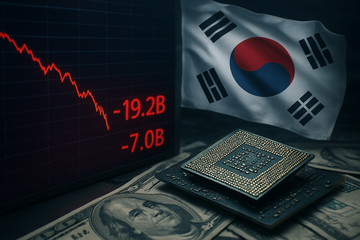
EM equity outflow, September 2026
$19.2B
Heavy foreign selling of Korean shares per Reuters/IIF
EM fixed-income outflow, September 2026
$7.0B
First monthly bond outflow since March per Reuters/IIF
Fed target range after Sep 16, 2026 FOMC
3.75–4.00%
+25 bp, unanimous, per Federal Reserve press release
Dot-plot signal for year-end 2026
16 of 18
Officials expect another hike; median endpoint 4.00–4.25%, per BondSavvy
KOSPI drawdown from peak
-20%
From 8,000+ in June to6,838 by Sep 30, 2026, per LSEG/Yahoo data
iShares MSCI South Korea ETF outflow, Sep 2026
-$1.69B
On track for 2nd-largest monthly outflow on record, per Global Markets Observer
The trigger
A Hawkish Warsh Fed Turned a Carry Trade Into an Equity Rout
On September 16, 2026, the Federal Open Market Committee lifted the target range to 3.75–4.00% — the first hike since 2023 — and new Chair Kevin Warsh joined a unanimous vote. The September SEP median now points to a year-end 2026 rate of 4.00–4.25%, with 16 of 18 officials penciling in at least one more move, per the dot-plot read by BondSavvy. The 10-year Treasury yield pushed through 5% during the month, dragging the U.S. dollar to a seven-week high.
Warsh's press conference refused to call it "tightening," framing the move as "removing accommodation," and signaled his inflation bar is lower than the median's — implying more hikes if prints don't cool (MUFG Research, Sep 16, 2026). Markets repriced: the Fed-funds futures curve now embeds a December hike as the base case, with December 2026 SOFR trading meaningfully above the pre-meeting level.
- DXY tagged a seven-week high the week of the hike; USD/KRW reached ~1,381 on Sep 17 before recovering (Yonhap).
- Korea's 3-year sovereign CDS widened in September as FX-hedging costs for won-funded carry positions climbed (KCMI).
- Global equity funds posted their first sustained weekly outflow in late September (Reuters flows data, Sep 25).
- EMB -style hard-currency spreads were stable into September even as flows turned, leaving duration risk as the main carry-cost lever.
The concentration
Three-Quarters of the Outflow Was Equity — And Three-Quarters of the Equity Was Korea
The September composition is the story. Of the $26.3B that left EM, $19.2B came out of equities — and the IIF attributed almost the entire equity leg to foreign selling of South Korean stocks, per the October 7 Reuters write-up. The bond piece ($7.0B) was modest by comparison and was the first monthly EM debt outflow since March. The skew is unusually sharp: in a typical EM risk-off month, fixed-income outflows run larger than equity outflows because the foreign holder base is bigger.
Equity share of September EM outflow
73%
$19.2B of $26.3B; IIF via Reuters, Oct 7, 2026
Korea share of September EM equity outflow
~95%
IIF cites heavy Korean selling as the driver; Reuters, Oct 7, 2026
Foreign selling of Korean stocks YTD 2026
$103.5B+
Net cumulative through July;36× full-year 2025, per KOSCOM via gate.com
Foreign selling, H1 2026 (Asia ex-Japan)
$137B
Korea and Taiwan absorbed the bulk, per Jul1 Reuters review
South Korea is the largest single EM equity market by foreign-held float and the most index-correlated to global AI hardware demand. That concentration is what turns a global sell-on-hawkish-Fed impulse into a single-country event when foreign portfolio managers rebalance — and 2026 is the year the AI-chip thesis collided with the rates cycle.
The mechanism
Why Korea Carries the Bellwether Tag: Three Forces Stacking Up
A foreign-investor outflow is a portfolio decision, not a fundamentals one. In Korea's case three things stack on top of each other: an overcrowded chip trade that needs to derisk, a won that the Bank of Korea is no longer willing to defend with rate cuts, and a corporate FX-debt profile that gets more punishing every time the curve flattens.
- Overcrowded chip longs unwinding — SK Hynix and Samsung Electronics together for ~50% of the KOSPI, and foreigners sold the pair aggressively into the Fed meeting (Maeil/KED Global, Sep 17).
- Bank of Korea defending the won with hikes, not cuts — the BoK delivered back-to-back 25 bp hikes in July and August 2026, taking the base rate to 3.00%, narrowing the Fed–BoK gap rather than widening it (Reuters, Aug 27, 2026).
- USD-funded carry trade unwinds — Korea's external debt reached $766.9B at end-2025, with short-term FX debt at 41% of $425B in reserves (KEIA), making the won hypersensitive to UST-yield spikes.
| Lever | Reading | Source |
|---|---|---|
| Fed–BoK rate gap (Sep16) | +75 bp (Fed 3.75–4.00% vs BoK 3.00%) | Fed press release Sep 16,2026; BOK Aug 27, 2026 |
| Korea short-term FX debt / reserves | ~25% (≈$105B / $417B) | CEIC Aug 2026 reserves; KEIA Apr 2026 |
| KOSPI foreign-held float as % of mkt cap | ~>25% (KRX disclosure) | Korea Exchange, Sep 30, 2026 |
| USD/KRW move in September | ~+2.7% (1,355→1,392) | FRED DEXKOUS, Sep 1–30, 2026 |
Read together, the three channels turn a 25 bp U.S. hike into roughly $11B of monthly equity outflow from Korea alone. Each additional 100 bp of Fed tightening that the market can no longer dismiss translates, on the September run-rate, to another ~$8–10B of monthly foreign selling.
The transmission
How the Shock Travels: Chip Margins, FX Hedging, and Bond Convexity
The Korea outflow is not isolated. The same hawkish Fed impulse flows through three parallel channels that hit corporate earnings, corporate balance sheets, and the EM bond fund complex — each with named listed counterparts.
1. Chip revenue cycle via dollar strength. When the dollar firms and EM currencies weaken, TSMC's non-USD revenue translates lower on every quarterly print. Korea-listed suppliers carry an additional translation loss because their billing is in USD while their labor and capex base is won-funded. SK Hynix — which sources advanced-node wafers from TSMC and sells primarily to U.S. AI customers — captures the revenue cycle but pays for it through won-denominated capex.
2. Corporate FX hedging costs. Korean corporates with USD debt roll their hedges through onshore banks; a steeper Fed–BoK curve widens the cross-currency basis and lifts the all-in cost of rolling USD obligations (KCMI, Jul 2026). The Bank of Korea raised the base rate 25 bp in August to defend the won, but it can only narrow the gap so far before it breaks the housing market.
3. EM hard-currency bonds. The $7.0B September bond outflow is the first since March and tracks the post-FOMC Treasury yield move. The iShares JP Morgan USD EM Bond ETF — the largest EM hard-currency fund, with ~$12.8B in AUM and a 30-day SEC yield of 6.52% as of Oct 5, 2026 — is the cleanest listed expression of this channel. When the curve bear-flattens, emb's price takes the convexity hit even as carry holds.
Where the September EM outflow landed
Composition of the $26.3B September 2026 outflow, by asset class
Unit: USD billions
EM equities (Korea-led)
19.2
EM bonds
7
The horizons
What Moves in Days–Quarters vs. 1–3 Years
Days to quarters. The next two IIF monthly flow prints (released early November and December) are the cleanest live signal. A second consecutive equity outflow above $15B confirms the September leg is structural; a bounce back to flat or positive in October tells you the move was a one-month position-cleaning into the FOMC. The Oct 21 Bank of Korea decision (current consensus: hold at 3.00%) and the December FOMC are the proximate triggers.
One to three years. The structural read is more interesting than the monthly noise. If Warsh stays hawkish and the Fed reaches ~4.25% by mid-2027, the won's implied revaluation risk extends the Korean chip-makers' revenue tailwind but worsens their cost-of-goods volatility. If the Fed pivots dovish on a labor-shock recession (the path markets are less willing to price, given Warsh's anti-inflation bias), Korea's $23B quarterly run-rate of foreign selling reverses first because the chip trade is the most rate-sensitive EM book.
Stocks this event actually touches
- Foreign selling is the dominant marginal seller in SK Hynix, but the ₩40T buyback (~2% of shares outstanding, completed ~45% by Sep 14) absorbs ~$8–10B of monthly selling on its own.
- Q2 FY2026 revenue of ₩79.3T (+50.9% QoQ, +257% YoY) and a 76% gross margin give the buyback a free-cash anchor even in a won-weaker regime.
- USD-funded capex plus won-denominated opex mean a 5% won move shifts operating margin by ~150–200 bp; the Bank of Korea's hawkish defensecaps won downside at the cost of compressing Korean demand.
- Samsung Electronics is ~22% of KOSPI by float and absorbs a disproportionate share of index-tracking redemptions tied to ewy's -$1.69B September flow.
- The ₩90–110T shareholder-return envelope announced Aug 21 backstops the stock but cannot offset a continued $15B+/month foreign-outflow regime.
- Memory pricing is in a structural up-cycle (Samsung raised chip-division 2026 profit outlook to ₩370T on Sep 16), but translation losses on a stronger USD shave 3–5% off reported Q3 sales.
- ewy was on track for its 2nd-largest monthly outflow ever in September (-$1.69B), the cleanest read on the Korea leg of the September $19.2B equity outflow.
- The fund is Samsung Electronics + SK Hynix + a handful of industrials, so the ETFtracks the chip-leverage trade one-for-one.
- When foreign flows turn, the dollar-AUM leg amplifies the won-denominated move by another 1.5–2.5% for U.S. holders.
- emb is the listed expression of the $7B September EM bond-outflow print; its 30-day SEC yield of 6.52% spreads wider with the Fed curve.
- NAV total return is -1.90% as of Oct 6, 2026 — the bond channel is taking a price hit even as carry holds.
- Spread duration of ~7 yrs means a 100 bp Treasury selloff shaves ~5–6% off NAV before any spread-widening adds to the loss.
- TSMC is the upstream wafer source for SK Hynix; a stronger USD lifts reported revenue but compresses Korean-customer order book.
- Taiwan's domestic TWSE saw a modest $21M net inflow year-to-date vs Korea's $103.5B outflow, so TSMC is the cleanest 'regional selloff with single-stock resilience' expressionin the same AI chip complex.
- If the Fed cuts into a labor-shock recession, TSMC's customer-order pipeline re-rates first because hyperscaler AI capex is the most rate-sensitive demand leg.
- eem is the broad-basket read on whether the September $26.3B was a Korea idiosyncrasy or a true EM regime change — flows into/out of eem over the next 30 days will answer that.
- Korea is ~15% of eem's weight, so a continued -$15B/month Korea outflow alone drags the index mechanically.
- Watch the emb-to-eem flow ratio: a divergence (bond out, equity in) means the foreign seller is repositioning, not de-risking outright.
- ewt is the cleanest cross-check on the Korea-specific read — Taiwan saw a small $21M net inflow YTD vs Korea's $103.5B outflow.
- Sept12 DeepSeek comment on lower HBM requirements hit ewt on the same session as ewy and confirmed the chip-complex is moving as one trade.
- ewt's Oct closetells you whether the chip-crowding unwind has further to run or has already washed through.