
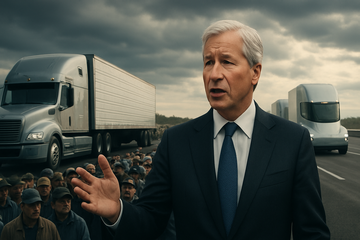
The Quote That Quantified the Trade
JPMorgan Chase CEO Jamie Dimon told Bloomberg TV on October 7, 2026 that a fast roll-out of AI through the long-haul trucking workforce would be politically combustible. His exact hypothetical: \"And should you do it all at once if 2 million people go from driving a truck making 150,000 a year to a next job that might be 25,000? No. You'll have civil unrest. So therefore, phase it in.\" He added that government should \"just tell them you can't layoff 2 million truckers tomorrow. You can phase it in over time.\" The comments, reported by Benzinga the same afternoon, escalate a theme Dimon first laid out at Davos in January and reiterated on JPMorgan's Q2 2026 earnings call on July 15 — but with one critical addition: a sector (long-haul), a population (the 2 million U.S. commercial drivers Dimon cited), a wage delta ($125,000), and a political risk (civil unrest) all named in a single sentence.
The number that anchors the trade is internal. On the Q2 2026 earnings call, Dimon said AI has already cut headcount by 30–40% in selected parts of JPMorgan Chase, and the bank reported 320,560 employees at June 30, 2026 — up just 2,048 from year-end 2025, despite a $19.8 billion 2026 technology budget that is up roughly 10% year over year. The implied math: the bank is not shrinking, but it is reallocating labor at a speed that has never shown up in any management's productivity guidance before.
The Trucking Math: $150K to $25K Is Closer Than It Sounds
Dimon's $150,000 anchor is the high end of the wage distribution, not the median. According to the Bureau of Labor Statistics, the U.S. had 2.1 million heavy and tractor-trailer truck drivers as of May 2025, with an annual mean wage of $59,710 and a median of $57,440. The top decile of employee drivers makes above $79,380, while owner-operators — the population Dimon's hypothetical most clearly targets — gross an average of $228,575 and the top performers can clear $300,000, per Truckstop and Glassdoor compilations of BLS data. The American Trucking Associations is forecasting a 174,000-driver shortage by the end of 2026, the largest in its data series. Against that backdrop, the long-haul workforce is already the most economically squeezed in freight: long-haul trucking employment was at a 12-year low earlier in 2026, with six straight months of recovery only beginning in spring.
- 2.1 million heavy/tractor-trailer truck drivers (BLS, May 2025)
- $59,710 mean annual wage; $57,440 median (BLS)
- $228,575 average owner-operator gross, top performers clear $300K+ (Truckstop/Glassdoor)
- 174,000 projected U.S. driver shortage by year-end 2026 (American Trucking Associations)
- $6.20/gal U.S. on-highway diesel, week of Oct 5, 2026 (EIA); California stations hit $8.38/gal in late September (CNN, Oct 7, 2026)
The squeeze is real and immediate. U.S. on-highway diesel averaged $6.20/gal for the week of October 5, 2026, down 18.3 cents from the prior week but well above the 2026 year-to-date average of $5.04/gal, per the EIA. CNN reported on the same day as Dimon's interview that California diesel hit $8.38/gal, and that food-industry pass-through of fuel costs takes 30 to 45 days to reach grocery prices, with full macro impact delayed six to nine months. The August 2026 social-media-driven trucker 'strike' for October 1 failed to organize a national shutdown, but it tapped into a margin compression that is now structural. Dimon's hypothetical is not happening in 2035; it is happening on a 12-month lag to diesel and a five-to-ten-year lag to autonomy.
McKinsey Already Named Transportation as the Front Line
On September 29, 2026, the McKinsey Global Institute published 'AI and the future of US jobs: Skills and pathways,' estimating that 11 million U.S. workers — about 7% of the labor force — may need to switch occupations entirely by 2035. The base case is 36 million jobs displaced and 41 million created, for a net 5 million gain; but roughly 770,000 workers per year would need to change occupational groups to absorb the shift, a pace 3.6 times the historical average. McKinsey's most under-reported finding: more than 75% of workers who may need to move into new occupations are concentrated in three fields — office and administrative support, retail and sales, and transportation and logistics.
| Field | Share of workers needing to switch | Why it matters now |
|---|---|---|
| Office & administrative support | ~30% of displaced cohort | Back-office automation is already showing up in JPM's 30–40% headcount cut |
| Retail & sales | ~25% of displaced cohort | Closest macro parallel to a 2M-worker transition |
| Transportation & logistics | ~20% of displaced cohort | The sector Dimon named; 2.1M U.S. truckers, 200 driverless Aurora trucks by year-end 2026 |
Dimon's 2-million-trucker hypothetical therefore maps directly onto the McKinsey 20%-of-the-11M transportation cohort — a population that McKinsey implicitly sizes at roughly 2 million workers who would need to transition. The two estimates, made by a bank CEO and a consulting firm's research arm ten days apart, are now mutually reinforcing.
The Autonomous Trucking Pipeline Is Already Commercial
The technology Dimon is warning about is no longer a pilot. Aurora Innovation said in its Q2 2026 8-K filing that it is \"fully allocated to exit the year with 200 driverless trucks in operation\" through its Transport-as-a-Service model, and the company's investor materials have logged 440,000 cumulative driverless miles through June 2026 — up from roughly 20,000 in mid-2025. Aurora's 2030 plan calls for more than 30,000 driverless trucks, working out to about 7,500 by 2028, a pace of roughly 125 trucks added per week. Q2 2026 revenue was $2 million against a $270 million net loss and $200 million Adjusted EBITDA loss, meaning the 200-truck 2026 exit fleet would represent approximately $80 million in annualized run-rate revenue per Aurora's CFO commentary on the Q2 business review.
- Aurora Innovation: 200 driverless trucks by year-end 2026; 440,000 driverless miles through June 2026; 30,000-truck 2030 target (Q2 2026 8-K)
- Kodiak AI (private): autonomous Dallas–Houston lane with Roehl Transport launched May 7, 2026
- Werner Enterprises: Aurora commercial pilot since 2022; Q2 2026 revenue $933.9M, EPS $0.11 (vs. -$0.34 Y/Y)
- Schneider National: Q2 2026 revenue $1.57B, EPS $0.28 (vs. $0.11 Y/Y); has run autonomous pilots
- J.B. Hunt Transport Services: Q2 2026 revenue $3.50B (+19% YoY), intermodal $1.75B (+22%); AI agents via Overroute partnership
On the carrier side, Knight-Swift reported Q2 2026 consolidated revenue of $2.1 billion, up 12.6% year over year, with operating income up 44.4% — a recovery story that is also the largest direct long-haul labor exposure in the U.S. public market. J.B. Hunt Transport Services's intermodal segment is structurally insulated from full autonomy because containers still need to be drayed and transferred, but its dedicated truckload business is not. The full Aurora/Kodiak/Werner commercial pipeline plus the JPM 1,000-use-case AI rollout make Dimon's hypothetical a question of when, not whether, and the 2026 diesel crisis makes the timing more politically charged than 2030.
The Macro Wage-Trade Reset
The Federal Reserve's July 2026 Monetary Policy Report described wage growth as 'solid' and 'roughly consistent with 2 percent inflation over time.' The September 16, 2026 FOMC minutes showed the employment cost index for private-sector workers up 3.3% over 12 months through June. Dimon's October 7 statement reframes that data: if 2 million workers in a single sector face a plausible $125,000 per-worker annual income collapse, the macro labor story stops being about average wage growth and becomes about a concentrated, sectoral income shock that demands a fiscal answer (retraining subsidies, expanded UI, possibly wage insurance). That answer is not in the Fed's toolbox, which is the part of Dimon's warning that moves bond markets.
JPMorgan Q2 2026: Record earnings, slower headcount growth
Net income reached $21.2B while total employee count rose only 2,048 from year-end 2025
Unit: USD / millions of employees
Net income ($B)
Q2 2026, all-time U.S. bank record
21.2
Revenue ($B)
Q2 2026, +15% YoY
82.5
Headcount growth from YE 2025
+2,048 employees; AI displaces in pockets
0
Tech budget 2026 ($B)
+10% YoY, includes ~$2B AI investment
19.8
Three things would have to be true for Dimon's scenario to remain hypothetical: the technology must lag, the labor must re-allocate faster than 770,000 workers per year (the McKinsey target), and the political response must be cheaper than the displacement. None of those are obviously the base case. Aurora's 22x year-over-year increase in driverless miles (20,000 mid-2025 to 440,000 mid-2026) implies a learning curve measured in months, not decades. The 12-year low in long-haul employment and the diesel-fueled 2026 wage compression mean incumbent drivers have less buffer to absorb transition. And JPMorgan Chase's own 30–40% headcount cut in selected functions is the proof of concept that AI can move faster than attrition.
Short-Term vs Long-Term: Two Different Trades
Over the next days to quarters, the trade is sentiment and the policy reaction. Dimon's October 7 interview was the same day CNN published its diesel-doubled piece, two days before EIA's next release (October 14, 2026), and inside the McKinsey report's 10-day news cycle. The next obvious catalysts are: the October 14 EIA diesel update, third-quarter 2026 earnings from Knight-Swift and J.B. Hunt in mid-to-late October, and any follow-up Dimon commentary at the next IMF/World Bank week or the Bipartisan Policy Center's economic security events. If the BLS October Employment Situation (early November) shows long-haul trucking payrolls flat or down, the 'phase it in' framing becomes data, not narrative.
Over one to three years, the structural trade is autonomy unit economics versus labor. Aurora Innovation's 30,000-truck 2030 target would replace roughly 30,000 driver positions, or about 1.4% of the 2.1 million base. The 2026–2028 ramp is therefore the bridge period: not enough to break the labor market, more than enough to anchor a fiscal-policy response. Watch for: any federal AI-displacement wage-insurance legislation, state-level CDL/automation rule changes (California has already approved Aurora Innovation and Kodiak testing), and the gap between McKinsey's 770,000-per-year reallocation target and actual reallocation data from BLS occupational mobility statistics.
Stocks this event actually moves
- Dimon's framing validates the autonomous-trucking thesis that drives AUR's 30,000-truck 2030 plan and the 200-truck 2026 exit target disclosed in its Q2 2026 8-K
- 200-truck fleet implies ~$80M annualized revenue (CFO commentary, Q2 2026 business review), the kind of operating leverage the narrative now has to defend
- Civil-unrest risk argues for a slower, government-orchestrated rollout — AUR's 125-trucks-per-week 2028 target pace is the bullish case for political acceptance
- Q2 2026 revenue of $2.1B (+12.6% YoY) and operating income +44.4% confirm the freight recovery thesis — but 2 million-trucker displacement caps the multiple a labor-heavy carrier can sustain
- Civil-unrest risk lowers the political cost of automating Knight-Swift's long-haul fleet, an offset that pure-play financials miss
- Dimon's call shifts the question from 'will freight rates normalize' to 'how fast does the labor base repriced' — KNX is exposed to both sides
- Q2 2026 intermodal revenue of $1.75B (+22% YoY) is structurally insulated from full autonomy because containers still transfer through human-driven drayage
- Overroute AI-agent partnership (announced July 21, 2026) lets JBHT capture the productivity narrative without taking the political heat for displacement
- If 770,000 workers per year need to reallocate (McKinsey), intermodal — the most labor-retainable freight mode — is the natural winner for capital reallocation
- Aurora commercial-pilot customer since 2022; WERN is the publicly traded carrier with the deepest direct line into the Dimon scenario
- Q2 2026 EPS of $0.11 (vs. -$0.34 a year ago) shows the operating leverage if autonomy economics work — Dimon just lowered the political cost of moving there
- Smaller market cap than KNX/JBHT means WERN is the cleanest equity expression of Dimon's 'phase it in' policy ask
- Q2 2026 revenue of $1.57B and EPS of $0.28 (vs. $0.11 Y/Y) show the recovery, but 2M-trucker displacement is direct exposure to the long-haul labor line
- Has its own autonomous pilot history, so SNDR sits on both sides of the trade
- Civil-unrest risk compresses the multiple for any carrier that hasn't yet locked in an autonomy partnership
- Dimon's 30–40% headcount cut in selected areas (Q2 2026 earnings call, July 15, 2026) makes JPMorgan Chase the proof-of-concept for the policy ask he made on Bloomberg TV
- Q2 2026 net income of $21.2B (record for a U.S. bank) and a $19.8B 2026 tech budget give it the balance sheet to acquire or partner with any autonomy pure-play, accelerating the 'phase it in' call
- Owns the narrative: the bank whose CEO defines the AI-labor macro is also the bank that captures the productivity dividend