
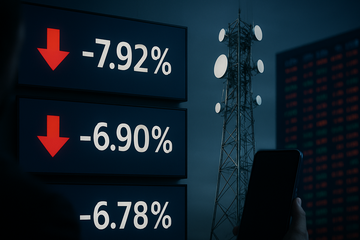
AT&T after-hours move (Oct 8)
−7.92%
to roughly $22.94; closed Friday at $23.25 (−6.51%) on 50.8M shares — most-active session of the year
Verizon after-hours move (Oct 8)
−6.90%
to ~$43.15; Friday close $43.64 (−5.85%)
T-Mobile US after-hours move (Oct 8)
−6.78%
to ~$159.71; Friday close $159.95 (−6.63%); TMUS had already pocketed $2.9B on the same spectrum just 58 days earlier
SpaceX gain (Oct 8 after-hours)
+2.56%
to $164.68; market cap ~$2.12T after the June IPO at $135
SpaceX spectrum stack (licensed through EchoStar + Grain)
~$25.5B
$17B AWS-4/H-block (EchoStar, FCC-approved May 12, 2026) + $2.6B AWS-3 (EchoStar, amended Nov 6, 2025) + ~$6B implied for 14 MHz of 800 MHz (Bloomberg, Aug 20, 2026)
Starlink Mobile revenue trajectory (2027 → 2030)
$1.14B → $25.35B
per New Street Research, reprinted Oct 1, 2026
SpaceX's October 8 announcement that it would acquire 100% of Grain Management's nationwide 800 MHz spectrum portfolio was, on its face, just the next slice in an eighteen-month stack of spectrum trades. Strip the noise away, however, and the move is the missing piece that turns Starlink Mobile from a satellite-to-feature add-on into a national carrier competitor — and the day's 6–7% drop in AT&T, Verizon and T-Mobile US is the market catching up to what the spectrum chain has already priced in. The non-obvious story starts with T-Mobile US's August sale, runs through the FCC's October 7 auction signal, and ends with what the secondary market is now telling every carrier holding idle mid-band.
The Spectrum is T-Mobile's, and It's Been a Conveyor Belt
The 800 MHz portfolio SpaceX just agreed to buy is the exact block T-Mobile US spent years trying to redeploy. T-Mobile completed its sale of the nationwide 800 MHz portfolio to Grain Management on August 11, 2026, for $2.9 billion in cash and Grain's 600 MHz licenses, with FCC approval coming July 1, 2026. The sale was controversial — utilities and rural carriers argued the transfer undermined the 800 MHz band's role as a backstop for industrial and critical-infrastructure users — but the FCC cleared it with a competitive-selection process designed to ensure the spectrum would reach a D2D-capable buyer.
Grain wasted no time. By August 20, 2026, Bloomberg reported both SpaceX and AST SpaceMobile had lodged preliminary interest in the same portfolio, with the spectrum valued around $6 billion in early bidding. SpaceX won the auction; AST SpaceMobile walked away with nothing. The transaction between Grain and SpaceX was announced October 8, with the price undisclosed — but based on the Bloomberg-stated portfolio valuation, the implied markup over T-Mobile's $2.9B exit is roughly 2x in 58 days.
Why Low-Band Is the Carrier-Killer Physics
Spectrum-band physics drive every dollar of the day's damage. The 65 MHz of AWS-4 and H-block mid-band that SpaceX acquired from EchoStar (FCC-approved May 12, 2026) gives Starlink Mobile raw capacity at roughly 2 GHz — good bandwidth, less reach. The 14 MHz of 800 MHz it just added from Grain supplies the missing coverage layer: 800 MHz signals propagate through walls, into buildings and across rural miles at a fraction of the cell-tower count a traditional carrier would need to match the same footprint. For comparison, T-Mobile US operates about 102,000 macro cell sites and 41,000 small cells to cover its 108.7M subscribers; Starlink's SpaceX-built satellite-to-device layer needs zero of them.
- AWS-4 (≈2000-2020/2180-2200 MHz) — capacity. 40 MHz of total bandwidth, enough for streaming and data — but blocked by walls and limited to satellite line-of-sight.
- H-block (≈1915-1920/1995-2000 MHz) — paired extra capacity. Adds 10 MHz nationwide; same propagation limits as AWS-4.
- AWS-3 unpaired uplink (1695-1710 MHz) — supplementary; closed in November 2025 for ~$2.6B in SpaceX stock.
- 800 MHz (≈824-849/869-894 MHz, the so-called Cellular band) — coverage. Reaches inside buildings, works at the edge of the network, already inside every modern phone's chipset via Qualcomm and Globalstar-era S-band support.
Together with the 15,000 direct-to-device satellites the FCC cleared on October 7, the EchoStar + Grain stack now gives SpaceX a coherent nationwide carrier network — coverage AND capacity, low-band AND mid-band, satellite AND ground — without owning a single cell tower. That is the structural threat the market is finally pricing.
Who's Most Exposed? The After-Hours Damage Tells You
All three national carriers dropped roughly the same headline percentage — but the underlying businesses are very different scales, which is why the selloff looks more like a uniform re-rating than a fundamental shock. Using TTM figures through Q2 FY2026 (June 30, 2026):
| Metric | T-Mobile US | Verizon | AT&T |
|---|---|---|---|
| Share price (Oct 9 close) | $159.95 | $43.64 | $23.25 |
| Market cap | $171.7B | $181.3B | $159.3B |
| TTM revenue | $92.2B | $138.9B | $127.2B |
| EBITDA margin (TTM) | 33.6% | 34.5% | 35.3% |
| Forward P/E | 11.7x | 8.7x | 9.9x |
| EV/EBITDA | 9.1x | 7.9x | 5.9x |
| Dividend yield | 2.5% | 6.1% | 4.5% |
| Friday volume vs avg | 0.93x | 0.84x | 0.93x |
Verizon is the most stretched on the wireline substitute axis — 7 million wireline broadband and 4 million Fios video connections depend on the bundle with wireless, and Starlink Roam + Starlink Mobile collapses the geographic moat Verizon's been monetizing for two decades. AT&T bought $23B of EchoStar's mid-band spectrum last May, so it has its own defensive spectrum play, but still sold off as hard as the others because the market cannot yet quantify the competition's demand for unlimited flat-rate data over satellite.
The Supply-Chain Spillover: Towers, ASTS, Iridium, Globalstar
If Starlink Mobile becomes a credible fourth carrier, every business model predicated on the current three-carrier structure is in play. The most direct read is on the tower REITs — Crown Castle and SBA Communications — which monetize each carrier's small-cell and macro-site footprint on multi-year contracts. Their existing lease revenue is protected for now (the carriers already pay for those towers and won't rip them out overnight), but incremental small-cell buildouts that drove 2024–25 capex are the marginal revenue stream at risk.
| Ticker | Last | Mkt Cap | Implication |
|---|---|---|---|
| AST SpaceMobile (ASTS) | $56.93 | $23.2B | Direct competitor to Starlink D2D; lost the 800 MHz auction to SpaceX per Bloomberg, Aug 20, 2026 |
| Iridium (IRDM) | $47.56 | $5.0B | Niche satellite peer; 54x P/E TTM reflects scarcity premium, vulnerable to share loss in consumer phone-satellite |
| Globalstar (GSAT) | $83.22 | $10.7B | Apple's emergency-SOS satellite provider; longer-term squeeze risk if Starlink opens iPhone compatibility |
| Crown Castle (CCI) | $68.89 | $30.1B | Tower REIT; new small-cell cycle under pressure if Starlink absorbs marginal coverage capex |
| SBA Communications (SBAC) | $169.18 | $17.9B | International tower exposure cushions US-specific risk |
AST SpaceMobile is the most strategically awkward position of the group. It has carrier partnerships with both AT&T and Verizon and is the only listed pure-play on the same D2D thesis — yet it lost the very spectrum auction that would have let it match Starlink Mobile's coverage layer. The market has been pricing that asymmetry all year: AST SpaceMobile shares trade at $56.93 against a 52-week high of $133.86, a 57% drawdown even before this week's news.
The FCC's October 7 Signal: A New Auction With D2D Flexibility Built In
One day before the Grain announcement, FCC Chairman Brendan Carr published a blog post and an NPRM schedule for an October 29 vote that re-prices the carrier-vs-satellite calculus at the policy level. The proposal would auction 25 megahertz of prime mid-band spectrum in the 1675–1695 MHz and 2020–2025 MHz bands with explicit flexible-use rights covering 5G, direct-to-device, or a combination of both. The same package proposes modernizing Supplemental Coverage from Space (SCS) rules adopted in 2024 to \"make more spectrum available for leasing\" and \"reduce regulatory barriers to deal flow.\"
Combined with the congressional 800 MHz pipeline mandate (auction at least 200 MHz of identified spectrum by July 2029, 800 MHz total by 2034), the secondary market for spectrum now has a clearer floor than at any point in the past decade — and a new class of bidder (private satellite operators sitting on cash and stock-based currency) that the incumbents cannot outbid without triggering regulatory scrutiny on coverage obligations.
Two Horizons: Days–Quarters vs 1–3 Years
Short-term (days to quarters): The most immediate catalyst is the FCC's October 29 vote on the new flexible-use mid-band auction. Carrier boards now face a hard strategic choice — buy more spectrum for cash and dilute buybacks/dividends, or sit out and concede the long-tail of ARPU to Starlink Mobile. AT&T reports Q3 FY2026 earnings on October 21 and is widely expected to address the Starlink competitive frame; a credible capex reallocation toward spectrum M&A rather than fiber build-out would be the cleanest signal that management has internalized the new baseline.
Medium-term (1–3 years): The thesis is the New Street Research forecast reprinted by Fierce Network on October 1 — Starlink Mobile scales from $1.14B in 2027 to $25.35B by 2030. Even being half right resets the carrier cost structure. T-Mobile US and Verizon have the deepest pricing defensive moats (mid-band C-band/cell-site density) but also the most exposure to a price war. AT&T has the cleaner balance-sheet profile but the smallest growth optionality at its current scale. The structural winners are SpaceX (cannibalizing carrier ARPU from outside the regulatory perimeter) and the operators with diversified non-wireless revenue (Crown Castle on its fiber business, Iridium on industrial/government satcom).
Lower frequencies travel farther and pass through obstacles much better. Starlink Mobile's global 2 GHz mid-band spectrum delivers the high-bandwidth capacity; the new 800 MHz low-band spectrum adds a coverage layer that gets through walls and reaches phones inside buildings.
Where the Trade Sits Today
- 800 MHz closes the coverage gap; total SpectrumX spectrum stack moves to ~$25.5B licensed.
- Starlink Mobile forecast ($1.14B 2027 → $25.35B 2030) gives a non-telco revenue line on top of $11.4B Starlink broadband.
- Stock has 18% weekly gain going into Friday; watch for pullback if FCC delays October 29 vote.
- EchoStar mid-band buy was supposed to be defensive — yet Friday close down 6.51% shows buyers don't yet see the ARPU offset.
- P/E 8.1x the cheapest of the three carriers; 4.5% dividend yield cushions but caps upside.
- Q3 FY2026 print on Oct 21 is the next decision-relevant catalyst — look for spectrum/capex reallocation signal.
- Most exposed to wireline-cannibalization: 7M broadband + 4M Fios video subscriptions depend on wireless bundle.
- Carries the highest dividend yield (6.1%) — a defensive anchor if rates fall, a tax-loss magnet if they don't.
- Friday close $43.64 vs 200-day MA $46.47 — chart damage done in one session.
- Already locked in $2.9B on the 800 MHz exit; T-Satellite partnership with Starlink gives near-term upside on rural penetration.
- But Friday's 6.63% drop shows the market isn't crediting the T-Satellite carry — it sees Starlink Mobile as a long-term competitor.
- Forward P/E 11.7x leaves room if Q3 FY2026 service revenue grows above the 7.9% TTM pace.
- Spectrum monetization largely complete ($40B sales approved by FCC May 12, 2026); catalyst is the Boost Mobile + Starlink Direct-to-Cell commercial agreement activation.
- Stock at $93.36 vs 200-day MA $108.7 suggests market is still waiting for confirmation the cash was deployed productively.
- Q3 FY2026 earnings window will be the read on whether Boost-Mobile → Starlink traffic is converting into ARPU.
- Lost the 800 MHz auction to SpaceX (Bloomberg, Aug 20, 2026), yet continues to operate as a pure-play D2D alternative.
- Drawdown of 57% from $133.86 52-week high suggests the market is repricing ASTS as a structural follower, not leader.
- AT&T and Verizon carrier partnerships preserved, but ASP per subscriber now has Starlink as the price-setter.
- Carriers won't abandon 40,000+ tower leases overnight — revenue is contracted — but the next small-cell/DAS capex cycle is at risk.
- Forward P/E 21.2x prices in growth; $30.1B market cap is exposed to a 100–200bps multiple compression if Starlink Mobile hits commercial milestones.
- Fiber business (80,000 miles) is the long-term defensive moat; watch Q3 FY2026 organic tower-revenue growth as the read.
- Industrial/government satcom franchise protected from consumer cannibalization, but L-band is a sub-scale consumer play.
- 54x TTM P/E reflects scarcity; vulnerable to subscriber-share loss if Starlink opens consumer iPhone compatibility post-2027.
- Q3 FY2026 will be the cleanest read on US-government contract book — the more durable moat.