
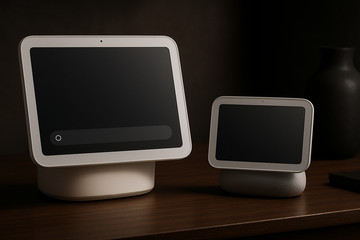
Apple's \"Welcome Home\" event lands October 13, 2026, at 9:00 a.m. Eastern, and the device at the top of the stack is HomeView — a 7-inch, iMac-Avo-inspired smart-home display on a metal speaker base, powered by an A18 chip, with a wall-mounted variant and no App Store. Preorders open the same week; the hub ships around November 14. A refreshed Apple TV 4K (A19 chip) and HomePod mini (S10 chip) arrive October 30 — a coordinated three-product push that signals Cupertino treating the smart home as a category, not a feature.
Apple event date
Oct 13, 2026
Welcome Home keynote, 9:00 a.m. ET, NYC Tribeca
HomeView ship window
Mid-Nov 2026
Countertop and wall-mounted versions; A18 silicon; no App Store
Apple TV 4K / HomePod mini ship
Oct 30, 2026
A19 chip and S10 chip; preorders open with HomeView
Reported HomeView price
~$350
Per earlier 2026 reporting; vs. Echo Show 8 at $180, Nest Hub at $99
What HomeView actually is — and what it isn't
HomeView pairs a squarish 7-inch panel with an A18 chip — the same family already in Apple's iPhone 16 — and runs voice-first via Apple Intelligence/Siri AI. The countertop version ships in space gray, silver, starlight, and pink; the wall-mounted variant is monochrome. There's no App Store: only a curated subset of Apple apps and HomeKit/Matter accessory control. Bloomberg's Mark Gurman, whose reporting drove the October 11 leak cycle, framed it explicitly as a HomeKit command center, not a tablet replacement.
The competitive math: 2x to 4x the price for a fraction of the addressable market
| Device | Display | Starting price | Assistant/AI |
|---|---|---|---|
| Apple HomeView (countertop) | 7-inch | ~$350 (rumored) | Siri AI / Apple Intelligence |
| Amazon Echo Show 8 (3rd Gen) | 8-inch | $180 | Alexa+ |
| Amazon Echo Show 11 (2025) | 11-inch | $220 | Alexa+ |
| Google Nest Hub (2nd Gen) | 7-inch | $99 | Google Assistant |
Apple enters at roughly double the Echo Show 8 and 3.5x the Nest Hub. That looks like a competitive disadvantage until you read the underlying market: Apple held an estimated 10–15% of the global smart-speaker market in 2025, while Amazon commanded the rest and Alphabet ran a distant third. Apple isn't chasing volume — it's chasing the slice of households already inside its ecosystem. The strategic question is how much incremental Services revenue, rather than model output, the hub can pull in.
- Apple's Wearables, Home and Accessories segment was $35.7B in FY2025 (10-K, ended Sep 27, 2025) — down 4% YoY — and is the only hardware segment shrinking, so HomeView's job is partly to reverse that slide.
- Apple TTM revenue through Jun 30, 2026 was $466.8B with 32.6% operating margin and 48.7% gross margin; Services grew +14% YoY in FY2025 to $109.2B — the engine HomeView will ultimately feed.
- Amazon's TTM revenue was $775.7B with 13.7% operating margin; the bulk sits in AWS and retail, not devices — so Echo is a defensive beachhead, not a profit center.
- Alphabet's TTM was $445.9B with 34.0% operating margin; Google has been deprioritizing Nest hardware in favor of Gemini-driven software, which opens a window Apple can walk into.
Supply chain: the silicon is settled, the accessory moat is the bet
Apple designs the A18 and Taiwan Semiconductor manufactures it on the N3E node — the same chip family in the iPhone 16, with already-ramped production. Assemblers will split among Apple's existing ODM trio — Hon Hai (Foxconn), Pegatron, and Luxshare — all of whom already build HomePods and other Wearables/Home SKUs. The novelty sits downstream: Apple has reportedly co-developed doorbells, thermostats, and outdoor cameras with LG Electronics, and European-market devices with Schneider Electric, both badged under an \"Apple Home Collection\" that surfaces only when HomeView is the hub.
Apple FY2025 net sales by segment (US$B)
Wearables/Home/Accessories is the smallest major segment and the only one shrinking.
Unit: US$ billions
iPhone
+4% YoY
209.6
Services
+14% YoY
109.2
Wearables, Home & Acc.
-4% YoY
35.7
The Siri tax — two postponements, one sensor for the thesis
HomeView was originally targeted for late 2025, slipped to spring 2026, then to fall 2026 — and Bloomberg tied both slips to Apple's struggles shipping the Apple Intelligence/Siri overhaul. The upgraded Siri shipped in iOS 26 in September 2026, which is what finally unlocked the October launch window. That history matters: HomeView's pitch is that Siri AI can finally compete with Alexa+ and Gemini. If Siri's contextual awareness stutters at scale, the $150–$250 premium over Echo Show 8 has no story behind it.
- HomePod mini (S10) and Apple TV 4K (A19) ship on Oct 30 — both act as HomeKit/Matter hubs too, so the install base for HomeKit routing is set to jump before HomeView even ships.
- Apple raised HomePod mini to $129 and HomePod 2nd-gen to $349 earlier in 2026 (Apple newsroom, June 2026 pricing update) — HomeView slots in above that band, not below.
- Apple Intelligence/Siri AI was announced June 8, 2026 and shipped September 14, 2026 — Apple explicitly tied HomeView's readiness to the September rollout (MacRumors, October 11).
Horizons: what moves first vs. what compounds
In the days-to-quarters window, the catalyst is the December quarter print: any commentary on Wearables/Home/Accessories returning to growth will move the stock. Apple has guided December-quarter Services to extend its record run, and HomeView shipments in November will land inside that quarter — management commentary on attach rate, Matter accessory take-up, and Siri AI usage will be the load-bearing disclosures on the late-January earnings call.
On the 1–3 year horizon, the structural question is whether HomeView accelerates the Apple Home Collection flywheel. If LG and Schneider drive meaningful volumes in doorbells, thermostats, and outdoor cameras — categories Apple has never sold in directly — the segment could re-rate from a shrinking $36B business into a growing one. The risk is non-arm's: Alphabet re-entering with a Gemini-native hub, Amazon pushing Alexa+ deeper into Prime, or Sonos-style premium audio-model retailers siphoning the design-conscious buyer.
Synthesis — what the article means, for whom, over what horizon
HomeView is Apple's first real test outside iPhone in a category where Alphabet and Amazon already dominate on price. The honest answer to \"can it beat them\" is: on units, no — Apple is structurally a premium-shareholder in a volume game. The answer Apple cares about is different: whether HomeView pulls more existing-Apple households deeper into Services, where margin is highest. The thesis hinges on Siri AI holding up at scale, the Apple Home Collection flywheel spinning up with LG Electronics and Schneider Electric, and the December quarter showing Wearables/Home/Accessories returning to growth. If those three hold, the ~$35B segment re-rates; if any one fails, the $150–$250 premium evaporates fast.
Stocks with verified linkages to the HomeView launch
- HomeView lands inside Apple's December quarter (FY26 Q1) and is the first major catalyst for the Wearables/Home segment since FY2025's $35.7B, -4% YoY print, per the FY2025 10-K filed Oct 31, 2025.
- Services revenue grew +14% YoY to $109.2B in FY2025; HomeView is the cleanest hardware-driven pull-through into Services attach Apple has shipped since Apple Watch, supporting the margin mix shift toward the 48.7% TTM gross margin through June 30, 2026.
- Short-term (days–quarters): Apple TV 4K (A19) and HomePod mini (S10) ship Oct 30 — both are HomeKit hubs, so HomeKit routing footprint expands before HomeView even ships Nov 14.
- Long-term (1–3 years): the Siri AI dependency is the real risk — the same delays that slipped HomeView twice in 18 months will define whether the premium pricing holds.
- Alphabet TTM revenue was $445.9B with 34.0% operating margin through June 30, 2026 — the size to absorb a defensive Nest refresh without margin damage.
- Google has signaled a move away from the \"Nest Hub\" brand for a spring 2026 Gemini-native refresh, so the WindowHomeView opens in late 2026 is exactly when Google's lineup is in transition.
- Short-term (days–quarters): Nest Hub (2nd Gen) is $99 vs. HomeView ~$350 — Alphabet's pricing power keeps a price war answer on the table.
- Long-term (1–3 years): if Apple Home Collection with LG Electronics draws mass-market buyers, Alphabet risks ceding the high-end installed base.
- Amazon's TTM revenue was $775.7B through June 30, 2026 with 13.7% operating margin — devices are a strategic beachhead, not a profit center, so Echo Show 8 at $180 can absorb more price pressure than peers.
- Alexa+ is bundled free with Prime on Echo Show 8/10/15/21 per Amazon's Sep 30, 2025 devices event — a structurally different monetization model than HomeView's hardware-first approach.
- Short-term (days–quarters): Echo Show 8 (3rd Gen) and Echo Show 11 are Apple's direct price competitors; expect Amazon to defend the sub-$200 tier aggressively through holiday2026.
- Long-term (1–3 years): AWS revenue (~16% of Amazon sales, ~50%+ of operating profit) makes Echo's role defensive — losing smart-home share doesn't break the business, but losing the consumer touchpoint may matter for Prime retention.
- HomeView's A18 chip is fabricated on TSMC's N3E node — same process as the iPhone 16 family already in mass production, so HomeView units add incremental N3E wafer demand without new tooling.
- TSMC TTM revenue was $4.44T TWD (~$129B USD) through June 30, 2026 with 60.3% operating margin — a single Apple SKU family at low-millions of units is small relative to total wafer volume, but high in margin contribution.
- Short-term (days–quarters): Apple TV 4K (A19) and HomePod mini (S10) all source from TSMC — three-product event locks in Q4 utilization even before HomeView ships.
- Long-term (1–3 years): if HomeView traction validates Apple Intelligence/Siri AI workloads on device, it reinforces TSMC's edge-node demand floor as Apple shifts more inference onto A-series chips.
- Apple reportedly co-developed doorbells, thermostats, and outdoor cameras with LG Electronics under the \"Apple Home Collection\" brand — a new category for Apple that LG already serves at scale.
- LG Electronics trades at a low multiple relative to peers and has signaled AI/semiconductor pivot plans in 2026 — Apple accessory partnership accelerates the consumer-AI angle.
- Short-term (days–quarters): HomeView launch is the gating event for Apple Home Collection visibility — if accessory take-up reads well on Apple's late-January 2027 earnings call, LG benefits first.
- Long-term (1–3 years): if Apple Home Collection becomes a meaningful share of LG's B2C appliance-and-accessory revenue, the stock re-rates from a hardware cyclical toward an Apple-supplier premium.
- Apple has reportedly partnered with Schneider Electric for European-market smart home devices under the \"Apple Home Collection\" — the only listed European name with a direct Apple accessory link.
- Schneider Electric trades on Paris (SU.PA) with US ADR SBGSY; size and Eurozone exposure make the US ADR the more accessible listing for US investors.
- Short-term (days–quarters): European HomeView launch readiness is the catalyst — HomeView ships mid-November, so EU accessory availability windows matter for Q1 2027 commentary.
- Long-term (1–3 years): Schneider's energy-and-sustainability positioning pairs cleanly with Apple's privacy pitch; if Apple Home Collection scales in Europe, Schneider becomes a structural supplier.
- Luxshare already assembles HomePods and other Apple Wearables/Home/Accessories SKUs, so HomeView slots into an existing production line rather than requiring new capacity.
- Luxshare acquired a 62.5% stake in Pegatron's Kunshan plant for ~$300M (Dec 2023), deepening its Apple-assembly footprint — HomeView is incremental volume into that capacity.
- Short-term (days–quarters): mid-November HomeView shipment timing puts Luxshare's Q4 2026 revenue line directly in the firing line.
- Long-term (1–3 years): Apple Home Collection accessories could lift Luxshare beyond iPhone-dependence, but execution risk is concentrated — one customer, one category.
- Sonos TTM revenue was ~$1.49B with 4.4% operating margin through June 30, 2026 — small and margin-thin versus Apple's $466.8B TTM base, so HomeView's premium-positioning can absorb audio-design buyers that Sonos traditionally captures.
- Sonos gross margin is 46.5% TTM vs. Apple at 48.7% — Apple's slight edge on premium audio pricing matters at the margin.
- Short-term (days–quarters): HomeView's iMac-Avo-inspired floating display competes for design-conscious buyers who historically chose Sonos plus an Echo Show for voice — bundling is a headwind.
- Long-term (1–3 years): if HomeView's speaker base matches Sonos audio quality benchmarks at the same price point, Sonos loses its premium-audio-in-the-smart home niche.