
VLCC Gulf of Oman fixtures
$1.16M / day
DHT Antelope to S-Oil for South Korea, Oct 7, 2026 — up ~34% from a recent $864K upper end
War-risk insurance (hull value)
~3%
Eased from ~5% peak in March; Joint Maritime Information Center rates Gulf of Oman \"moderate\" vs Strait of Hormuz \"severe\"
Ships struck in / near Hormuz
12+ tankers
Since Sep 29, 2026, per USNI News tally; nine ships struck Oct 1-7 alone
Brent crude (Oct 12, 2026)
$105.48 / bbl
Up 4.1% on Oct 8 to $104+, holding above $100 as the Ocean Molica strike and tanker hits lifted insurance premia
The trigger
A bulk-carrier strike is doing a tanker's job.
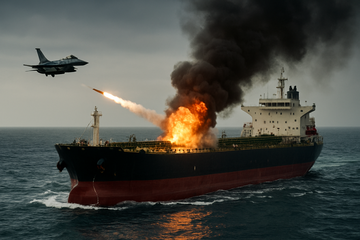
On October 10, 2026, a US Air Force fighter jet put a precision munition into the Panama-flagged M/V Ocean Molica — a 1996-built dry-bulk carrier also sailing as 'Arika Sun' — disabling the vessel but leaving the crew unharmed after it ignored repeated warnings and 'attempted to run' the US naval blockade of Iranian ports, according to a CENTCOM statement carried by Al Jazeera on October 11. Two more tankers were then hit by projectiles in the Strait of Hormuz within 24 hours — one outbound tanker struck port-side around 1920 UTC on October 10, another struck October 11 — per advisories issued by UK Maritime Trade Operations, with Iranian forces separately reported to have attacked the Saudi-owned tanker GEM No. 2 the same day.
The transmission runs through insurance, not oil. With eight of the world's twelve largest maritime insurance clubs having issued Gulf war-risk cancellation notices since March 1, 2026, and Lloyd's-listed underwriters still willing to write hull war-risk at roughly 3% of vessel value — down from the 5% panic peak but still 10-15x the pre-conflict baseline — the marginal tanker now transits the Gulf of Oman at a freight premium that has decoupled from the front-month Brent tape. The Ocean Molica strike simply removed the option value of waiting for normalization: war-risk is base case.
Where the dislocation lives
Gulf of Oman loadings — not the Hormuz choke point — are where the freight premium is concentrated.
The Joint Maritime Information Center rates the Strait of Hormuz as 'severe' (its second-highest tier) and the Gulf of Oman as 'moderate,' yet owners routing Gulf of Oman loadings are fixing at near-Hormuz levels. Per shipping-market reporting on October 7, 2026, the VLCC DHT Antelope (operated by DHT Holdings) was fixed to S-Oil at $1.162M per day for a voyage to South Korea, while the VLCC Silverstone (operated by Koch Shipping) was confirmed at $1.015M per day for a Gulf of Oman load — both deals running roughly $200K-$300K per day above the prior Gulf of Oman ceiling of $864K and almost 60% above the $719K lower end of the recent range.
- DHT Antelope (DHT Holdings, VLCC) fixed to S-Oil at $1.162M/day — Gulf of Oman to South Korea, Oct 7, 2026
- Silverstone (Koch Shipping, VLCC) confirmed at $1.015M/day — Gulf of Oman loading, Oct 7, 2026
- Saudi shuttle trade rerouting via ship-to-ship transfers (STS) in the Gulf of Oman — Bahri has tentatively chartered ~19 VLCCs from the spot market to clear Aramco cargoes around Hormuz
- VLCC TD3C (Gulf of Oman to China) at Worldscale 450 / ~$11.50 per barrel on Sep 11, 2026 — the highest on record, per Maritime Radar
The mechanism is straightforward. With roughly half of all sand transit now passing the Strait of Hormuz subject to attack (nine ships struck Oct 1-7 alone, per USNI News), charterers are routing loadings through the Gulf of Oman, but the supply of available VLCCs willing to enter those waters at all is finite. Each successful Gulf of Oman fixture resets the comp for the next one. Saudi Aramco's pivot to STS shuttle tonnage via Bahri in the Gulf of Oman — Reuters reported STS hubs 'at limit' as of late September — adds a second leg of structural VLCC demand on top of the rate spike.
The earnings channel — tanker pure-plays
Q3 spot cover shows the freight spike is already booked, not just hoped for.
The cleanest read is in the Q2 and Q3 disclosures. Frontline booked Q2 2026 VLCC spot TCE at $152,700/day (vs. $74,200/day a year earlier), net income of $659M, EPS of $2.96, and a $2.61 quarterly payout;86% of Q3 spot days are now locked at $156,900/day, a 2.7% sequential bump and roughly6.6x the cash break-even of ~$23,800/day. DHT Holdings booked Q2 2026 VLCC spot TCE at $162,600/day, posted $198M of net income and $1.23 of EPS, and has 48% of Q3 spot days fixed at $139,700/day with 74% of total revenue days locked at a blended $94,300/day. International Seaways — diversified across VLCCs, Suezmaxes, Aframax/LRs and MRs — printed record Q2 results of $295M in net income ($5.91 diluted EPS) on $467M of revenue, declared a record $5.05 quarterly dividend (21% trailing yield), and generated $261M of free cash flow in a single quarter. Nordic American Tankers sits lower in the leverage stack but is up roughly 86% YTD per September prints, reflecting the same underlying freight signal.
| Company | Q2 2026 EPS | Q2 2026 net income | Q2 VLCC spot TCE | Q3 2026 spot cover |
|---|---|---|---|---|
| Frontline | $2.96 | $659M | $152,700/day | 86% at $156,900/day |
| DHT Holdings | $1.23 | $198M | $162,600/day | 48% spot at $139,700/day; 74% total at $94,300/day |
| International Seaways | $5.91 diluted | $295M (record) | Fleet-blended | Fleet-blended; $5.05/qtr dividend declared |
The other end of the dislocation — refiners
Crack spreads widen in the same direction as freight, for the same reason.
If war-risk is the new floor on tanker freight, the same insurance shock is the new floor on Gulf-Coast refining margins. The 3-2-1 crack spread stood at $64.34/bbl in mid-September — 15% below the May 2022 record of $75.89 but exponentially above any pre-2026 reading — and JPMorgan's Q3 2026 model has Valero earning ~$8.95B of pre-tax pretax (50% above the prior three months and roughly2x the same quarter a year earlier) on Gulf Coast spreads of ~$47.11/bbl. Marathon Petroleum printed $17.68 of Q2 EPS on $52B of revenue and authorized an additional $5B of buybacks specifically citing the refining-margin boost from the Iran war, and Phillips 66 — paired with US refiners in the October rally — has tracked the same crack-spread move.
The mechanic is a price wedge: the same war-risk premium that raises the landed cost of Middle Eastern crude also lifts distillates because the disrupted refining base (Iran, Israel damage, Persian Gulf flows) tightens product supply faster than crude supply. Valero is now trading near 52-week highs on the thesis; over the past 12 months Valero has gained ~161% and PBF Energy ~211% as diesel margins tripled, per Yahoo Finance reporting. The risk to the trade is the inverse: a Hormuz reopening or ceasefire would compress both the freight premium and the crack premium in the same week, which is why the pair typically trades as one — not two — geopolitical-risk expression.
3-2-1 crack spread
$64.34 / bbl
Mid-September 2026 — 15% below the May 2022 record of $75.89 but multiples of pre-conflict levels
Valero Q3 pretax (JPM est.)
$8.95B
Up ~50% sequentially on ~$47.95/bbl Gulf Coast spreads
Marathon Petroleum Q2 EPS
$17.68
On $52B of revenue; $5B incremental buyback authorized May 2026 citing the refining-margin boost
Refiner YTD performance
+161% VLO
PBF Energy +211% over the trailing 12 months as diesel margins tripled, per Yahoo Finance, Oct 5
Horizons
Two clocks, one catalyst: Q3 prints will settle who owns the rerun.
- Short-term (days to quarters): Q3 2026 earnings — Frontline reports Nov 30, 2026, with 86% of VLCC TCE already locked; DHT prints a business update through Q3 with ~half of spot days at $139,700/day; refiners face a JPM Q3 print at $8.95B Valero pretax. A Hormuz ceasefire compresses both freight and crack premia in the same week — the cleanest risk to both trades.
- Long-term (1-3 years): Structural VLCC demand persists while newbuilding orders surge. The Saudi shuttle trade (STS in the Gulf of Oman, Bahri chartering ~19 VLCCs from spot) is an incremental tonne-mile layer that survives even partial reopening. Refining capacity destroyed in the war (Iran, Israel damage) takes 12-24 months to rebuild, leaving Gulf-Coast crack spreads structurally wider than pre-conflict.
- Watch points: any Lloyd's-Listed market Friday for W Friday for W weekly war-risk repricing (the 3%-of-hull figure moves first on Monday opens); JMIC risk-tier revisions for Gulf of Oman (currently 'moderate'); CENTCOM strike cadence vs Iranian retaliation as the binary catalyst for the next leg.
Listed names that carry this dislocation
- Q3 spot TCE contracted at $156,900/day with 86% of VLCC days locked — pulls the freight spike into reported earnings regardless of where the next strike lands
- Cash break-even ~$23,800/day vs contracted TCE ~$156,900/day — fixed deposits 7x break-even out of the rate curve, leaving the next dividend reset as the only near-term catalyst
- Long-term: 1-3 years of book-building is supported by the Saudi Bahri shuttle-VLCC demand that survives even partial Hormuz reopening
- Pure-play VLCC: DHT Antelope just fixed to S-Oil at $1.162M/day — names the fleet as the literal beneficiary of the Ocean Molica repricing
- Q2 2026 VLCC spot TCE $162,600/day vs $94,300/day blended Q3 cover — locked-in rate rising as open days get re-priced into the spike
- Watch: Q3 EPS print likely around $1.55-1.85 on the locked-in rates per Street modeling; balance-sheet deleveraging continues as appraised-value uplift flows to further dividend capacity
- Diversified tanker book (10 VLCCs, 13 Suezmax, 4 Aframax, 28 MR) — captures the freight spike across crude and product tankers, not just VLCCs
- Record Q2 2026: $295M net income, $5.91 diluted EPS, $5.05 quarterly dividend declared (21% trailing yield) — translates the rate spike directly into shareholder distributions
- Q3 horizon: $261M of free cash flow in Q2 is the floor, not the ceiling; cycle Aframax/LR2/MR rates still have catch-up upside vs the VLCC leg
- Suezmax-heavy book (20 tankers per company disclosure) — Suezmax TCE rates $111,500/day at FRO in Q2 vs $53,800 a year earlier — captures the Suezmax leg of the same dislocation
- Up ~86% YTD per September print; trailing dividend reset is the next near-term catalyst as the company transitions from sale-leaseback proceeds to sponsor-buyback proceeds
- Lower operating leverage than FRO/DHT but cleaner spot exposure — watch Q3 print for Suezmax TCE inflection
- JPMorgan Q3 2026 pre-tax $8.95B — up 50% sequentially on Gulf Coast crack spreads of ~$47.11/bbl, lifted by the same insurance-driven crude dislocation that repriced tanker rates
- Q2 2026 EPS $12.62 on $36.6B of revenue; VLO +161% over the trailing 12 months, near 52-week highs
- Risk: a Hormuz ceasefire compresses both freight and crack premia — VLO is the cleaner hedge-of-last-resort on a single geopolitical-risk expression
- Q2 2026 EPS $17.68 on $52B of revenue — already harvesting the crack-spread move; $5B incremental buyback authorization explicitly cited the Iran war refining-margin boost
- Gulf Coast and Mid-Continent footprint means MPC captures the distillate-led crack premium (diesel and jet fuel spreads lead the move per AJOT) — same dislocation as VLO, broader geography
- Q3 2026 print should land materially above $2.0B EPS run-rate on continued spread compression; watch Q42026 guidance for any reversion signal as the EIA forecasts Q4 narrowing
- Refining + midstream book pairs the crack-spread move with Gulf-Coast logistics exposure — the same war-risk premium that compresses freight rates is widening PSX's take-it-base
- Rally, +7% in the same window as VLO +11% (per AINvest) — third-leg exposure to the Iran-war refining complex, with lower beta than the pure-play refiners
- Watch: Q3 2026 print for refining segment EBITDA vs midstream throughput delta — the trade is the refining leg, not the midstream leg