
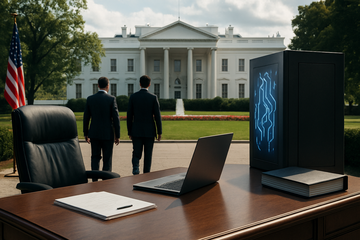
The move is small in headcount and enormous in control
On October 12, 2026, The Information reported — and Reuters confirmed — that three senior officials of the Center for AI Standards and Innovation are being pulled out of the Commerce Department's National Institute of Standards and Technology and physically relocated to the White House complex, where they will report jointly to OSTP Director Michael Kratsios and National Cyber Director Sean Cairncross. Neither the White House nor Commerce responded to requests for comment, per the reports.
CAISI is the renamed U.S. AI Safety Institute, rebranded by the Trump administration in June 2025 and housed at NIST. It has run more than 40 frontier-model evaluations since 2024, holds voluntary pre-deployment testing agreements with OpenAI, Anthropic, Google DeepMind, Microsoft and xAI, and authored the September 2025 DeepSeek evaluation that became a touchstone for U.S. policy toward open-weight Chinese models. Pulling three of its senior officials out of NIST and into the Executive Office of the President puts the agency that draws that line inside the building that signs federal contracts.
This is the third act in a four-month restructuring
The October move did not arrive in a vacuum. It is the visible tip of a restructuring that has touched personnel, public reporting, and statutory authority in succession. The sequence: on May 5, 2026, CAISI announced voluntary testing agreements with Google DeepMind, Microsoft and xAI, joining OpenAI and Anthropic on the agreement list. By May 11, the Commerce Department had scrubbed the announcement from its website, and on June 9, the Wall Street Journal reported that the White House had instructed CAISI to halt public release of model assessments. On June 2, 2026, Executive Order 14409 — \"Promoting Advanced Artificial Intelligence Innovation and Security\" — codified a classified NSA-led benchmarking process that decides which frontier models earn the \"covered frontier model\" tag.
- July 20, 2026: CAISI director Chris Fall resigns after three months; NIST director Arvind Raman takes acting role.
- June 2, 2026: EO 14409 cuts the pre-release access window for developers from 90 to 30 days and makes the NSA director the arbiter of \"covered frontier model\" status.
- March 6, 2026: GSA publishes the \"Basic Safeguarding of Artificial Intelligence Systems\" clause — a proposed GSAR deviation requiring contractors to disclose every AI system used in performance, including any configured to comply with non-U.S. frameworks.
- March 18, 2026: GSA and CAISI formalize a joint effort to evaluate AI in federal procurement — the procurement gate and the safety gate are already being wired together.
Relocating the officials is the personnel expression of a procurement strategy that is already in writing. EO 14409 explicitly disclaims a mandatory licensing regime, but the Lawfare analysis of the order points out the obvious: federal procurement can convert any voluntary framework into contract conditions through solicitation language, evaluation factors, and the False Claims Act exposure that follows material false certifications. GSA's proposed AI clause already obliges every federal contractor — not just frontier labs — to disclose every AI system used in contract performance, and to reveal whether any such system has been modified to comply with the EU AI Act or other non-U.S. frameworks. Once CAISI sits inside the White House, the bench that drafts that language and the bench that classifies the models are the same bench.
Who has a seat at the table — and who has already been cut out
The federal AI procurement market is now a tiered structure, and the CAISI move makes the tiers more enforceable. At the top sit the labs that signed voluntary agreements and cleared the GSA catalog: OpenAI (ChatGPT Enterprise at $1 per agency through September 2026), Google (Gemini for Government at $0.47), Microsoft (Copilot and Azure under the multi-billion-dollar OneGov deal worth $3.1B in year-one savings), and xAI (Grok for Government at $0.42 per agency through March 2027). Anthropic is the named exclusion — in February 2026, the Trump administration ordered agencies to stop using Anthropic products, and the Pentagon terminated its $200 million Anthropic contract.
| Vendor | Listing | Federal vehicle / status | Pricing / scale |
|---|---|---|---|
| Microsoft (MSFT) | Azure, M365 Copilot, OpenAI models | GSA OneGov, Sep 2, 2025 | $3.1B year-one savings; opt-in through Sep 2026 |
| OpenAI (private) | ChatGPT Enterprise, GPT-5 | GSA Advantage; Pentagon $200M contract | $1 per agency through Sep 2026 |
| Alphabet (GOOGL) | Gemini for Government, Google Cloud | GSA OneGov, Aug 21, 2025 | $0.47 per agency through Sep 2026 |
| xAI (private) | Grok 4, Grok 4 Fast | GSA OneGov, Sep 25, 2025; $200M Pentagon | $0.42 per agency through Mar 2027 |
| Anthropic (private) | Claude | Effectively excluded from federal use | $200M Pentagon contract terminated Feb 2026 |
| DeepSeek (private) | V4 Pro open-weight | NIST evaluation flagged security and capability gaps | Procurement bar raised via GSA AI clause |
The pattern is the article. Voluntary CAISI testing has translated, lab by lab, into a GSA catalog line, a Pentagon ceiling award, and a $1-or-less per-agency price. The GSA catalog is the gate; CAISI's stamp is the credential. Anthropic is the demonstration that the same gate can be slammed shut — it still has a voluntary testing agreement with CAISI but no path to federal revenue. Inside the White House, the officials who decide what earns the stamp are now one floor away from the officials who decide what fills the catalog.
The supply chain has to follow the gate
The federal AI procurement pipeline is not just the model labs. It runs through cloud, accelerator, integration, and deployment layers — and each layer inherits the same gate. The GSA-NIST joint evaluation work means CAISI's methodology will increasingly sit inside the request for proposals that flow to those layers. Microsoft booked Q3 FY2026 Microsoft Cloud revenue of $54.5B, with Azure up 32% year over year, and Alphabet's Google Cloud continues to scale behind the Gemini for Government line. Both now route their federal AI exposure through channels where CAISI's blessing, or silence, is the deciding factor.
- Palantir — government AI integration is the company's core franchise (Gotham, Foundry, AIP), and the Tysons Corner / defense-intelligence revenue line is the most direct downstream play on White House-controlled AI procurement; a friendly classification regime is a tailwind for AIP deployments.
- Oracle — runs the OCI federal cloud, holds the TikTok deal architecture and several defense workloads; sits one layer below the model labs and inherits any procurement-gate signal that CAISI sends upstream.
- NVIDIA — supplies the accelerators under every cloud and every federal AI deployment; the GSA AI clause's ban on non-U.S. AI systems (American AI Systems defined as developed and produced in the U.S.) protects U.S.-designed silicon stacks inside federal procurements.
The GSA AI clause extends the obligation down the supply chain. Subcontractors and resellers of AI systems are required to flow down disclosure and use-rights terms. That turns the CAISI stamp into a precondition not just for selling AI to the government, but for any prime contractor that touches an AI system to subcontract work to a non-stamped vendor. The procurement gate widens as it moves downstream.
What the data is already showing
CAISI evaluations completed (cumulative)
40+
Across OpenAI, Anthropic, Google DeepMind, Microsoft, xAI, Meta, and DeepSeek, per Cloud Security Alliance research note, May 2026
CAISI FY2026 budget
$10M
Per FY2026 appropriations; vs. $84M–$100M identified need, per Institute for Progress and Fedscoop, July 2026
Microsoft OneGov year-one savings
$3.1B
Multi-billion-dollar GSA OneGov agreement signed Sep 2, 2025
Pentagon frontier-AI contract ceiling (per lab)
$200M
OpenAI, Google, xAI, Anthropic ceiling awards, June 2025; Anthropic terminated Feb 2026
Three quarters of Microsoft's Q4 FY2026 revenue run through the cloud segment that carries the OneGov exposure. Alphabet's federal business is structurally smaller, but the Gemini for Government line is a clean policy test bed — every procurement clause is a precedent. Palantir operates on a much smaller revenue base ($6.2B TTM revenue) but trades at ~165x earnings because federal exposure compounds: a stamp of approval on a frontier model means an immediate downstream contract for AIP-based deployment.
Short-term: the next 90 days decide the operating reality
Three near-term catalysts will tell investors whether the October move was administrative housekeeping or the start of a much harder procurement regime. First, the finalization of the GSA AI clause: the comment period was extended to April 3, 2026 and a final rule has not yet appeared. The clause's exact terms — particularly the scope of disclosure and the prohibition on non-U.S. AI systems — will set the floor for every federal AI vendor. Second, the implementation of EO 14409's classified benchmarking process: the EO gave agencies 60 days, and the threshold a model must clear to be classified as a \"covered frontier model\" is the single most important market signal in the file. Third, a permanent CAISI director: the July 20 resignation of Chris Fall left NIST director Arvind Raman as acting head, and the first real signal of how the relocated officials will operate is the type of director the White House chooses to install.
Long-term: the gate becomes the moat
The structural read is that \"AI safety tested\" is migrating from a public-goods label — the original 2024 AI Safety Institute framing — to a procurement credential whose value is set inside the Executive Office of the President. Once that credential is inside GSA solicitations, every prime contractor and subcontractor needs it, and the labs that hold it (OpenAI, Microsoft, Google, xAI) collect both the federal revenue and a defensive moat against competitors the White House has chosen to exclude. Anthropic is the case study for the downside: even with a CAISI testing agreement in hand, the absence of political clearance has cost the company access to a Pentagon contract estimated at $200M and effectively blocked the rest of the federal pipeline. The longer the relocated CAISI team operates, the more that pattern hardens into a durable procurement regime rather than a one-off decision.
Downstream, the same gate compounds. Palantir and Oracle benefit from a regime in which a small set of approved frontier models flow through a small set of approved integrators into the federal workflow. NVIDIA holds the accelerator position under any of those approved models. The procurement clause's requirement that AI systems be \"developed and produced in the United States\" protects that downstream layer against foreign competition — including the open-weight Chinese models that CAISI's own September 2025 evaluation flagged as a security risk. The CAISI move is the personnel expression of a policy direction that is already written into GSA clauses, executive orders, and Pentagon ceilings — and the listed companies best positioned to clear that gate are the ones whose federal revenue compounds.
Stocks exposed to the relocated CAISI gate
- Holds the largest federal AI footprint via the $3.1B OneGov deal and a Q3 FY2026 Microsoft Cloud line of $54.5B, 32% YoY Azure growth, putting it closest to the relocated CAISI officials' approval pipeline.
- Carries a CAISI voluntary testing agreement covering Azure-hosted OpenAI models; a White House-aligned stamp is now contractually load-bearing in any GSA OneGov renewal or Pentagon task order.
- Risk in 1–3 years: any front-end tightening of EO 14409's classified benchmarking could add weeks to model release cycles for Azure-hosted frontier models and pressure gross margin on U.S. government cloud deals.
- The Gemini for Government line at $0.47 per agency through Sep 2026 is the cleanest policy test bed for the new CAISI gate — the more closely the relocated officials track federal deployments, the higher the switching cost for every agency that has already onboarded.
- Google Cloud's Q2 2026 revenue growth of 24% YoY and the explicit OneGov vehicle for Gemini and Workspace make Alphabet a direct downstream beneficiary of any procurement-credential regime that excludes the unvetted Chinese models.
- Over 1–3 years, the GSA AI clause's \"American AI Systems\" definition and any CAISI-led certification of Gemini's classification will become a structural barrier to non-U.S. open-weight competitors in the federal pipeline.
- Palantir's AIP sits directly downstream of any certified frontier model, and a White House-controlled CAISI simplifies the procurement signal that primes need to award AI integration work — the Tysons / defense-intelligence revenue line is the most leveraged federal AI play in the U.S. listed universe.
- With TTM revenue of $6.2B and operating margin near 47%, Palantir's federal exposure is concentrated enough that any easing of the procurement gate compounds into a measurable contract pipeline within 2–3 quarters.
- Over 1–3 years, the moat widens: GSA flow-down requirements push every AI-using contractor toward a small set of integration platforms, and Palantir is one of two or three realistic options.
- Oracle Cloud Infrastructure carries the federal workloads the relocated CAISI team is most likely to vet, and the TikTok / data-residency architecture gives it a defensible position in defense and intel AI deployments.
- But Oracle's TTM free cash flow is negative and the Stargate-related capex is heavy — any near-term tightening of EO 14409's benchmarking threshold delays model launches hosted on OCI and pressures the federal revenue line.
- Over 1–3 years, Oracle benefits as a downstream layer if a unified CAISI stamp raises the federal barrier to non-U.S. AI systems, but the bet is execution-dependent and capital-intensive.
- Every approved frontier model running in every federal cloud runs on NVIDIA silicon; the GSA AI clause's \"American AI Systems\" definition protects that accelerator layer against foreign substitution in U.S. government procurements.
- The CAISI move sharpens the procurement signal for hyperscalers (Microsoft, Alphabet, Oracle) and integrators (Palantir) to standardize on U.S.-designed accelerators, supporting the TTM gross margin above 75% on data-center revenue.
- Over 1–3 years, any CAISI-led certification regime that includes compute provenance extends NVIDIA's moat against AMD and custom accelerators in the federal market.
- AWS Bedrock is the third federal cloud and the only major hyperscaler without a named CAISI voluntary testing agreement; the relocation of CAISI officials makes any future federal AI workload that lands on Bedrock contingent on a stamp Amazon does not yet hold.
- Amazon's largest AI investment is Anthropic — the same company the Trump administration has already barred from federal work — which makes AWS's federal AI position structurally weaker than Microsoft or Alphabet for the next 1–2 years.
- Watch for a Bedrock-anchored CAISI agreement or a renewed Anthropic federal relationship; absent either, federal AI revenue remains a watch item rather than a tailwind.