
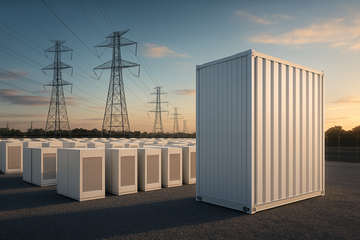
California VPP dispatch record (Sept 9, 2026)
580 MW
517 MW from Tesla Powerwalls +63 MW Sunrun; 110,000 Powerwalls dispatched for 3 hours
VPP record (Oct 8, 2026)
85,000+ Powerwall owners
Dispatched 600+ MW to California's grid during peak demand; surpassed Sept 9 record
Tesla Q3 2026 energy storage deployed
13.7 GWh
Second-best quarter ever, edged up from 13.5 GWh in Q2; reported Oct 2, 2026
Tesla energy segment 2026E revenue
$18.3B
+43% YoY vs $12.8B in 2025; energy to be ~20% of total revenue
Sunrun–Tesla–Renew Home hyperscaler VPP
16 GW
Announced June 24, 2026; 8M+ smart thermostats + 100,000+ home batteries
PG&E 2027 capex cut
$2B
Plan trimmed to $11.4B after California wildfire-liability reform failed; deferring new connection projects
The California VPP turn
Newsom Signed a Law That Makes VPPs — and Megapacks — Recurring Utility Procurement
On September 30, 2026, Governor Newsom signed SB 913 and SB 905 — two bills that turn California's virtual power plant market from a pilot program into a regulated, rate-based procurement channel. SB 913 requires the CPUC to establish a valuation methodology for customer-sited batteries that export to the grid during stress events, and lets aggregated fleets qualify for Resource Adequacy — the capacity that California's investor-owned utilities are legally required to buy. SB 905 forces utilities to publish a grid-utilization metric on every circuit, exposing where ratepayer money is being spent on equipment that runs flat-out for only a handful of hours per year. Both bills are written to attack the cost of those aging gas-fired peakers the VPP concept was built to displace.
The implementation deadline lands the trade in 2027. Per the bill text, the CPUC, working with the California Energy Commission and CAISO, must enhance the market-integrated pathways for aggregated distributed resources to qualify as RA capacity on or before June 30, 2027. That timing is what makes the trade calendar-sensitive: contract awards and Megapack purchase orders signed under the new rules will start flowing in the second half of 2027 and into 2028.
The capacity proof
September 9 Showed 580 MW Can Already Do a Peaker's Job
The procurement argument needs a demonstration, and on the evening of September 9, 2026, Tesla and Sunrun provided one. Their jointly coordinated dispatch sent more than 580 MW into the California grid during an extreme-heat event, with Tesla Powerwalls contributing 517 MW from 110,000 customer units. Sunrun dispatched more than 30,000 additional batteries from other manufacturers, and the two companies combined could have delivered over 720 MW had the September 9 and September 10 dispatch windows fallen on the same night. A separate SCE-territory dispatch on September 10 alone delivered 140 MW.
- 517 MW from Tesla Powerwalls alone in a single three-hour event on Sept 9, 2026 — equivalent to a large utility peaker running at full output
- 110,000 Tesla Powerwalls coordinated for the Sept 9 dispatch; 85,000+ owners on the platform by Oct 27 (per Tesla Energy's own update)
- Cumulative 5 GWh dispatched back to California's grid across 10 major VPP events in 2026 — enough to power roughly 1.2 million homes for one hour
- Combined Sept 9 + Sept 10 deliverable headroom exceeded 720 MW; both events triggered when CAISO day-ahead locational marginal prices cleared above $200/MWh
- Sunrun–Tesla–Renew Home pipeline of 16 GW of VPP capacity for hyperscalers and utilities, announced June 24, 2026 — the largest in the U.S.
The proof isn't a press release; it's a paid dispatch. California's Demand Side Grid Support program and the CPUC's Emergency Load Reduction Program pay participating customers $2.00/kWh of incremental discharge, and the September events cleared that threshold during CAISO's day-ahead market. That's a recurring revenue stream that flows directly to Tesla's Powerwall owners and, through service agreements, back to Tesla and Sunrun. It also gives the CPUC the empirical case it needed to push SB 913 through — the same case it will use to set RA credit values in the 2027 rulemaking.
The 2027 catalyst
PG&E's $2B Capex Cut Is the Tell — Utilities Will Buy Megapacks to Avoid Buying Peakers
Three weeks before the bill signing, PG&E told investors it was cutting 2027 capital spending by $2 billion — to $11.4 billion — after California legislators adjourned without passing a wildfire-liability reform bill. CEO Patti Poppe framed the cut as a deferral of new connections, large-load interconnections, and technology upgrades, and suspended the 2028–2030 capex outlook that had penciled in nearly $48 billion. The capex that remains is weighted toward wildfire mitigation, not generation — which is exactly the gap VPPs and utility-scale batteries were designed to fill. Edison International's SCE and Sempra's SDG&E face the same cost-base pressure; both ran their territories in the September 9 dispatch.
Megapack economics justify the switch. The CPUC's own filings cite a current Tesla-quoted price of $1,900+/kW (pre-tax) for a 5 MW, 4-hour Tesla Megapack — already 10% below earlier quotes. Tesla started Megapack 3 production at its Brookshire, Texas Megafactory in August 2026; each Megapack 3 packs roughly 5 MWh, about 28% more energy than the Megapack 2 XL, and the new line is designed for 50 GWh of annual output. With megawatt-hours getting cheaper and the procurement channel opening, the Tesla energy segment doesn't need Cybercab volume to compound.
The numbers
Energy Is Already Tesla's Fastest-Growing, Cleanest-Cash Segment
| Period | Energy revenue | YoY change | GWh deployed | Source |
|---|---|---|---|---|
| FY2025 | $12.8B | +26.6% | 46.7 | Tesla Q1 2026 Update PDF |
| Q1 FY2026 | — | — | 8.8 | Tesla Q1 2026 Update PDF |
| Q2 FY2026 | $3.14B | +13% | 13.5 | Tesla Q2 2026 10-Q (filed Jul 23, 2026) |
| Q3 FY2026 | — | — | 13.7 | Tesla Q3 2026 production/deployments (Oct 2, 2026) |
| FY2026E | $18.3B | +43% | 56.5 | Reuters / Visible Alpha consensus |
Q2 FY2026 energy segment gross profit was $640 million on $3.14 billion of revenue, a gross margin of about 20.4% — down from a year earlier as Megapack mix shifted toward lower-priced hyperscaler and utility deals, but still meaningfully positive. The bigger story is the recurring-revenue trajectory: the September 9 dispatch paid out under existing DSGS/ELRP tariffs, and the 16 GW Sunrun/Renew Home/Tesla hyperscaler pipeline announced in June represents multi-year contracted capacity that doesn't depend on the auto business at all.
Tesla energy storage deployments by quarter (GWh)
Quarterly GWh deployed across Megapack and Powerwall
Unit: GWh
Q1 2026
Reported Apr 22, 2026
8.8
Q2 2026
Reported Jul 2, 2026
13.5
Q3 2026
Reported Oct 2, 2026
13.7
Supply chain
Who Wins and Loses as VPPs Eat the Peaker Budget
Upstream, the demand is unambiguous. Tesla's Megapack 3 line is fed by LFP cells from LG Energy Solution's Michigan plant under a $4.3 billion supply arrangement, with Albemarle supplying lithium feedstock into the LFP chain and Contemporary Amperex Technology (CATL) competing for adjacent BESS contracts that flow to the same hyperscaler RFPs. Sungrow Power Supply and other Chinese integrators are priced out of California by domestic-content rules, so the 2027 procurement cycle favors the LG-anchored Tesla supply chain.
Downstream, the customer is the California ratepayer — and the three investor-owned utilities that buy capacity on their behalf. PG&E, Edison International, and Sempra all run VPPs in their territories; all three will be filing procurement plans under the new SB 913 framework in 2027. The losers are incumbent peaker owners and the merchant generators whose gas-fired capacity gets squeezed out of the RA stack by cheaper, faster battery alternatives — including Fluence Energy, the Tesla Megapack rival whose domestic content story is weaker and whose California public-utility wins have lagged.
- Upstream beneficiaries: Albemarle (lithium), Contemporary Amperex Technology (LFP cells, where reachable), LG Energy Solution (LFP for Tesla Megapack 3)
- Downstream buyers: PG&E, Edison International, Sempra — all three buy VPP-delivered Resource Adequacy starting 2027
- Residential VPP aggregator partners: Sunrun (110,000+ Powerwalls dispatched Sept 9), Enphase (microinverter-attached solar-plus-storage)
- Direct competitor at risk: Fluence Energy — slower California public-utility track record, weaker domestic-content positioning for federal procurement overlays
Implementation risk
The Risk Is a CPUC Foot-Drag and a Governor Transition
SB 913 and SB 905 set the framework; the CPUC sets the price. The California Public Advocates Office's commentary in March2026 was careful to say VPPs should be \"among the options\" and warned about ratepayer cost shifts. Brad Heavner of the California Solar and Storage Association told Canary Media that meaningful implementation — export valuation, fleet measurement and settlement, and customer enrollment rules — will be decided by the next governor's CPUC appointees in the first six months of the next term. Newsom's bills pass the baton; the next administration runs the race.
Competitive risk is real but bounded. Fluence Energy has won Arizona and several U.S. utility-scale projects, but Tesla still leads on integrated cell-to-software stack, Megapack 3 cost per MWh, and the only large residential+utility dual fleet in production. The largest risk to the thesis isn't Fluence Energy — it's the CPUC moving slowly enough that California utilities lean on existing peakers through 2027 and let the new VPP procurement framework mature on the books before signing large Megapack orders.
The trade
Megapack Is the Cleanest 2027 Cash-Flow Lever on Tesla
Cybercab is a story; Megapack is a regulated utility procurement line with 13.7 GWh of confirmed Q3 2026 deployment, $640 million of Q2 gross profit, and a back-end visibility path through the SB 913 Resource Adequacy framework plus the 16 GW Sunrun/Renew Home/Tesla hyperscaler pipeline. The auto business needs Cybercab to drive multiple expansion; the energy business only needs the CPUC to honor a law Newsom already signed. For 2027, that's the cleaner trade — and the one that doesn't require new product launches to compound.
Stocks exposed to the California VPP trade
- Megapack + Powerwall set a 580 MW VPP record on Sept 9, 2026 — the same day the CPUC's RA framework for aggregated batteries is being written
- Q3 2026 deployments of 13.7 GWh keep Tesla on track for $18.3B in 2026 energy revenue (+43% YoY), per Reuters/Visible Alpha
- Megapack 3 production at Brookshire (50 GWh designed capacity) plus the16 GW Sunrun/Renew Home hyperscaler pipeline lock in 2027 Megapack order book before RA rules finalize
- Coordinated 580 MW Sept 9 dispatch — 63 MW from Sunrun's 30,000+ non-Powerwall batteries; same VPP channel monetized at $2.00/kWh under DSGS/ELRP
- 16 GW Sunrun/Renew Home/Tesla hyperscaler partnership gives Sunrun a multi-year contracted backlog from data-center customers that doesn't depend on the residential cycle
- SB 913 letting aggregated fleets qualify for Resource Adequacy converts VPP enrollment from a one-off rebate to a recurring capacity sale
- The $2B 2027 capex cut pushes PG&E harder into Tesla Megapack and Sunrun VPPs as a peaker substitute, but also delays new-connection revenue
- SB 913+SB 95 Resource Adequacy eligibility for aggregated batteries cuts PG&E's long-run capacity-procurement cost — supportive for rate-base earnings power
- Wildfire-liability reform failure leaves the same overhang that triggered the PG&E capex compression; structural risk unchanged
- SCE territory drove the September 10 follow-on dispatch of 140 MW, validating the VPP channel in Edison International's service area
- Cost-base pressure parallels PG&E's — utilities will buy more Tesla Megapack, but Edison International capex flexibility is constrained until wildfire reform returns
- Watch the Q4 2026 / Q1 2027 capex update; an explicit VPP/Megapack procurement line item would be the cleanest signal
- Sempra's SDG&E territory has the highest residential rates in California (45.7¢/kWh as of March 2026) — making it the most cost-sensitive VPP rollout market
- Resource Adequacy procurement under SB 913 should favor Sempra's distribution-grid-heavy service territory, but wildfire capex absorbs most of the offset
- Texas and Mexico LNG/utility exposure is the bigger2027 driver for Sempra; the California VPP trade is incremental, not core
- Enphase IQ batteries plus the new CPUC storage net-metering rules (approved Feb 2026) pull more third-party storage onto California grids — feedstock for the VPP pool
- Aggregator relationships give Enphase a path to VPP revenue sharing independent of Tesla Powerwall economics
- Watch for VPP-compatible firmware rollouts through2027; the CPUC's June 30, 2027 RA framework deadline is the binding milestone
- Fluence Energy is the named Tesla Megapack rival but has limited California public-utility wins to date — the SB 913 framework could open a door it hasn't yet walked through
- Arizona Pioneer Clean Energy Center and other2026 wins show Fluence Energy can compete outside California; domestic-content eligibility is the key gating factor
- Direction depends on Q4-2027 California IOU RFP outcomes — until then, the stock is a proxy on AI-data-center storage demand rather than the California VPP trade
- Albemarle is the U.S.-listed lithium feedstock into the LFP supply chain that powers Tesla Megapack 3 and the broader California BESS buildout
- California's data center demand projected to grow from ~1,000 MW today to 4,500 MW by 2040 (CEC) — multi-year lithium offtake support
- Watch the Albemarle Q4 2026 update for explicit BESS/lithium contract disclosure tied to the SB 913 procurement cycle