
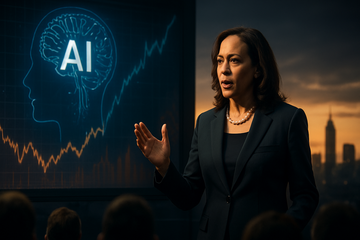
Harris's headline warning
\"The window is shutting\"
Reuters interview, Seoul, Oct. 14, 2026
Combined AI-lab IPO pipeline value
~$3.6 trillion
Bloomberg cluster estimate, OpenAI/Anthropic/SpaceX, June 2026
Share of Anthropic S-1 devoted to AI risk
~one-third
Leaked prospectus reported by Reuters, Sept. 28–29, 2026
Anthropic 2025 net loss
$42B
Of which ~$34B is a non-cash accounting charge; reported Sept. 28, 2026
Anthropic compute obligations (next decade)
$518B
Across six partners; S-1, Reuters, Sept. 29, 2026
NVIDIA Q3 FY27 DC-China revenue in guide
$0
Q2 FY27 earnings release, Aug. 26, 2026
The event
A 2028 Frontrunner Just Made AI Safety a US-China Bargaining Chip
Kamala Harris, the leading Democratic presidential contender for 2028, told Reuters in Seoul on Oct. 14, 2026 that the world has run out of time to negotiate AI guardrails. Her verbatim warning — 'My concern is that the window is shutting' — was paired with a direct request that the US engage Beijing on shared AI rules, calling for 'healthy and robust competition, but not conflict.' She named three 'existential dangers' that governments and companies must move against immediately: cyberattacks enabled by AI, AI-empowered weapons, and systems that 'escape human control.'
The statement repeats a position she first laid out on Sept. 14, 2026 in a four-paragraph post on X urging Congress to 'establish a new federal entity to provide oversight and independent testing' and asking the president to pursue a treaty with countries including China. It is also the same week the Trump-Xi summit (Sept. 23–26, 2026) produced the first US-China AI-safety channel and a $30 billion reciprocal tariff cut. The Reuters story noted Harris said Democrats have a 'good shot' to win both houses of Congress in November — making her policy position a plausible 2027–2028 governing agenda rather than a campaign slogan.
The S-1 pipeline
Anthropic Already Wrote the Risk. OpenAI Delayed to Avoid It. SpaceX Slew-Footed Past Both.
Anthropic confidentially submitted its draft S-1 on June 1, 2026 and the public prospectus was reported by Reuters on Sept. 28 — making it the closest frontier-lab listing to price. The leaked document devotes roughly a third of its pages to 'risk factors,' including an explicit warning that 'advanced AI could pose catastrophic or existential risks to humanity,' and a separate risk that US government actions — including a February 2026 executive order barring federal agencies from using Anthropic's models and a Pentagon supply-chain designation — could damage commercial relationships 'far beyond any federal contract.' Anthropic's 2025 net loss of $42 billion (~$34 billion of it a non-cash accounting charge) sits beside a $518 billion, ten-year compute-obligation schedule with six partners, plus reports of roughly $585 billion in deals spanning 14 suppliers.
OpenAI took the opposite path. The company filed a confidential draft S-1 on June 8, 2026 with a target valuation up to $1 trillion, then CEO Sam Altman told Fortune on Sept. 12 that OpenAI will not IPO in 2026 because the company cannot yet make 'confident safety decisions' — and CFO Sarah Friar had already told employees in August that the listing would slip to 2027 or later. Anthropic's public prospectus shows a Q2 2026 revenue print above $11.5 billion (per Bloomberg/CNBC), versus OpenAI's annualized run rate near $50 billion in September 2026 — but a $20 billion gap, per the Financial Times, between headline ARR and what OpenAI recently told investors.
SpaceX (with xAI folded inside after the February 2026 merger) filed its S-1 in May, priced its June 12 Nasdaq debut above the targeted range, and closed its first day at a $2.1 trillion market cap — sidestepping the safety debate entirely by burying frontier-model risk inside a multi-segment conglomerate. Bloomberg's combined valuation of the three-company cluster sits at roughly $3.6 trillion, a figure the market now has to defend against US-China policy that none of the prospectuses modeled.
| Company | S-1 status | Target valuation | Disclosure posture |
|---|---|---|---|
| Anthropic | Confidential filed Jun. 1, 2026; public prospectus reported Sept. 28, 2026 | >$2 trillion | ~1/3 of S-1 = risk factors; explicit Washington-risk warning |
| OpenAI | Confidential filed Jun. 8, 2026 | Up to $1 trillion | IPO pushed to 2027+ by Altman, citing safety concerns (Sept. 12, 2026) |
| SpaceX / xAI | Public S-1 May 2026; Nasdaq debut Jun. 12, 2026 | $2.1 trillion at debut | Frontier-model risk buried in multi-segment conglomerate; minimal safety carve-out |
Upstream
Compute Is the Choke Point: NVIDIA, TSMC and SK Hynix Set the Speed Limit
Policy risk meets physical reality one layer deeper: every Anthropic, OpenAI and xAI safeguard conversation runs on the same hardware stack, and that stack is sold by a handful of listed names. NVIDIA is the most directly exposed. Its Q2 FY27 (quarter ended Jul. 31, 2026) earnings release reported $96.3 billion in revenue, up 106% year on year, with Data Center at $89.0 billion, and guided Q3 FY27 to $108 billion ±2% — 'with NVIDIA not assuming any Data Center compute revenue from China in its outlook.' The Beijing negotiation Harris just reopened is therefore a one-way upside lever on a line item currently booked at zero.
Memory is the second lever. SK Hynix holds roughly 57–62% of HBM shipments by Counterpoint's count, and HBM4 qualification is the gating event for every 2027 frontier-model launch. Micron is the only credible US-domestic challenger; TSMC sits in the middle packaging everything through CoWoS, which industry estimates put at 75–80k wafers per month in mid-2026 scaling to 130k by year-end — fully booked 52–78 weeks out. With memory running 40–50% of the bill of materials on a modern AI accelerator, the Sept. 2026 quarterly print of 40–50% HBM price hikes is doing more to determine frontier-lab compute costs than any treaty language.
Frontier-AI compute supply chain — exposure snapshot
Capacity and revenue figures tied to public filings and 2026 industry reporting
Unit: see note
NVIDIA Q2 FY27 revenue
$ billions, ended Jul. 31, 2026
96.3
NVIDIA Q3 FY27 guide midpoint
$ billions; excludes China DC
108
TSMC CoWoS target, end-2026
thousand wafers/month
130
SK Hynix Q2 2025 HBM share
% of shipments, Counterpoint
62
HBM price hike Q3 2026
midpoint of 40–50% range
45
Downstream
Hyperscalers Underwrite the Whole Trade — and the Risk
Anthropic's $518 billion compute envelope is funded by six hyperscale and chip-design counterparties, and two of them dominate. Amazon's AWS holds the largest single commitment — a $100 billion, ten-year deal announced April 20, 2026 for up to 5 GW of Trainium capacity — atop Amazon's existing $8 billion equity stake and a fresh $25 billion investment tranche. Alphabet plus Broadcom anchor the second leg: the April 6, 2026 expansion delivers multi-gigawatt TPU capacity (reported at 3.5 GW) coming online from 2027, with Anthropic separately reported to have earmarked $200 billion for Google Cloud and chips. Smaller reported allocations span NVIDIA GPUs, AMD silicon and additional cloud suppliers.
OpenAI's stack runs through Microsoft Azure under the long-running partnership, with Oracle added via the Stargate build-out. xAI/SpaceX leans on CoreWeave and SpaceX's own data-center footprint. The policy lever for every one of these counterparties is the same: a US-China AI framework that loosens chip exports lifts NVIDIA's ceiling and adds optionality on the China cloud market, while a hardened Democratic agenda with the FRONTIER Act in force raises per-model compliance cost across the entire stack — a cost Anthropic has already pre-flagged in its prospectus and OpenAI is openly using as the reason to delay its own listing.
- Pins a $100B, 10-year AWS spend to Anthropic's safety trajectory — Amazon's $25B equity top-up signals confidence in that underwriting, but every federal carve-out Harris proposes flows through this contract
- Turns the Google–Broadcom 3.5 GW TPU deal into a regulated asset class — Alphabet and Broadcom's custom-silicon bet becomes harder to reprice if frontier-model testing becomes mandatory
- Shifts OpenAI's IPO timeline onto Microsoft's earnings narrative — the $1T target was the bull case for MSFT's $13B stake; a delayed listing compresses the equity-stake re-rating into a longer window
- Reopens China's data-center door for NVIDIA — Q3 FY27 guidance already excludes China DC revenue, so any thaw is incremental upside not currently in consensus
Synthesis
Two Halves of the Trade — and the Catalysts That Move Them
Two scenarios bracket the next twelve months. In the cooperative track, the Trump-Xi AI safety channel already operational (announced Sept. 26, 2026) widens into a treaty framework after the November midterms and the 2028 election, chip-export licensing eases, NVIDIA's China DC revenue returns, and Anthropic's prospectus narrative shifts from 'existential risk' to 'regulated but investable.' In the hardened track, Democrats hold or expand their Congressional margin, the FRONTIER Act (H.R. 9925, introduced July 23, 2026) advances, an independent federal testing body is stood up, and S-1 risk-factor sections expand — OpenAI's delay becomes the template, Anthropic's $518B compute commitments get haircut in the roadshow, and SpaceX/xAI trades on Starlink and launch economics rather than frontier-model multiples.
Three catalysts sit in plain sight between now and Q1 2027. First, Anthropic's public S-1 hitting EDGAR and the start of its roadshow, currently tracked for the October–November window. Second, the November 3 midterm results, which determine whether the FRONTIER Act and any Harris-aligned AI bill has a legislative vehicle. Third, NVIDIA's Q3 FY27 print (reported late November 2026), where any incremental China commentary — even a single licensing footnote — moves the China DC line from $0 toward whatever the BIS licensing framework clears. The cleanest framing for an investor: Harris's 'window shutting' is not a forecast, it is a referendum. The supply chain is the ballot.
If we are to have any guardrails and safeguards, they have to be at the table. My concern is that the window is shutting.
Where to Take the Trade
- Q3 FY27 guide excludes any China DC revenue — reopens the door the very moment export licensing loosens, and the comment from the Trump-Xi channel on chip-sharing limits already shapes that ceiling
- Data Center Q2 FY27 of $89.0B is 92.5% of total revenue, so even small changes in China-license conversion move the multiple
- Harris's federal testing proposal is a long-tail compliance cost for Anthropic, OpenAI and SpaceX/xAI customers — a slower frontier-model release cadence tightens NVIDIA's 2027 demand pull
- CoWoS scaling from ~75–80k wafers/month mid-2026 to a targeted 130k by year-end means every cooperative-or-controlled AI scenario routes through TSMC packaging
- NVIDIA's 850k-wafer 2026 book locks utilization, so the equity story is decoupled from any single frontier-lab IPO outcome
- Exposed to export-control enforcement on China customers — a US-China framework that eases licensing is upside; hardened controls force China-customers to route around TSMC, hitting utilization at the margin
- Holds ~57–62% HBM share by Counterpoint and leads HBM4 qualification — every 2027 frontier-model launch needs SK Hynix first, so a delayed OpenAI IPO does not change the underlying pull
- Q3 2026 memory price hikes of 40–50% are flowing through contracts already signed; cooperative US-China framework could unlock incremental HBM China demand
- Long-term risk is a Democratic supermajority imposing frontier-testing carve-outs that throttle customer deployment tempo, compressing 2027 unit volume
- $100B AWS commitment from Anthropic plus a fresh $25B equity top-up makes AWS Anthropic's largest compute counterparty — every federal testing rule becomes an AWS services line
- Trainium ramp ties AWS margins to Anthropic's 2027–2028 capex schedule; any Anthropic S-1 haircut flows back to AWS revenue assumptions
- Less direct NVIDIA exposure than peers if Trainium captures more Claude workload — a moat that strengthens under either policy scenario
- Anthropic earmarked ~$200B for Google Cloud and chips per Reuters reporting, layered on the April 6 3.5 GW TPU expansion — a regulatory win for Anthropic validates this spend
- Gemini competes head-on with Claude, so Anthropic's IPO valuation is a real read on Google's own internal-AI pricing power
- Most insulated among hyperscalers from a China-chip-export shock because TPUs are US-designed silicon manufactured through Broadcom partner foundries
- Co-designs the next-generation TPUs that Anthropic and Alphabet are scaling from 2027 — a hard regulatory moat as custom AI silicon becomes a substitute for NVIDIA supply
- Per-share economics scale with TPU volume, so any cooperative framework that frees up foundry capacity lifts the 2027 backlog
- Diversifies away from generic networking exposure into long-duration AI custom-silicon contracts tied to the same safety-and-export-control policy debate
- OpenAI's IPO delay into 2027+ keeps Microsoft's $13B stake and reported ~49% economic interest locked inside a longer-dated re-rating window
- Azure's OpenAI workload visibility is now policy-dependent: a cooperative framework speeds monetization, a hardened FRONTIER-Act path slows it
- Most directly exposed to the regulatory carve-out question because OpenAI's own messaging — 'we cannot yet make confident safety decisions' — is now a market-wide line