
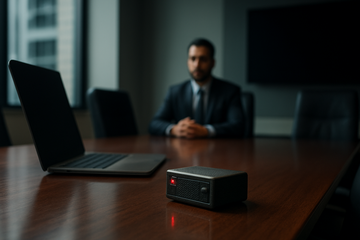
On October 13, 2026, the U.S. Department of Justice unsealed a single-count complaint that, for the first time, treats the inside of a frontier-AI lab the way it treats a defense contractor's SCIF: a place where a USB-sized bug wrapped in toilet paper is enough to trigger a federal wiretap charge. The defendant, OpenAI product engineer Abdulrahman Alfozan, allegedly installed a thumb-sized audio recorder in an executive conference room, encrypted it to evade OpenAI's monitoring, and then left a second device in his personal bag when he was about to be cut off from the building. The case matters less for what was taken — prosecutors say no model weights, source code, or customer data were accessed — and more for what it implies about how every AI lab, every chipmaker, and every cloud provider has to price physical-world insider risk from now on.
The Bug, the Engineer, and the Confession Trail
- Who: Abdulrahman Alfozan, 35, a Saudi national and U.S. lawful permanent resident since September 2020, joined OpenAI in July 2025 as a product engineer and was its only Saudi employee, per reporting from Newsweek and the DOJ complaint unsealed October 13, 2026.
- What: On or about September 28, 2026, Alfozan allegedly plugged a covert audio recording device — with a microphone, camera-capable port, and encrypted storage — into a USB port on the back of a television in an executive conference room in one of OpenAI's San Francisco buildings, wrapping it in toilet paper to disguise it.
- When discovered: OpenAI personnel found the first device on or about September 30, 2026; a second, similar customized device was recovered from Alfozan's unattended bag on October 5, 2026, after security opened it and found his wallet and ID inside.
- The digital trail: Between September 24 and 30, a chatbot account linked to Alfozan's spouse submitted prompts about building, obscuring, and remotely accessing audio recorders, and encrypting the SD card — including, on September 27–28, queries about the exact device and unique MAC address later recovered from the conference room.
- The AI-on-AI twist: Alfozan used a productivity tool in the weeks before the planting to research building addresses, meeting-room calendars, and \"leadership and exec\" locations; OpenAI then used its own internal AI models to trace the device and identify the responsible employee.
- The charge and penalty: Using or endeavoring to use an electronic device to intercept oral communications — carrying a maximum of 5 years in prison, a $250,000 fine, and 3 years of supervised release; a detention hearing is scheduled for October 19, 2026.
Defendant
Abdulrahman Alfozan, 35
Saudi national; U.S. LPR since Sept 2020; OpenAI product engineer since July 2025
Statute charged
18 U.S.C. § 2511(2)(d)
Using/endeavoring to use a device to intercept oral communications
Maximum penalty
5 yrs prison / $250K fine
Plus 3 years of supervised release
Devices recovered
2
Device 1: USB-port audio recorder in conf room (Sept 28); Device 2: similar unit in personal bag (Oct 5)
Encryption status of Device 1
Encrypted, inaccessible
OpenAI said the device was designed to evade monitoring
Detention hearing
Oct 19, 2026
Northern District of California; AUSA Nicolas Parker; NSD Trial Attorney Kate Tagert
The Saudi Pipeline Behind the Recorder
Alfozan is not a lone actor in a vacuum. According to Newsweek, he has been listed since 2025 as a Venture Partner at RAED Ventures, a Saudi venture capital firm whose funding base includes Saudi government-backed entities; a Hacker News thread cross-referenced a public X post placing the son of a senior Saudi intelligence official in the same RAED Ventures partnership. A second X post identified a \"senior adviser at a Saudi government investment fund\" commenting on the same OpenAI product announcement Alfozan shared — a small detail that is, in the language of counterintelligence, a contact rather than a coincidence.
The most obvious Saudi institutional counterparty is HUMAIN, the Public Investment Fund subsidiary launched in May 2025 to build Saudi Arabia's \"entire AI stack\" — data centers, cloud, models, and applications. PIF filings describe it as a $100B-class initiative, and Bloomberg reported in September 2026 that HUMAIN was raising an initial $2.5B fund for data centers. RAED Ventures sits one tier down the same ecosystem. That doesn't make every Saudi investor a suspect, but it does make the burden of proof on hiring and on-the-floor security dramatically heavier for any AI lab that ever takes a Saudi-government-backed check.
Why This Is Not the Apple–OpenAI Lawsuit
| Dimension | Apple v. OpenAI (filed July 10, 2026) | U.S. v. Alfozan (unsealed Oct 13, 2026) |
|---|---|---|
| Accused party | OpenAI and two former Apple employees (digital exfiltration of AI-hardware trade secrets) | A single OpenAI employee (physical audio surveillance of executive meetings) |
| Vector | Code, documents, and AI models carried by departing employees | Covert analog/digital recorder disguised in a conference-room TV |
| Plausible principal | OpenAI as competitor hiring Apple staff | Apparent state-adjacent investor ecosystem (RAED Ventures, PIF/HUMAIN orbit) |
| What was taken (alleged) | Apple trade secrets tied to a personal-AI hardware project | Nothing exfiltrated, per OpenAI; recordings were encrypted and never retrieved |
| Legal vehicle | Civil trade-secret suit, Northern District of California | Federal criminal complaint, 18 U.S.C. § 2511; NSPM-11 framing |
| S-1 risk-factor bucket | IP litigation / employee mobility | Nation-state insider threat / physical security |
OpenAI's lawyers do not appear to be ignoring the second bucket. The company confirmed it used internal AI models to identify the responsible employee, gradually restricted his access, suspended his physical and network credentials, placed him on leave, secured his equipment, then terminated him, and cooperated with the FBI before the October 9 arrest. That sequence — internal AI triage, compartmentalized revocation, evidence preservation, and a federal referral — is the playbook a public company will need to defend as reasonable under NSPM-11's accountability pillar.
Insider Threat Becomes a Hard S-1 Line Item
OpenAI submitted a confidential draft S-1 to the SEC on June 8, 2026, at a last-private valuation of $852 billion. Even before the Alfozan arrest, peer Anthropic was already warning its prospective public-market investors, in its September 29, 2026 filing, that advanced AI could pose \"catastrophic or existential risks.\" Physical-world insider espionage is the kind of risk that does not survive an S-1 redline as a vague sentence — it shows up as a quantified line for security spend, retention, and contingent liabilities.
Cybersecurity markets absorbing the insider-risk premium
Sized in U.S. dollars; bars reflect year-of data from each cited source, not a single model.
Unit: USD billions
Insider threat management (2025)
Mordor Intelligence, 2026
3
Zero-trust architecture (2026E)
Grand View Research, 2026
44.8
Global security spend (2026E)
Gartner, Feb 2026 forecast
244.2
AI-security market (2027E)
Gartner press release, Aug 26, 2026
4.8
Three published datapoints frame the market that OpenAI — and Anthropic, and any later frontier-lab IPO — must now buy into. The insider-threat-management market sits at $3.03B in 2025 and is projected to reach $6.32B by 2030 at a 15.8% CAGR. The zero-trust market was $44.8B in 2026 and is projected to compound to $136.6B by 2033. Total information-security spend is on track to reach $244B in 2026 per Gartner, while the dedicated AI-security sub-market is forecast to nearly triple in 2027 to about $4.8B. The Alfozan case is a marketing event for that entire stack — particularly the user-behavior, data-loss-prevention, and physical-monitoring layers that sit on top of endpoint and zero-trust.
The Bid Lands in Five Cybersecurity Tickers
| Ticker | Most recent reported quarter | Revenue (latest quarter) | YoY growth | Market cap | Insider / zero-trust franchise |
|---|---|---|---|---|---|
| Palo Alto Networks | Q4 FY2026 (ended July 31, 2026) | $3.41B | +34% | ~$326B | Cortex XDR / XSIAM; Precision AI for behavioral insider detection |
| CrowdStrike | Q4 FY2026 (ended Jan 31, 2026) | $1.31B | +23% | ~$268B | Falcon Insider Risk; AIDR ARR nearly tripled in latest quarter |
| Zscaler | Q4 FY2026 (quarter ended July 31, 2026) | $1.32B (subscription) | +26% (Q1 FY2027 vs. Q1 FY2026) | ~$37B | ZIA / ZPA Zero Trust Exchange; AI-driven data-loss prevention |
| SentinelOne | Q1 FY2027 (quarter ended July 31, 2026) | ~$292M (subscription, +21%) | +21% | ~$8.3B | Singularity Platform; behavioral AI for endpoint & insider |
| Fortinet | Most recent (per filings) | Not quoted here | Not quoted here | Not quoted here | FortiGuard insider / DLP / secure access bundles |
- Palo Alto Networks is the most natural beneficiary on a dollars-of-platform basis: a 34% quarterly revenue print and a Next-Generation Security ARR that grew in lockstep make every AI-lab board add-on a quota-buster for the FY2027 cycle.
- CrowdStrike's AIDR and Insider Risk modules are the explicit bull case here — net new ARR of $333M (+51% YoY) in the most recent print means a single large frontier-lab contract shows up in a single quarter's beat.
- Zscaler is the zero-trust pure play, with 9,400+ customers on the ZIA/ZPA exchange and a recently issued 2026 AI Threat Report that flagged a 91% YoY surge in AI-related traffic — both the demand and the threat are visible inside the same dashboard.
- SentinelOne is the undercapitalized relative-value play: at ~7x EV/sales versus CrowdStrike at ~49x and Palo Alto Networks at ~28x, it is the cheapest Singularity-platform exposure if insider-risk tailwinds turn into multi-year contracts.
- Fortinet is the network-controls incumbent — the laggard in this group on insider analytics, but the front-runner on physical-site appliances in the conference rooms where the next recorder gets plugged in.
The Alfozan complaint is also a sales aid for the broader S&P 500 security stack: Microsoft (Purview Insider Risk, Sentinel, and the 27% stake in OpenAI that gives it visibility into the customer's procurement), Apple (already a counterparty in the parallel trade-secrets litigation and a likely buyer of physical-site security consulting), and CrowdStrike's smaller peer group all read the same memo. The strategic question for an investor is not whether insider-risk spend goes up — it does — but which vendor captures the marginal dollar inside an AI lab that now has to disclose this risk on a single page of its S-1.
Horizons: Days, Quarters, Years
Short-term, the next 30–90 days will be dominated by the legal process: the October 19 detention hearing, the unsealing of any further complaint, the first discovery fights, and likely a wave of congressional or Commerce Department statements tying the case to NSPM-11. Expect the listed security names to see a short, sharp bid — the kind of event-driven flow that drove 5–6% single-day moves in Palo Alto Networks and CrowdStrike on prior AI-security news in August 2026 — and a faster bid for pure-play SentinelOne.
Long-term, the real number is the one written into the S-1 risk-factor and into procurement contracts: how much does a frontier AI lab, or a hyperscaler selling to one, now have to spend to make a physical conference room, a remote employee, and a spouse's chatbot prompt a single monitored surface? If the answer converges on the 11–15% CAGR the market is already pricing for insider-risk and zero-trust tooling, then the security vendors are paid; if the answer stalls because enterprises treat Alfozan as a one-off, then the multiple compresses first and the revenue comes later.
Stocks this event actually moves
- Frontier-lab security refresh lands inside a quarter where Palo Alto Networks is already guiding for Next-Generation Security ARR growth in the mid-30s; one flagship AI-lab contract adds tens of millions to FY2027 ARR with minimal incremental sales cost.
- Insider-risk and physical-access modules are bundled with the Cortex platform, so the Alfozan-style threat tightens the bundling story versus best-of-breed rivals.
- Bears will point to a ~28x EV/sales multiple as priced for perfection, so the near-term move depends on whether OpenAI's S-1 names insider risk explicitly.
- Falcon Insider Risk and AIDR are the explicit product hits: AIDR ARR nearly tripled in the most recent print, and a single frontier-lab win compounds the FY2027 net-new-ARR line that just hit an all-time record of $333M.
- CrowdStrike's platform approach means each new insider-risk module lifts attach rates across the broader Falcon estate, not just the specific product.
- Watch the November 2026 10-Q for any large AI-sector deal disclosure; an AI-lab reference customer would re-rate the multiple relative to SentinelOne's cheaper platform.
- Zero-trust is the architectural answer to the threat Alfozan represents, and the ZIA/ZPA exchange sits in front of the data exfiltration that an insider could attempt.
- But Zscaler is the worst-performing major cybersecurity name of 2026 (down >20% YTD) and competes for the same security dollar as the endpoint vendors; insider-risk tailwinds alone will not close that valuation gap.
- Recovery depends on the November investor day and on whether insider-risk growth re-accelerates the new-ARR trajectory.
- Cheapest exposure to the same theme at ~7x EV/sales versus CrowdStrike at ~49x, with a Singularity platform that already markets behavioral AI for insider and identity threats.
- If OpenAI's S-1 names insider risk, smaller-cap pure-plays re-rate faster than incumbents because the multiple has more room to expand.
- Execution risk is real — SentinelOne is still loss-making at the operating line, so the catalyst must translate into ARR bookings within 2–3 quarters, not just narrative.
- Microsoft is the largest single counterparty in the OpenAI ecosystem — $24.1B of FY2026 revenue from the OpenAI relationship and a 27% stake — so any AI-lab insider-risk directly raises the cost of Microsoft's hyperscaler and M365 contracts with frontier labs.
- On the other hand, Microsoft Purview Insider Risk Management is one of the largest incumbent insider-risk platforms globally, and the Alfozan case validates the Microsoft-led zero-trust narrative at trillion-dollar scale.
- The share-price impact is muted by Microsoft's $4T+ market cap, but the strategic option value is large: owning the security stack that frontier labs buy is a long-cycle annuity.
- Already a counterparty in the parallel Apple v. OpenAI trade-secret suit, Apple now has a second, criminally charged data point to cite in that discovery fight, strengthening its claim that OpenAI's insider controls are inadequate.
- Insider-risk language in discovery could push the case toward settlement or, conversely, harden Apple's position ahead of the next motion to dismiss.
- Binary catalyst pending: the next substantive docket entry in Apple v. OpenAI, expected in late 2026, will be the test of how directly the Alfozan case can be used in the civil litigation.