
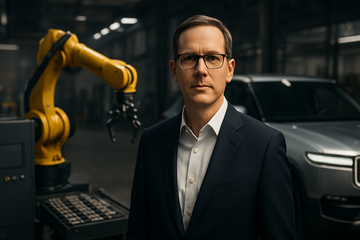
Doug Field appointment
President, Mind Robotics
Announced Oct. 13, 2026 at TechCrunch Disrupt 2026
Mind Robotics total funding
$1B+ in 10 months
Seed Nov 2025; Series A Mar 2026; follow-on May 2026
Mind Robotics last-round valuation
$3.4B
Kleiner Perkins-led $400M round, May 2026, per Reuters
Rivian Q3 2026 deliveries
19,248 vehicles (+46% YoY)
Reported Oct. 2, 2026; production 19,751 units
Rivian Q2 2026 revenue
$1.658B (+27% YoY)
Reported Jul. 30, 2026; first material R2 shipments
The event
Mind Robotics Hires the Engineer Who Lifted Model 3, Then Dissolved Ford's EV Unit
On Oct. 13, 2026, onstage at TechCrunch Disrupt, Rivian founder and CEO RJ Scaringe announced that Mind Robotics — the industrial-AI and robotics company he spun out of Rivian ten months ago — had hired Doug Field as president. Field will run day-to-day product, engineering and operations, leaving Scaringe in a chair role. The hire is the most senior OEM-production executive yet to cross over to a private physical-AI startup, and it lands a deliberate six months after Field quietly left Ford as the auto maker dissolved the unit he led.
- Field joined Ford in 2021 from Apple and ran the chief EV, digital and design officer role for five years.
- He departed in April 2026 as Ford folded the EV, digital and design group into a new structure under CEO Jim Farley.
- Mind Robotics was created in November 2025, has raised more than $1B across three rounds, and counts Rivian as its launch customer and major shareholder.
Career arc
Field's Resume Reads Like a Checklist for Industrial-AI
What Mind Robotics actually bought is a specific blend of skills that almost no other human in the U.S. labor market carries: software-defined-vehicle architecture, automotive-grade quality systems, and a real factory ramp. Field was senior vice president of engineering at Tesla during the Model 3 production hell; ran Apple's special-projects group after the company shut down Project Titan in 2024; and then oversaw Ford's electric-vehicle, digital and design function across the F-150 Lightning, Mustang Mach-E and a software stack that never quite shipped. That stack is now exactly what industrial AI needs to graduate from demos to line work.
| Stop | Years | What he ran | What Mind Robotics inherits |
|---|---|---|---|
| Tesla | Pre-2018 | SVP Engineering; Model 3 program | Auto-grade ramp at scale, supplier management |
| Apple | 2018–2021 | VP Special Projects; Project Titan | Hardware-software co-design, sensor stack |
| Ford | 2021–Apr 2026 | Chief EV, Digital & Design Officer | Software-defined vehicle architecture, OEM quality |
| Mind Robotics | Oct 2026– | President (operations, engineering) | Full production handoff at a $1B-funded startup |
Money trail
Mind Robotics Has Raised $1B in Ten Months — Most of It From the Same Six Names
Mind Robotics was created in November 2025 with a $115M seed round led by Eclipse, with Rivian also investing. A $500M Series A followed in March 2026, co-led by Accel and Andreessen Horowitz, valuing the company at roughly $2B. In May 2026, Kleiner Perkins led a $400M round that pushed the valuation to $3.4B, per Reuters. Across those rounds, the same institutional pattern shows up: top-tier Silicon Valley venture funds plus the venture arms of Volkswagen and Salesforce — i.e., a U.S. car buyer, a German OEM that already has a $5.8B JV with Rivian, and a software giant that runs call-center automation at scale.
Mind Robotics funding trajectory
Capital raised since the November 2025 spinoff
Unit: $ millions
Seed (Nov 2025)
Eclipse-led
115
Series A (Mar 2026)
Accel + a16z co-led, $2B valuation
500
Follow-on (May 2026)
Kleiner Perkins-led, $3.4B valuation
400
Rivian context
Rivian's Numbers Are Good, but the Stock Is Reading the Optionality, Not the Cars
The parent is executing. Rivian reported Q3 2026 deliveries of 19,248 vehicles on Oct. 2, a46% jump year-over-year and roughly 1,300 units above Wall Street estimates, per CNBC. Q2 2026 revenue of $1.658B grew 27% year-over-year on the first external R2 shipments and produced a positive gross profit of $179M, per the company's Jul. 30 earnings release. The R2 program officially started production at the Normal, Illinois plant on April 22, 2026, with a designed capacity of up to 155,000 units per year. None of that has translated into a working multiple: Rivian trades around $13.40 with a market cap near $16.2B — barely half of what the company's Q2 enterprise value implied a quarter ago — and a CFO transition announced Aug. 27 sent the shares down 6.3%.
Rivian TTM revenue
$5.883B
TTM through Jun 30, 2026
Rivian Q2 2026 gross profit
$179M
10.8% gross margin, Jul. 30 2026 release
VW-Rivian JV committed
$1.0B funded Oct. 7, 2026
$5.8B total JV commitment; first $1B 10-year note fully drawn
R2 designed plant capacity
Up to 155,000 units/year
Normal, Illinois, per company statements
The CFO transition announced Aug. 27 — Claire McDonough stepping down Oct. 30 after nearly six years, with Derek Mulvey named successor — is unrelated to Mind Robotics on paper but identical in pattern: another senior Rivian operator is leaving the EV business, and the market has no clean way to mark the residual value of the 35–40% stake the company is widely estimated to retain in Mind.
Sector map
Mind Robotics Is Now the Fifth $1B-Plus Physical-AI Startup in Twelve Months
Mind's $1B raised in 10 months is not an outlier — it is the floor for serious embodied-AI capital in 2026. Figure raised more than $1B at a $39B valuation in September 2025; Apptronik closed a $520M Series A extension in February 2026 at roughly a $5B valuation; Physical Intelligence raised $400M in late 2024 at a $2.4B valuation; and 1X Technologies is publicly targeting a $10B valuation. The capital is no longer flowing toward humanoid demos alone — it's flowing toward companies with at least one anchor industrial customer. Mind's anchor is Rivian; Apptronik's is Google's DeepMind-aligned logistics pilots; Physical Intelligence's is a BMW partnership; Figure's is BMW manufacturing deployments.
| Company | Round / Date | Total raised | Last valuation | Anchor customer |
|---|---|---|---|---|
| Figure | Series C, Sep 2025 | ~$1.9B | $39B | BMW manufacturing |
| Apptronik | Series A extension, Feb 2026 | $520M (round) | ~$5B | Logistics / DeepMind pilots |
| Mind Robotics | Series A + follow-on, Mar–May 2026 | $1B+ | $3.4B | Rivian Normal, IL plant |
| Physical Intelligence | Late 2024 | $400M | $2.4B | BMW partnership |
| 1X Technologies | Series B / pre-IPO, 2024–2026 | $100M (Series B) | ~$10B target | Pre-order consumer |
Spillover
The Public-Market Beneficiaries Sit on the Compute and the Picking-Rug Side
The Field hire crystallizes a rotation that has been quietly underway for two years. Capital is leaving auto incumbents and landing on three layers of the physical-AI stack: the compute layer (NVIDIA), the cobot and mobile-robot layer (Teradyne via Universal Robots, and Yaskawa/FANUC on the industrial side), and the warehouse-automation layer (Symbotic, AutoStore, Rockwell). On the other side, the legacy OEM that just lost Field is shrinking its own robotics footprint: ABB agreed in October 2025 to sell its entire robotics division to SoftBank for $5.375B, with the deal expected to close in mid-to-late 2026.
Public-market positioning vs. embodied-AI capex
Trailing-twelve-month revenue across the spillover names
Unit: $ millions
NVIDIA (compute)
TTM through Jul 2026
302,970
Ford (incumbent auto)
TTM through Jun 2026
187,973
Rivian (EV incumbent)
TTM through Jun 2026
5,883
Teradyne (cobot owner)
TTM through Jun 2026
4,464
Symbotic (warehouse robots)
TTM through Jun 2026
2,646
Two distinct sell-side frames now compete. Bulls argue that NVIDIA's Jetson and Omniverse stack becomes the default substrate for any industrial foundation model — including Mind's — which means each $1B in private robot capital eventually pulls a margin-rich order through NVIDIA's data-center and edge-AI lines. Bears point out that ABB's exit proves even the largest installed-base industrial-robot company could not monetize the physical-AI transition in-house, and that Symbotic's 500x trailing P/E and Teradyne's 53x are pricing in much of the same optionality the private market is paying for in startups like Mind.
Horizons
What Moves First, and What Doesn't
In the days and quarters ahead, the catalysts are execution, not narrative. Mind's first deployment — Dexterous manufacturing cells inside the Rivian Normal, Illinois R2 line — has to ship with the unit's published capacity ramp from April 2026 toward 155,000 vehicles per year, or the foundation-model thesis loses its single most important training-data source. The next public milestone is Rivian's Q3 2026 earnings call on Oct. 29, where investors will likely press for any incremental Mind revenue contribution or updated stake disclosure. On the public side, NVIDIA's GTC fall event and Teradyne's Q3 print are the closest windows into whether industrial-AI capex is turning into orders.
Over the one-to-three-year horizon, the structural call is sharper. If Rivian succeeds in converting its R2 ramp and the Volkswagen JV into a stable foundry-style production base, Mind becomes a credible second-act option for any OEM executive watching the same talent flow; if not, Mind pivots into third-party deployments and the $3.4B valuation becomes the new benchmark rather than a special case. Either path keeps the demand-side case for NVIDIA, Teradyne and Symbotic intact, and either path continues to drain engineering talent from the Ford and Tesla benches — which is the original tell.
How to position the trade
- Rivian owns a widely estimated 35–40% stake in Mind Robotics and provides the live factory floor; Rivian captures any future Mind re-rating through equity and data access.
- Q3 2026 deliveries of 19,248 (+46% YoY) and Q2 gross profit of $179M give the EV business a self-funding base, but a $13.40 stock and the pending CFO exit keep the multiple compressed.
- Near-term catalyst: Oct. 29, 2026 earnings call and any Mind stake disclosure; long-term, a successful R2 ramp at Normal, IL to 155,000 units/year validates the Mind data flywheel.
- Field's exit in April 2026 came as Ford folded its EV, digital and design group; the Mind hireconfirms the talent loss is permanent, not a transition pause.
- Ford's TTM revenue of $188B still carries a -3.9% net margin and a 6.5x forward P/E, but no growth path into physical-AI, which limits multiple expansion.
- Bear case: Ford becomes a hardware-only OEM supplier to whoever wins embodied-AI, ceding software-stack economics entirely.
- NVIDIA's Jetson, Omniverse and Isaac platforms are the de facto substrate for industrial foundation models, including Mind Robotics's; each $1B of private physical-AI capital pulls orders through [NVIDIA](nvda]'s stack.
- Jensen Huang publicly called physical-AI the next trillion-dollar opportunity in 2026, and NVIDIA's $303B TTM revenue puts it at scale to monetize immediately.
- Near-term: GTC fall 2026 announcements; long-term, NVIDIA's edge-AI footprint in factories, not just data centers, is the embedded option.
- Symbotic is the closest public proxy for warehouse-automation deployments — the same downstream customers Mind Robotics targets — with $2.65B TTM revenue and a Walmart-led order book.
- Trailing P/E of 501x and a stock near $40 (52-week low $37.68) already price in slow near-term execution; a Mind-Rivian type deployment story resets the multiple expansion runway.
- Watch the Symbotic Q4 FY2026 print for any new automotive or general-manufacturing wins.
- Teradyne owns Universal Robots (cobots) and MiR (mobile robots), the installed base closest to Mind's target use case; Teradyne monetizes the same demand without the equity-execution risk of a startup.
- Trailing P/E of 53x and a 52-week range from $135 to $488 already reflect an aggressive growth premium; upside depends on Universal Robots outpacing Mind and Apptronik in real deployments.
- Near-term: Q3 2026 earnings and any cobot order disclosures; long-term, the question is whether Teradyne's hardware DNA can pivot to foundation-model-driven automation.
- Tesla is Field's former employer and the highest-stakes competitor to Mind Robotics via Optimus; Tesla has reportedly ordered parts for ~15,000 Optimus units in 2026 per third-party tracking.
- Tesla's vertical integration is the bull case; Mind Robotics's specialization is the bear case — first mass deployment will settle the question.
- Watch the Optimus production commentary on Tesla's Q3 2026 earnings and any disclosure of internal vs. external customer deployments.
- ABB agreed in October 2025 to sell its robotics unit to SoftBank for $5.375B, expected to close mid-to-late 2026 — a clear admission that even the largest installed-base industrial-robot company could not monetize the physical-AI transition in-house.
- Cash proceeds of ~$5.3B give ABB a one-time capital return opportunity, but the long-term story is exit, not leadership.
- Read-through: traditional industrial-robot incumbents are being repriced as legacy assets, not platform plays.