
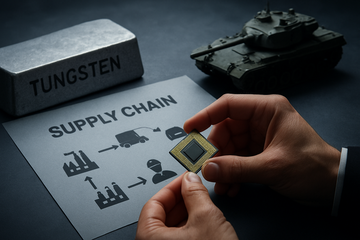
The story investors should price isn't the $25M Scimplify raised on Oct. 14, 2026 — it's the kind of twelve months it just compressed. The Bengaluru-based specialty-chemicals platform shipped a cathode active material to TDK in May 2026 after first meeting the buyer in March, the kind of timeline that's almost impossible in a market where qualification cycles normally run a year to a year and a half. The round brings total equity to $80M and lifts post-money valuation to roughly $250M from $150M after its $40M Series B in March 2025.
Round size
$25M
All-equity strategic round, closed Oct. 14, 2026
Lead investor
Hitachi Ventures
Existing Hitachi is also a customer
Customer mix shift
<15% → ~45–50%
Defense, energy and electronics share of revenue, year over year
Qualification cycle
~2 months
vs. 12–18 months typical, per TechCrunch
The Bottleneck Scimplify Is Actually Selling
Scimplify is not pitching a novel molecule. Its AI platform — branded Scinode — coordinates a network of more than 500 partner manufacturing facilities in India by mapping their technical capabilities, equipment, capacity, compliance posture, and production history, then routes each new project to the site and the scientists best suited to run it. Laboratory data and reactor-level IoT readings flow back into the model. The thesis is that discovery was already cheap; qualification was the bottleneck, and qualification is mostly logistics.
The company's own working example: a Japanese electronics customer met the team in March 2026, placed a trial order in April, and received its first cathode active material in May. A US-headquartered metals manufacturer is using Scimplify's tungsten-from-scrap process for industrial and defense markets. A separate Japanese semiconductor materials customer is sourcing a high-purity chemical outside China. The unifying claim across all three is the same — the qualification gapcloses from a year and a half to two months.
From customer requirements to finished material
Scimplify's Scinode compresses the industry-specific qualification timeline to a small fraction of the historical norm
Unit: months
Industry typical
12–18 month range, midpoint shown
15
Scimplify Scinode
TDK cathode shipped in ~2 months, Mar–May 2026
2
What It Already Ships — and to Whom
Scimplify's revenue has tripled to a roughly $200M annualized run rate; the US book alone is running near $60M. Energy, electronics and defense now make up ~45–50% of revenue — up from under 15% a year earlier — and the company serves more than 1,000 customers in over 40 countries. About 90% of current manufacturing is in India; the new round earmarks $7.5M for US capacity.
| Customer | Material category | Verified use case |
|---|---|---|
| TDK | Cathode active material | Shipped May 2026 after a March2026 introduction and April trial order |
| BASF | Specialty chemicals (multi) | Long-standing buyer on Scimplify's specialty-chemicals platform |
| Hitachi | Specialty chemicals (multi) | Lead investor in the Oct. 2026 round and existing customer |
| Henkel | Specialty resins / formulation | New investor on Oct. 2026 round and existing customer |
| Tokuyama and unnamed Japanese electronics firms | Cathode active material, high-purity chemicals | One Japanese electronics buyer met March 2026, trial April, shipment May |
| Unnamed US-headquartered metals manufacturer | Tungsten recovered from industrial scrap and spent catalysts | Industrial and defense applications |
Why Hitachi Ventures Led, and Why Now
Hitachi Ventures frames the deal as a bet that specialty chemicals demand has outgrown the sector's old manufacturing model: a lot of Indian capacity exists, but most of it lacks the science and quality systems global customers demand. Hitachi Ventures — whose India managing director Radhika Ananth made the case publicly — has more than 40% of its portfolio in advanced materials for semiconductors, batteries, and critical minerals. The Hitachi parent is also a Scimplify customer, the cleanest possible vote on the platform's commercial viability.
The timing of this round is not accidental. China's Ministry of Commerce has progressively restricted gallium, germanium, antimony, graphite, and superhard materials since 2023, then layered on seven heavy rare earths in April 2025 (samarium, gadolinium, terbium, dysprosium, lutetium, scandium, yttrium) and five more in October (holmium, erbium, thulium, europium, ytterbium). Per a Council on Foreign Relations assessment, China now restricts17 of the 34 materials the European Union classifies as critical. The October 9, 2025 package — including license requirements on lithium batteries, battery components, and battery-production technology — was suspended in November2025 under a US–China trade truce, but the suspension expires in November 2026. Scimplify's US footprint and qualification speedland inside that exact window.
The CuspAI Contrast — Two Different Lanes
Two months before Scimplify's raise, UK-based CuspAI closed a $450M Series B at a $2.6B valuation, co-led by Bezos Expeditions, Kleiner Perkins, and NEA, to launch the AI Materials Foundry. CuspAI's pitch is generative-AI discovery of semiconductor materials — 80% of near-term research is allocated to that lane — backed by a coalition of more than 45 industrial and academic partners. Scimplify is the opposite shape of bet.
| Dimension | Scimplify | CuspAI |
|---|---|---|
| Stage | Revenue-generating at ~$200M run rate | Pre-revenue R&D platform |
| Focus | Process design, qualification, multi-sector manufacturing | Generative AI discovery, primarily semiconductors |
| Latest round | $25M strategic, Oct. 14, 2026, ~$250M post | $450M Series B, July 20, 2026, $2.6B post |
| Lead investor logic | Hitachi Ventures — 40% of portfolio in advanced materials | Bezos Expeditions + Kleiner Perkins + NEA — chip supply chain |
| Traction proof | TDK cathode shipped May 2026; 1,000+ customers | 45–48 Foundry coalition partners announced |
Scimplify's $25M is meaningful precisely because it is small. CuspAI's $450M buys discovery runway for a market that may take half a decade to clear qualification gates. Scimplify is already clearing those gates for existing chemistries — tungsten derivatives from scrap, lithium battery cathode active material, ultra-high-purity chip chemicals — and capturing revenue as it does so.
Upstream and Downstream Spreads
- Upstream — critical-minerals miners benefit as substitution clears qualification. MP Materials (Mountain Pass, the only operating US rare-earth mine) reported Q2 FY2026 consolidated revenue of $108.5M, up 89% year-over-year on NdPr oxide and metal sales; USA Rare Earth and Lynas Rare Earths run parallel mine-to-magnet ambitions. Scimplify's downstream conversion is a tailwind for all three — a faster non-China buyer set expands the addressable customer base.
- Upstream — defense metals validators. MP Materials sold a 15% stake to the US Department of Defense for $400M in July 2025, with a 10-year offtake at a $110/kg floor; Vulcan Elements separately secured $1.4B of US government partnership in November 2025. These anchor deals only monetize if non-China Western customers can actually qualify — which is what Scimplify's Scinode is selling.
- Midstream — chemical incumbents face a software-mediated rival. BASF reported €61.7B of TTM revenue through Q2 FY2026; Linde reported $35.4B. Specialty-chemicals incumbents can't easily match Scimplify's two-month qualification cadence without rebuilding their own AI layer — a slow-motion margin threat to traditional discovery-driven units.
- Downstream — defense primes secure a non-China route. Lockheed Martin reported $77.0B of TTM revenue through Q2 FY2026 and identifies rare-earth samarium as a binding input for THAAD interceptors and other missile-defense systems. RTX reported $93.5B of TTM revenue and Northrop Grumman $42.9B. Scimplify's tungsten-from-scrap customer is already a direct supplier into defense and industrial channels.
- Downstream — Japanese electronics and battery buyers secure a captive alternative. TDK is already receiving cathode active material; Hitachi is investing alongside its customer relationship; Tokuyama operates in the same specialty chemicals adjacency. These buyers faced the most acute exposure to China's October 2025 controls, and Scimplify's US-and-India footprint gives them a non-China second source in months rather than years.
Short-Term and Long-Term — Who Signs First vs. What Survives
On a 0–12 month horizon, the catalyst to watch is the next large Western buyer contract. The TDK precedent (March 2026 meeting, May 2026 first shipment) is the template. The Pentagon's parallel bets — $400M into MP Materials preferred, $620M loan into Vulcan Elements, $1.4B aggregate — show what a buyer with hard leverage states looks like. Any defense prime or US battery gigafactory that signs a multi-year Scimplify offtake converts the $25M round into a much harder-to-replicate commercial moat.
On a 1–3 year horizon, the structural question is whether Scimplify's software-mediated execution layer eats the qualification bottleneck before China can reassert leverage. If the November 2026 truce expires and Beijing reactivates the most expansive rare-earth rules — license requirements for any third-country end product where China-origin rare earths account for 0.1% or more of value — Western buyers without a Scimplify-style two-month option will be paying for a year's worth of qualification they cannot afford. Scimplify's installed base makes the next round of substitution economics arithmetic instead of national-security.
Stocks the Scimplify round actually touches
- Scimplify's non-China buyer pipeline widens MP Materials' addressable customer base within 2027, complementing the Pentagon's $400M preferred stake and 10-year $110/kg offtake.
- MP Q2 FY2026 revenue rose 89% YoY to $108.5M on NdPr sales — execution is already moving; a working substitute pipeline de-risks the demand side of the rare-earth pivot.
- Near-term drag: stock trades at $39.95 vs. $97 52-week high; TTM net loss of $60.6M and capex of $230M in Q2 show that mining and processing execution, not customer availability, is the binding constraint.
- Public-market pure-play on US NdFeB magnets with explicit defense, automotive, and aerospace exposure — a direct beneficiary if Scimplify's qualification cadence converts defense pilot orders into multi-year offtakes.
- Enterprise value is negative ($1.37B market cap against higher cash balance), so the equity is essentially a call option on mine-to-magnet execution through 2027.
- Risk to thesis: pre-revenue stage with negative TTM EBITDA of -$108M; catalyst is binary on magnet facility commissioning rather than steady-state earnings.
- THAAD and other missile-defense platforms need samarium-cobalt magnets that are still partially routed through Chinese processing; Scimplify's two-month qualification reduces single-source risk for a binding input rather than expanding the topline.
- Materials cost is a tiny share of Lockheed Martin's $77B TTM revenue at 8.2% net margin — the trade is a margin protectant, not a revenue accelerator.
- Watch the Pentagon's 2027 deadline to eliminate Chinese rare-earth content from defense systems; that date sets the binary catalyst on whether defense primes must contract non-China alternatives.
- Raytheon's missile-defense and propulsion systems share the same rare-earth exposure as Lockheed Martin; Scimplify's qualification speed preserves margin in supply-disruption scenarios rather than expanding the order book.
- RTX reported $93.5B of TTM revenue with 8.3% net margin — too diversified for materials-cost news to move the stock materially in the short term.
- Mixed but with a real defensive bid: a working non-China alternative makes RTX a less risky long in any2026–2027 China-control escalation scenario.
- Named Scimplify customer — cathode active material shipped May 2026 — so TDK already has a captive non-China battery-materials second source in production today.
- Scimplify's $7.5M US expansion aligns with TDK's North American EV and electronics customer reshoring, putting Scimplify capacity in the same geography as TDK's growing US footprint.
- CuspAI's AI Materials Foundry targets the same semiconductor lane as TDK's passive components business — the two AI-materials startups are on converging fronts even as Scimplify executes the closer-to-revenue beat.
- Strategic lead investor and existing customer — the cleanest possible vote that Scimplify's Scinode works commercially and that Hitachi's $16B-equivalent revenue base in industrial systems has a software-mediated specialty-chemicals growth lane.
- Hitachi Ventures has 40% of its portfolio in advanced materials for semiconductors, batteries, and critical minerals — Scimplify slots directly into the thesis the corporate parent is underwriting.
- Less obvious: FY2025 consolidated revenue of ¥10,586.7B (+8% YoY) gives Hitachi the balance sheet to follow on, and any Hitachi industrial-systems integration of Scimplify would be a meaningful re-rating event.