
Laplace sells failure modes — and that's the gap nobody else is filling
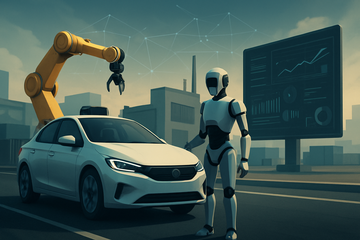
Laplace Intelligence took the Startup Battlefield stage at TechCrunch Disrupt on October 13, 2026 with a deliberately narrow pitch: it runs automated red-teaming on robots and AVs before they reach the road or warehouse. The stack pairs a high-fidelity digital twin of the real world with an AI agent whose only job is to break the system under test. The simulation is a post-trained version of NVIDIA's Cosmos model, grounded in Street View and TomTom traffic feeds, so the agent can rebuild an Arizona highway or a Paris crossing to scale and then mutate it on the fly with language prompts — add afternoon traffic, change pedestrian behaviour, replay a police report from yesterday.
The commercial signal is unusually clean for a one-year-old spinout: the company is already profitable on project-based revenue, mostly from autonomous driving use cases, and is converting that to recurring contracts. Co-founder and CEO Howie Sun and chief scientist Henry Liu, both out of the University of Michigan, named Bot Auto — a Houston L4 trucking company that says it can outfit a Class 8 truck with a full autonomy hardware stack for about $50,000 — a major Japanese automaker, NVIDIA and T-Mobile on a free smart-city pilot in San Jose, plus early humanoid-robotics work in warehouses as named customers.
NVIDIA calls the layer 'Halos' — but the validation piece keeps escaping
On paper, NVIDIA already owns the physical-AI safety category. The company launched Halos for Robotics on June 22, 2026, positioning it as the industry's first full-stack safety system for physical AI across AVs and robots — silicon (IGX Thor, DRIVE AGX Thor), certified operating systems, sensor bridges, simulation libraries and an ANAB-accredited inspection lab. TÜV SÜD certified DriveOS 6.0 to ISO 26262 ASIL D, and TÜV Rheinland separately inspects the robotics stack for certification readiness.
| Halos component | Function | Laplace's relative position |
|---|---|---|
| DRIVE AGX Thor / IGX Thor | Safety-engineered compute silicon | Adjacent — Laplace runs on Cosmos, not on Thor |
| Halos OS, Core, Middleware | ASIL-D OS, isolation, deterministic comms | Outside scope — software inside the vehicle |
| Holoscan Sensor Bridge | Sensor-to-AI safety processing | Outside scope — in-vehicle perception |
| Isaac Lab / Omniverse sim | Test robot behaviour across conditions | Direct overlap — Laplace differentiates on agentic corner-case generation |
| Halos Safety Evaluation Framework | Evidence to support AV safety cases | Direct overlap — Laplace's red-team is the evidence generator |
| Halos AI Systems Inspection Lab | Certification readiness reviews | Outside scope — third-party assessment layer |
The product story inside NVIDIA is the simulation-and-validation column of the stack. What Laplace shows is that an independent vendor — built on top of NVIDIA's own Cosmos foundation model — can do the agentic part of that column better than the platform owner. That makes NVIDIA both supplier and competitor, and the more interesting question is whether Halos eventually bundles a Laplace-style red-team agent or acquires the capability. With Q1 FY2027 revenue of \\$81.6 billion (period ended April 26, 2026, reported May 20, 2026) and Q2 FY2027 revenue of \\$96.2 billion (period ended July 26, 2026, reported August 26, 2026), the NVIDIA balance sheet can absorb any realistic physical-AI safety startup without needing a second thought — a context that frames every competitor's defensive calculus.
CrowdStrike, Palo Alto Networks and Zscaler left a physical-world hole
The AI-safety press cycle this fall has been about cloud agents. CrowdStrike's Fal.Con 2026 keynote ran an AI-versus-AI autonomous attack-and-defend demo inside the Falcon console. Palo Alto Networks and NVIDIA extended their AI-factory security architecture in June 2026 and pinned Prisma AIRS to the BlueField DPU for OT and industrial edge. Zscaler has an Auto-ISAC partnership and sells zero-trust for automotive manufacturing floors. Every one of those products assumes the AI is running inside a data centre, a factory, or a SaaS tenant — not behind the wheel of a 40-tonne truck.
Laplace's layer is closer to a QA/SRE function than a security function. The buyer is the autonomy team that has to certify a system before regulators, insurers and the public will accept it. That's why it sits in a budget line that rarely intersects with the CISO — and why the eventual acquirer is more likely to be an AV platform company or NVIDIA than a pure-play security vendor. The exception is Palo Alto Networks, which already calls Prisma AIRS an 'AI agent security' product and has the integration runway to bolt physical-AI validation onto BlueField if it chooses.
The two security incumbents most likely to bid for the physical-AI validation layer
ARR scale, latest reported quarter. CrowdStrike reports ARR; Palo Alto Networks reports Next-Generation Security ARR.
Unit: $B
CrowdStrike ARR (Jul 31, 2026)
5.8
Palo Alto Networks NGS ARR (Jul 31, 2026)
9.1
The customer roster is the part of the pitch investors should actually price
Laplace named three categories of early customer. The first is autonomous trucking, anchored by Bot Auto — a Houston-based L4 startup that has raised $20 million in a pre-A round and recently appointed a former freight executive as president. The second is a major Japanese automaker working on passenger autonomy. The third is the San Jose smart-city pilot with NVIDIA and T-Mobile, plus humanoid-robotics work in warehouses.
The relevant listed-vehicle comparator is Aurora Innovation, the only US-listed pure-play L4 autonomous trucking operator. Aurora reached \\$2M in Q2 FY2026 revenue (period ended June 30, 2026) while burning roughly $266 million in operating costs for the quarter — a cash-intensity profile that makes any external validation tool a material line item, not a rounding error. Aurora already retained Edge Case for an independent safety assessment in Q1 2026 and has its own Safety Case Framework. That is a direct, named competitor to what Laplace sells, and a demand signal that the market is real.
On the robotaxi side, Pony.ai reported Q2 2026 robotaxi revenue of $12.1 million (+691% year-over-year) and total revenue of $36.2 million (+68.8%), with a stated goal of more than 3,500 robotaxis across 20+ cities by year-end 2026. Every additional market is another corner-case discovery problem. The same logic applies to Mobileye's consumer ADAS pipeline — the lower the autonomy level, the cheaper the red-team needs to be, which is where the recurring-software revenue line Laplace wants to build becomes the more important economic question than the per-project price.
The market is bigger than the AV segment, and the supply is already consolidating
The TAM argument rests on three external forecasts that the primary sources actually anchor. ABI Research projects an installed base of 49 million L3–5 AVs by 2035. Omdia estimates about 60 million industrial robots will be deployed between 2026 and 2035. And twenty-seven physical-AI startups raised a combined $6.4 billion in Q1 2026 alone across seed and later stages — a third-party confirmation that physical-AI safety tooling is being priced as its own category, not as a feature line on a larger robotics stack.
Projected L3–5 AVs by 2035
49M
ABI Research, cited in NVIDIA Halos blog, Sep 21, 2026
Projected industrial robots, 2026–2035
60M
Omdia, cited in NVIDIA Halos blog, Sep 21, 2026
Q1 2026 physical-AI startup funding
$6.4B
27 deals across seed and later stages, per fast.io summary, Jun 30, 2026
Direct comparator — Applied Intuition Series F
$600M
Raised Jun 17, 2025 at $15B valuation; Applied Intuition press release
The closest analogue in the AV simulation market is Applied Intuition, which closed a $600M Series F at a $15B valuation in June 2025 and is reportedly targeting a $30B valuation in its next round. Applied owns the front end of the simulation toolchain — what autonomy teams use during model development. Laplace's angle is the back end — red-teaming the trained system before and after deployment — and the fact that both can grow without obvious product cannibalisation is what makes this category unusually investable on a multi-year horizon.
Two-year view: three outcomes, each with a different investor trade
- Best case for investors: Laplace raises a growth round at a multi-billion valuation, scales to seven-figure annual contracts per AV program, and becomes the category-defining company — the 'Datadog for physical AI' that ends up in every AV and humanoid-robot stack. Track the named customers (Bot Auto, the Japanese OEM, NVIDIA) for the proof points; each new robotaxi market or humanoid deployment is a TAM add, not a one-off.
- Most likely outcome: NVIDIA acquires Laplace — or a competitor like it — and folds the agentic red-team into Halos Safety Evaluation Framework, turning a software subscription into an integrated Halos feature. With NVIDIA running at a roughly $80–96B quarterly revenue run-rate, the size of the cheque is irrelevant; the strategic question is whether Cosmos stays open or becomes the moat.
- Bear case: AV programs mature and the red-team gets commoditised inside the NVIDIA stack before any independent vendor reaches scale. Aurora's use of Edge Case hints that this consolidation is already happening — and the longer Laplace stays private, the harder it will be to monetise the independence.
The trade for listed investors is therefore not 'which cloud-security vendor wins physical AI' — that question is too early, and the spend isn't going through the CISO. It is which platform company gets the highest-margin adjacency from owning the validation layer while the category is still pre-consolidation. NVIDIA has the cleanest read because it owns both the compute substrate (Cosmos, DRIVE, IGX) and the closest incumbent stack (Halos). The cybersecurity names (CrowdStrike, Palo Alto Networks, Zscaler) are not the natural buyers of a digital-twin-and-red-team product — but Palo Alto Networks's BlueField-anchored OT push makes it the most credible bidder if it chooses to expand from factory-floor zero-trust into pre-deployment validation.
Where the validation layer ends up on the cap-table
- Laplace's Cosmos dependency makes NVIDIA the natural acquirer; Q1 FY2027 revenue of $81.6B funds any realistic deal without dilution.
- Halos already covers 60% of the stack (silicon, OS, inspection lab); the missing 40% is the agentic red-team — exactly what Laplace sells.
- AV and robotics attach lifts the automotive segment, which sat at $586M in Q2 FY2026, off its current low single-digit percent of total revenue.
- CrowdStrike's $5.84B ARR (Jul 31, 2026, +25% YoY) gives it M&A firepower, but Fal.Con 2026 product line is still cloud-agent, not physical-AI.
- Watch Fal.Con 2027 for any AV/robotics security SKU — its absence would confirm the gap and a possible inbound bid for a Laplace-style vendor.
- Agentic AI runtime defense crosses over into physical AI only if CrowdStrike acquires a Cosmos-adjacent simulation shop — a 12–18 month watch item.
- Palo Alto Networks's $9.10B NGS ARR (Jul 31, 2026, +63% YoY) is the largest security war chest and the only one with a credible industrial-edge foothold via Prisma AIRS on BlueField.
- Most plausible security-vendor acquirer of a physical-AI red-team vendor given existing NVIDIA AI-factory co-engineering track record.
- OT/automotive zero-trust pipeline gives Palo Alto Networks a customer entry point that CrowdStrike and Zscaler lack — Auto-ISAC footprint included.
- Aurora's $266M quarterly operating loss versus $2M of revenue makes external validation tooling a material, not cosmetic, line item — exactly the buyer Laplace wants.
- Targets 200 driverless trucks by year-end 2026, 1,000 by 2027; each new commercial lane is a Laplace-style red-team contract waiting to happen.
- Already retained Edge Case for independent assessment in Q1 2026 — validates that AV operators pay for third-party validation, not just internal QA.
- Mobileye's consumer ADAS volume (millions of EyeQ chips per year) implies a recurring need for low-cost red-team tooling — but at much lower per-unit price than L4 programs.
- If a Laplace-style vendor reaches scale, Mobileye becomes a buyer; if it doesn't, the validation burden falls on in-house QA and the moat softens.
- Listed ADAS chip vendors sit between NVIDIA's Halos and the OEM customer — the company that captures the validation-revenue pass-through wins the most upside.
- Pony.ai's 691% YoY robotaxi revenue growth in Q2 2026 and 3,500-vehicle target by year-end 2026 create a non-US red-team demand pool.
- Geopolitical constraints on US pilots keep Pony.ai out of the NVIDIA Halos-Laplace revenue loop — but Chinese physical-AI tooling may fork off independently.
- Stock catalyst: any US pilot restart via Uber partnership or a London test launch would reopen the validation-spend question for the listed peer group.