
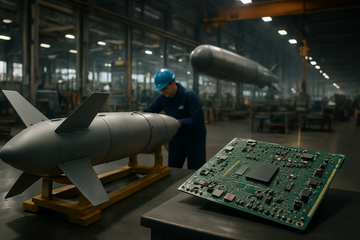
On October 20, 2026, RTX reported third-quarter sales of $24.97 billion, up 11% year over year, adjusted EPS of $2.26, up 33%, and a record $340 billion backlog, then raised full-year adjusted sales to $97.0–$97.5 billion and adjusted EPS to $7.65–$7.75. The demand behind that raise is not in doubt: defense bookings were about $59 billion in the quarter, a 4.6x defense book-to-bill, and Raytheon alone booked $52.3 billion at a 6.54x book-to-bill. The more important disclosure came on the call, where chief executive Chris Calio said the constraint on all of it is physical — castings, rocket motors and circuit boards — and that output rates have to run 2x to 4x current levels before 2030.
Third-quarter sales
$24.97B
Up 11% year over year; reported Oct 20, 2026
Adjusted EPS
$2.26
Up 33% year over year
Record backlog
$340B
$176B commercial and $164B defense at Sept 30, 2026
Raytheon bookings
$52.3B
Book-to-bill of 6.54x in the third quarter
Third-quarter free cash flow
$2.1B
Down from $3.9 billion a year earlier
2026 adjusted EPS guidance
$7.65–$7.75
Raised from $7.10–$7.25 on Oct 20, 2026
The print
Guidance moved twice after January, and each time added more earnings than sales
This was the third guidance revision of 2026, and the pattern matters more than any single quarter. The January opening guide implied roughly5–6% organic sales growth; by October the company was guiding to 10–11% organic growth with adjusted sales $4.5 billion higher at the midpoint. Adjusted EPS guidance rose $1.00 over the same stretch, from $6.60–$6.80 to $7.65–$7.75. Each raise added more earnings than sales — roughly $1.35 billion of adjusted earnings on $4.5 billion of extra revenue, an implied incremental margin close to 30% against a company net margin near 10%.
| Guidance date | Adjusted sales | Adjusted EPS | Free cash flow |
|---|---|---|---|
| Jan 27, 2026 (2025 results) | $92.0–$93.0B | $6.60–$6.80 | Not stated |
| Jul 23, 2026 (second quarter) | $95.0–$96.0B | $7.10–$7.25 | $8.50–$8.75B |
| Oct 20, 2026 (third quarter) | $97.0–$97.5B | $7.65–$7.75 | $9.0–$9.2B |
- Guidance moved twice after January: each raise added more earnings than sales.
- The driver was identified by segment — defense sales expected to grow at a low double-digit rate, carried primarily by Raytheon, with commercial aftermarket upgraded to low-teens growth from low double digits on higher GTF volume.
- Raytheon's nine-month bookings of $79 billion are now larger than its entire 2025 backlog of $75 billion at December 31, 2025, so the order book is compounding faster than the revenue line can absorb it.
That 30% implied incremental margin is the number the bull case rests on, and it is the number capacity investment threatens. A price increase or a mix shift drops through at high margin. A production ramp does not: it arrives with tooling, test equipment, new suppliers, scrap, overtime and a working-capital build that has to be funded before the parts ship.
The constraint
Management named the three bottlenecks: castings, rocket motors and circuit boards
- Castings, rocket motors and circuit boards are the constraints holding back higher missile output, according to chief executive Chris Calio on the October 20 call.
- The Tomahawk and AMRAAM multiyear framework agreements point to production rates running anywhere from 2x to 4x current levels.
- Raytheon added 150 new suppliers during 2026 and is working with the Department of Defense on supply-chain capacity, test requirements, producibility and new supplier qualification.
- The ramp starts in earnest over the next two years, with full rate production around 2030.
- A $50 million expansion of Raytheon's Forest, Mississippi plant adds capacity for a next-generation jammer and other radar systems.
The mechanism behind the margin question is contractual. Revenue on these programs is recognised as costs are charged to the contract, so a ramp pulls in cash and cost before it pulls in profit. That is why the same quarter produced a 33% jump in adjusted EPS and a 46% fall in free cash flow. Revenue follows the spend, not the order, and the spend for a 2x–4x rate increase runs ahead of the revenue it eventually produces.
The demand
Two missile families are 71% of Raytheon's quarterly bookings
Two missile families dominate what Raytheon booked in the third quarter
Raytheon bookings by program, third quarter 2026. The residual is total bookings of $52.3 billion less Tomahawk and AMRAAM.
Unit: $ billions
Tomahawk
Multiyear framework agreement
23
AMRAAM
Multiyear framework agreement
14.3
All other programs
Includes Patriot GEM-T, AIM-9X, ESSM, NASAMS, SM-3 and classified work
15
Tomahawk and AMRAAM together account for $37.3 billion of the $52.3 billion Raytheon booked in the quarter, and they are precisely the two families management tied to 2x–4x rate increases. Behind them the restock is broad — $3.7 billion of Patriot GEM-T for Ukraine, $1.1 billion of AIM-9X Block II, $0.8 billion each for ESSM and LTAMDS, plus $5.7 billion of classified contracts in the first nine months alone. Raytheon's $130 billion backlog covers roughly four years of sales at the current run rate. The shop floor, not the order book, is the constraint on what any of this becomes in 2027 and 2028.
The funding
The customer is now buying the capacity that the primes cannot build in time
- The Department of War invested $1 billion in L3Harris's Missile Solutions business in April 2026 as a convertible preferred security that converts at an initial public offering, with warrants, and L3Harris retaining more than 80% of the business.
- Proceeds are earmarked for solid rocket motor plants in Camden, Arkansas, Huntsville, Alabama and Orange, Virginia, serving PAC-3, THAAD, Tomahawk and Standard Missile.
- Lockheed Martin signed a strategic cooperation agreement with Avio on October 13, 2026 for access to merchant motor capacity for ER GMLRS and PrSM, with Avio USA investing more than 500 million in new US solid rocket motor capacity.
- L3Harris took a $250 million solid rocket motor award for record production on October 12, 2026, and still intends to list Missile Solutions in the second half of 2026.
- Those motors feed the missile families RTX's own ramps depend on.
This is the most under-read fact of the quarter. When a constraint is physical and takes years to build, the customer eventually funds it, and the funding shows up as government capital rather than prime capital spending. RTX's own capital spending barely moved: nine-month capital expenditure was $2.12 billion against $2.00 billion a year earlier, up about 6%, while guidance implies a 2x–4x rate increase. Customers are paying for capacity RTX is not buying, which protects near-term cash but caps margin, because a prime paid to build for a customer captures less of the value than a prime paid to deliver a higher price.
The cash
Cash follow-through broke in the quarter that earnings beat
| Third quarter | Q3 2025 | Q3 2026 | Change |
|---|---|---|---|
| Sales | $22.5B | $25.0B | +11% |
| GAAP net income | $2.0B | $2.7B | +35% |
| Cash from operations | $4.6B | $2.9B | -38% |
| Capital spending | $0.7B | $0.7B | Flat |
| Free cash flow | $3.9B | $2.1B | -46% |
| Cash from operations ÷ net income | 2.3x | 1.1x | — |
Earnings rose 35% and cash from operations fell 38% in the same quarter, and cash conversion halved to 1.1x net income from 2.3x. Part of the quarter's cash was not repeatable: management said $300 million of tariff recoveries were received in the third quarter with another $50 million expected in the fourth, after which those items are behind the company. Nine-month free cash flow of $6.15 billion is still 40% above the $4.40 billion of the same period in 2025, so the $9.0–$9.2 billion full-year guide holds — but it implies about $2.9–$3.1 billion in the fourth quarter after a $2.1 billion third quarter, and the working-capital build that a 2x–4x ramp requires is still ahead. Cash has stopped following earnings, and that is the cost of capacity becoming the constraint.
- A $500 million free cash flow tailwind lands in 2027 as the powder metal matter declines, offsetting cash in the 2026 guide that does not repeat.
- Management framed the munitions framework agreements as largely cash neutral into 2027, with operational margin growth and working capital becoming the swing factors.
- Detailed 2027 guidance arrives with the fourth-quarter results in January, when management said it expects another year of sales, earnings and cash flow growth.
The margin
Margin follow-through is real at Raytheon, but flattering at the group level
Segment profitability and the peer comparison
Collins Aerospace — Q3 2026
$8.4B sales, 21.3% margin
Sales up 10% year over year
Pratt & Whitney — Q3 2026
$9.2B sales, 6.6% reported / 10.5% adjusted
Sales up 10%; $360M of adjusted items
Raytheon — Q3 2026
$8.0B sales, 14.1% margin
Sales up 14%; nine-month margin was 13.0%
Lockheed Martin Missiles and Fire Control — Q2 2026
$4.1B sales, 14.5% margin
Sales up 19% year over year on PAC-3, THAAD and PrSM ramps
Raytheon's14.1% third-quarter margin was above its 13.0% nine-month margin, which is what fixed-cost absorption on rising volume looks like. But it still sat below Lockheed Martin's missile segment at 14.5% — even though Raytheon booked $52.3 billion in a single quarter and Lockheed's missile sales grew 19% year over year. The group-level picture needs a haircut as well: Pratt & Whitney's adjusted operating profit of $968 million sits $360 million above the $608 million it reported, and an implied incremental adjusted margin close to 30% on $2.5 billion of added quarterly sales is not a mix that repeats. The margin gain is real but flattering, because it is being read off a quarter that contained both a large add-back and a large tariff recovery.
Horizons
Rate is the only variable that matters, and the next two quarters will start to price it
- Lockheed Martin's third-quarter results on Oct 22, 2026 are the first clean read on whether rivals convert missile backlog faster than RTX is converting its own.
- L3Harris reports on Oct 29, 2026, with the planned Missile Solutions listing the item that would put a market price on government-funded motor capacity.
- January 2027 brings RTX's 2027 framework — the first guidance built on rate assumptions rather than on order intake.
- Quarterly Raytheon book-to-bill and the split between framework munitions and everything else will show whether the rate ramp is being funded or merely promised.
- 2027–2028: whether Tomahawk and AMRAAM rates can double without castings, motors and circuit boards expanding as fast as the order book.
- 2029–2030: full rate production, where the margin on a decade of orders is actually earned.
- The main risk to the bearish reading: capacity arrives faster than planned. Avio's new US motor plant and government-funded motor expansions could pull revenue forward and leave the 2026 guide looking conservative.
Supply chain
The constraint is owned by the supplier chain, not the prime
| Layer | Company | Evidence of the link |
|---|---|---|
| Upstream — solid rocket motors | L3Harris Technologies | $1 billion Department of War investment in Missile Solutions, April 2026, funding motor plants in Camden, Huntsville and Orange that serve PAC-3, THAAD, Tomahawk and Standard Missile |
| Upstream — solid rocket motors | Northrop Grumman | Plans to lift solid rocket motor output to more than 25,000 units a year by 2029, and raised its 2026 profit forecast on Oct 20, 2026 alongside RTX |
| Upstream — circuit boards | TTM Technologies | Aerospace and defense revenue of $382.8 million in the June quarter, up 14%, with total program backlog above $1.7 billion |
| Upstream — actuation and valves | Curtiss-Wright | Supplies electromechanical actuation for mobile ground-based air defence; first-quarter 2026 sales up 13% to $914 million at a 17.5% operating margin, with full-year guidance raised on May 6, 2026 |
| Downstream — engine overhaul | Kawasaki Heavy Industries | About ¥7 billion investment in PW1100G-JM engine maintenance, targeting at least 50 engines a year by fiscal 2031 |
| Downstream — allied second source | Hanwha Aerospace | First-stage solid rocket booster agreement with Northrop Grumman in April 2026, adding Western motor capacity outside the US primes |
This is not a chain of vendors but a scramble for the same three inputs, and the listed exposure to the restock sits mostly outside the prime. The motor suppliers now have government money behind them, the circuit board supplier is growing aerospace and defense revenue at 14% while spending cash to do it, and the actuation supplier is earning a 17.5% margin on content that scales with interceptor rates. The constraint is owned by the supplier chain, not the prime, which is the strongest argument for owning the constraint directly rather than the backlog headline.
Stocks that carry the capacity thesis
- Raytheon booked $52.3 billion at a 6.54x book-to-bill, so the order book is not the risk — the 2x–4x production-rate requirement is.
- Adjusted EPS guidance rose $1.00 since January on $4.5 billion of added sales, an implied near-30% incremental margin that capacity spending should compress.
- Third-quarter free cash flow fell 46% to $2.1 billion while earnings rose 33%, so the 2026 cash guide depends on a fourth quarter of $2.9–$3.1 billion.
- Over 1–3 years, margin expansion depends on rates reaching full production around 2030, not on the 2026 guide being beaten.
- Missiles and Fire Control sales rose to $4.1 billion in Q2 2026, up 19% year over year, on PAC-3, THAAD and PrSM ramps.
- The record $230 billion backlog already includes a multi-year THAAD interceptor contract, locking missile capacity in ahead of rivals.
- Third-quarter results on Oct 22, 2026 are the cleanest read on missile conversion speed outside RTX.
- Guidance of $79.75–$81.75 billion of sales and $29.95–$30.65 of EPS frames the bar RTX must clear from a $340 billion backlog.
- The Department of War's $1 billion converts into Missile Solutions equity at a planned second-half listing, putting a market price on government-funded motor capacity.
- Motor plants in Camden, Huntsville and Orange serve PAC-3, THAAD, Tomahawk and Standard Missile — the motors RTX's own ramps need.
- A $250 million solid rocket motor award on Oct 12, 2026 for record production shows the same bottleneck pricing from the supplier side.
- Near term, results on Oct 29, 2026 value that capacity; over 1–3 years, an IPO could reset how missile capacity is priced.
- Plans to lift solid rocket motor output to more than 25,000 units a year by 2029, the clearest evidence that motor supply is the industry's scarce input.
- Raised its 2026 profit forecast on Oct 20, 2026 alongside RTX, confirming the restock is industry-wide rather than RTX-specific.
- Over 1–3 years, owning both interceptors and motors hedges the exact constraint that limits rival conversion rates.
- Supplies electromechanical actuation for mobile ground-based air defence, content that scales with interceptor rates rather than with budgets.
- First-quarter 2026 sales rose 13% to $914 million at a 17.5% operating margin, and full-year guidance was raised on May 6, 2026.
- Component content on every additional missile is the least capacity-constrained way to own the same restock.
- Circuit boards are one of the three bottlenecks RTX named, and TTM's aerospace and defense revenue grew 14% to $382.8 million in the June quarter.
- Capital spending of $50.4 million against $96.4 million of operating cash flow left free cash flow at just $46.0 million.
- Backlog above $1.7 billion gives visibility; the cash cost of chasing it, not demand, is the risk over the next several quarters.
- About ¥7 billion of investment in PW1100G-JM engine maintenance targets at least 50 engines a year by fiscal 2031, capturing the shop visits RTX's aftermarket ramp creates.
- Pratt & Whitney raised commercial aftermarket growth to low teens from low double digits, widening the pool this maintenance capacity serves.
- The payoff sits beyond 2029 and sits inside a diversified conglomerate, so this is optionality rather than a driver.
- An air and missile defence prime competing for the same European rearmament pool Raytheon booked $52.3 billion of in a single quarter.
- Its first-stage solid rocket booster agreement with Northrop Grumman in April 2026 adds Western motor capacity outside the US primes.
- Bull case, an alternate source for allies short of Patriot output; bear case, it competes with RTX for the same government capacity funding.
- Trailing free cash flow yield below 2% shows how working-capital heavy this ramp is for every player in the chain.