
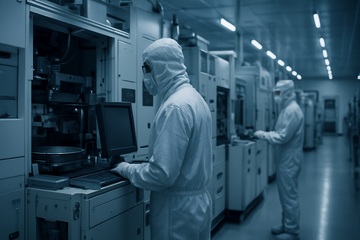
Samsung Electronics and SK Hynix are spending advanced-node money inside China at the same moment Washington is deciding, year by year, whether their US tools may cross the border. On Oct 21, 2026, Reuters reported that Samsung's Xi'an fab is moving to 286-layer V9 NAND and that SK hynix's Dalian fab is targeting at least 240 layers. Read as defiance, that is a misread: both groups are keeping their China lines one generation behind Korea, because the binding constraint is now a licence that expires every December, not a node specification.
Dalian tool licence expiry
Dec 31, 2026
No 2027 authorisation issued as of October 2026
China share of revenue, major tool vendors
30–34%
AMAT, LRCX, KLA and TEL, latest fiscal years
CXMT share of global DRAM revenue
9.5%
2Q26, up from 7.6% in 1Q26
Huawei AI accelerator price increase
+20%
Ascend 950DT card, Sept 10, 2026
THE EVENT
The Upgrade Is Real, and So Is the Compliance Strategy
Reuters reported on Oct 21, 2026 that the upgrades are already underway and that waiting for Washington has become expensive. Six days earlier, Solidigm — SK hynix's NAND unit — asked US authorities to approve sending more American chipmaking equipment to Dalian as a condition of continuing its US fab build-out. At the same time SK hynix said it was not seeking any capacity expansion at Dalian Mod B, the unused 2023 building next to the live 192-layer line. Both statements can be true: the request is for tools, the denial is about wafers. That gap is where the whole regime now lives.
| China site | Owner | Product | Status under US export rules | Why it matters |
|---|---|---|---|---|
| Xi'an | Samsung Electronics | NAND flash | Annual licence granted Dec 30, 2025 for 2026; EUV excluded | About 30–35% of Samsung Electronics's NAND output |
| Wuxi | SK Hynix | DRAM | Annual licence granted for 2026 | Nearly50% of SK Hynix's DRAM capacity, per Semicone |
| Dalian (Mod B unused section) | SK Hynix via Solidigm | NAND flash | One-year licence expires Dec 31, 2026; no 2027 authorisation issued | About 40–45% of SK Hynix's NAND output; new V8 line would add roughly 50,000 wafers a month |
| Nanjing | TSMC | Mature-node logic | Annual licence granted for 2026 | Mature-node capacity; validated end-user status revoked in 2025 |
THE REGIME
Export Controls Now Bind a Calendar, Not a Specification
On Sept 2, 2025, the Commerce Department's Bureau of Industry and Security struck Intel Semiconductor (Dalian), Samsung China Semiconductor and SK hynix's Chinese entities off the validated end-user list, ending the standing authorisations that had let them ship US tools without case-by-case approval. In their place came annual licences for 2026, granted on Dec 30, 2025, covering Samsung's Xi'an NAND fab and SK hynix's Wuxi DRAM and Dalian NAND plants. Those licences permit operation and maintenance of existing capacity; EUV was never available. What they do not settle is the following year. SK hynix's one-year Dalian authorisation expires on Dec 31, 2026, and as of mid-October 2026 Washington had not issued a 2027 authorisation.
- Shipments that were self-executing became annual, case-by-case approvals, so every December now reprices the installed base.
- What is graded is the tool and the destination, not the chip that leaves the fab — so an in-China node upgrade needs Washington even when the product is sold domestically.
- The hedge is domestic: Reuters reported Samsung and SK hynix spent roughly two years testing AMEC etch and deposition tools, and both companies denied testing when asked. No production deployment has been confirmed.
- The counterparty changed. Solidigm's request ties China tool access to a US fab commitment, so China approvals now sit on the US side of the ledger.
What the companies have not disclosed
Dollar value of approved 2026 tool shipments
Not disclosed
Reuters said it could not confirm how much equipment US authorities approved
Node roadmap for SK hynix's Wuxi DRAM fab
Not disclosed
No company-confirmed node target; Semicone puts Wuxi at nearly half of DRAM capacity
AMEC tools in production use in China
Not confirmed
Both Samsung and SK hynix denied the reported trials
Samsung and SK hynix revenue attributable to China
Not disclosed
Neither company breaks out China sales in quarterly reporting
THE STRUCTURE
Compliance by Construction: China Runs One Generation Behind
| Line | Product | Technology in place or targeted | Where it runs |
|---|---|---|---|
| Frontier | 3D NAND | V10 in production; about 60% of V-NAND capacity at 286-layer V9 | Samsung Electronics Korea |
| China line | 3D NAND | 236-layer V8 moving to 286-layer V9, with cleanroom build-out reported | Samsung Electronics Xi'an |
| Frontier | 3D NAND | 321-layer, already the largest NAND production segment in 2Q26 | SK Hynix Korea |
| China line | 3D NAND | 192-layer floating-gate in Fab 1; new V8 line of roughly 50,000 wafers a month targeted for 1H27 | SK Hynix Dalian |
| Frontier | DRAM | HBM4 mass shipments began in 2Q26 with a ramp planned for 2H26 | SK Hynix Korea |
| China line | DRAM | Node roadmap not disclosed; the fab runs under an annual licence | SK Hynix Wuxi |
The arithmetic explains the discipline. Roughly 40–45% of SK hynix's NAND output and 30–35% of Samsung's comes from China, and the Wuxi DRAM fab alone supplies nearly half of SK hynix's DRAM capacity. Those are not marginal lines that can be idled in a shortage — they are part of why the two groups can post record profit at all. Samsung's Device Solutions division earned ₩89.2 trillion of operating profit in the second quarter, and memory revenue and profit were an all-time high. Running the China line one generation behind is the cheapest way to stay inside the licence while keeping the line good enough to defend share against YMTC and CXMT.
- Share defence: YMTC moved to No. 3 in NAND in 2Q26 and CXMT's DRAM revenue share jumped to 9.5% from 7.6%, so a China line stuck on yesterday's node loses its customers.
- Product fit: Dalian is the only plant in the world making 192-layer floating-gate NAND for Solidigm's AI, enterprise and hyperscale SSDs — a differentiated product a node upgrade would not improve.
- Migrations cost volume: Xi'an output fell 5–6% during the shift to 200-plus-layer NAND, with the V9 transition expected to complete within 2026.
- Margin sits elsewhere: SK hynix describes its approach as maintaining capital expenditure discipline while pushing Korea to 321-layer, where roughly half of domestic NAND capacity is expected to sit by year-end.
UPSTREAM
Absolute China Revenue Is Holding; Only the Label Is Shrinking
China is still 30–34% of revenue for the tool vendors that supply these fabs
Latest reported fiscal years: Applied Materials FY2025 (ended Oct 26, 2025), Lam Research and KLA FY2026 (ended June 2026), Tokyo Electron FY2026 (ended March 2026)
Unit: % of revenue
China revenue of $8,529M
30.1%
China revenue of $7,860M
33.8%
China revenue of $4,048M, flat year on year
29.8%
Tokyo Electron
China share of fiscal 2026 sales;26.8% in the March quarter
34.1%
This is where the decoupling thesis breaks. Applied Materials shipped $8.5 billion into China in fiscal 2025, 30.1% of revenue; Lam Research shipped $7.9 billion, 33.8% of fiscal 2026 revenue; KLA shipped $4.05 billion, 29.8%. None of those numbers fell. KLA's China revenue was flat year on year — its China share of revenue dropped from 42.8% to 29.8% because Korea grew 26.2% on HBM and advanced DRAM investment, not because China stopped buying. Export controls have not closed China's tap; they have put it on an annual meter.
- Chinese vendors — NAURA, AMEC, Piotech and others — took 6.5% of the global $41.4 billion wafer fabrication equipment market in 2025, up from 5.6%. That is real, and it is small.
- The constraint is physical, not political: NAURA and AMEC doubled domestic etch share to 18% between 2023 and 2025 but remain limited to 14nm-and-above nodes.They cannot build a 286-layer NAND line.
- So substitution happens where it always has — mature layers, deposition, cleaning and service — not in the licensed, advanced-node money that the licences still protect.
- Compliance risk sits upstream too: Applied Materials discloses multiple US subpoenas over China shipments, which makes the licence a legal question as well as a revenue one.
DOWNSTREAM
China Reclaims Pricing Power Where It Has Supply, Not Where It Needs HBM
CXMT's DRAM revenue share, 2Q26: a commodity share gain, not an HBM foothold
TrendForce global DRAM revenue share, 2Q26, with CXMT at 9.5% versus 7.6% in 1Q26
Unit: % of global DRAM revenue
The intuitive read — China builds memory, China takes the pricing power back — is backwards for now. China is short high-bandwidth memory, and short memory is expensive memory: on Sept 10, 2026, Reuters reported Huawei raised the indicated price of its Ascend 950DT accelerator card above 250,000 yuan, a 20% increase, because HBM supply was tightening. Chinese accelerator vendors are repricing because the memory underneath them is scarce. Meanwhile CXMT is growing where supply already exists — monthly DRAM capacity near 320,000 wafers rising to about 420,000 by 2027, and a 9.5% share of global DRAM revenue in 2Q26. CXMT is a share donor at the commodity end, not a price setter at the HBM end.
- The threat has a date: CXMT's reported HBM3E entry is the first Chinese supply that could touch HBM pricing, but volumes are unquantified and 2027 expansion plans remain plans.
- Demand absorbs the ramp. TrendForce's view is that new Chinese capacity will not meaningfully change the global supply-demand balance before 2027, with much of it consumed inside China's own AI and cloud build-out.
- For pricing, YMTC's No. 3 NAND position and CXMT's 9.5% DRAM share bite into commodity pricing first. HBM, where the profit pool is, stays a Korean and US story for now.
FUNDAMENTALS
The Supercycle Is What Makes the Upgrade Rational
| Metric | SK Hynix, 2Q 2026 | Samsung Electronics, 2Q 2026 |
|---|---|---|
| Revenue | ₩79.3T, +257% YoY | ₩171.5T, +28% QoQ |
| Operating profit | ₩60.5T, +557% YoY; 76% margin | ₩89.5T group; Device Solutions ₩89.2T |
| Bottom line | Net profit ₩93.9T, +1,242% YoY | EPS ₩10,849, +52% |
| Cash generation | ₩127.2T operating cash flow and ₩36.0T capital expenditure over the trailing twelve months, leaving ₩91.2T of free cash flow | Memory revenue and operating profit at all-time highs; HBM4 scaled up and first HBM4E samples shipped |
| China exposure | Nearly 50% of DRAM capacity at Wuxi; roughly 40–45% of NAND output | Roughly 30–35% of NAND output from Xi'an |
The point of those numbers is capacity to act. SK hynix generated ₩127.2 trillion of operating cash flow over the trailing twelve months against ₩36.0 trillion of capital expenditure, leaving ₩91.2 trillion of free cash flow — ample to equip a Dalian line while still funding Korea. Samsung's profit engine is even more concentrated: Device Solutions' ₩89.2 trillion of operating profit was 99.7% of group operating profit. Neither group is upgrading China because it is short of capital; both are upgrading because they cannot afford to let a third of their memory output fall behind.
HORIZONS
A December Deadline, a 2027 Capacity Cliff
| Horizon | Catalyst | Who it moves |
|---|---|---|
| Days to quarters | US decision on SK hynix's 2027 Dalian authorisation, due by Dec 31, 2026 | SK Hynix, Lam Research, Applied Materials |
| Days to quarters | SK hynix third-quarter results on Oct 28, 2026; NAND prices forecast to rise 15–20% in 4Q26 | SK Hynix, Micron, Samsung Electronics |
| Days to quarters | Solidigm's reported 2027 US IPO, raising about $10 billion at a valuation of up to $100 billion, which prices the Dalian asset in public | SK Hynix |
| One to three years | CXMT capacity reaching roughly 420,000 wafers a month by 2027 and reported HBM3E output | Micron, SK Hynix, Samsung Electronics |
| One to three years | Chinese tool substitution in mature-layer and service spend; Dalian V8 line adding roughly 50,000 wafers a month from 1H27 | AMEC and NAURA (unlisted), SK Hynix |
Where the China fab decision actually lands
- Q2 2026 operating profit of ₩60.5T, +557% YoY, funds the Dalian upgrade without touching the balance sheet.
- The one-year Dalian tool licence expires Dec 31, 2026 with no 2027 authorisation issued, the sharpest binary in the group.
- About 40–45% of NAND output sits in China, so a refusal to renew strands the highest-margin line.
- Horizon: one to three years, a licensed V8 line would add roughly 50,000 wafers a month at Dalian.
- Device Solutions operating profit of ₩89.2T is 99.7% of group profit, so memory is the entire earnings story.
- Xi'an's 286-layer V9 transition protects roughly 30–35% of NAND output from YMTC at a one-generation compliance gap.
- Near term: memory revenue and operating profit were all-time highs in 2Q26 with HBM4 scaled up.
- Horizon: one to three years, holding China a generation behind preserves compliance and commercial relevance at once.
- CXMT's DRAM revenue share rose to 9.5% from 7.6%, and Micron has no China fab with which to defend share.
- Mainland China and Hong Kong were only 10.1% of fiscal 2025 revenue, so China demand offers little cushion.
- Horizon: one to three years, capacity rising to roughly 420,000 wafers a month by 2027 takes share, not just price.
- Fiscal 2026 revenue of $133.2B and operating income of $99.9B show the pricing cycle still dominates near-term results.
- China was $8.5B, 30.1% of fiscal 2025 revenue — demand the decoupling thesis had written off is still shipping.
- Chinese etch and deposition rivals remain limited to 14nm-and-above nodes, protecting advanced-node tool revenue.
- Horizon: one to three years, annual licences keep the installed base supplied and service revenue intact.
- Against that, multiple US subpoenas over China shipments remain an open compliance overhang.
- China was $7.9B, 33.8% of fiscal 2026 revenue, the heaviest China exposure among the US tool names.
- Etch and deposition is exactly where NAURA and AMEC are taking share, together at 18% of domestic etch.
- Horizon: a refused Dalian renewal would hit the memory order book where Korean and Chinese fabs pull back together.
- Customer concentration compounds it: four customers were 16%, 15%, 12% and 12% of fiscal 2026 revenue.
- China revenue was flat at $4.05B in fiscal 2026, so the flow did not stop.
- China's share of revenue fell from 42.8% in fiscal 2024 to 29.8% because Korea grew 26.2%, not because China shrank.
- Horizon: metrology and inspection are harder to localise than etch or deposition, so the level should hold.
- Against that, restrictions on advanced transactions already offset legacy-node investment in China.
- China was 34.1% of fiscal 2026 sales and had already fallen 5.0 points to 26.8% in the March quarter.
- Its 91% share of coater and developer tools is the least substitutable position in the chain.
- Horizon: memory was 41% of new-equipment sales, so Korean and Chinese memory capex set the order book.
- The wafer fabrication equipment market is forecast at $150–170 billion a year for 2026–27, which supports the cycle.
- Chinese accelerator pricing is set by HBM scarcity, not compute: vendors lifted prices 20% or more in 2026.
- CXMT's move to 9.5% of global DRAM revenue is the only credible path to cheaper local high-bandwidth memory.
- Watch catalyst: CXMT ramping HBM3E output in 2027, which would normalise domestic accelerator margins.
- Near term, no relief: high-bandwidth memory supply remains the binding input for Chinese accelerators.