
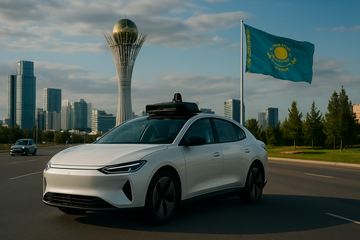
Two things happened on Oct. 23, 2026 that read as one event. Pony.ai, inDrive and NVIDIA signed a memorandum of understanding to put Gen-7 robotaxis on inDrive's app in Astana, and Baidu quietly held the better position: its Apollo Go unit disclosed a separate Kazakhstan memorandum with Turlov Private Holding in second-quarter results five weeks earlier. So the \"first mover\" framing is wrong on the facts. What is right is more useful — Kazakhstan is where a Chinese Level 4 stack gets its cheapest possible validation ground, and where an English-language platform company with a Kazakh founder and one of its largest employee hubs can pre-write the playbook for dozens of other lightly governed markets.
Astana population
~1.7M
Pilot launch city; population cited in the Oct. 23, 2026 joint announcement
Kazakhstan pilot window
3 years
Pilot rules approved Aug. 3, 2026 for Astana, Almaty and Kokshetau
Astana trial start
H1 2027
Safety-operator stage first, per inDrive's CTO, Oct. 22, 2026
Pony.ai robotaxi revenue
US$12.1M
Q2 2026, up 691.2% year over year; fare-charging revenue up 849.3%
Pony.ai robotaxi fleet
1,975
As of June 30, 2026; company targets more than 3,500 by year-end
Apollo Go fully driverless rides
~1 million
In Q2 2026 alone; more than 23 million cumulative public rides by June
NVIDIA Edge Computing revenue
$7.2B
Quarter ended July 26, 2026, within total revenue of $96.2B
Uber revenue
$14.19B
Q2 2026, quarter ended June 30, 2026; net income $2.39B
Regulatory
Kazakhstan Wrote the Rulebook Before the Vehicles Arrived
The order of events is the whole point. In late January 2026, Kazakhstan's Ministry of Artificial Intelligence and Digital Development, the Ministry of Transport and the Astana city government signed memoranda with inDrive and Yandex Qazaqstan for a three-year autonomous taxi pilot, with road markings, signage and pick-up zones scheduled for the first quarter. By early August, the ministries had approved the pilot's operating rules, and by late September the deputy prime minister said robotaxis would start in Kazakhstan in 2027. The Pony.ai memorandum arrived after the regulatory scaffolding was already standing.
| Date | Action | What it established |
|---|---|---|
| Jan. 27, 2026 | Ministry of AI and Digital Development, Ministry of Transport and Astana akimat sign pilot memoranda with inDrive and Yandex Qazaqstan | Three-year pilot; first stage at a test ground, then phased deployment on pre-agreed Astana and Almaty routes; road markings, signage and pick-up zones due in Q1 2026 |
| Mar. 31, 2026 | Deputy prime minister Zhaslan Madiyev sets pilot implementation for Q2 2026 | Named testing locations: Astana, Almaty and the Akmola region |
| Aug. 3, 2026 | Joint ministerial order approves the pilot rules | Three-year pilot in Astana, Almaty and Kokshetau; conditional automation requires a human ready to take over; high automation permitted with no driver in the cabin under remote operator supervision; data recorders, video surveillance, emergency stop, tamper protection and \"Autonomous control\" labelling mandated |
| Sept. 22, 2026 | Government says robotaxis will launch in Kazakhstan in 2027 | Pilot already running in Almaty, Astana and Kostanay; Yandex Qazaqstan testing a driverless car in Almaty to build a digital city map, needing several thousand kilometres before commercial trips; fines for aggregator violations raised from 30 to 100 monthly calculation units and about 70,000 right-hand-drive vehicles pulled from Yandex and inDrive fleets |
| Oct. 23, 2026 | Pony.ai, inDrive and NVIDIA sign memorandum of understanding | Gen-7 robotaxis offered through the inDrive app; Astana named as launch city; launch conditional on an agreement with the Kazakh government |
- High-automation vehicles may run with nobody in the driver's seat, provided a remote operator supervises them — the single most contested concession in the rulebook and the one a Chinese stack can actually use.
- Conditional automation still requires a person ready to take over, which matches the safety-operator stage inDrive described for the Astana trials.
- Every vehicle must carry data recorders, video surveillance, an emergency shutdown of the driving system and tamper protection, plus \"Autonomous control\" signage and liability insurance.
- The pilot is three years long, so an operator that starts in 2027 is buying regulatory cover through 2029 rather than a permanent licence.
Astana is also the second-coldest capital in the world, with long winters, snow and ice. Launching here will provide an important opportunity to evaluate autonomous driving technology in challenging winter conditions.
Competition
Baidu Reached Kazakhstan First, and Brought More Operating Data
In its second-quarter results filed on Aug. 18, 2026, Baidu disclosed a memorandum of understanding with Kazakhstan's Turlov Private Holding to jointly explore autonomous ride-hailing. Apollo Go ran roughly one million fully driverless rides in the quarter, had passed23 million cumulative public rides by June, and has accumulated more than 350 million autonomous kilometres across 28 cities, including fully driverless commercial operations in Dubai available through the Uber app and Hong Kong's first fully driverless permits. By the time the Pony.ai memorandum was announced, Baidu had beat Pony.ai to the Kazakh starting line by five weeks and held one to two orders of magnitude more real-world operating data.
| Operator | Announced position | Disclosure date | Status of evidence |
|---|---|---|---|
| Baidu Apollo Go with Turlov Private Holding | Memorandum to jointly explore autonomous ride-hailing in Kazakhstan | Aug. 18, 2026 (second-quarter results) | Company-reported in a filed results release |
| inDrive and Yandex Qazaqstan with the transport ministry and Astana akimat | Named parties to the three-year pilot memoranda; infrastructure preparation | Jan. 27, 2026 | State news agency report of ministerial memoranda |
| Yandex Qazaqstan | First driverless car under test in Almaty, collecting data and building a digital city map | Sept. 22, 2026 | Quoted by name at a government meeting |
| Pony.ai with inDrive and NVIDIA | Gen-7 robotaxis through the inDrive app in Astana, subject to a government agreement | Oct. 23, 2026 | Memorandum of understanding; no fleet size, price or date disclosed |
| inDrive with AI Driver | Separate agreement to explore WeRide-powered autonomous vehicles starting in Riyadh | Disclosed Oct. 22, 2026 | Exploratory agreement; start of testing unconfirmed |
Disclosure
What the Memorandum Does Not Disclose
Read the announcement for what is missing. Neither the joint statement nor the Pony.ai investor-relations release names a vehicle count, a contract value, a duration, a deployment schedule or even a binding launch date for Kazakhstan. The three-way split is: Pony.ai supplies Gen-7 vehicles, inDrive supplies the platform and runs the service, and NVIDIA supplies the AI infrastructure, with Hyperion as the Level 4 reference sensor and compute platform combined with the Alpamayo stack and Halos safety system. The launch \"would follow agreement with the government of Kazakhstan.\"
- No vehicle count, no capital commitment, no revenue or margin sharing terms between the three parties.
- No binding launch date — the only timing anywhere in the record is inDrive's chief technology officer saying Astana tests begin in the first half of 2027, with a safety operator on board before fully driverless rides.
- No guarantee of government consent; the memorandum makes the Kazakh agreement a precondition, which leaves the critical path in Astana and not in Guangzhou.
- No scope for Almaty or Kostanay, the two cities where pilot activity is actually running, despite Astana being named the launch city.
Compare that with how Pony.ai frames its European commitments: more than 2,000 robotaxis contracted with Uber across five European cities, and over 4,000 vehicles under agreement or negotiation across international markets. Kazakhstan is the one market where the company has a signed partner, a named city and a reference compute stack — and tells investors the pilot is a pilot. That is not necessarily bad; it is a deliberately cheap option on a regulatory outcome.
Supply chain
Where the Money Sits: Compute Upstream, Platform in the Middle, Aggregators Downstream
| Layer | Company | Documented linkage | Anchor figure |
|---|---|---|---|
| Compute and safety | NVIDIA | Hyperion reference platform plus Alpamayo stack and Halos safety system named as the stack for the Kazakh deployment | Edge Computing revenue $7,198M in the quarter ended July 26, 2026 |
| Sensors | RoboSense | Four E1 solid-state lidar units per Gen-7 robotaxi; lidar cost down 68% in the Gen-7 redesign | Six categories of production sensors on the Gen-7 platform |
| Vehicle platforms | BAIC BluePark, GAC Group, Toyota | BAIC, GAC and Toyota models carry Gen-7 robotaxis now in daily service | Gen-7 system cost down 70% versus the previous generation |
| Autonomy stack owner | Pony.ai | Supplies Gen-7 robotaxis and runs its own world model and virtual driver stack | Robotaxi services revenue US$12.1M in Q2 2026, up 691.2% year over year |
| Demand and operations | inDrive | Runs the service on its app in 47 countries; one of its largest employee hubs is in Kazakhstan | 2025 revenue US$601.6M, up 31% |
| Global aggregator | Uber | Distributes Apollo Go in Dubai and rides Pony.ai Gen-7 in Zagreb and London | Q2 2026 revenue $14,191M and net income $2,394M |
| Rival stack | WeRide | Its stack powers the Riyadh agreement inDrive signed with AI Driver | Q2 2026 revenue CNY 231.7M against an operating loss of CNY 421.9M |
| Local incumbent | Yandex Qazaqstan | Testing a driverless car in Almaty and building the city's digital map | Pilot live in Almaty, Astana and Kostanay |
The structure is worth stating plainly because it decides who collects what. Pony.ai sells vehicles and software, not rides; inDrive owns the rider relationship and the operating licence; NVIDIA owns the compute and, more importantly, the safety doctrine that a regulator is likely to reference. So a Kazakh pilotharms no listed bottom line and creates no near-term revenue — it is a reference implementation whose value accrues to whoever owns the standard.
Two upstream facts sharpen the point. Gen-7 is described by Pony.ai as the first system built on 100% automotive-grade components, with system cost down 70% against the previous generation, lidar cost down 68% and the vehicle computing unit down 80%, and the company has said it wants per-vehicle breakeven. That cost curve is what makes a fleet of tens of vehicles in Astana plausible, and it is also why the chassis suppliers — BAIC BluePark, GAC Group and Toyota — are the ones absorbing the pressure of supplying platforms at scale for a customer with pricing power.
Fundamentals
The Numbers Behind the Headline Are Small, and the Comparators Are Not
Pony.ai revenue mix, Q2 2026 (US$ millions)
Robotaxi services reached a third of group revenue for the first time, on a base that is still small in absolute terms. Source: Pony.ai second-quarter 2026 results, Aug. 17, 2026.
Unit: US$ millions
Robotaxi services
Up 691.2% year over year
12.1
Robotruck services
Up 40.0% year over year
13.3
Intelligent solutions
Broadly flat against US$10.4M
10.8
Total revenue
Up 68.8% year over year
36.2
Robotaxi revenue has grown to a third of group revenue, but the denominator is what constrains the Kazakhstan story. First-half2026 revenue was US$70.5M against an operating loss of US$124.1M, with research and development of US$104.1M, and the company held US$1,390.5M of cash, short-term investments and wealth-management instruments at June 30. Divide the Q2 robotaxi figure by the 1,975-vehicle fleet and revenue works out near US$6,100 per robotaxi per quarter — a rough ratio, since the fleet grew through the period and segment revenue includes more than fares, but the right order of magnitude.
| Metric | Latest reading | Comparison | Period and source |
|---|---|---|---|
| Total revenue | US$36.22M | US$21.455M a year earlier, up 68.8% | Q2 2026, results furnished Aug. 18, 2026 |
| Robotaxi services revenue | US$12.1M | Up 691.2%; fare-charging revenue up 849.3% | Q2 2026, results furnished Aug. 18, 2026 |
| Gross profit | US$6.35M | 17.5% of revenue, on US$29.87M cost of revenue | Q2 2026, results furnished Aug. 18, 2026 |
| First-half revenue | US$70.47M | US$35.43M a year earlier, up 98.9% | Six months to June 30, 2026 |
| First-half operating loss | US$124.08M | US$117.31M a year earlier | Six months to June 30, 2026 |
| Cash and investments | US$1,390.5M | Cash, short-term investments, restricted cash and wealth-management debt instruments | As of June 30, 2026 |
| Robotaxi fleet | 1,975 vehicles | Company targets more than 3,500 by year-end 2026 | As of June 30, 2026 |
| Overseas vehicles under agreement or negotiation | Over 4,000 | Includes more than 2,000 robotaxis contracted with Uber across five European cities | Q2 2026, results furnished Aug. 18, 2026 |
Set the same quarter against the two comparators and the scale gap is stark. NVIDIA reported US$96.2B of revenue for the quarter ended July 26, 2026, with Data Center at US$89.0B and the combined Edge Computing line that now carries automotive, gaming and robotics at US$7.2B — so the Kazakh pilot cannot move NVIDIA's numbers by any visible amount. Uber reported US$14.19B of revenue and US$2.39B of net income for the June quarter, and it collects riders whether the vehicle behind them is Baidu, Pony.ai or WeRide. The Kazakh pilot barely dents any of these profit and loss statements.
NVIDIA revenue by market platform, quarter ended July 26, 2026 (US$ millions)
Automotive, robotics, gaming and professional visualisation are now reported inside a single Edge Computing line, so vehicle compute is a rounding error next to data center demand. Source: NVIDIA Form 10-Q for the quarter ended July 26, 2026.
Unit: US$ millions
Data Center
Hyperscale US$48,710M plus AI Clouds, Industrial and Enterprise US$40,313M
89,023
Edge Computing
Now includes gaming, professional visualisation and automotive
7,198
Horizons
Days to Quarters, Then 2027 to 2029
| Checkpoint | Timing | Why it matters |
|---|---|---|
| Agreement with the Kazakh government | Undated; the stated precondition for any launch | Converts a memorandum into a permitted commercial service and unlocks the Astana safety-operator stage |
| Pony.ai third-quarter results | Nov. 18, 2026 | First filing after the memorandum; watch for a Kazakhstan fleet number, a contract value or a named local operator |
| Pony.ai Gen-7 road tests with Uber in London | From weeks after Oct. 8, 2026 | The same software stack in a regulated Western market, with the UK Automated Vehicles Act expected to be fully implemented in 2027 — a harder test than Astana |
| Astana safety-operator trials | First half of 2027 | First live Gen-7 operation with Hyperion and Halos in a cold, snowy climate |
| Kazakhstan commercial launch | 2027, per the deputy prime minister on Sept. 22, 2026 | Separates a supervised pilot from a paid service and reveals whether operators and riders actually transact |
| End of the pilot window | 2029 | Three-year pilot approved Aug. 2026; renewal is a political decision, not an engineering one |
Over a one-to-three-year view the question is whether the doctrine travels. If Astana shows that a Chinese stack can run driverless under remote supervision through a Kazakh winter while a Kazakh regulator signs off, inDrive can point at a legal precedent across 1,200 cities in 47 countries — and the same regulatory template becomes a substitute for a home-market champion in places where inDrive already has drivers and users. That is the strategic content of the announcement, and it is also why the Kazakh pilot matters to NVIDIA: a safety stack that a regulator has already blessed in one jurisdiction is cheaper to certify in the next.
- Replication is the bull case: a 2027 Astana start, driverless-without-a-safety-driver conversion, and then the same approval pattern applied to other unregulated or newly regulated markets served by inDrive.
- Unit economics is the test: Pony.ai has said it wants per-vehicle breakeven after a 70% Gen-7 system cost reduction, and Kazakhstan's small, cold, supervised fleet is the cheapest place to find out whether that curve actually reaches breakeven.
- The local-operator slot is the fight: Baidu arrived with Turlov Private Holding, Yandex Qazaqstan is building the digital map of Almaty, and whoever holds the local relationship holds the operating licence.
- Risks are real: the memorandum is non-binding, the pilot expires in 2029, Kazakhstan is simultaneously tightening on aggregator conduct, and export or data-sovereignty friction can close a market that opened in a single ministerial order.
Synthesis
A Regulatory Premium Priced Like an Option
Separating the three layers of confidence. Facts: Pony.ai, inDrive and NVIDIA signed a memorandum on Oct. 23, 2026 to explore Gen-7 robotaxis in Astana; Kazakhstan approved autonomous taxi pilot rules in August, including driverless operation with remote supervision; Baidu disclosed its own Kazakhstan memorandum in August and ran about a million fully driverless rides in the June quarter. Inference: the value of Astana is precedent and certification rather than rides, because a 1.7 million-person capital cannot support fleet economics. Speculation: that the precedent migrates into dozens of other lightly governed markets, which nobody can yet observe.
The uncomfortable implication is that this is not a Western-versus-China story. Nothing in the record shows the United States or Europe denying anything: Uber is already running Pony.ai Gen-7 vehicles in Zagreb, plans London road tests, and offers Baidu's fully driverless Dubai fleet in its own app. Kazakhstan is parallel to the UK's 2027 implementation timetable, not ahead of it. The arbitrage is cheaper permission, not earlier permission, and it is captured by the platform and the standard-setter rather than by whoever flags the first ride.
So Pony.ai trades on optionality in a market it has not entered, and its third-quarter print on Nov. 18 is the first place that optionality could become a number. If the company discloses a Kazakhstan fleet, a contract value or a named local partner, the template thesis gains a hard data point; if the only disclosure is a repeat of the memorandum, then the honest conclusion is that a licensing framework was built for an operator that has not yet committed to it — useful for the ecosystem, and not yet an earnings event for anyone.
Where the exposure actually sits
- Robotaxi services revenue of US$12.1M in Q2 2026, up 691.2% year over year, with fare-charging revenue up 849.3% — the growth engine is domestic, not Kazakh.
- Astana trials begin in the first half of 2027 with a safety operator aboard, and the launch still requires a Kazakh government agreement that has no date.
- The third-quarter results on Nov. 18, 2026 are the first disclosure checkpoint for a Kazakhstan fleet number or contract value.
- Over 1,975 robotaxis and over 4,000 vehicles under international agreement or negotiation mean Kazakhstan is optionality rather than a swing factor for revenue.
- Hyperion, Alpamayo and Halos are the only compute and safety stack named for the Kazakh deployment, giving the platform a third-jurisdiction reference install.
- Edge Computing revenue of US$7,198M in the quarter ended July 26, 2026 sits inside US$96.2B of total revenue, so a Kazakh pilot is immaterial to earnings.
- A remote-operator supervision doctrine blessed by a regulator can be reused in each subsequent market, which compounds standard-setting value far faster than hardware sales.
- The near-term risk is that a safety stack referenced in one pilot does not travel to London, Zagreb or Riyadh on the same timetable.
- Apollo Go ran about one million fully driverless rides in Q2 2026 and passed 23 million cumulative public rides, against Pony.ai's 1,975-vehicle fleet.
- Its Kazakhstan memorandum with Turlov Private Holding was disclosed on Aug. 18, 2026, five weeks before the Pony.ai announcement.
- Fully driverless commercial operations in Dubai, available through the Uber app, and Hong Kong's first fully driverless permits show the stack already clears harder regulators.
- The counterweight: Kazakhstan's rules admit multiple operators, so first arrival secures a partner position, not exclusivity.
- Uber monetises rider demand regardless of which stack wins, distributing Apollo Go in Dubai, Pony.ai Gen-7 in Zagreb and London, and WeRide in Riyadh.
- Q2 2026 revenue of US$14,191M and net income of US$2,394M give Uber the balance sheet to aggregate rival autonomy stacks without owning them.
- Autonomy partnerships are a supply hedge against driver supply and a defence against Baidu and Pony.ai building their own demand aggregators.
- The risk is that serving Chinese-built vehicles in the US and Europe carries regulatory and data-sovereignty exposure that offsets the option value.
- Its stack powers the Riyadh agreement inDrive signed with AI Driver, giving WeRide a route into inDrive's 1,200-city footprint.
- Q2 2026 revenue of CNY 231.7M, up from CNY 127.2M, came with an operating loss of CNY 421.9M and research spending of CNY 434.3M.
- inDrive is running two rival Chinese stacks, and the rival stack took the marquee Astana slot.
- Watch whether the Riyadh programme actually begins operating; as of Oct. 22, 2026 the agreement was described as exploratory.
- Four E1 solid-state lidar units sit on every Gen-7 robotaxi, so each overseas vehicle adds sensor content.
- The same redesign cut lidar cost 68% and the vehicle computing unit 80%, which protects volume but compresses price per unit.
- Gen-7 platforms from BAIC, GAC and Toyota are already in daily service, so unit demand comes from fleet scale rather than from Astana alone.
- Six categories of production sensors on Gen-7 mean the content story survives the cost-down, but only if fleet volumes materialise.
- Its BAIC platform carries Gen-7 robotaxis in daily service, giving it a real position in the Chinese robotaxi supply chain.
- Yet the customer captures the economics: Gen-7 system cost fell 70%, lidar cost 68% and the computing unit 80%.
- Robotaxi volumes in Kazakhstan would be immaterial against its core vehicle business, which funds a multi-billion renminbi revenue base.
- The asymmetry to watch is who absorbs the cost of supplying at scale for a customer with per-vehicle breakeven as its goal.
- A Pony.ai autonomy kit has run on a Hyundai Kona for two years over 87,000 km of Gangnam testing ahead of a Korean joint venture.
- That venture with FutureLink targets 200 driverless robotaxis in Seoul by 2028.
- Korea still operates only 132 driverless vehicles with 13.06 million cumulative kilometres across 55 pilot zones, so certification is the binding constraint, not demand.
- A Korean rollout would give Pony.ai a second regulated overseas corridor and a second policy template to carry.