
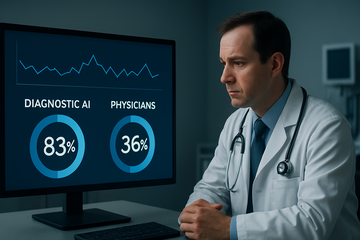
Three things landed in the same week. Microsoft put a peer-reviewed diagnostic benchmark in Science on Oct 22, 2026 and told investors to expect clinical AI deployments in production next year. California signed two laws that make clinical decision support a compliance obligation from Jan 1, 2027 — and vetoed the single bill that would have protected the clinician who overrules it. The result is a company holding a proven benchmark and no defensible path to a revenue line, because the binding constraint on clinical AI is now who carries the liability, not who writes the better system.
MAI-DxO accuracy on 304 NEJM cases
83%
Science, Oct 22, 2026; generalist physicians scored 36.1% with references and 22.3% without
Emergency-department accuracy
80.3%
MIMIC-IV-ED cases; physicians averaged 47%
Average testing cost per case
$1,303–$8,945
Benchmark estimate of tests ordered, not compute; ED cases averaged $4,980
Microsoft fiscal 2026 revenue
$331.8B
Year ended June 30, 2026; healthcare reported inside cloud services with no separate line
The paper, audited
83% Is Real. It Was Also Won on Paper, Not on Patients.
Microsoft's Diagnostic Orchestrator is an orchestration layer that behaves like a virtual specialist panel: it asks the patient questions, orders tests, and revises the differential as results arrive. The benchmark, called SDBench, converted 629 cases — 304 complex cases published in the New England Journal of Medicine plus emergency-department encounters from MIMIC-IV-ED — into interactive diagnostic puzzles where information arrives in stages. That structure is the point: it removes the cheat of a fully revealed chart, which is where earlier medical-model benchmarks flattered themselves.
| Measure | Microsoft MAI-DxO | Physicians | Read-through |
|---|---|---|---|
| Complex NEJM cases (304) | 83% (79.6%–84.5% across cost settings) | 36.1% with references; 22.3% without; best single physician 51.8% | A 2.3x gap over generalists, not a defeat of specialists |
| Emergency-department cases | 80.3% | 47% | 1.7x on common presentations, not rare ones |
| Average testing cost per case | $1,303–$8,945; $4,980 on ED cases | Not reported | Cost advantage proven against rival AI systems, not against physicians |
| Evidence base | Retrospective simulation of published cases | Clinicians given references, working individually | No prospective clinical validation; the system cannot examine a patient |
Sequential diagnosis accuracy: Microsoft's orchestrator against generalist physicians
MAI-DxO results from the Science paper and Microsoft's Oct 22, 2026 announcement; NEJM-case and emergency-department bars are separate benchmarks.
Unit: % diagnostic accuracy
MAI-DxO (NEJM cases)
304 published cases
83%
MAI-DxO (ED cases)
MIMIC-IV-ED
80.3%
Best single physician (NEJM)
Even this physician was beaten on cost
51.8%
Physicians with references (NEJM)
Average
36.1%
Physicians without references (NEJM)
Average
22.3%
Physicians (ED cases)
Average
47%
The cost figures need careful reading. The benchmark's “cost” is the medical workup — tests ordered — not compute, and the paper reports no physician workup cost at all. Microsoft's claim that its system reaches a correct diagnosis “at half or even one third of the cost” is therefore verified only against rival AI configurations: GPT-5 in a single-model baseline scored 78.9% at roughly $8,400 per case, and adding orchestration cut that by about $3,000 while adding about four points of accuracy. Nothing in the study shows a cheaper workup than a doctor's.
The deployment queue
A Benchmark Is Not a Product
Between the Science paper and a paying hospital customer sit five gates Microsoft has not cleared. It is not a technology problem; it is the ordinary friction of selling software into a profession where the buyer, not the vendor, carries the outcome.
- Prospective validation: Microsoft is beginning hospital testing with Beth Israel Deaconess Medical Center using independent physician assessment, and as of Oct 22, 2026 offered no start date beyond “the next couple of months.”
- Cohort mismatch: the benchmark pitted generalist physicians working alone against an orchestrated panel, while specialist teams — who handle cases like these in practice — were excluded from the comparison.
- No product form: no SKU, no price and no regulatory pathway has been disclosed, and Microsoft's fiscal 2026 accounts disclose no healthcare revenue figure.
- No indemnity: no malpractice or product-liability commitment has been announced for MAI-DxO, and a clinician who follows its guidance still carries the exposure personally.
- Asset ownership: in the Mayo Clinic collaboration announced Jun 2, 2026, the frontier health model is owned by Mayo Clinic and deployed by Microsoft — the shape of a cloud contract, not a medical-device sale.
- Governance burden: from Jan 1, 2027, California's SB 503 requires developers and deployers of clinical decision support to document training data, performance, bias evaluation and monitoring, so every hospital that wants the tool inherits that duty.
We're going to build something that is indistinguishable from human performance … in the next couple of years.
Set that against Microsoft's other promise — “next year we're going to see extremely impressive deployments of intelligent systems in production” — and the arithmetic tightens. Deployments in 2027 implies validation results in 2027 and commercial contracts after that. Investors funding clinical AI in 2026 are funding a research program with a distribution strategy attached, and Microsoft paired the Science paper with a companion vision paper in BMJ Digital Health & AI the same day, co-authored with outside clinical academics and its own health leadership, to keep the narrative ahead of the evidence.
Where the money is
Microsoft Is Selling Cloud Consumption, Not Diagnosis
The commercial logic is already visible in Microsoft's own accounts. Healthcare sits inside the Intelligent Cloud segment as “Health and Life Sciences cloud services (formerly Nuance Healthcare cloud services)”, a line inside server products and cloud services with no revenue figure attached. Clinical AI is monetized the way all of Microsoft's AI is monetized: Azure consumption, seats and model calls, with the diagnostic capability as the proof point that pulls the consumption.
| Metric | FY2026 | FY2025 |
|---|---|---|
| Revenue | $331.8B | $281.7B |
| Operating income | $155.2B | $128.5B |
| Net income | $133.7B | $101.8B |
| Diluted earnings per share | $17.95 | $13.64 |
| Cash from operations | $182.9B | $136.2B |
| Property and equipment spending | $115.9B | $64.6B |
| Free cash flow | $67.0B | $71.6B |
| Azure and other cloud services growth (Q4) | +43% constant currency | — |
| Azure full-year revenue | Passed $100B for the first time | — |
| Commercial remaining performance obligations | $678B, up 84% | — |
Microsoft's capital spending nearly tripled in two years while free cash flow fell
Property and equipment spending from Microsoft cash flow statements; free cash flow moved from $74.1B in fiscal 2024 to $67.0B in fiscal 2026.
Unit: USD billions
FY2024
44.5
FY2025
64.6
FY2026
115.9
- Epic is the distribution: the largest EHR vendor ships AI Charting built on Microsoft models running in Azure, and Microsoft's Dragon Copilot release notes for version 3.6 turn on a limited set of Epic FHIR APIs so the assistant can read medications, conditions and prior findings directly.
- Dragon Copilot is the beachhead: more than 100,000 clinicians used it as of March 2026, with partner software from Optum, Canary Speech, Humata Health and Regard sold inside the same interface.
- Copilot Health is the consumer wedge: since March 2026 the tool pulls records from more than 50,000 US hospitals and providers through HealthEx and reads more than 50 wearables, turning health data into engagement rather than clinical revenue.
- The knowledge layer is rented, not owned: Microsoft partnered with Wolters Kluwer for evidence content inside Dragon Copilot, which is how a clinical assistant becomes defensible without building a proprietary corpus.
Liability, not capability
The Law Decides Whose AI Gets Used
The gatekeeper is a state legislature in Sacramento. On Sept 30, 2026 Gov. Newsom signed AB 1979, which from Jan 1, 2027 requires health facilities, clinics and physicians to take reasonable steps to ensure a licensed clinician exercises independent judgment whenever care is informed by a clinical decision support system, with violations enforceable as unprofessional conduct. He also signed SB 503, which puts the documentation burden on the other side of the contract: developers and deployers of clinical decision support must identify foreseeable biased impacts, document training data and performance, and monitor effects after deployment.
| Party | Where the record stands | Effect of an MAI-DxO-class tool |
|---|---|---|
| Clinician | Malpractice law still treats the physician as the focal point of liability; “the AI got it wrong” is not a defense (Medscape, Jan 2026) | A tool proven more accurate than generalists raises the cost of ignoring it |
| Health system | AMA's governance toolkit requires local evaluation, defined use cases, training and monitoring; AB 1979 adds a professional-conduct backstop from Jan 1, 2027 | Hospitals become the gatekeeper and absorb the governance cost |
| AI vendor | BMJ's June 2026 analysis describes clinicians exposed while vendors stay shielded; California's AB 2575, which would have barred vendors from blaming a clinician who failed to override, was vetoed on Sept 30, 2026 | Without indemnity there is no hospital sign-off |
| Courts | No US malpractice verdict has rested on AI as its central claim as of early 2026, despite 1,300 FDA-authorized AI-enabled devices | Case law will be written by whichever system adopts first |
This produces an incentive that runs against Microsoft's own sales motion. Medscape describes the trap precisely: clinicians are criticised for leaning on flawed AI and equally criticised for failing to use tools that could have caught a lesion — and if practice guidelines eventually absorb AI-assisted tools, “not using a tool that improves detection could become harder to defend.” A benchmark that proves AI outperforms generalists therefore raises the malpractice bar for the physician first and the vendor second. Adoption is already broad enough for that to bite — the AMA's survey put physician use of AI tools at 66% in 2024 against 38% in 2023 — and the first test cases are arriving: a Florida hospital group is defending a lawsuit alleging AI contributed to a patient's delayed cancer diagnosis, and no court has yet ruled on how an AI output enters the standard of care.
Supply chain
Orchestration Is the Moat, Which Is Exactly the Problem for Point AI Vendors
The most revealing number in the Science paper is not 83%. It is 46.4%: Gemini 2.5 Flash's standalone score on the complex cases, which rises to nearly 69% once Microsoft's orchestration wraps around it. The durable asset is the coordination layer, not the underlying model — and a coordination layer is not proprietary to anyone.
- Compute: orchestrated diagnosis multiplies model calls per case, and Microsoft put $115.9 billion into property and equipment in fiscal 2026, up from $64.6 billion, funding the Azure capacity that runs it.
- Frontier models: the published result leans on OpenAI's GPT-5 and its April 2026 successor GPT-5.5, which lifted complex-case accuracy from 72% to nearly 87% with the orchestration unchanged — Microsoft's increasingly independent medical stack still rents its best models.
- Clinical records: the benchmark itself runs on Beth Israel Deaconess's MIMIC-IV-ED dataset, and deployment depends on the same longitudinal record access Epic's FHIR interfaces provide.
- Evidence content: knowledge publishers supply the citations and guidelines that turn a plausible answer into a defensible one, with Wolters Kluwer's content already wired into Dragon Copilot.
- Data plumbing: HealthEx is the conduit that turns 50,000-plus US hospital record sets into a consumer product, which is how Microsoft's health footprint reaches patients before it reaches clinicians.
The same logic is already documented against the incumbents. In Nature Medicine on Jun 12, 2026, an NYU Langone team showed general-purpose models beating specialised clinical tools on all three evaluations: GPT-5.2 scored 88.0 on HealthBench against 62.6 for OpenEvidence and 61.3 for UpToDate Expert AI, and on 100 real clinician queries graded blind, the two clinical tools had 49% to 87% lower odds of outrating Gemini 3.1 Pro. If orchestration is what beats doctors and general models are as good as clinical models, then “medical superintelligence” is a workflow feature any model vendor can ship — and the buyers gain negotiating power against every vendor selling point AI in medicine.
- Hospitals buy the governance, not the model: HCA Healthcare generated $75.6 billion of fiscal 2025 revenue and $12.0 billion of operating income, and adding a diagnostic tool to that base adds monitoring, training and indemnity cost before any clinical benefit.
- Testing volume is the quiet casualty: Quest Diagnostics grew revenue 11.8% to $11.0 billion in fiscal 2025 and 10.2% year over year in the second quarter of 2026, but Microsoft's cost claim — half to a third of the workup cost of rival AI systems — is a per-case testing-intensity headwind if the tool ever scales.
- Payers capture the savings: UnitedHealth Group reported $447.6 billion of fiscal 2025 revenue while Optum already sells software inside Dragon Copilot; a workup that costs half as much is a medical-cost margin story for the payer, and a utilisation-review story regulators are already circling.
Horizons
What Moves in Days and Quarters, and What Moves by 2029
The next two quarters will produce commentary, not revenue; the next three years will produce contracts, if anyone underwrites the risk.
- Days to quarters: no healthcare revenue disclosure is plausible before fiscal 2027 results, with the Health and Life Sciences line staying unquantified inside cloud services.
- The first hard datapoint is the Beth Israel Deaconess prospective study — Microsoft's own clinical lead said testing would start “in the next couple of months” from Oct 22, 2026 — and the first governance bill lands Jan 1, 2027 when California's AB 1979 and SB 503 take effect.
- Also worth watching: Epic's own AI Charting, built on Microsoft models inside Azure, proves the substrate while keeping the workflow, and it is the competitive event that matters more than any benchmark.
- One to three years: a clinical product becomes plausible only when somebody indemnifies it, which means an insurer, a hospital or Microsoft itself absorbing medical-liability risk that nobody has priced yet.
- The likeliest 2029 outcome is that Microsoft's clinical AI becomes invisible infrastructure inside Epic and Oracle workflows, billed as cloud consumption, with the diagnostic moat captured by whoever owns the medical record.
- Downstream, per-case testing intensity falls before diagnosis volume rises: laboratories get squeezed first, payers second, and point-AI vendors get squeezed from both sides.
Bottom line
A Capability Claim, an Azure Line and a Liability Queue
The most defensible reading of Oct 22, 2026 is narrow: a credible orchestration system, validated on published cases, that beats generalists on a simulation and on emergency-department records. Everything beyond that — a product, a price, a liability regime, a revenue line — remains unbuilt, and the first three gates are legal, not technical.
- The benchmark is real and narrower than the headline: 83% on 304 published cases in simulation, against generalists working alone, not against specialist teams.
- The revenue sits upstream of the diagnosis: Azure consumption and seats, with clinical AI strengthening demand for a segment that already exceeds $100 billion a year.
- The binding constraint is legal: California's Jan 1, 2027 compliance duties and a vetoed clinician-protection bill decide deployment speed, not model quality.
- The investable consequence is dispersion, not a winner: compute and cloud capture the near-term spend, payers capture the cost savings, laboratories carry the testing-intensity risk, and AI-native diagnostics vendors face a bar set by somebody else's orchestration.
Stocks this event actually touches
- books no healthcare revenue line despite a benchmark-winning diagnostic AI, so the paper cannot move fiscal 2027 numbers
- Azure passed $100 billion of annual revenue in fiscal 2026 and grew 43% in constant currency in the fourth quarter; clinical AI is demand, not segment.
- Near term: California duties from Jan 1, 2027 slow hospital procurement; long term: the clinical layer risks becoming invisible infrastructure inside Epic and Oracle workflows.
- funds the inference substrate behind orchestrated diagnosis, with Microsoft's fiscal 2026 property and equipment spending reaching $115.9 billion
- NVIDIA's fiscal 2026 revenue of $215.9 billion grew 65% year over year; clinical AI adds nothing material to that base, so the read-through is Microsoft's capex, not the Science paper.
- Long term: orchestrated clinical workflows multiply model calls per case, the same compute shape as enterprise agents.
- holds the second-largest EHR estate that Microsoft's Epic-based distribution bypasses, pressuring Oracle Health's clinical AI positioning
- Oracle's fiscal 2026 revenue was $67.4 billion with $10.3 billion of research and development; the health franchise competes for the same hospital AI budget.
- Counterweight: Oracle keeps the Cerner data and contracts captive, so Microsoft's diagnostic layer must win on workflow rather than on record access.
- pays the governance bill before it sees any clinical AI benefit, with AB 1979 and SB 503 duties landing Jan 1, 2027
- HCA produced $75.6 billion of fiscal 2025 revenue and $12.0 billion of operating income; no disclosed MAI-DxO deployment exists at any large for-profit operator.
- Catalyst: a paid deployment contract with indemnification would mark the first hospital system willing to underwrite diagnostic AI liability.
- absorbs the first squeeze if per-case testing intensity falls, because Microsoft's cost claim is about the workup, not compute
- Quest grew revenue 11.8% to $11.0 billion in fiscal 2025 and 10.2% year over year in the second quarter of 2026, so today's demand reflects none of this.
- Long term: more correct diagnoses can add confirmatory testing, and the net effect depends on which effect arrives first.
- captures the medical-cost savings if a workup costs half as much, and already sells software inside Microsoft's clinical interface
- UnitedHealth reported $447.6 billion of fiscal 2025 revenue; Optum's presence in Dragon Copilot makes the payer a channel as well as a buyer.
- Risk: the same autonomy that trims testing can automate utilisation review, the area drawing regulatory scrutiny.
- feels the orchestration bar as general-purpose models match purpose-built clinical AI on published benchmarks
- Lunit's first-quarter 2026 revenue rose 25% to KRW 23.95 billion, but research headcount fell 26.7% to 137 by June 2026 as it pushed for profitability.
- Horizon: demand for independently validated imaging AI rises even as differentiation falls, giving buyers a cheaper alternative to negotiate against.
- watches a hyperscaler's accuracy bar from a 3.8% healthcare revenue base, with smart healthcare growing more than 20%
- iFLYTEK's intelligent-medicine revenue was CNY 438.0 million in the first half of 2026 while group revenue grew 7.99% in the third quarter.
- Catalyst: whether a hyperscaler-grade diagnostic model reaches China through an approved local partner, which would reset pricing for domestic clinical AI.