
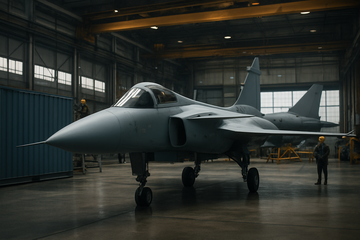
Defense aerospace • Gripen • Ukraine sustainment economics
A single Gripen E contract changed the math on Saab’s backlog—fast
Saab’s latest update tied a step-change in its order momentum directly to the Ukraine Gripen award. In the quarter, Saab booked SEK 65.825B of new orders, including a SEK 24.6B Gripen E order for Ukraine and ending the period with a SEK 364.2B order backlog.
New orders booked (quarter)
SEK 65.825B
Q3 2026 (bookings reported with Jan–Sep 2026 highlights), announced Oct 23, 2026
Ukraine Gripen E contract value
SEK 24.6B
16 Gripen E fighters; booked in Q3 2026, announced Oct 23, 2026
Ending order backlog
SEK 364.2B
End of Q3 2026, announced Oct 23, 2026
Event verification • What exactly was awarded
What was won: 16 Gripen E aircraft, delivered later, booked now
The Gripen order wasn’t framed as a near-term “revenue spike,” but as a program award that is booked at signing and delivered later. Saab said it signed a contract with Sweden’s defense materiel administration (FMV) for 16 Gripen E fighter aircraft for Ukraine, with deliveries scheduled for 2029–2030.
| Item | Disclosure | Timing anchor |
|---|---|---|
| Aircraft | 16 Gripen E fighters | Contract disclosed with the Ukraine order |
| Counterparty | Swedish Defence Materiel Administration (FMV) | Company-reported contracting party |
| Order value | Approximately SEK 24.6B | Booked in Q3 2026 |
| Delivery window | 2029–2030 | Company-reported delivery scheduling |
Competitive channel • Why US “primes” can lose leverage
The channel shift: Europe’s “own prime + sustainment” path can skip US FMS priming
The core investment angle is competitive structure. When fighter demand is satisfied via a European prime’s direct line to an end customer (through European government contracting and industrial workshare), it can reduce the “deal surface area” for US primes that often sit earlier in the allocation chain through US-led prime offerings and foreign military sales orchestration. In Saab’s case, the quarter’s surge was driven by the Ukraine Gripen booking, which Reuters also described as underpinning Saab’s order intake rising 216% year-on-year.
Supply chain • What changes when backlog rises
Full lifecycle transmission: aircraft primes now “own” more than airframes
- When Saab books a large Ukraine Gripen award, it expands the long-duration sustainment workload that follows delivery and modernization.
- A 16-aircraft contract scales the need for spares, software support, and periodic upgrades—where primes usually retain a higher share than in the initial airframe sale.
- Backlog scale at Saab improves forward visibility, which tends to support investment in production capacity and supplier readiness for later delivery windows (2029–2030).
Short-term vs long-term • What investors should watch next
Horizons: near-term booking momentum vs 2027–2030 sustainment economics
Near term (quarters): this is a bookings story—Saab showed a clear booking impulse in Q3 2026 tied to Ukraine Gripen. Longer term (delivery and lifecycle): investors should focus on what fraction of Gripen program value flows into sustainment contracts, modernization options, and mission system upgrades as the installed base grows into the 2029–2030 delivery window.
Data-backed thesis • One clear takeaway
Thesis: Saab’s Gripen order proves Europe can capture fighter demand—and the margin stays closer to the European prime
Saab disclosed that the quarter’s order intake included a SEK 24.6B Ukraine Gripen E award for 16 aircraft, lifting total quarter bookings to SEK 65.825B and ending with a SEK 364.2B backlog. The non-obvious implication is competitive: a large chunk of new fighter-related spend can remain with a European prime’s sustainment-and-upgrade ecosystem instead of passing through a US prime-led pipeline.
Listed peers and competitive transmission (what to watch)
- A Gripen-for-Ukraine order is less likely to route through US prime offerings for this incremental demand, tightening future allocation for US-led channels.
- Because the disclosed delivery window starts in 2029–2030, the competitive pressure can show up in order selection decisions over the next 12–36 months (as follow-on packages get negotiated).
- If European primes capture more fighter demand, some mission-system and integration budgets may re-balance away from US prime-centric bundles tied to new buys.
- At the same time, if sustainment becomes a larger share of lifecycle spending, RTX’s defense electronics exposure can stay bid via component-level work—but the net direction depends on contractual workshare.
- A European fighter award that scales European backlog supports the broader “European prime sustainment” model, which can buoy competitor order intake narratives.
- Over 1–3 years, if the channel shift persists, BAE’s future airpower workshare negotiations may benefit from the same procurement pivot referenced by Saab’s Ukraine order flow.
- If fighter demand continues to route via European primes, new airborne integration opportunities may arrive later or through non-US-led packages (watch bid lists over the next 4–8 quarters).
- Northrop should track whether component sustainment and upgrade rounds still expand demand beyond initial fighter buys as installed bases grow.