
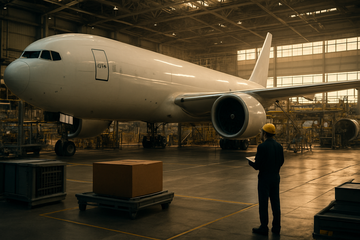
Boeing did not run out of freighters to sell. It ran out of one machined wing part. The 777 freighter line has stood idle for nearly two months after VAERO, the Jacksonville, Florida operation that supplies the trailing-edge rib kits used in777 and 767 wing assembly, stopped shipping in a pricing dispute. Boeing put the cost of the darkness at up to $6.5 million a day in its August court complaint, and a related Delaware filing put the supplier's ask at roughly $31 million above contract pricing.A $31 million demand threatened to trigger roughly $390 million of idle time, which is the real lesson: in the widebody chain, leverage belongs to whoever owns a qualified process, not to whoever owns the largest balance sheet.
Disruption cost per day
Up to $6.5M
Boeing's August2026 court complaint, reported Oct 23, 2026
Supplier price demand
~$31M above contract
Kaman Aerospace's Delaware Chancery filing, May 2026
777F line downtime
Nearly 2 months
Still not resumed as of Oct 23, 2026
Commercial Airplanes margin
(2.7)%
Q2 2026, reported Jul 28, 2026
Inventory at a stopped line
$88.4B
As of Jun 30, 2026
Total backlog
$715.3B
As of Jun 30, 2026
The event
One Part, Two Months, and a Wing Line That Stopped Moving
The dispute is narrow in scope and wide in consequence. Boeing alleges that VAERO stopped delivering trailing-edge rib kits — a machined structural assembly Boeing calls indispensable and for which VAERO is the sole supplier — stalling work on the Everett wing line that feeds both the 777 freighter and the 767, including 767 freighters and KC-46 tankers. The 777X was unaffected. Three Boeing workers told Reuters in late October that 777F production had still not resumed nearly four weeks after a late-September settlement, and that two partly built freighters had been pulled off final assembly.
| Date | Event | Why it matters |
|---|---|---|
| 2024 | Kaman sold its Jacksonville aerospace product line to VECCO Aerospace Group, creating Falcon Jacksonville, the VAERO plant that builds the rib kits | A new private owner inherited a loss-making, sole-source Boeing contract |
| August 2026 | Boeing filed suit in Delaware Chancery alleging VAERO stopped delivering trailing-edge rib kits and demanding tens of millions of dollars in added compensation | A pricing dispute became a court record with a dollar figure attached |
| August 2026 | Boeing's complaint set the disruption's cost at up to $6.5 million a day and described the part as indispensable with a single supplier | Boeing put its own exposure on the record, which fixes the size of the leverage |
| Late September 2026 | The parties settled the dispute | The price fight ended; the assembly line did not restart |
| Oct 13, 2026 | Boeing reported 5 777 and 10 767 deliveries in Q3, plus 15 KC-46 tankers year to date | The 767 and tanker lines share the same wing work, and pre-assembled wings kept deliveries flowing |
| Oct 23, 2026 | 777F production still not resumed; two partly assembled freighters sat off final assembly, one identified as destined for FedEx | The cash cost kept accruing after the settlement, and a customer aircraft was already collateral |
- The part, the sole source and the stoppage are all documented in the complaint Boeing filed in August and in Reuters reporting on Oct 23, 2026.
- Not disclosed: the settlement terms, whether VAERO was paid, and whether any price was rolled into future contracts.
- Not disclosed: VAERO's revenue or margins — the group runs three plants in Jacksonville, Wichita and Sterling Heights, and no financial disclosure is available for the operation.
- Not disclosed: a revised delivery schedule for the freighters pulled from final assembly, or a quantified capacity effect on any cargo customer.
The mechanics explain why the standoff was so expensive. A trailing-edge rib kit is not a commodity: it is a qualified, low-volume, machined assembly that must be produced under an FAA-certified quality system, and a second source has to clear Boeing's supplier qualification before it can ship. VAERO's certifications — AS 9100D, FAA Part 145 repair-station approval and EASA approval — are exactly the qualification that a competitor cannot buy quickly. The scarce asset was process approval, not metal, and that is why capital could not solve the problem quickly and why Boeing's answer was to make the part itself.
Leverage
Why a Three-Plant Machine Shop Could Idle a $715 Billion Order Book
The arithmetic is stark once the two documents are placed side by side. Kaman Aerospace, which sold the Jacksonville plant, told the Delaware Court of Chancery that Falcon Jacksonville had threatened to suspend deliveries unless Boeing paid approximately $31 million above existing contract pricing. Boeing, three months later, told the same court the stoppage was costing it up to $6.5 million a day. The supplier's price demand was worth roughly five days of the disruption it triggered, and Boeing refused it — then settled in late September without the line running.
| Item | Amount | Basis |
|---|---|---|
| Supplier's demand above contract pricing | ~$31M | Kaman Aerospace's Delaware Chancery filing, May 2026 |
| Boeing's claimed cost of the stoppage | Up to $6.5M per day | Boeing's August 2026 complaint |
| Two months at that rate | ~$390M | Boeing's own daily figure extended across the reported downtime |
| Boeing free cash flow, Q2 2026 | $631M | Boeing second quarter 2026 results, Jul 28, 2026 |
| Boeing operating cash flow, trailing twelve months | $3.64B | Boeing Form 10-Q for the quarter ended Jun 30, 2026 |
| Boeing free cash flow, trailing twelve months | -$210M | Boeing Form 10-Q for the quarter ended Jun 30, 2026 |
| Consideration paid to buy Spirit AeroSystems | $8.37B | Boeing 2025 Form 10-K |
What two months of a stopped wing line cost, against what Boeing earns and spends
A price demand of about $31 million, set against the cash consequences of refusing it and the scale of Boeing's own supply-chain purchases
Unit: US$ millions
Supplier's price demand
Kaman Aerospace's Delaware filing
31
Two months of idle 777F line
Boeing's up-to-$6.5M-a-day claim extended
390
Boeing Q2 2026 free cash flow
Boeing second quarter 2026 results
631
Boeing trailing-twelve-month operating cash flow
Boeing Form 10-Q, quarter ended Jun 30, 2026
3,639
The deeper cause is ownership, not machining. Kaman sold the Jacksonville product line in 2024 to VECCO Aerospace Group, affiliated with VAERO; in June 2026, Cendry Capital launched an aerospace and defence investment platform anchored by VAERO. That chain matters because a loss-making sole-source contract sitting inside a sponsor-backed platform creates a negotiation the customer cannot exit: VAERO told the Chancery court it was trying to renegotiate pricing after losing substantial money on the Boeing program, and the court declined to order emergency relief, reasoning that the dispute was commercial and financial rather than irreparable.
Structural response
Boeing Bought Its Way Up the Supply Chain and Still Missed This Part
The uncomfortable irony is that Boeing had just spent $8.37 billion buying the tier-one supplier it wanted to control. The Spirit AeroSystems acquisition closed on Dec 8, 2025, with $8,371 million of total consideration — $4,704 million in Boeing stock, $2,571 million of loans and advances, and $948 million of Spirit debt repaid — and $9,997 million of provisional goodwill assigned to Commercial Airplanes. Buying the wing structures company did not protect the wing line from a tier-two machining bottleneck, because vertical integration buys capacity and know-how, not dual-sourcing.
- Vertical integration reduces dependence on a seller's willingness; it does not create a qualified second source for a specific machined part.
- The widebody franchise is still in write-down mode: Boeing recorded a $4,899 million 777X reach-forward loss in 2025, after $3,499 million in 2024.
- The in-house build is the right answer but a slow one, because the part has to be re-qualified on Boeing's process, not merely machined.
- Boeing's own filings already name the risk: the2025 annual report states that the company works with a small number of sole-source suppliers to ensure continuity of supply for certain items.
The balance sheet shows what a stopped line does to a manufacturer carrying more than a year of inventory. At Jun 30, 2026, Boeing held $88.4 billion of inventory against $6.1 billion of total stockholders' equity and $38.7 billion of net debt, with $64.1 billion of customer advances deferred in liabilities. A wing line that cannot advance does not stop spending; it converts cash into inventory, at roughly360 days of inventory on a trailing basis. That is the transmission from a $31 million price argument to Boeing's cash statement, and it is why the dispute reached a courtroom rather than a procurement escalation.
Downstream
The Bill Lands on Lift Capacity, Not on Cargo Customers
Downstream, the disruption is a supply event for freighters, and freight is a seller's market. IATA's 2026 outlook, published in January, has cargo demand rising 2.6% to 289.5 billion cargo tonne-kilometres, airline cargo revenue up 2.1% to $158 billion, and widebody capacity under pressure for years because the aircraft order backlog exceeds 17,000 units — about 60% of the active fleet and eleven years of deliveries — with net cargo fleet additions falling in both 2024 and 2025 and normalisation unlikely before the early 2030s. Two missing months of 777F capacity tighten a market that already has no spare widebody lift, so the freight-rate consequence lands on the buyers of lift, while the cash consequence lands on the manufacturer.
| Company | Role in the chain | Exposure |
|---|---|---|
| Boeing | OEM; stopped777F line, 767 wing work, KC-46 tankers | Up to $6.5M a day of its own disruption; 777F output still not resumed on Oct 23, 2026 |
| GE Aerospace | Sole engine supplier on the 777F and 777-8F | Q3 2026 revenue $14.1B; engine and spares deliveries deferred with the airframe |
| FedEx | Largest 777F operator; one of the two pulled freighters was its aircraft | FY2026 revenue $94.72B, operating income $6.38B — one aircraft of capacity plan slipped |
| UPS | Buys third-party airfreight capacity in the same lanes | Q2 2026 operating income of $930M, down 49% year over year on $22.83B of revenue |
| Korean Air | Operates 12 777 freighters; ordered eight 777-8Fs | Growth in long-haul freight capacity now depends on a line that stopped twice |
| Air China Cargo | Operates 14 777 freighters; took its 14th on Oct 1, 2026 | H1 2026 sales of CNY 12.48B against CNY 10.89B a year earlier; future deliveries exposed |
- Deliveries still flowed where wings were already built: Boeing delivered 5 777s and 10 767s in Q3 2026 and 20 777s in the first nine months.
- The defense line was inside the same blast radius, with Reuters reporting that 767 output including freighters and KC-46 tankers was disrupted; Boeing still delivered 7 KC-46s in Q3.
- Demand is not the constraint: 777F unfilled orders stood at 38 as of Sep 30, 2026, with six more ordered in 2026, on a list price near $360 million per aircraft.
The practical read for cargo customers is uncomfortable but survivable. A 777F is a capital asset with a decade-plus life, so a two-month slip in one delivery is a timing problem, not a capacity cliff — the fleet cannot be rebuilt before the early 2030s, but a handful of airframes can be re-sequenced.What cannot be re-sequenced is the pricing power of a captive buyer: Air China Cargo took its 14th 777F from Everett on Oct 1, 2026 and grew first-half sales to CNY 12.48 billion, while Korean Air, with 12 777 freighters and eight 777-8Fs on order, has more of its future capacity tied to the same Everett wing line.
Near term
The Next 90 Days: Restart Evidence and the Oct 27 Print
The near-term question is not whether the dispute is over — it is — but whether the line runs and what the settlement cost. Reuters reported on Oct 23 that Boeing had received some parts for the 767 line since the settlement while the 777 freighter line remained stopped, with aircraft that had wings already assembled still deliverable. A confirmed restart, not a settlement announcement, is the signal that converts this from a cash loss into a scheduling delay.
- Watch for restart confirmation and in-house qualification milestones, including whether Boeing states that trailing-edge rib kit production is fully internal.
- Q3 2026 results on Oct 27 are the first hard read: look at Commercial Airplanes margin against (2.7)% in Q2, inventory against $88.4 billion, and whether operating cash flow holds the $1.36 billion posted in Q2.
- Watch the two freighters pulled from final assembly — their delivery is the cleanest public read on whether customer schedules slipped by weeks or by quarters.
- Watch for a second-source qualification announcement, which is the only structural answer to the exposure Boeing has disclosed in its own annual report.
Long term
Three Years Out: What In-Housing Changes and What It Never Will
In the one-to-three-year window, the strategic consequence is a redesign of how Boeing buys parts rather than a change in what it sells. Bringing the rib kits inside removes one qualified single point of failure and, on the arithmetic above, was worth paying roughly $31 million. It also raises fixed cost and adds machining capability Boeing did not previously own. The commercial reality is that the whole widebody supply chain is being re-priced by the same squeeze: no spare lift until the early 2030s, a backlog above 17,000 aircraft, and cargo added to the fleet falling in both 2024 and 2025. The part Boeing failed to secure was the one part nobody else could make, at the one moment it could not wait.
- Milestone to watch in 2027: full in-house production of trailing-edge rib kits with no recourse to VAERO for the 767 and 777F lines.
- Risk to the thesis: the cost of that decision shows up in Commercial Airplanes margin, which was still (2.7)% in Q2 2026 against a $597 billion commercial backlog.
- Risk to the thesis: a repeat — the same structure, a different part, with the same qualification lock-in — is not excluded by anything disclosed in the filings.
- Structural context: the 777X program absorbed a $4,899 million reach-forward loss in 2025, so widebody margin recovery is not a given even with the part fixed.
The broader implication is about who holds power in industrial supply chains after a decade of private-equity consolidation. A sponsor-backed platform that owns a certified, sole-source machining operation has a weapon that no amount of Boeing's scale can immediately neutralise: stop shipping. The counterweight is not scale, it is redundancy — two qualified sources for every part where a line stoppage would cost more than the price increase. Leverage in the widebody chain sits with qualification lock-in, and the only durable fix is to remove the lock.
Evidence
Where the Evidence Stops
| Claim | Status | Basis |
|---|---|---|
| Boeing's 777 freighter line was idle for nearly two months and had not resumed as of Oct 23, 2026 | Established | Reuters, Oct 23, 2026, corroborated by two independent republications |
| The stoppage cost up to $6.5 million a day | Established as Boeing's own claim | Boeing's August 2026 complaint, reported by Reuters |
| The supplier demanded roughly $31 million above contract pricing | Established as Kaman's characterisation; Boeing says tens of millions | Delaware Chancery filing and Law.com reporting on Boeing's complaint |
| Two months at $6.5 million a day equals roughly $390 million | Inference from Boeing's own daily figure | Extension of a company-stated rate across the reported downtime |
| Settlement terms, VAERO's revenue, and revised customer delivery dates | Not disclosed | No public disclosure located |
| Boeing will qualify a second source for the part | Speculation | Only the in-housing intention has been reported |
The investable read
- The stoppage cost up to $6.5 million a day, and 777F output had still not resumed a month after the late-September settlement.
- Near term, Q3 results on Oct 27 will show whether the 777F line restarted and whether commercial margin improved on (2.7)% in Q2.
- Long term, in-house rib kits remove a sole-source choke point, but qualification takes quarters and Boeing's own annual report flags sole-source dependence.
- GE Aerospace is the sole engine supplier on the 777F, so a stopped airframe line defers engines rather than the franchise.
- Q3 2026 revenue of $14.1 billion and operating profit of $2.37 billion are the commercial engine base Boeing's widebody rate decisions feed.
- Long term, Boeing cannot multi-source the engine, so this franchise is insulated from the leverage reversal Vaero demonstrated.
- One of the two 777 freighters pulled from final assembly was destined for FedEx Express, so FedEx's own capacity build slipped.
- FY2026 operating income of $6.38 billion on $94.72 billion of revenue leaves a thin buffer for costly substitute lift.
- Long term, in-house rib kits restore Boeing's 777 rate, but no new widebody lift arrives before the early 2030s.
- UPS operating income fell 49% year over year to $930 million in Q2 2026 on $22.83 billion of revenue.
- UPS buys third-party airfreight capacity, so removing 777F lift in e-commerce-heavy lanes pushes the cost of moving volume up.
- IATA sees widebody capacity under pressure into the early 2030s; the share of the margin squeeze attributable to air freight is not disclosed.
- Korean Air flies 12 777 freighters and has ordered eight 777-8Fs, the programme most exposed to Boeing's widebody rate decisions.
- Near term, deferred 777F and 777-8F deliveries slow Korean Air's long-haul freight expansion.
- Long term, a capacity squeeze that lifts yields on the freighters it already flies offsets the lost growth.
- Air China Cargo took delivery of its 14th 777F from Everett on Oct 1, 2026, showing deliveries still flow at the margin.
- H1 2026 sales rose to CNY 12.48 billion from CNY 10.89 billion, with net income of CNY 918 million.
- IATA expects Asia-Pacific cargo demand to grow 6% in 2026, the fastest of any region, in a market with no spare widebody lift.