
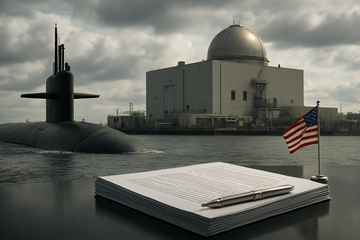
U.S. defense nuclear propulsion
The $2.409B award targets reactor readiness, not grid-scale generation
On Sept. 24, 2026, the U.S. Navy awarded Fluor Marine Propulsion a $2.409B contract modification for naval nuclear propulsion work at the Naval Nuclear Laboratory (NNL). The award is structured as a cost-plus-fixed-fee modification to a previously awarded contract (N0002418C2130), with the immediate contracting activity led by Naval Sea Systems Command.
Awarded modification value
$2.409B
Cost-plus-fixed-fee modification announced for Fluor Marine Propulsion for Naval Nuclear Laboratory work (Award date: Sept. 24, 2026)
Previously awarded contract
N0002418C2130
Contract reference tied to the modification (Naval Nuclear Propulsion work at NNL)
Primary contracting activity
Naval Sea Systems Command
Contracting activity listed in the award notice
Site constraints and what they imply for business models
NNL reactor work is inherently non-sitable on a data-center campus
NNL’s core value proposition is operational: it supports the reactor fleet and trains sailors who will run naval reactors at sea. In the related award coverage, NNL is described as including the Kenneth A. Kesselring Site in West Milton, New York—where sailors train to operate naval reactors—before those operators deploy into the fleet.
That training-and-support mission draws a hard boundary against AI-driven power demand. AI hyperscalers can influence grid interconnection, power purchase agreements, and fuel logistics for electricity. But they cannot “move” the naval reactor readiness pipeline onto a commercial campus without replacing the training and safety-of-operation framework that the Navy is funding.
- NNL work is tied to Naval Nuclear Propulsion readiness and training, not to electricity delivery to commercial loads
- AI power demand creates leverage for grid generators, but it doesn’t recreate the Navy’s reactor training and fleet support contract structure
- As a result, the market for naval nuclear competence behaves more like defense maintenance & readiness than like merchant power capacity
Supply-chain map (what captures margin where)
Margin capture shifts toward reactor-systems vendors and naval-capable yards—not AI-focused EPC
Because the award is explicitly for Naval Nuclear Laboratory naval-reactor work, the supply chain that profits is the one that can produce and sustain naval reactor engineering, training enablement, and reactor life-cycle support. That generally points to: (1) nuclear engineering and component-qualified vendors, (2) defense prime integration capacity across ships and subs, and (3) shipyard and systems organizations that can bundle nuclear propulsion work into platform schedules.
Even the geographic workshare highlights how specialized the labor footprint is. The coverage of the modification describes workshare allocation near Pittsburgh, Pennsylvania (47%); Schenectady, New York (45%); and Idaho Falls, Idaho (8%). That distribution is consistent with a specialized, defense-nuclear ecosystem rather than a scalable, repeatable “build it on your campus” model.
| Supply-chain link | What the Navy is buying | Why it’s hard to substitute with AI power demand |
|---|---|---|
| NNL engineering + readiness support | Naval nuclear propulsion work at NNL (including fleet reactor support and training enablement) | The buyer outcome is fleet readiness and trained naval operators, not generation interconnection |
| Training operations (Kesselring Site context) | Sailor training to operate naval reactors | Commercial campuses don’t recreate the Navy’s operational training pipeline |
| Defense ship integration capacity | Ability to keep nuclear-powered platforms mission-capable over time | Shipyard scheduling and qualification cycles are platform-specific and defense-controlled |
Investor lens
The “AI nuclear” thesis will keep growing—but it won’t automatically lift naval nuclear primes
Here’s the core divergence: AI-driven power growth increases demand for electricity generation and grid infrastructure. Naval propulsion growth increases demand for reactor readiness, training, and fleet lifecycle support. The $2.409B NNL modification is an example of the second bucket—where the “power” output is not sold to a customer’s meter; it is embedded into the Navy’s ability to operate submarines and carriers.
- AI-linked nuclear spending tends to cluster around grid interconnection, fuel logistics, and plant-scale generation schedules
- Naval nuclear spending tends to cluster around reactor support, training enablement, and platform life-cycle maintenance contracts
- A stock that looks cheap in grid nuclear terms may not capture the margin structure of naval-reactor readiness—and vice versa
Near-term vs. long-term horizons
What moves first: contract continuity and training throughput (not AI load growth)
In the near term (days to quarters), the measurable impact for naval-nuclear supply-chain companies is usually continuity of work: follow-on modifications, sustained reactor engineering staffing, and the ability to execute under readiness-driven schedules. The Sept. 24, 2026 award date and the NNL scope emphasis on propulsion work and training signal that this is a rolling program—more like sustained operations support than a one-off build.
Over a 1–3 year horizon, the more material question is whether the Navy’s reactor support pipeline expands alongside fleet build and modernization. The key risk is that investors may extrapolate AI-driven nuclear cash flows into the wrong sub-market; the correct read-through is Navy readiness and propulsion lifecycle activity, which can evolve on a different clock than commercial power demand.
Verification highlights
What the primary award notice establishes
Hard facts directly stated in the award coverage
Fluor Marine Propulsion award value
$2,409,077,590
Cost-plus-fixed-fee modification tied to Naval Nuclear Laboratory naval nuclear propulsion work
Award date
Sept. 24, 2026
Listed as the award date for the modification
Previously awarded contract number
N0002418C2130
Referenced as the contract being modified
Workshare geography (as described)
PA 47% / NY 45% / ID 8%
Breakdown for work locations cited in related coverage
Listed equities with defensible linkage to naval nuclear propulsion work
- NNL propulsion support expands by continuing naval-reactor work that tends to favor companies with nuclear fabrication and qualified nuclear components
- The Sept. 24, 2026 modification supports steady execution leverage over the next few quarters rather than a one-time build spike
- Naval propulsion readiness spending reinforces platform lifecycle focus that ultimately depends on ship integration and schedule execution
- Workshare tied to specialized sites points to sustained defense ecosystem depth—often translating into multi-year yard planning
- Naval nuclear propulsion work can increase downstream demand for nuclear-mission systems integration, but AI-driven energy spend does not substitute for fleet nuclear readiness
- The contract is readiness-oriented, so near-term upside may be incremental rather than “explosive” like new power-plant announcements
- Sustained NNL naval propulsion work supports the operating foundation for nuclear-powered submarine fleets, which aligns with defense platform demand cycles
- Because the award targets training-and-support, execution momentum matters in the next 1–2 quarters more than longer-dated AI load growth