
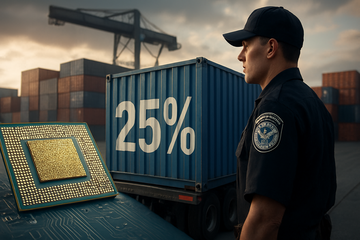
Additional duty
25%
Section 232 semiconductor duty; effective for covered entries on Oct. 26, 2026
Coverage
3 HTS lines
Covered lines identified in the October 2026 customs guidance
Collection mechanism
Chapter 99
Additional duty applies on top of the regular tariff where the covered classification is used
First exposure
Imported chips
The duty is assessed at entry; downstream cost effects depend on contract terms and product scarcity
What changed
The duty is narrow in code but broad in bargaining power
The practical change on October 26 is not a new semiconductor tax rate across every chip. It is the start of collection under a Chapter 99 heading covering three HTS lines and adding 25% to the regular duty. That distinction matters because classification, origin, exemptions and the physical form of the imported article determine who actually pays.
| Layer | Immediate effect | Who has leverage |
|---|---|---|
| Customs entry | Importer owes the additional 25% duty on covered value | Customs classification and origin documentation |
| Chip supplier | May reprice, absorb the charge or redirect production | Capacity scarcity and customer contracts |
| System designer | Higher component cost or a forced sourcing change | Product qualification and substitution difficulty |
| Cloud or enterprise buyer | Higher accelerator, server or networking cost | Ability to defer purchases or pass through pricing |
Transmission mechanism
Foundries can pass through the duty faster than chip designers can
TSMC's economics show why the first-round impact is unlikely to be evenly shared. The company reports a trailing gross margin of 65.8% and an operating margin of 57.9%, giving it more room than a lower-margin system vendor to negotiate pricing or absorb a temporary customs charge. Its U.S. manufacturing buildout also creates a route around some imported-wafer exposure over time, although domestic production does not eliminate imported equipment, materials or packaging inputs.
TSMC gross margin
65.8%
Company-reported trailing period through the latest reported quarter
TSMC operating margin
57.9%
Company-reported trailing period through the latest reported quarter
TSMC net cash position
Net cash
Trailing balance-sheet metrics show net debt to EBITDA below zero
The more vulnerable party is the company that buys a scarce chip and sells a complete product at a negotiated system price. NVIDIA reports a trailing operating margin of 65.2%, so the tariff is not an immediate solvency issue. The risk is strategic: if the duty applies to imported components inside a finished accelerator system, the company must choose between absorbing the charge, raising prices or shifting assembly and sourcing without disrupting qualification.
Memory and HBM
Memory suppliers have the strongest short-term pass-through case
The tariff arrives while high-bandwidth memory and advanced DRAM remain capacity-constrained. That gives SK hynix and Micron more negotiating power than a supplier selling interchangeable, oversupplied components. A buyer that needs qualified HBM for an accelerator cannot easily switch vendors merely to save the 25% customs charge.
| Company | Trailing operating margin | Trailing P/E | Investor read-through |
|---|---|---|---|
| SK hynix | 68.0% | 5.6x | Strong pricing power, but memory-cycle risk remains high |
| Micron | 74.6% | 12.0x | Large margin cushion, with valuation already reflecting a strong cycle |
| Samsung Electronics | 36.9% | 9.4x | More diversified, but less direct exposure to a single memory tariff line |
Micron's trailing gross margin is reported at 80.7%, while SK hynix reports a 76.2% gross margin. Those figures do not prove that either company will pass through the full duty. They do show why a temporary 25% import charge is more likely to be negotiated into pricing than to erase supplier profitability. The risk shifts to buyers with fixed-price contracts or products whose end-market demand is more elastic.
Downstream exposure
The bill of materials rises before cloud pricing does
The downstream chain is less flexible. An accelerator, server or networking platform may contain chips sourced from multiple countries and assembled in another. The customs liability therefore depends on the declared article, origin and entry structure, not simply on the nationality of the chip designer. That creates a compliance and routing incentive, but it does not make re-routing free: qualified designs, packaging capacity and customer acceptance constrain substitution.
- The first financial effect is working-capital pressure at the importer, not necessarily a lower semiconductor selling price.
- The next effect is contract renegotiation as suppliers and customers decide whether the duty is a pass-through, a shared cost or a margin hit.
- HBM and advanced packaging are less exposed to pure price competition because qualification and capacity are difficult to replace.
- Commodity memory and older-node logic face more demand sensitivity if customers can delay orders or switch suppliers.
- A domestic assembly route may reduce some entry exposure, but the tariff does not remove dependence on imported equipment, materials or wafers.
NVIDIA is the clearest downstream watchpoint because its products combine high-value logic, memory and advanced packaging. Its trailing revenue is reported at roughly $303.0 billion and its trailing net margin at 63.7%, so the central issue is not whether a 25% duty threatens the business. It is whether a small cost increase becomes a pricing signal in an already capacity-constrained AI infrastructure market.
What moves first
The near-term trade is about customs data, not quarterly earnings
Over the next several weeks, investors should watch customs filings, distributor quotes and management commentary rather than expect an immediate change in reported revenue. The duty begins at entry, while financial statements recognize the effect only as inventory is sold or as suppliers revise prices. That timing can separate the first market reaction from the eventual margin impact.
The pass-through sequence
The expected order of events is customs payment, contract response, inventory recognition and finally end-customer pricing.
Unit: Sequence
Customs payment
Begins Oct. 26, 2026
1
Supplier negotiation
Days to weeks
2
Inventory recognition
Weeks to quarters
3
End-market pricing
Quarters, depending on contracts
4
One to three years
The tariff accelerates localization, but it cannot create capacity overnight
The long-term effect is more important than the first customs bill. A durable 25% charge on selected semiconductor imports increases the value of U.S. wafer fabrication, assembly and testing, but semiconductor plants take years to build and qualify. The result is likely to be a more expensive and geographically diversified supply chain rather than a rapid replacement of Asian production.
Milestones investors should track
Customs scope
Classification and exemption decisions
The three covered HTS lines define the first-order exposure
Supplier contracts
Pass-through language
Watch memory, foundry and packaging agreements
U.S. capacity
Qualification, not groundbreakings
Commercial output matters more than announced construction
Customer pricing
Accelerator and server quotes
Higher prices confirm downstream absorption
The main risk to the localization thesis is that the tariff raises costs without changing sourcing behavior. If U.S. capacity remains scarce, buyers may simply pay more for the same overseas supply. The main upside is that sustained policy support improves the economics of domestic production and makes supply-chain redundancy a purchasing requirement rather than a contingency plan.
Investment conclusion
Memory has the cleanest pass-through; systems carry the execution risk
The October 26 duty is best understood as a bargaining-power event. SK hynix and Micron have the strongest short-term ability to defend margins because scarce memory and HBM are difficult to replace. TSMC is better positioned than most suppliers to negotiate the charge because of its margins and customer dependence, although its global manufacturing footprint keeps classification and origin important. NVIDIA and other system vendors face the harder question: whether customers will accept higher prices before the supply chain becomes more local.
For the next few quarters, the decisive evidence will be whether suppliers mention successful pass-through without losing volume. Over one to three years, the thesis depends on domestic capacity reaching commercial scale. Until then, the duty is more likely to redistribute margin across the semiconductor chain than to reduce the industry's dependence on cross-border production.
Stocks most exposed to the pass-through question
- Its 74.6% trailing operating margin provides room to defend profitability if HBM and DRAM pricing absorbs the 25% customs charge.
- HBM scarcity supports near-term pass-through, but a memory downcycle would weaken that leverage over the next one to three years.
- The stock's 12.0x trailing P/E is less demanding than the foundry and accelerator leaders, providing valuation support if pricing holds.
- HBM qualification and supply scarcity give SK hynix the strongest near-term ability to shift the duty into customer pricing.
- Its 68.0% trailing operating margin shows substantial capacity to absorb a temporary charge without immediate earnings damage.
- The 5.6x trailing P/E leaves the stock highly sensitive to memory pricing, making the tariff a secondary issue versus the cycle.
- Its 57.9% trailing operating margin supports pass-through, but imported wafers, equipment and packaging keep origin analysis relevant.
- U.S. production can reduce some future customs exposure, while qualification and capacity constraints limit the speed of substitution.
- The 24.3x trailing P/E means investors need evidence of sustained AI demand to offset any incremental cost pressure.
- Its 36.9% trailing operating margin is lower than the leading memory specialists, leaving less room to absorb a full 25% duty.
- Diversification across memory, devices and consumer electronics reduces dependence on the three covered lines but also dilutes the direct upside from HBM pass-through.
- Its 9.4x trailing P/E offers valuation support if the tariff accelerates demand for diversified, geographically redundant supply.
- A 25% duty on covered imported content raises accelerator-system costs before cloud customers agree to higher prices.
- Its 65.2% trailing operating margin can absorb a temporary charge, but fixed-price contracts would shift the first impact to gross profit.
- The 27.0x trailing P/E makes evidence of successful pass-through important over the next several quarters.