
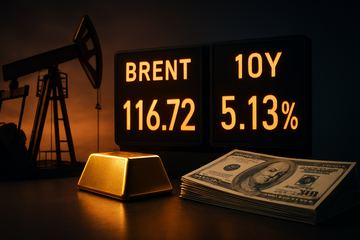
Brent crude, front-month settlement
$116.72
Friday, Oct 23, 2026 — highest close since Apr 29 and a third straight weekly gain of 6.2%
10-year Treasury yield
5.13%
Oct 21, 2026 daily constant-maturity close; 4.96% by Oct 22
Spot gold
Under $4,000
Oct 23, 2026 — first sub-$4,000 print since mid-July, on the same session as the oil high
Nasdaq Composite
-2.60%
Oct 22, 2026 — steepest one-day drop since early June, on AI financing-cost doubts
Semiconductor index
-6.7%
Oct 22, 2026 — biggest one-day fall since Jun 23; still 51.5% higher year to date
The S&P 500 finished the week modestly lower while the Dow rose, with defensives leading the decline — a week that looked like one story but was three. A supply-driven oil spike, an AI funding scare and a long end that would not fall even with the Fed sitting still all landed inside 72 hours, and only the shock that owns the scarce good gets paid.
The 72 hours
Three Prices, One Mechanism
The three prints are not three problems; they are one mechanism. A supply-driven oil shock lifts inflation and the discount rate at the same time, and that is the one combination that makes a duration hedge and an inflation hedge fail together.
The 72 hours, session by session
Wed, Oct 21
$64.60B revenue, $34.91B capex, -$2.12B free cash flow
Meta reports after the close; 10-year Treasury at 5.13%
Thu, Oct 22
Nasdaq -2.60%, semiconductor index -6.7%, S&P 500 -1.21%
10-year falls 17bp to 4.96% as financing doubts hit AI capex
Fri, Oct 23
Brent $116.72; spot gold under $4,000 an ounce
S&P 500 -0.43% to 7,629.92; Nasdaq -0.08% to 25,986.95
Tue, Oct 28
FOMC decision, then Alphabet and Microsoft results
About a third of the S&P 500 reports this week
What makes this a regime rather than a headline: the drivers were unrelated on the surface and identical underneath. Hormuz barrels, HBM capacity and a central bank's credibility are different markets, but a supply shock in any of them raises the discount rate applied to every other cash flow. Correlation is not a coincidence here; it is arithmetic.
The oil leg
Spot Crude Sits Far Above Every Published Price Assumption
Every price assumption in the system was set before the Houthis started hitting Saudi facilities and the United States pulled non-essential personnel out of the kingdom. Brent at $116.72 sits $11.72 above the EIA's own fourth-quarter forecast, so the risk to published estimates is still to the upside rather than down.
Spot crude sits far above the price assumptions built into forecasts
Brent's Oct 23 settlement against the EIA's fourth-quarter 2026 forecast and the price assumptions INPEX used to build its fiscal-2026 numbers.
Unit: $ per barrel
Brent settle, Oct 23
Highest close since Apr 29
116.7
EIA 4Q26 forecast
Raised $14 in the October outlook
105
INPEX FY2026 assumption
Company planning price for the year
81.4
INPEX 4Q26 assumption
Fourth-quarter planning price
70
- The EIA still expects Middle East flows to stay constrained through the fourth quarter, and it explicitly cites extreme diesel tightness raising demand for crude to help refiners meet it — so the oil price is being pulled by the same shortage that is squeezing freight
- The IEA expects global oil supply to decline by 5.7 million barrels a day, roughly 6%, in 2026 on the delayed return of normal Gulf flows — the structural reason the curve does not mean-revert on its own
- INPEX built its fiscal-2026 numbers on $70 Brent for the fourth quarter and $81.40 for the year, so guidance written in the summer is now about 40% below the market price
- PetroChina already reported record first-half profit of RMB103 billion, up 22%, and Reuters reported it is set for a record trading profit as war-disrupted flows cut both ways through its marketing business
- Cracks are the other half of the story: US diesel crack spreads have shattered previous records, with the premium over crude climbing above $100 a barrel and the crack reaching $118.32 a barrel in mid-September
For the first time in this cycle, the companies whose guidance embeds a $70 barrel are the ones with the most room to raise numbers. Upstream cash flow converts a Brent surprise into distributable earnings inside the quarter, which is why the revision trade starts upstream and ends at the refiner.
The rates leg
The Fed Cannot Hike, So the Long End Is Doing the Tightening
The bond market has already made its decision about the Fed: the 2-year at 4.65% on Oct 22 prices roughly 80bp of tightening against a 3.75%-4.00% target range. What the 10-year adds on top is the price of holding duration through a supply shock the Fed cannot control.
| What | Where the market stands | Why it matters |
|---|---|---|
| October meeting (Oct 27-28) | 94 of 100 economists expect a hold at 3.75%-4.00% | The rate decision itself is already priced |
| December meeting | All 100 economists expect a 25bp hike | A hold in December is the real risk, not a hike |
| 2-year Treasury | 4.81% on Oct 21, 4.65% on Oct 22 | Roughly 80bp of tightening priced into the two-year horizon |
| 10-year Treasury | 5.13% on Oct 21, 4.96% on Oct 22 | Term premium sitting on top of any policy path |
| Inflation path | PCE median more than 100bp above target until at least 2028 | No return to 2% inside the official forecast horizon |
- The 2s10s slope barely moved while the whole curve repriced: 33bp on Oct 20, 32bp on Oct 21, 31bp on Oct 22 — the bond market is disputing the level of policy, not the shape of the path
- The Fed's own communication apparatus has gone quiet, which removes the forward-guidance channel that normally lets a central bank pre-announce a hiking cycle and take the heat out of the long end
- Economists do not expect inflation back at target until at least 2028, so the December hike is likely to be followed by a slower, more data-dependent sequence that a term premium cannot easily price
Warsh's refusal to guide is not a communications quirk; it is the price of a chair who knows December is fully priced and knows the White House wants the opposite. A central bank that cannot pre-commit in either direction must be paid a term premium, and that premium is what a 5% long end actually is.
The AI leg
Meta's Negative Free Cash Flow Is Where the AI Story Becomes a Credit Story
The AI story used to be an equity story about demand. It is now a credit story about funding: $34.91B of capex against $32.79B of operating cash flow, long-term debt up $25.9B in three months, and a new non-voting share class that does not exist yet. Meta answered a negative free cash flow quarter with a new class of stock, effective January 2027.
| Meta (USD) | June 2026 quarter | September 2026 quarter | Trailing twelve months |
|---|---|---|---|
| Operating cash flow | $31.86B | $32.79B | $133.09B |
| Capital expenditure | $30.12B | $33.94B | $104.44B |
| Free cash flow | $1.75B | -$1.16B | $28.65B |
| Long-term debt | $83.66B | $109.57B | — |
| Cash and cash equivalents | $15.46B | $11.22B | — |
| Cash and short-term investments | $90.26B | $82.45B | — |
| Capex as a share of operating cash flow | 95% | 104% | 78% |
- Goldman Sachs Research put roughly a third of hyperscaler capex on debt in 2026, with about 35% expected in 2027, against $108 billion of issuance in 2025
- AI issuers have gone from about 1% of investment-grade supply in 2024 to roughly 18% year to date, and 40% of 15-year-plus investment-grade issuance in 2026 now comes from AI and thematic borrowers
- New-issue concessions on a large hyperscaler deal have widened from two to three basis points before the market got crowded to as much as 20 basis points, which is a funding cost that shows up before any guidance cut
This is the hinge of the whole week, and it is why the oil, the bonds and the AI trade are one story. Every basis point of long-end yield raises the coupon on the next data center, so a 5% long end and a de-rating in AI capex are not two events that happened to coincide — they are one financing cost arriving through two doors.
The counter-intuitive leg
The Suppliers Are Paid; the Sponsors Are Financing
The market sold the buyers of AI capacity, not the sellers of it. Micron's quarterly revenue rose fourfold in a year, from $13.64 billion to $54.23 billion, at an 86.7% gross margin, while the shares of the companies funding the buildout were repriced.
Micron's quarterly revenue rose fourfold in a year
Micron's reported revenue by fiscal quarter across fiscal 2026.
Unit: $ billions
FQ1, ended Nov 27, 2025
13.6
FQ2, ended Feb 26, 2026
23.9
FQ3, ended May 28, 2026
41.5
FQ4, ended Sep 3, 2026
54.2
- SK hynix reported second-quarter revenue of 79.3 trillion won and operating profit of 60.5 trillion won, a 76% operating margin — yet the shares fell more than 10% on Oct 15, alongside Samsung Electronics down 8.73%
- Twenty of the most valuable global AI and semiconductor names shed more than $1 trillion of value in that week, with the semiconductor index down 6.7% on Oct 22 alone, more than 26% below its June 22 record close and still 51.5% higher year to date
- Nvidia fell only 1.84% on the same Oct 15 session while the financing-sensitive names fell hardest, which is the signature of a funding scare rather than a demand scare
This is the part the tape misread. Memory suppliers bank contracted margin while their customers now finance capex with debt priced off a 5% long end, so the credit market, not the earnings model, becomes the first place a capex cut shows up — which is also why the Oct 28 guidance matters more than the Fed.
The pass-through
Oil's Pass-Through: Refiners Collect the Spread, Freight Pays the Tax
The oil shock is not one tax; it is a transfer. Refiners capture the spread created by the shortage while freight absorbs the fuel cost that shortage creates, and the two read the same $116.72 barrel in opposite directions.
| Company | Where it sits in the chain | Latest evidence | The read |
|---|---|---|---|
| Valero | Refiner: buys crude, sells products | Q3 operating income $9.07B vs $1.51B a year earlier; diluted EPS $23.89 vs $3.53; gross margin 20.4% vs 5.5% | Collects the spread |
| Exxon | Integrated major | Trailing EV/EBITDA 10.9x; pre-announced Q3 refining earnings near $8.5B | Paid on refining, not the barrel |
| PetroChina | Upstream, refining and trading | Record H1 profit of RMB103bn, up 22%; record trading profit expected | Paid three ways over |
| INPEX | Pure-play upstream | Fiscal-2026 assumptions of $70 Brent for Q4 against a $116.72 spot price | Guidance is stale, the oil is not |
| J.B. Hunt | Freight: burns diesel | Q3 gross margin 9.5%, down from 10.1% in June; dedicated operating income -22% YoY | Pays the tax |
| Meta | AI capacity sponsor | Q3 capex $34.91B; free cash flow -$2.12B; long-term debt up $25.9B in the quarter | Pays it in funding cost |
| Micron | Memory supplier to the buildout | FQ4 revenue $54.23B at an 86.7% gross margin; trailing EV/EBITDA 8.8x | Already paid |
The damage outlives the crude spike. EIA expects crack spreads to ease while keeping retail diesel above $4 a gallon through 2027, so the margin structure of the refiner holds longer than the oil headline does — and the cost structure of the trucker stays inflated long after it.
The week ahead
Three Catalysts That Decide Which Story Wins
The FOMC is the least interesting event of the week; it is priced and a hold is a foregone conclusion. Alphabet and Microsoft's capex guidance on Oct 28 decides whether the AI de-rating is a funding scare or a discount-rate scare, and that determines which hedge belongs in the portfolio.
- Tue-Wed, Oct 27-28 — FOMC: a hold at 3.75%-4.00% is the consensus, so the statement and press conference matter more than the rate; a December hike that is not pre-committed leaves the term premium exactly where it is
- Wed, Oct 28 after the close — Alphabet and Microsoft: consensus looks for roughly 25% revenue growth at Alphabet and 14.3% earnings growth with 16.8% revenue growth at Microsoft, but the capex lines are what the market is trading
- Thu, Oct 29 — Amazon reports, and about a third of the S&P 500 reports this week, so a single guidance cut can reprice a quarter of the index
- Fri, Oct 30 — Chevron reports, with Exxon due in the same window and its own pre-announcement already showing refining carrying the quarter
- Wed, Dec 9 — the December FOMC, where 100 of 100 economists expect a 25bp hike; a hold is the last genuine policy surprise left on the calendar
Horizons and risks
What Moves First, What Compounds, and What Would Break It
| Horizon | What happens | Where the money goes |
|---|---|---|
| Days to one quarter (to Q1 2027) | FOMC holds on Oct 28 and hikes on Dec 9; Alphabet, Microsoft and Amazon guide capex; Chevron and Exxon report; oil stays above $100 | Energy estimate revisions and short-dated cracks; AI credit spreads and new-issue concessions |
| One to three years (2027-2029) | Roughly 35% of hyperscaler capex debt-financed; EIA sees retail diesel above $4 a gallon through 2027; IEA sees 2026 supply down 5.7 million barrels a day; upstream guidance resets toward $116 Brent | Whether the AI buildout earns its cost of capital, and whether energy cash returns get spent, taxed or recycled |
In the next quarter, the repricing happens in energy estimates rather than in the index. Guidance built on $70 Brent gets rewritten first, and refiner estimates move last and only if cracks normalize, which is the sequence that keeps upstream and refining on opposite sides of the same trade.
- De-escalation is the main risk to the energy leg: Brent back under $100 removes the refining earnings surprise before it removes upstream cash flow, and freight margins recover fastest
- A December hike the market believes would flatten the long end and hand investors back the duration hedge they lost on Friday
- A raised hyperscaler capex guide on Oct 28 ends the funding scare but leaves the discount-rate problem untouched, which is the one that actually sets multiples
- If crude holds above the EIA's $105 forecast, energy estimates rise while the Fed's inflation problem worsens — the worst combination for everything that is valued on a discount rate
Synthesis: this is not a risk-off market that rewards caution, and it is not an inflation trade that rewards commodities. The shock pays whoever owns the scarce good and charges whoever finances the buildout, and over the next quarter that split is worth more than any directional call on the index.
There is still fallout from the questioning of the AI trade. There's certainly the potential that we see less invested in an AI data center build-out next year than has been projected.
Where the shock lands as revenue and where it lands as cost
- Q3 free cash flow of -$2.12B with $34.91B of capex turns the AI buildout into a funding question inside one quarter
- Long-term debt rose $25.9B in three months to $109.57B while cash and equivalents fell to $11.22B, so the balance sheet now constrains the buildout rather than the income statement
- Horizon (one to three years): about a third of hyperscaler capex is debt-financed in 2026 and near 35% in 2027, so every turn of the long end reprices the cost of the next data center
- Catalyst to watch: the Oct 28 capex guides from Alphabet and Microsoft, not the FOMC
- Q3 operating income of $9.07B against $1.51B a year earlier and gross margin of 20.4% versus 5.5% show the crack spread, not the barrel, is doing the work
- At 7.0x trailing EV/EBITDA with an 8.4% free cash flow yield and 49.9% return on equity, this is the cheapest cash flow in the story
- Horizon (one to three years): EIA expects cracks to ease but keeps retail diesel above $4 a gallon through 2027, so the earnings base survives even as the peak fades
- Risk: the shares have already doubled in a year, so normalizing diesel cracks removes the surprise that drove the estimate upgrades
- Trailing EV/EBITDA of 10.9x and a 4.1% free cash flow yield price Exxon's cash flow like an average industrial while refiners with record margins trade at 7.0x
- Exxon's own pre-announcement points to roughly $8.5B of refining earnings in the third quarter, so the barrel is no longer the earnings driver
- Horizon (days to one quarter): Chevron reports Oct 30 and Exxon follows in the same window, giving the first read on $116.72 Brent
- Mixed: higher crude lifts cash flow per barrel while the multiple keeps paying for the average of a cycle that is now refining-led
- FQ4 revenue of $54.23B at an 86.7% gross margin and $32.87 of diluted EPS show the memory suppliers are already paid
- At 8.8x trailing EV/EBITDA with a net cash balance sheet, memory is the cheapest way to own AI volume if the buildout survives its financing
- Horizon (one to three years): the risk flagged on Oct 15 was global memory oversupply as early as 2029, not a shortage of demand in 2026
- Mixed: earnings are contracted while the demand forecast belongs to customers who now fund capex with debt
- A Q3 gross margin of 9.5%, down from 10.1% in June, with dedicated operating income down 22% year on year, shows diesel arriving before surcharges can recover it
- EIA expects retail distillate above $6 a gallon this month and above $4 through 2027, so the cost base stays inflated after the crude spike fades
- Horizon (one to three years): freight is the most diesel-intensive, most rate-sensitive corner of the economy and recovers only when cracks normalize
- Second-quarter operating profit of 60.5 trillion won on a 76% operating margin means the October rout repriced the multiple, not the earnings
- At 5.6x earnings with a net cash balance sheet, the valuation already assumes the capex cycle runs; a credit-funded buildout that stalls is what breaks it
- Horizon (days to one quarter): the shares fell more than 10% on Oct 15 alongside Samsung Electronics down 8.73% as financing costs rather than memory pricing drove the de-rating
- Record first-half profit of RMB103 billion, up 22%, was struck with Brent in the $70s, so the third quarter is the first print to capture $116
- Reuters reported the company is set for a record trading profit as war-disrupted flows cut both ways through its marketing business
- At 6.6x trailing EV/EBITDA with a 4.0% dividend yield, the Hong Kong line is a cheap way to own the barrel in Asia
- Fiscal-2026 assumptions of $70 Brent for the fourth quarter and $81.40 for the full year sit about 40% below the market price
- At 3.8x trailing EV/EBITDA with net debt near 0.7x EBITDA, the balance sheet can absorb the upside without a capital raise
- Horizon (days to one quarter): the guidance reset arrives with fiscal-2026 results and the FY2027 plan, and it is the cleanest read on how much of $116 is durable