
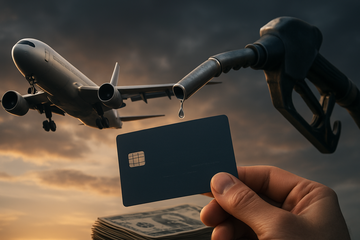
The price American Airlines can raise is not the seat. It is the card. On August 3, 2026 the airline and Citi said the AAdvantage Executive World Legend card would go from $595 to $695 on August 23; on October 27 they said the Platinum Select and Business cards will go from $99 to $150 on January 24, 2027. Together the two moves reopen a fee schedule that had been frozen since 2019. The airline needs that money because it cannot get it at the fare table, and because the fee is the cheapest way to fund the rewards that pull bookings through its own channels.
Q3 2026 revenue
$16.3B
Up 19.3% year over year, reported Oct 22, 2026
Q3 2026 net loss
$(269)M
GAAP, or $(0.41) a share; adjusted loss $(182)M
Q4 2026 guided fuel price
$4.70/gal
Forward curve as of Oct 19, 2026; nearly double Q4 2025
AAdvantage enrollment growth
+27.4%
Year over year in Q3 2026
Co-brand card spend growth
~+10%
Year over year in Q3 2026 on the Citi portfolio
New Platinum Select fee
$150
Up from $99, effective Jan 24, 2027
The cost side
The Fare Table Broke First
American Airlines's problem is fuel, not demand. Third-quarter revenue of $16,335 million was 19.3% above the prior year, yet the company posted a net loss of $269 million, or $(0.41) a share, with adjusted loss of $(0.28), and operating income slipped to $115 million from $151 million. Nine-month fuel expense rose 55.2% to $12,444 million on a 50.8% higher average price of $3.58 a gallon, while gallons consumed rose only 2.9% — fuel, not traffic, explains why record revenue produced a loss.
American Airlines quarterly net income (GAAP)
Q2 2026 was the only profitable quarter of 2026; Q3 swung back to a $269 million loss.
Unit: Net income (US$ millions)
Q4 2025
99
Q1 2026
-382
Q2 2026
71
Q3 2026
-269
| Metric | Q2 2026 | Q3 2026 | Q4 2026 guidance |
|---|---|---|---|
| Total revenue | $16.7B | $16.3B | +19.5% to +22.5% YoY |
| Net income (loss) | $71M | $(269)M | Not guided |
| Diluted EPS (GAAP) | $0.11 | $(0.41) | Not guided |
| Adjusted EPS | — | $(0.28) | $(0.50) to $(1.10) |
| Average fuel price per gallon | — | $3.85 | ~$4.70 |
| Co-branded card spend growth | — | ~+10% YoY | — |
The repricing
Loyalty Is the Only Price American Airlines Can Raise
A co-brand card is not a fare. It is a subscription to miles, status and lounge access, and no passenger compares it against another airline's seat price — so it can be repriced without the customer defecting to a competitor. That is why the fee schedule moved while the fare table did not: the Executive card's authorized-user fee alone is $175, and the refreshed mid-tier cards keep a $0 first-year waiver, both of which sit outside any published airfare comparison. The decision is not about extracting margin from cardholders; it is about funding a richer rewards package the airline could not otherwise afford to offer.
| Card | Annual fee before | Annual fee after | Effective |
|---|---|---|---|
| Citi AAdvantage Executive World Legend card | $595 | $695 | Aug 23, 2026 |
| Citi AAdvantage Platinum Select World Elite card | $99 | $150 | Jan 24, 2027 |
| Citi AAdvantage Business World Elite card | $99 | $150 | Jan 24, 2027 |
| United Airlines Club Card, issued by JPMorgan Chase | $695 | — | Current |
| United Airlines Quest Card, issued by JPMorgan Chase | $350 | — | Current |
| United Airlines Explorer Card, issued by JPMorgan Chase | $150 | — | Current |
| Delta Air Lines SkyMiles Reserve Card, issued by American Express | $650 | — | Current |
| Delta Air Lines SkyMiles Platinum Card, issued by American Express | $350 | — | Current |
| Delta Air Lines SkyMiles Gold Card, issued by American Express | $150 | — | Current |
| American Express consumer Platinum Card | $450 in 2015 | $895 | Raised in 2025 |
AAdvantage annual fees, before and after the 2026 repricing
The mid-tier card took the largest percentage hit: $99 to $150 is a 51.5% increase.
Unit: Annual fee (US$)
Executive, before
595
Executive, from Aug 23, 2026
695
Platinum Select, before
99
Platinum Select, from Jan 24, 2027
150
Business, before
99
Business, from Jan 24, 2027
150
- Three times AAdvantage miles on eligible AAdvantage Hotels and AAdvantage Cars bookings, twice at gas stations and EV chargers, twice on streaming services and twice on rides and rails.
- A $150 American Airlines flight discount after $20,000 of annual purchases, up from $125 — a spend threshold set to pull the top of the wallet.
- Up to $500 back on American Airlines Vacations packages, up to $100 on inflight and Admirals Club purchases, and up to $120 for Global Entry or TSA PreCheck every four years.
- Complimentary annual Walmart membership valued at $98, a 50% discount on the annual FOX One subscription, and up to $180 a year in Turo statement credits.
- The Executive card now pays up to $180 a year in Lyft credits, up from $120, after three eligible rides a month, and lifts hotel and car earn to 12X from 10X.
- The Business card adds a 99-dollar companion certificate after $30,000 of annual spend and lets authorized users earn loyalty points through Dec 31, 2028.
AAdvantage enrollments and spending on our cobranded credit cards are up year over year, and the AAdvantage program remains 1 of our strongest competitive advantages.
Issuer economics
Citi Collects the Fee, the Network Collects the Volume
The fee is an issuer's margin instrument, and the evidence sits in Citi's third quarter: revenue of $23.8 billion, up 8%, net income of $5.25 billion, up 40%, and $2.85 a share of earnings — yet profit on credit cards fell 8% year over year even as clients spent 13% more and card loans grew 9%. A book that spends faster but earns less has to be repriced, and the AAdvantage reset is that repair. American Airlines is a willing host, because every dollar of new fee income arrives with the miles already provisioned.
| Player | Role | What the repricing does |
|---|---|---|
| Citi | Exclusive U.S. issuer since April 2026, under a 10-year agreement signed in December 2024 | Books $51 more per mid-tier card and $100 more on the Executive card |
| Mastercard | Network on the refreshed World Elite and World Legend cards | Earns on volume rather than fees; switched transactions grew 9% in Q2 2026 |
| American Airlines | Supplies the miles, the status and the redemption liability | Funds richer earn rates and a larger deferred-revenue float |
| Barclays | Former issuer; its AAdvantage portfolio was bought by Citi | Lost the AAdvantage book entirely |
| American Express and JPMorgan Chase | Competing premium and co-brand issuers | Hold the industry ceiling at $895 and $695 for the flagship card |
- Barclays shared the AAdvantage book until its portfolio was acquired, and two issuers meant two fee schedules with no incentive for either to reprice.
- Citi became the sole issuer of AAdvantage cards in April 2026, ending the arrangement that had kept the fee schedule static.
- Mastercard reported $9.28 billion of second-quarter 2026 revenue on gross dollar volume up 8% to $2.9 trillion, with cross-border volume up 12% — the network is paid on spend, not on fees.
- The industry backdrop explains why every issuer is climbing: across 21 premium travel cards there have been 20 annual fee increases and not one cut since 2015, with10 of them since 2024.
Why it matters
The Loyalty Float Is Now Doing Balance-Sheet Work
The loyalty program is not a side business at American Airlines; it is the funding engine. AAdvantage enrollments rose 27.4% year over year in the third quarter and spending on the co-branded cards rose nearly 10%, against 8% for full-year 2025. On the September 30 balance sheet the airline carried $13.9 billion of current deferred revenue and $7.1 billion of non-current, and management attributed the doubling of nine-month operating cash flow to $4.4 billion from $2.2 billion mainly to working capital in air traffic and loyalty program liabilities. With $35.2 billion of net debt, book equity of negative $4.2 billion and a market capitalization of $8.2 billion, every dollar of unredeemed miles is working capital the airline does not have to borrow.
Deferred revenue
$20.9B
$13.9B current and $7.1B non-current at Sept 30, 2026
Current loyalty program liability
$4.2B
American Airlines 10-Q, first quarter 2026
Nine-month operating cash flow
$4.4B
vs. $2.2B a year earlier, lifted by air traffic and loyalty liabilities
Net debt
$35.2B
American Airlines 10-Q, third quarter 2026
Total stockholders' equity
-$4.2B
Negative book value at Sept 30, 2026
Market capitalization
$8.2B
Against a $43.2B enterprise value
Partners
Downstream: American Is Buying Bookings It Cannot Sell at the Fare Table
Here is the part the fare table cannot do. Both refreshed cards pay 3X miles on eligible AAdvantage Hotels and AAdvantage Cars bookings, and the Executive card pays 12X, up from 10X. American Airlines is therefore paying partners' distribution economics in miles to move bookings onto its own booking engine, using card fees to fund a discount it could not afford to advertise at the fare table. The timing is not accidental: in September 2026 the airline and Hyatt Hotels confirmed they are ending their loyalty partnership as Hyatt signed an exclusive global tie-up with Delta Air Lines.
- Hotels reached through AAdvantage Hotels — including participating Hyatt Hotels properties, where stays still earn 500 AAdvantage miles — now capture 3X earn from both refreshed cards.
- With the Hyatt partnership winding down, the airline is paying 3X to own the booking channel it can no longer borrow.
- The AAdvantage Cars rental channel, operated by Avis Budget Group for American Airlines, now earns 3X for cardmembers; Avis Budget Group reported second-quarter 2026 revenue of $3.0 billion, down 1.3%, with adjusted EBITDA down 11%.
- Lyft rides are funded up to $180 a year on the Executive card, up from $120, after three eligible rides a month — guaranteed rider volume bought with card economics.
- Walmart membership worth $98 a year comes free with the refreshed Platinum Select, putting a mass-market retailer inside the premium-flyer basket.
- Turo credits of up to $180 a year and a 25% discount on a Melio business-payment plan extend the same playbook into peer-to-peer rentals and small-business spend.
Elasticity and horizons
The Test Nobody Has Run Yet
No one has yet tested the elasticity, and the first evidence arrives with January's renewal cycle. A 51.5% increase on a $99 card is a large percentage move for a product whose value is miles, and American's own numbers show the funnel filling faster than the money: enrollments grew 27.4% while co-brand spend grew about 10%. If spend growth converges toward enrollment growth after January 24, the fee will have suppressed the very monetization it was raised to fund.
| Window | Catalysts | Falsifier |
|---|---|---|
| Next 90 days | Q4 2026 results with fuel near $4.70 a gallon and a guided adjusted loss of $(0.50) to $(1.10) a share | A fuel reversal would make the fee increase look opportunistic and reversible |
| Q1 2027 | January 24 renewals reprice existing Platinum Select and Business cardholders to $150 | Co-brand spend growth slipping below the roughly 10% pace of Q3 2026 |
| 1–3 years | The 10-year Citi agreement fixes the counterparty through the mid-2030s | A re-trade of the revenue share or the return of a second issuer |
| 1–3 years | Enrollment growth compounds deferred revenue and the redemption float | Redemption costs rising with fuel-linked ticket prices, turning the float into a liability |
Synthesis
What Actually Changed
The right way to read this repricing is not as evidence that airlines have pricing power. It is evidence that loyalty programs have pricing power that airlines do not. American Airlines raised the price of the one product its most engaged customers buy while $16.3 billion of quarterly revenue turned into a $269 million loss, because a $4.70 gallon forward curve does not fit inside a fare table. The fee lands with the issuer, the volume lands with the network, and the float lands on the balance sheet of the only participant in the chain with negative book equity. That is the trade, and it is why the fee reset is the most important pricing decision the airline made all year.
| Carrier | Q3 2026 revenue | Q3 2026 net income (loss) | Diluted EPS | Flagship co-brand fee |
|---|---|---|---|---|
| American Airlines | $16.3B | $(269)M | $(0.41) | $695 Executive card |
| Delta Air Lines | $20.2B | $756M | $1.15 | $650 Reserve Card |
| United Airlines | $17.9B | $1,029M | $3.14 | $695 Club Card |
- First-quarter 2027 co-brand card spend growth against the roughly 10% pace of Q3 2026 — the first hard read on fee elasticity.
- Whether the entry-tier AAdvantage card is repriced next; both announcements have covered only the mid-tier and Executive products.
- Citi's credit card profit margin, which fell 8% in Q3 2026 even as client spending rose 13%.
- Delta Air Lines and United Airlines card refreshes: the same lever, and the competitive cost of not pulling it.
- Hyatt Hotels, which reports third-quarter results on October 29, 2026 — the first quarter where the Delta Air Lines alliance replaces American Airlines as Hyatt's airline partner.
Who the fee reset actually pays
- Co-brand spend grew nearly 10% and AAdvantage enrollments 27.4% in Q3 2026, so the loyalty flywheel is still paying American's bills.
- Q4 2026 fuel near $4.70 a gallon and a $(1.00) to $(1.60) full-year adjusted loss keep the equity a levered call on execution.
- A 51.5% fee increase on the $99 card lands with existing cardholders in January 2027, and the first elasticity read arrives with Q1 2027 card spend.
- With $35.2 billion of net debt and negative book equity, the loyalty float funds the airline instead of cushioning it.
- Citi books $51 more per Platinum Select and Business card and $100 more on the Executive card, turning a $99 product into a $150 one.
- Citi's credit card profit fell 8% in Q3 2026 even as client spending rose 13%, so fee income is the fastest lever on card margin.
- Barclays left the book in April 2026, leaving Citi as sole issuer under a 10-year agreement, with no second issuer to price against.
- Horizon: if the January repricing slows card spend, Citi's fee win shrinks with the volume it was meant to protect.
- Network revenue follows volume rather than fees: gross dollar volume rose 8% to $2.9 trillion in Q2 2026 and switched transactions grew 9%.
- AAdvantage card spend up nearly 10% feeds more switched transactions on an exclusive portfolio.
- Horizon: Mastercard is paid on spend, so the fee reset stays second-order unless card spending accelerates after January.
- Amex raised its consumer Platinum to $895 from $450 in 2015, resetting the ceiling American's $695 Executive card now chases.
- Delta's Amex ladder at $650, $350 and $150 shows the airline co-brand tier still has headroom below the consumer card.
- Third-quarter net income of $3.7 billion and EPS of $5.43 give Amex room to keep escalating premium fees.
- Hyatt replaced American as its exclusive global loyalty partner in September 2026, handing Delta a hotel book its rival no longer co-brands.
- Third-quarter revenue of $20.2 billion and EPS of $1.15 show Delta earning through the same fuel that buried American.
- Horizon: Delta's Amex ladder tops out at $650, leaving room to reprice if its own card profit gets squeezed.
- Hyatt's second-quarter 2026 revenue of $1,829 million and RevPAR growth of 5.9% give it scale, but losing American's cross-sell removes one demand channel.
- American's 3X earn on AAdvantage Hotels bookings keeps Hyatt rooms flowing through the airline's engine, a distribution gain funded in miles.
- Horizon: the Delta alliance launches in the coming months, and Hyatt's loyalty pipeline now points at a rival carrier.
- Avis Budget operates the AAdvantage Cars channel that now earns 3X on both refreshed cards, so American is renting cars with card-funded miles.
- Second-quarter 2026 revenue fell 1.3% to $3.0 billion and adjusted EBITDA dropped 11%, and a subsidised channel is a cheaper way to grow volume.
- Horizon: Avis Budget reports third-quarter results on November 3, 2026, a catalyst for testing whether the channel moves rental volume.