
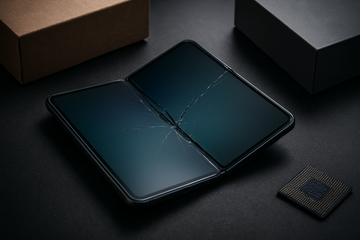
iPhone Duo, Oct 23–26, 2026
Apple Confirmed the Defect Three Days After Launch
Apple publicly acknowledged an inner-display problem on the $1,999 iPhone Duo on Oct. 26, 2026, telling reporters it is aware of \"an issue impacting the inner display on a small number of iPhone Duo units\" and will replace affected devices under AppleCare. Owners who secured a phone on the Oct. 23 launch weekend report cracks running along the center crease, sometimes after hearing a crunch as the device was unfolded. Apple has not disclosed a failure rate, a bad lot, or a service bulletin.
Launch price
$1,999
On sale Oct 23, 2026
Days from launch to Apple's admission
3 days
Launch Oct 23; statement Oct 26, 2026
Reported final-assembly yield
~60%
Supply-chain estimate, Sept 29, 2026
Foldable panel cost to Apple
$250
Per M16 OLED panel, three-year Samsung Display deal
Inner-display repair without coverage
$999
Published Apple service price, Oct 14, 2026
Morgan Stanley December-quarter estimate
$14B
On about 6.5M Duo shipments, Dec 2, 2026
| Date | What happened | Why it matters |
|---|---|---|
| May 18, 2026 | Hinges repeatedly failed Apple's quality-control standard in endurance testing | Yield, not industrial design, was the gating issue five months before launch |
| Jun 22, 2026 | Samsung Display began OLED module production for the foldable under a three-year exclusive agreement | Apple has no qualified second source for the panel |
| Sep 3, 2026 | CINNO Research mapped primary hinge assembly to Amphenol and Taiwan's Shin Zu Shing | Hinge content sits with two suppliers, one of them US-listed |
| Sep 11, 2026 | Apple agreed to pay about $250 per M16 foldable OLED panel | The panel alone absorbs roughly one-eighth of the retail price |
| Sep 29, 2026 | Supply-chain sources put final-assembly yield only just above 60%; the hinge carries more than 100 parts | A 40% scrap and rework rate sits between the order book and the customer |
| Oct 12, 2026 | Apple raised 2026 Duo orders about 30%, toward 10 million units | More volume was ordered into a line that cannot yet hold tolerance |
| Oct 16–23, 2026 | Pre-orders opened Oct 16; the $1,999 device went on sale Oct 23 | Demand ran ahead of what the constrained line could build |
| Oct 26, 2026 | Apple confirmed an inner-display issue on a small number of units and said it would replace them under AppleCare | The first public admission lands four days after launch |
Cause, not symptom
The Screen Is the Symptom; the Hinge Is the Disease
A crack along the crease points to hinge tolerance rather than panel quality. The Duo folds on a precision hinge of more than 100 parts working under tight tolerances, and production orders specified a crease shallower than 0.15mm and an angle under 2.5 degrees. Supply-chain reporting says the same hinge was consistently failing Apple's quality-control standard under repeated open-and-close testing as early as May, and that final assembly was running at a yield only just above 60% in late September.
That chain runs straight through Apple's own filings. The company warns that some components come from single or limited sources and that initial capacity constraints exist until supplier yields mature — the same single-source panel dependence and immature-yield language that now describes both the missing volume and the cracked units. The defect and the delay are one problem, and Apple's risk factors described it before the incident did.
- Crease cracking: owners report horizontal bright lines and cracks radiating from the hinge within hours or days of the first weekend, and Bloomberg reports customers describing a crunch as the device unfolded.
- Mixed durability verdicts: a 32,000-fold test reported on Oct 21 found the hinge stiffer but intact, which argues against a simple cycle-life failure and points to tolerance, contamination or assembly variation instead.
- Late material change: Apple reconsidered liquid metal for some hinge parts before mass production and chose a different solution, which resets validation for a supplier set already under strain.
- Not disclosed: the failure rate, the affected lot, and whether the fault is mechanical, material or batch-related. Until Apple publishes a service bulletin, no unit-level conclusion is available.
| Who pays | Cost per unit | Basis |
|---|---|---|
| Owner without AppleCare+ | $999 | Published Apple service price, Oct 14, 2026 |
| Owner with AppleCare+ | $99 | Same price list; AppleCare+ costs $19.99 a month or $199.99 a year |
| Apple under warranty | Not disclosed | Apple says affected units will be replaced under AppleCare |
| Panel or hinge supplier | Not disclosed | No supplier remediation has been announced |
| Samsung Display and hinge makers | Contract price unchanged | Apple's panel commitment is priced at about $250 per M16 panel |
Bill of materials
The Cost Stack Is Squeezed From Both Ends
The Duo is the most expensive iPhone Apple has ever sold and the most expensive to build. The foldable panel absorbs about $250 of a $1,999 retail price, locked for three years under Samsung Display's exclusive M16 deal. On top of that, Apple's June-quarter 10-Q says component costs for advanced semiconductors, NAND and DRAM are rising on supply-demand imbalances the company expects to intensify, and that higher memory costs partially offset product gross margin.
Memory is the second squeeze. Contract DRAM prices are forecast to rise 10–15% sequentially in the fourth quarter of 2026 and NAND 15–20%, with suppliers prioritising server memory over mobile allocations and depleted low-cost inventories weighing on smartphone production. Apple's September-quarter gross margin of 50.1% included roughly two points from tariff refunds, so underlying margin was closer to 48% — and the memory line is moving the wrong way into the December quarter.
Quarterly revenue at the memory supplier behind the price spike has quadrupled in four quarters
Revenue by fiscal quarter at Micron, from its fiscal 2026 10-K filed Oct 9, 2026.
Unit: USD billions
FQ1 2026
Quarter ended Nov 27, 2025
13.6
FQ2 2026
Quarter ended Feb 26, 2026
23.9
FQ3 2026
Quarter ended May 28, 2026
41.5
FQ4 2026
Quarter ended Sept 3, 2026; net income $37.7B
54.2
| Scenario | Duo units shipped | Foldable revenue | Share of Apple's Dec-2025 quarter revenue |
|---|---|---|---|
| Morgan Stanley base case | 6.5M | $14.0B | 9.7% |
| 25% ramp slip | 4.9M | $10.5B | 7.3% |
| 50% ramp slip | 3.3M | $7.0B | 4.9% |
Supply chain
Who Gets Paid, and Who Absorbs the Yield
| Link in the chain | Who does the work | Evidence | Who carries the risk |
|---|---|---|---|
| Foldable OLED panel | Samsung Display, the unlisted display arm of Samsung Electronics | Three-year exclusive deal at about $250 per M16 panel; module production began Jun 22, 2026 | Apple is locked in; Samsung Display carries panel yield |
| Hinge | Amphenol and Taiwan's Shin Zu Shing, with Dongguan Eontec on liquid-metal spindles and Lens Technology on ultra-thin glass | CINNO Research supply-chain map, Sep 3, 2026 | Apple through its own redesign; suppliers through requalification |
| Final assembly | Hon Hai's Foxconn unit, whose mainland affiliate is Foxconn Industrial Internet | Reported assembly yield only just above 60%, Sept 29, 2026 | The assembler absorbs scrap, rework and retooling |
| Memory | Micron and SK hynix | SK hynix second-quarter revenue KRW 79.3T, up 257% year over year | Memory makers hold the pricing power |
| Panel challengers | BOE Technology and Visionox Technology | BOE reportedly failed Apple's foldable quality bar, yet shipped 13 million smartphone OLED panels to Apple in Q3 2026 | Both are locked out of the foldable until 2027 at the earliest |
| Downstream rival | Motorola, the handset business of Lenovo Group | No. 3 foldable vendor in Q2 2026 with shipments down 28% year over year | Rivals inherit share if the Duo's halo turns negative |
- Samsung Display's exclusivity is now an asset for Samsung and a constraint for Apple: switching panels mid-cycle means requalifying a supplier that BOE reportedly could not pass, so the $250 price holds while Apple repairs the defect.
- The assembler carries the yield risk without Apple's pricing power: a reported 60% yield means scrapped and reworked units are charged to the line, not to Apple's gross margin.
- Amphenol sits on the wrong side of Apple's design control, because the hinge was redesigned late and liquid metal was dropped from some parts, leaving a listed hinge supplier competing with an in-house design.
- Memory is the cleanest winner in the chain: contract DRAM and NAND prices are rising into the December quarter, and Apple's own filing says those costs will intensify rather than fade.
- Dongguan Eontec is the clearest loser: its liquid-metal hinge-spindle thesis is diluted by Apple's late switch, while its Changshantou plant and Zhuzhou liquid-metal factory are still being built against that demand.
Downstream
The Credibility Bill Lands on the Rivals
A cracked halo product does more than add a warranty line; it prices the category. IDC expects Apple to take 44% of foldable market value in 2026 on 31% of units and to lead in both value and units by 2027, and TrendForce puts the Duo's 2026 shipments near 5 million units, about a quarter of all foldables shipped. If the newest and priciest flagship cracks in its launch weekend, the buyer at the $1,500–$2,000 tier makes waiting look cheaper than buying — and that wait lands on a Razr or a Galaxy Fold with a proven service history.
- Motorola, inside Lenovo Group, was the world's No. 3 foldable vendor in the second quarter of 2026 with shipments down 28% year over year, and Lenovo has reported its flip and fold line held more than half of foldable share outside China.
- Samsung's own Galaxy foldables face the opposite trade: a rival's early failure strengthens the incumbent's repair-and-quality story in the holiday quarter.
- For buyers without coverage, a cracked inner display costs $999 on a $1,999 phone — half the device's price again — while AppleCare+ holders pay $99 for the same repair.
Horizons
Two Quarters of Catalysts, Three Years of Structural Choices
- Oct 28, 2026: SK hynix reports third-quarter results, the first check on whether mobile memory allocations stay tight as AI demand absorbs capacity.
- Oct 29, 2026: Samsung Electronics holds its third-quarter earnings call, where foldable panel capacity and the Apple exclusivity surface in display commentary.
- Late October: Apple reports its September quarter, the first print that contains no Duo revenue and the first chance to reset the December ramp expectation.
- Fourth quarter: contract memory prices reset up 10–15% for DRAM and 15–20% for NAND, landing inside the December quarter's bill of materials.
- Any time: a formal Apple service program would convert an anecdotal complaint thread into a measurable return rate, and a measurable failure rate is what forces a hinge redesign.
- A hinge redesign is the near-certain response, because a crease that cracks under normal use cannot be cured by swapping panels.
- The panel decision follows: Samsung Display is the only qualified foldable source today, BOE reportedly failed Apple's bar, and Samsung Display's foldable OLED shipments are expected to reach 15 million units in 2027 from 8 million in 2026, leaving Apple little reason to break exclusivity first.
- If Apple brings more of the hinge in-house, listed hinge suppliers carry design-out risk; if it keeps them, a second assembly qualification lands in 2027.
- The category's volume case does not depend on the Duo — IDC put worldwide foldable shipments at 20.6 million units in 2025, up 10% year over year, before Apple arrived — so the growth story survives a one-quarter delay while the premium-price story does not.
What is fact: Apple has acknowledged an inner-display defect on a small number of units, will replace them under AppleCare, and has disclosed no failure rate. What is inference: cracks clustered at the crease, an assembly yield near 60% and hinge quality-control failures dating to May point to hinge tolerance as the common cause. What is not knowable yet: whether the affected units share a panel lot, a hinge lot or a supplier. What would falsify this reading: a published return rate in the low tens of thousands against a 2026 build approaching 10 million units, which converts this from a design signal into a contained lot problem.
Where the iPhone Duo Defect Actually Lands
- Morgan Stanley's $14B December-quarter foldable estimate equals about 9.7% of the $143.8B Apple booked in the same month a year earlier; a 25% unit slip costs roughly $3.5B of revenue.
- Warranty exposure is immaterial at current scale: 200,000 replaced inner displays at $999 each would be roughly 0.15% of $128.9B trailing net income.
- Near term: watch the September-quarter print and any change to the December launch plan; the risk moves into fiscal 2027 if the hinge is redesigned.
- Longer term: Apple's own 10-Q warning that memory costs will intensify caps both margin and the second-generation foldable ramp.
- The three-year exclusive panel deal at about $250 per M16 OLED locks in Apple's foldable screen spend, and BOE reportedly failed Apple's foldable quality bar.
- Samsung Display earns the panel money with no need for a second source while Apple repairs the defect.
- Second-quarter 2026 revenue of KRW 171.5T, up 28% sequentially, shows the same memory pricing that inflates Apple's bill of materials.
- Horizon: Samsung's own Galaxy foldables gain credibility in the December quarter if the Duo's early cracks sour category trust.
- Fiscal Q4 2026 revenue of $54.2B, up from $41.5B in the prior quarter, shows price rather than unit growth driving the memory cycle.
- Fourth-quarter contract DRAM is set to rise 10–15% sequentially and NAND 15–20%, lifting Apple's handset bill even if Duo units slip.
- Micron keeps pricing power as Apple's bill of materials inflates, since Apple's own filing says memory costs will intensify.
- Horizon: the read-through is sector-wide rather than foldable-specific; every iPhone shipped in the December quarter carries a higher memory price.
- Second-quarter 2026 revenue of KRW 79.3T, up 257% year over year, shows how tight memory supply has become with capacity pulled toward AI servers.
- Mobile DRAM allocations stay tight into the fourth quarter, so the Duo's ramp competes for the same bits as server demand.
- Firm pricing supports supplier margins even if Apple's foldable units slip by a quarter.
- Horizon: SK hynix reports third-quarter results on Oct 28, 2026; mobile allocation commentary is the near-term tell.
- CINNO Research named Amphenol a primary hinge assembly supplier, but Apple redesigned the hinge late and dropped liquid metal from some parts.
- Amphenol carries design-out risk from Apple's in-house hinge work; second-quarter 2026 revenue of about $8.8B sits inside a much larger portfolio.
- A foldable hinge share loss would appear in the mobile-devices segment before it reaches guidance.
- Horizon: the hinge requalification cycle, if it comes in 2027, is when content decisions are actually made.
- BOE reportedly failed Apple's foldable OLED qualification, so the foldable panel business sits with Samsung Display for three years.
- BOE still shipped 13 million smartphone OLED panels to Apple in Q3 2026, growing flat-panel share without foldable revenue.
- BOE waits for a 2027 qualification decision on Apple's second foldable model before foldable becomes a real revenue line.
- Horizon: a second-source announcement is the first re-rating trigger; nothing in the current panel deal changes before 2027.
- Final assembly yield of about 60% means scrapped and reworked units are charged to the assembler's line economics, not Apple's gross margin.
- Trailing revenue of about $152B leaves a wide base against which one new program's rework is easily absorbed.
- The mainland-listed Foxconn affiliate absorbs rework and retooling costs for a $1,999 product with no pricing power to pass them on.
- Horizon: a clean hinge fix in early 2027 ends the drag; a second redesign extends it.
- Motorola was the world's No. 3 foldable vendor in Q2 2026 with shipments down 28% year over year, and Lenovo reported more than half of foldable share outside China.
- If the Duo's early cracks make buyers wait, that wait lands on the Razr line.
- Lenovo inherits foldable share if Apple's halo turns negative, though a Duo ramp that reaches $14B keeps premium buyers away from Razr.
- Horizon: Motorola holiday sell-through against a slipping Duo ramp is the deciding data point.