
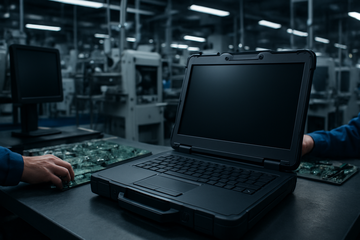
On October 27, 2026, Anduril and Qualcomm announced BlueChip, a hardened laptop designed and assembled in the United States for defense, government and first-responder buyers. Circuit board assembly is planned for Anduril's Arsenal-1 facility in Pickaway County, Ohio; the processor is a Snapdragon X Series part built at TSMC's Arizona fabs. More than 90% of the prototype's component procurement cost already comes from US and allied suppliers, and the stated long-term goal is a fully domestic bill of materials. Orders open in 2027.
BlueChip prototype sourcing
>90%
of component procurement cost from US and allied countries, per Anduril on Oct 27, 2026
Order book opens
2027
preorder availability; price and unit volume not disclosed
Price premium vs. high-end PC
~20%
estimate by Anduril co-founder Palmer Luckey, Oct 27, 2026
Trusted-assembler certification
8–16 months
IPC-1791 lead time in DoD's proposed PCB rule, posted Jul 2, 2026
Federal display deadline
Jan 1, 2030
FY2026 NDAA target to end reliance on adversary-sourced computer displays
Sizing the announcement
A Prototype With No Price Is Not a Product Cycle
Start with the arithmetic, because it disciplines everything else. Take a first-year scenario of 25,000 units at an assumed $2,400 average selling price — a high-end PC plus the roughly 20% premium — and BlueChip does about $60 million of revenue. That is roughly 1.4% of the $4.3 billion Anduril expects to book in 2026, and about 0.14% of the $44.1 billion Qualcomm has reported across its last four quarters. Even a tenth of the roughly $5 billion rugged-computing market Anduril's founder cites would be about $500 million: material to Anduril, still rounding error for Qualcomm.
That asymmetry is why the announcement matters more than the device. Anduril is private. It reported $2.2 billion of 2025 revenue in January, expects roughly $4.3 billion in 2026 with operating losses widening toward $1.2 billion, and last set a $61 billion valuation in a round reported in May; Reuters reported in July that the company was discussing a new round at roughly $100 billion, with no decisions made. Investors cannot buy the company most exposed to the trusted-hardware shift. They can buy the suppliers it depends on.
- Disclosed: US assembly, board assembly at Arsenal-1 in Ohio, a Snapdragon X Series chip from TSMC's Arizona fabs, and more than 90% of prototype component cost from US and allied countries.
- Not disclosed: price, unit volume, the first contract vehicle, and the number of qualified domestic suppliers for each component.
- Known hard: display panels are still only manufactured in China, so a 100% domestic build is a roadmap, not a 2027 deliverable.
- Uncertain: the market itself. Luckey calls rugged computing about a $5 billion market; narrower 'rugged notebook' data put 2025 at $3.4 billion, rising to $7.6 billion by 2034.
The rulebook
The Paperwork Is the Product: Four Pillars, One Clock
The rulebook is the actual announcement. On July 2, 2026 the Department of Defense published a proposed rule to implement statutory restrictions on covered printed circuit boards — DFARS Case 2022-D011 — and asked industry how the government should buy a board when the board itself may be foreign. The comment period closed on August 31, 2026.
| Pillar | What DoD will require | What it locks out |
|---|---|---|
| Supply-chain integrity | Current ISO/IEC 20243 (O-TTPS) certification at every tier | Suppliers that cannot hold enterprise-level traceability |
| Provenance | IPC-1782 Level 3 or 4 machine-level data, including base-material origin and the specific fabrication machinery | Boards whose origin cannot be proven point by point |
| Trusted assembly | IPC-1791 certified trusted assembler; certification is available to non-US facilities only via sponsorship | Covered-nation facilities, which DoD says are unlikely to qualify |
| Design data | Gerber files, netlists and schematics protected as controlled unclassified information | Any route where a clean board carries altered design files |
Two features turn a compliance document into a competitive moat. First, the waiver path requires blind hardware-assurance testing by a certified domestic or allied trusted assembler before a covered-nation board enters a system, and DoD estimates that certifying such a facility takes 8 to 16 months. Second, the rule would flow down mandatorily to every tier, commercial subcontracts included. A prime that owns its own assembly — Anduril at Arsenal-1, where the first Ohio-built Fury rolled off the line in July 2026 — can absorb the requirement inside its own footprint, while a contractor that buys boards from a covered nation cannot.
The bottleneck
The Display Is the Constraint, and Corning Sits at the Toll Booth
Anduril named its own hardest constraint: it found a US supplier for display glass, but the display panels themselves are only manufactured in China. That single component is why100% domestic is a roadmap rather than a spec. The economics of the trusted-hardware build now sit inside the glass supply chain.
Corning's AI optics boom is not a glass boom
Corning sales growth by segment, third quarter of 2026 versus a year earlier
Unit: % YoY
Optical Communications
Q3 2026 sales $2.379 billion
44%
Core sales
$5.081 billion
19%
Net sales
$4.855 billion
18%
Glass Innovations
$1.506 billion; segment now includes display glass
3%
Two data points frame the opportunity. Corning's Glass Innovations segment, which since the first quarter of 2026 bundles display glass with specialty materials, grew 3% in the third quarter to $1.506 billion, while Optical Communications grew 44% to $2.379 billion on consolidated net sales of $4.855 billion. The trusted-glass business is the part of Corning nobody is paying for. The FY2026 NDAA then gives that business a deadline: January 1, 2030 to end reliance on adversary-sourced optical glass and computer displays in defense procurement, with a recycling pathway that only counts if refining happens in the US or a qualifying allied country.
Apple has already shown the funding model — a $2.5 billion commitment to Corning's Harrodsburg, Kentucky plant to make all cover glass for iPhone and Apple Watch in the United States. Scaled domestic glass capacity gets built when an anchor customer finances it, not when a rulebook asks for it.
The platform vendor
For Qualcomm, BlueChip Is a Footnote; for the Supply Chain, It Is a Spec
| Segment | Q3 FY2026 | Q3 FY2025 | Change |
|---|---|---|---|
| QCT Handsets | $5,086M | $6,328M | -20% |
| QCT Automotive | $1,588M | $984M | +61% |
| QCT IoT | $1,830M | $1,681M | +9% |
| QCT total | $8,504M | $8,993M | -5% |
| QTL | $1,278M | $1,318M | -3% |
| Total revenue | $9,947M | $10,365M | -4% |
Qualcomm's own numbers say the laptop is a rounding error. Third-quarter fiscal 2026 revenue was $9.947 billion with GAAP EPS of $1.87 and non-GAAP EPS of $2.21, and fourth-quarter guidance is $9.7 billion to $10.5 billion of revenue with $2.05 to $2.25 of non-GAAP EPS. Handsets, still half the company, fell 20% year over year to $5.086 billion, while automotive rose 61% to $1.588 billion and IoT rose 9% to $1.830 billion. Qualcomm has told the market that non-handset growth accelerates from 24% in fiscal 2026 to more than 60% in fiscal 2027, and its 2026 investor day lifted the fiscal 2029 non-handset target to $40 billion from $22 billion.
- Qualcomm's fiscal 2026 fourth-quarter results land on November 4, 2026 — the first test of the 24% to more than 60% non-handset growth path.
- Data center is the actual pivot: $0.3 billion of revenue in fiscal 2026 rising to $5 billion in fiscal 2027 and $15 billion or more in fiscal 2029, with custom silicon due in the first quarter of fiscal 2027.
- PC revenue is not disclosed separately and sits inside the IoT line, whose fiscal 2029 target is $14 billion or more — BlueChip lands in a segment that already has to grow.
- The $65 billion automotive design-win pipeline as of June 24, 2026 is the benchmark a new PC channel has to clear, and BlueChip is nowhere near it.
The incumbents
The PC Majors Have a Margin Problem, Not a Tariff Problem
Only the certified supply chain can fund a 20% premium
Latest reported gross margin across the trusted-hardware chain
Unit: %
TTM to Jun 28, 2026
54.2%
TTM to Sep 30, 2026
36.4%
Q2 FY2027
20.9%
Q3 FY2026
18.8%
Lenovo
FY2025/26
15.4%
| Company | Period | Revenue | Gross margin |
|---|---|---|---|
| Dell Technologies | Q2 FY2027, ended Jul 31, 2026 | $46.97B | 20.9% |
| HP Inc | Q3 FY2026, ended Jul 31, 2026 | $15.68B | 18.8% |
| Lenovo | FY2025/26, ended Mar 31, 2026 | $82.73B | 15.4% |
| Corning | TTM to Sep 30, 2026 | $17.72B | 36.4% |
| Qualcomm | TTM to Jun 28, 2026 | $44.07B | 54.2% |
Put those margins next to a 20% compliance premium and the arithmetic decides who can play. Dell Technologies ran a 20.9% gross margin on $46.97 billion of revenue in its fiscal second quarter, HP Inc ran 18.8% on $15.68 billion, and Lenovo ran 15.4% on $82.73 billion for the year to March 2026. A 20% premium is affordable to a company running a 21% gross margin and dangerous to one running 15%. The certified supplier banks the premium; an incumbent either matches it and gives back the margin, or refuses and loses the refresh. None of the three has the other half of the product: a defense-prime relationship, an owned US board-assembly plant, or the certificate itself.
Timing
Two Horizons: A 2027 Prototype and a 2030 Deadline
- Next quarters: Qualcomm's fiscal 2026 fourth-quarter print on November 4, 2026, guided to $9.7 billion to $10.5 billion of revenue and $2.05 to $2.25 of non-GAAP EPS.
- Next quarters: the first hard BlueChip numbers — order intake, price and the first defense or government contract vehicle — none of which exist yet.
- Next quarters: DoD's final DFARS rule on covered PCBs after the August 31, 2026 comment close, including the phase-in period of 12, 18 or 24 months that DoD has asked about.
- Next quarters: Corning's Glass Innovations line; any move above the 3% third-quarter growth rate is the first evidence that trusted-display demand reaches a profit and loss statement.
- 2027: BlueChip availability, and the first domestic display supply agreements — a 100% domestic build needs a panel partner that does not yet exist.
- 2028: qualification capacity becomes the bottleneck, since IPC-1791 certification takes 8 to 16 months and trusted assembly slots get allocated before they are built.
- 2030: the January 1, 2030 statutory deadline for adversary-sourced computer displays and optical glass turns a procurement preference into a hard constraint.
- 2027 to 2029: if Windows-on-Arm compatibility holds for decades-old agency software, a defense prime with a certified factory becomes a PC vendor with pricing power it has never had.
Three things would break this thesis. BlueChip has no price, no volume and no named customer; a thin 2027 order book turns the standard-setting story back into a press release. The display-panel gap may be structural rather than transitional, leaving a permanent ceiling on how domestic the bill of materials can be. And Qualcomm's engineering attention is committed elsewhere: custom silicon in the first quarter of fiscal 2027 and a $5 billion data-center year do not leave spare bandwidth for a defense rugged platform that only starts shipping in 2027.
Conclusion
Bottom Line: Own the Certificate, Not the Laptop
The trusted-hardware thesis is real, but the asset is not the laptop. Three facts define it: the Pentagon is converting provenance into a certification requirement with an 8-to-16-month lead time; the FY2026 NDAA puts a January 1, 2030 deadline on adversary-sourced computer displays and optical glass; and Anduril, the company with the most direct exposure, is private and pre-IPO at a $61 billion last round, so it cannot be bought on an exchange. That last point decides where the exposure sits. If provenance is the moat, the trade is the certified supply chain that already holds the paperwork — TTM Technologies in boards and traceability, Corning in the only scaled US cover-glass footprint, TSMC in the leading-edge silicon made inside US borders, and Panasonic Holdings in domestic battery scale. Qualcomm holds the platform and the option; the PC majors hold the customers and the thinnest margins in the chain.
It will cost about 20% more than typical high-end PCs. If you were a normal consumer, I'd be better off buying a Dell Technologies laptop.
- If BlueChip's first order book lands at scale in 2027, a defense prime has set the trusted-hardware standard and the tier-one suppliers collect the premium.
- If BlueChip stalls, the rulebook still stands and the certificate holders win anyway, because the certification clock starts whether or not the laptop ships.
- Either way the exposure sits with TTM Technologies, Corning and TSMC rather than with the private brand that announced it.
Where the trusted-hardware exposure actually sits
- BlueChip is immaterial to estimates: a first-year scenario of $60 million is about 0.14% of the $44.1 billion of trailing revenue reported through the fiscal third quarter of 2026.
- Handsets, still half the company, fell 20% to $5.086 billion in Q3 FY2026, and Qualcomm guides non-handset growth from 24% in fiscal 2026 to more than 60% in fiscal 2027.
- Near term the November 4, 2026 print against $9.7 billion to $10.5 billion of guided revenue is the only date that matters; longer term a government channel governments cannot switch off is a floor under a PC line never broken out separately.
- BlueChip's Snapdragon X is built at TSMC's Arizona fabs, so the trusted-hardware channel puts a demand anchor on leading-edge capacity inside US borders.
- Third-quarter 2026 net revenue was US$46.72 billion at a 66.4% gross margin; fourth-quarter guidance of US$44.6 billion to US$45.8 billion implies a sequential step down.
- Near term the guide-down shows AI capex, not defense laptops, sets TSMC's demand; longer term allied-sourcing rules make domestic leading-edge capacity scarce.
- Cover glass is the one component Anduril named as unobtainable domestically, and Corning's Glass Innovations segment grew just 3% to $1.506 billion in the third quarter of 2026.
- Apple's $2.5 billion commitment to Corning's Harrodsburg, Kentucky plant shows how domestic glass capacity actually gets financed.
- Near term the fourth-quarter core sales guide of $5.2 billion to $5.3 billion is all AI optics; longer term the January 1, 2030 display deadline turns idle glass capacity into strategic capacity.
- DoD's proposed PCB rule would make IPC-1782 traceability and IPC-1791 trusted assembly conditions of sale, with certification taking 8 to 16 months.
- Revenue rose from $846.0 million in the first quarter of 2026 to $1,004.1 million in the second, against $2.91 billion for all of fiscal 2025.
- Near term a final DFARS rule after the August 31, 2026 comment close is the catalyst; longer term certified domestic board capacity becomes scarce as waivers get harder to win.
- Anduril's own founder says a consumer would be better off buying a Dell laptop, which is the incumbent defense: channel, service and price.
- Second-quarter fiscal 2027 revenue of $46.97 billion at a 20.9% gross margin can absorb a 20% compliance premium that would erase a 15% margin.
- Against that, Dell has no defense-prime relationship, no owned US board-assembly plant and no IPC-1791 trusted-assembler certification, so it can match price but not the audit trail; near term there is no BlueChip revenue.
- Third-quarter fiscal 2026 revenue of $15.68 billion came at an 18.8% gross margin, with no defense-grade procurement channel to price the shift.
- Trailing revenue of $59.16 billion leaves no cushion to match a certified supplier's premium while holding margin.
- Near term the effect is negligible; longer term, if refresh contracts start scoring provenance, HP is the PC major with the least ability to certify into the category.
- Toughbook is the rugged incumbent BlueChip attacks, and Panasonic Energy's De Soto, Kansas plant — a $4 billion build running toward 32 GWh of planned annual capacity since July 2025 — is exactly the domestic battery scale a trusted bill of materials needs.
- BlueChip is simultaneously a competitor in rugged computing and a potential customer for domestic cells.
- Near term there is no revenue link before 2027; longer term, if trusted-hardware volumes surprise, domestic cell supply becomes a strategic asset in a category Panasonic already sells into.
- Fiscal 2025/26 revenue of $82.73 billion at a 15.4% gross margin is the thinnest margin among the PC majors and the thinnest cushion for a 20% compliance premium.
- The mitigating fact is that Lenovo's exposure sits mainly in commercial and consumer PCs, where provenance carries no premium today.
- Near term there is no BlueChip effect; longer term, if government refresh contracts start scoring origin, the largest PC builder has the least margin room to chase them.