
Policy rate after the October decision
3.75%–4.00%
Held on Oct 28, 2026; Governor Cook and Cleveland's Hammack dissented for a 25 basis point hike
Rate-setting votes ahead
7 in 2027, 6 in 2028
One and two strategy sessions replace rate votes, with no policy statement
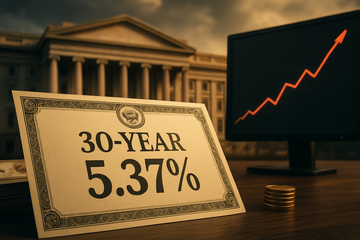
30-year Treasury yield
5.37%
Oct 28, 2026 — about 150 basis points above the 3.875% policy midpoint
December hike priced
~76%
Prediction-market pricing for the Dec 9, 2026 decision
Headline CPI
3.7%
September 2026, year over year; core 2.6%
30-year mortgage rate
7.32%
Freddie Mac survey, Oct 22, 2026, down from 7.40% a week earlier
October 28, 2026
The Hold Was the Easy Part
The Federal Open Market Committee left the target range at 3.75%–4.00% on October 28, with Governor Lisa Cook and Cleveland Fed President Beth Hammack dissenting in favor of a 25 basis point increase. The statement was blunt about the present — inflation remains elevated, and the committee will deliver price stability — and silent about the future by design. Chairman Kevin Warsh repeated that he does not believe in forward guidance absent exigent circumstances, absent a crisis.
- Seven rate-setting votes in 2027 and six in 2028, with the balance of the calendar handed to strategy sessions that carry neither a rate vote nor a policy statement.
- Forward guidance reserved for crises: Warsh said again that in normal, ordinary times he does not favor it, and FOMC statements no longer describe the path.
- No soft inflation target: “There is no soft inflation target, there is no soft implicit target — not on this committee's watch. There is only a target, and it's 2%.”
- The chair no longer submits his own rate forecast, calling the exercise unhelpful for the conduct of policy.
The calendar
A Shorter Calendar Concentrates the Risk Into Fewer Dates
The Fed is not cutting the number of times it meets. Warsh said eight meetings per year is the right number for the committee. What changes is the number of times it votes on rates: from 2027, one meeting each year will be devoted to broad strategy, with neither a rate vote nor a policy statement, and in 2028 that becomes two meetings.
| Calendar year | FOMC meetings | Rate-setting votes | Strategy sessions (no vote, no statement) |
|---|---|---|---|
| 2026 | 8 | 8 | 0 |
| 2027 | 8 | 7 | 1 |
| 2028 | 8 | 6 | 2 |
- Fewer repricing events means each surviving decision carries more of the year's policy information — and therefore more event premium in front-end options.
- Longer gaps between decisions means path risk that a statement used to absorb must now be hedged, and hedges are priced by dealers rather than by the Fed.
- No statement means no narrative: the committee will be judged on outcomes, with the September minutes already flagging that market-implied volatility of longer-term rates increased on net.
- What is not disclosed: whether a strategy session will publish an economic projection. The framework review, not the calendar, becomes where the substantive news lands.
The second axis is the balance sheet. Warsh appointed a task force to review a roughly $6.7 trillion portfolio in June and said on October 28 that the committee may weigh balance sheet issues early next year. With no forward guidance on rates, the plumbing that supports them — reserves, repo, the standing facility — stops being a technical detail and becomes part of the policy message itself.
Where the path lives now
The Dots Are Already Dead; December Trades in Futures and Prediction Markets
The Fed still publishes a Summary of Economic Projections, but its information value has collapsed under this chair. The September 16 projection put the median year-end 2026 federal funds rate at 4.125%, one more quarter-point increase from 3.75%–4.00%, with the longer-run median near 3.25%. The chair himself no longer submits a rate forecast, and the press coverage of the dot plot has already moved to its obituary.
| Channel | What it says about December | As of |
|---|---|---|
| FOMC statement | Describes inflation as elevated and promises 2%; says nothing about the next move | Oct 28, 2026 |
| September economic projections | Median year-end 2026 rate of 4.125% — one more hike — but no longer the chair's own forecast | Sep 16, 2026 |
| Warsh press conference | “I don't believe in forward guidance, absent exigent circumstances, absent a crisis” | Oct 28, 2026 |
| Prediction markets | About 76% priced for a 25 basis point increase on Dec 9 | Oct 28, 2026 |
| Economist survey | All 100 respondents expect a December hike; nearly 60% see the policy rate peaking at 4.00%–4.25% | Oct 20, 2026 |
Market-implied probabilities around the October meeting
The December decision now carries the entire hike expectation. The two 2026-wide measures were struck after the September inflation report in mid-October; the December figure is prediction-market pricing for the Dec 9 decision.
Unit: percent
Hike priced for Oct 28
7
Hike priced for Dec 9
76
At least one hike priced for 2026
95
Rates50bp higher priced for 2026
40
This is the part that matters for positioning. When a central bank publishes a path, the market trades the path and the central bank absorbs the tail. When it publishes nothing, the market must price the whole distribution itself, in futures, in options and in prediction markets, and the December meeting becomes a price discovery event rather than a confirmation. The market's own answer — a 76% chance of 25 basis points, with a 40% chance of a half-point move priced for the year — is now more informative about the Fed than any statement the committee publishes.
The long end
The Silence Gets Taxed at 30 Years, Not at the Policy Rate
The front end is where the December hike lives; the long end is where the absence of guidance lives. The 10-year Treasury yield closed at 5.05% on October 28, above the 5.04% intraday peak set on September 15, the highest since July 2007, and the 30-year closed at 5.37%. The chair has already conceded the mechanism: in July he said the lack of forward guidance may have driven Treasury yields higher.
| Maturity | Yield, Oct 28, 2026 | Premium over the 3.875% policy midpoint |
|---|---|---|
| 1 month | 4.07% | +20 bp |
| 3 months | 4.10% | +23 bp |
| 1 year | 4.47% | +60 bp |
| 2 years | 4.85% | +98 bp |
| 5 years | 4.95% | +108 bp |
| 10 years | 5.05% | +118 bp |
| 20 years | 5.41% | +154 bp |
| 30 years | 5.37% | +150 bp |
- Rate risk is being priced in bonds, not in equities: the ICE BofA MOVE index closed at 97.87 on October 27 while the VIX sat at 17.52 — a divergence that says the market is worried about the Fed, not about earnings.
- The 20-year at 5.41% and the 30-year at 5.37% leave the long end roughly150 basis points above the policy rate. Some of that is inflation; the rest is what investors demand for a committee that will not describe itself.
- A one-month bill at 4.07% is the tell: that is close to the average of a 3.875% target range for the first eight days of November and 4.125% for the rest. A December hike is already the base case in the bills, which leaves the meeting with asymmetric risk.
Banks
2027 Net Interest Income Guides Are Now Curve Bets, Not Fed Promises
The communication vacuum does not change bank arithmetic; it changes who has to be right. Under a guided Fed, a bank modelled asset and liability yields off the committee's own projected path. With no guidance, the 2027 net interest income guide is a bet on where the curve sits, and the curve is now set by futures and options. JPMorgan Chase, Bank of America and Wells Fargo all posted strong September quarters on that backdrop.
| Bank | Net interest income | Year over year | Net income |
|---|---|---|---|
| JPMorgan Chase | $27.0B | +13% | $15.3B |
| Bank of America | $16.4B | +8% | $6.9B |
| Wells Fargo | $12.5B | +5% | $6.0B |
The2027 guides are where the regime change bites. JPMorgan forecast net interest income excluding markets of about $107 billion for 2027, roughly $10 billion above this year, and Bank of America's CFO guided to 8% or more net interest income growth in 2027 after about 8% this year. Both guides are built on a path that the Fed has announced it will no longer describe.
- Funding is the pressure point: average deposits at JPMorgan rose 8% year over year in the September quarter, and a Fed that raises without guiding raises the cost of winning that money.
- The most exposed guide is the largest one: roughly $10 billion of JPMorgan's 2027 net interest income growth disappears if the December decision fails to deliver and the curve reprices lower.
- Offsetting the risk: with the 30-year at 5.37% and the 10-year at 5.05%, securities portfolios have been marked up, and loan growth at JPMorgan ran 10% year over year.
Supply chain
Whoever Runs Duration on Borrowed Money Pays for the Silence
Upstream, in the funding chain, the cost shows up first at the leveraged intermediaries that hold agency paper with short-term funding. Annaly Capital Management lost $985 million, or $1.36 a share, in the September quarter; book value per share fell 11.4% to $17.86 and GAAP leverage rose to 8.0 times. Total assets of $146.1 billion are funded with $85.5 billion of short-term borrowings, which is what a Fed that raises rates without telling you when it stops looks like from inside the trade.
Downstream, in the demand chain, housing is where the silence is most visible to households. D.R. Horton cut its fiscal 2026 revenue outlook to $32.5 billion–$33.0 billion on October 22 and guided fourth-quarter home sales gross margin to 20.5%–21%. The 30-year mortgage rate averaged 7.32% in the same week, more than 200 basis points above the 10-year Treasury yield, which is the price of borrowing to buy a house when nobody is steering the long end.
- Mortgage REITs run duration on repo: a Fed that removes guidance makes each funding renewal a repricing of the entire hedged book.
- Homebuilders sell to households that must qualify at 7.32%, which is why incentives, not prices, are clearing the market.
- Banks' consumer books are the slow channel: card net charge-offs at JPMorgan ran 2.91% in the September quarter, and a no-guidance Fed extends the high-for-longer phase that feeds that line.
The new intermediaries
Dealers, Bill Buyers and the Hong Kong Dollar Take Over the Fed's Old Job
Goldman Sachs is the listed proxy for the trade that replaces guidance. Net revenues of $18.68 billion in the September quarter were up 23% year over year, earnings per share were $17.01 and annualized return on common equity was 18.7%. The honest caveat is that the beat was equities-led: FICC revenue of $3.47 billion was down 1% year over year, so the rates-volatility premium has not yet shown up in fixed income results.
Berkshire Hathaway is the listed proxy for the other side of the trade. It held $365.5 billion of cash and Treasury bills and $361.6 billion of long-term investments at June 30, so a Fed that promises no cut path keeps the marginal buyer of bills in the market at a 4.07% one-month yield. Berkshire is paid to wait; dealers are paid to hedge; the households financing a 7.32% mortgage are paying the difference.
In Hong Kong, the transmission is mechanical rather than rhetorical. The dollar is pegged, so Hong Kong interest rates follow the Fed's trends closely, and HSBC led Hong Kong banks in cutting its prime-rate band to a 3.75%–4.00% range in line with the last move. A December increase would lift that band mechanically and reprice prime-linked loans without any Hong Kong policy input at all.
- Asia hears the dollars, not the speeches: KB Financial Group's first-half 2026 net interest income of KRW 6.48 trillion grew only 1.7% year over year even as the Fed raised rates, because Seoul sets the rate that drives KB's book and Washington only sets the dollar funding cost.
- Japanese banks are further insulated: Mizuho Financial Group lifted its domestic loan-and-deposit margin to 1.26% in the June quarter from 1.10%, driven by the Bank of Japan rather than by the Fed.
- The exception that proves the rule is the dollar-funded balance sheet: the firms whose assets and liabilities both sit in dollars feel the Fed's regime change first, whether they are in New York, London or Hong Kong.
Horizons
Days to Quarters, and One to Three Years
| Horizon | What moves | Catalysts and dates |
|---|---|---|
| Days to quarters | Front-end repricing of December; the curve around the Nov 3 midterms; funding costs at levered mortgage books | US midterms on Nov 3, 2026; FOMC on Dec 9, 2026; monthly CPI and payrolls; weekly mortgage surveys |
| One to three years | Seven rate-setting votes in 2027 and six in 2028; the balance sheet review; whether 3.7% inflation returns to target without a guidance framework | Strategy-session agenda for 2027; Fed balance sheet options; long-run inflation expectations |
- Near term: December is the last rate decision of 2026, and with the bills already pricing a full hike, the meeting's risk is skewed toward delivering more than the market wants.
- Near term: midterms change the political read of a Fed that no longer speaks. Warsh said he heard no politics and that elections had no role in the decision, but a silent committee is far harder to audit than a talking one.
- Long term: the balance sheet task force reviewing a roughly $6.7 trillion portfolio could reshape the plumbing the front end depends on, and matters more than any single rate decision.
- Long term risk: a central bank that refuses to describe a path must be judged only by outcomes, and the outcome it has delivered so far —3.7% headline CPI against a 2% promise — is the wrong one.
Falsifiers
What Would Break This Thesis
- A single line of conditional language in a December statement — even a nod to a data-dependent path — would show the communication regime was rhetorical, and the 150 basis points of long-end premium would compress quickly.
- Headline inflation falling back toward 2% without a further hike would validate the no-guidance experiment and pull the long end down with it, relieving mortgage books and homebuilders at the same time.
- A funding accident anywhere in the agency mortgage chain would force the Fed back into communication, because the pledge to speak only in a crisis turns plumbing problems into regime events.
- A strategy session that rewrites the target framework itself would make today's December pricing irrelevant and reprice the entire curve.
Where this regime change shows up in listed equities
- Q3 net interest income of $27.0 billion ran 13% above a year earlier, and the roughly $107 billion 2027 guide excluding markets is the sector's biggest curve bet.
- Near term, a December hike lifts reinvestment yields on a $1.5 trillion cash and marketable securities book within two quarters.
- Long term, deposit competition is the risk: average deposits rose 8% year over year and a silent Fed cannot anchor deposit pricing.
- Q3 net interest income of $16.4 billion grew 8% year over year, with management guiding to 8% or more growth for 2027.
- Near term, a December increase adds roughly 25 basis points to asset yields before deposit betas respond.
- Watch the assumption: the 2027 guide implicitly assumes further rate increases, and a flatter curve breaks it first.
- Net interest income rose 5% to $12.5 billion and diluted earnings per share reached $1.87 from $1.66 a year earlier.
- Near term, the December repricing sets the funding-cost assumption that carries into the first quarter of 2027.
- Long term, margin expansion depends on deposit pricing that the Fed has stopped steering.
- Net revenues of $18.68 billion rose 23% year over year, with earnings per share of $17.01 and an annualized 18.7% return on common equity.
- Long term, a Fed without guidance forces clients to buy hedges and dealers sell them; FICC revenue of $3.47 billion was still flat year over year.
- Watch: if rate volatility fades, the hedging volume premium unwinds fastest of any beneficiary.
- Cash and Treasury bills of $365.5 billion earn close to the 4.07% one-month bill yield, and the Fed now promises no cut path to pull it down.
- Near term, a December hike lifts the reinvestment rate on the float before any portfolio decision.
- Long term, the $361.6 billion long-term book benefits from a 5.37% 30-year but is exposed if the term premium unwinds.
- A $985 million quarterly loss cut book value per share 11.4% to $17.86 and lifted GAAP leverage to 8.0 times.
- Near term, $85.5 billion of short-term borrowings reprice around every remaining Fed decision, and there are only six in 2028.
- Long term, the agency book only works if the Fed stops raising, and a no-guidance Fed keeps that risk open.
- Fiscal 2026 revenue guidance was cut to $32.5–$33.0 billion with fourth-quarter home sales gross margin of 20.5%–21%.
- Near term, a 7.32% mortgage rate against a 5.05% ten-year keeps incentive-loaded orders rather than price-led demand.
- Long term, housing recovers only if the long end falls, and the Fed has withdrawn the signal that would move it.
- Hong Kong rates follow the Fed automatically through the peg, so a December hike lifts HSBC's prime-rate loan book without any local policy input.
- Near term, the Hong Kong prime band moves from 3.75%–4.00% at the December decision, repricing linked loans immediately.
- Long term, dollar funding and Asian trade finance gain volume, but deposit repricing in Hong Kong caps the margin gain.