
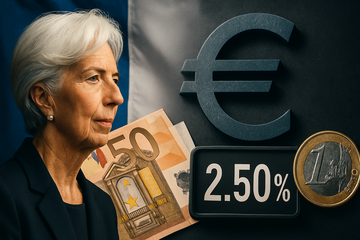
The ECB did something unusual on 29 October 2026: it held rates, flagged upside inflation risks, told markets it would not pre-commit to any rate path, and lost its president, all before lunch. What it did not do is sell the December hike — pricing firmed to about 88% for a quarter-point move by the end of the session. What it did do was show investors what a leadership vacuum does to a currency: EUR/USD broke to 1.113, its weakest since May, and French borrowing costs kept grinding higher, with the 10-year OAT yield above 5% for the first time since 2002. the market is pricing a credibility discount in the euro and in French bonds, not in the ECB's December vote — which is why this vacancy is an FX problem before it is a rates problem.
ECB deposit facility rate
2.50%
Held on 29 October 2026, after 25bp increases in June and September
Euro-area inflation
3.8%
Euro area HICP, September 2026, up from 3.2% in August
French 10-year OAT yield
5.089%
22 October 2026, first time above 5% since 2002
EUR/USD
1.113
29 October 2026, weakest since May, down 4.2% year on year
Brent crude
$113.77
29 October 2026, still about 16% above the EIA's 2026 average forecast
December ECB hike priced
~88%
About 22bp by the close of the 29 October statement, up from 80%
The decision itself
What the ECB Actually Decided, and What It Refused to Promise
The Governing Council left the deposit facility at 2.50%, main refinancing at 2.65% and marginal lending at 2.90%, on the same day it told the market that the energy shock creates upside risks to inflation and downside risks to growth. Underlying inflation was described as broadly stable and wages as showing no material response to higher prices — the exact combination that justifies tightening an imported shock. the council bought credibility for December by refusing to pre-commit to anything beyond it, and markets read the combination as a hike-in-waiting rather than a pivot.
- Rates were held at 2.50% (deposit), 2.65% (refinancing) and 2.90% (marginal lending), with APP and PEPP portfolios declining at a measured pace and no reinvestment of principal.
- The council stated that energy prices have continued to rise, and that the increased magnitude and duration of the shock is likely to drive inflation up and growth down.
- The council also stated that it is not pre-committing to a particular rate path — the formal reason a successor inherits an open-ended hiking mandate rather than a fixed one.
- Lagarde said the run-up to the final meeting of the year would be information-rich, and that the ECB has instruments to respond if market developments threaten smooth transmission through unwarranted and disorderly market movements.
| Eurosystem staff projection | June 2026 round | September 2026 round |
|---|---|---|
| Headline HICP, 2026 | 3.0% | 3.0% |
| Headline HICP, 2027 | 2.3% | 2.5% |
| HICP excluding energy and food, 2026 | 2.5% | 2.5% |
| HICP excluding energy and food, 2027 | 2.5% | 2.6% |
| Real GDP growth, 2026 | 0.8% | 0.9% |
| Real GDP growth, 2027 | 1.2% | 1.4% |
| Deposit facility rate at the decision | 2.25% | 2.50% |
The deposit facility has moved 50bp in 2026 and stopped
ECB deposit facility rate. The pre-June level follows from the council's 25bp increase to 2.25% in June and 2.50% in September.
Unit: %
Before June 2026
Level implied by the June 25bp increase
2
11 June 2026
First increase of the tightening phase
2.3
10 September 2026
Second increase; inflation projected at 3.0% for 2026
2.5
29 October 2026
Held, with a December hike left on the table
2.5
Successor risk
The Vacancy Is Priced Before It Is Filled
The ECB's own statement gave no reason for the departure, and the political calendar is the reason investors are reading into it: a nine-month-early exit lets EU leaders appoint a successor while Emmanuel Macron is still in the Élysée and before the French presidential election in April or May 2027. the successor is therefore selected under French political constraint, not solely on monetary-policy merit, which is why the appointment calendar itself now carries a rate risk.
| Candidate | Base | What they inherit on 7 February 2027 |
|---|---|---|
| Klaas Knot | Dutch central bank president, 2011–2025 | A pragmatic hawk with 14 years on the Governing Council and no public break with Lagarde; Reuters reports France could back him if a French candidate takes the chief economist post |
| Pablo Hernández de Cos | Spanish candidate | Reported by Bloomberg-affiliated economists and CNBC as one of two leading contenders, alongside Knot |
| Joachim Nagel | German candidate | Listed by the Guardian among the plausible successors, and the bloc's largest economy is where the OAT problem is least tolerable |
| The post-2027 question | Undisclosed | No successor has published a reaction function, and the ECB did not publish a new staff projection set in October — the next one lands with the December decision |
The currency channel
The Credibility Discount Shows Up in the Euro Before It Shows Up in Rates
Two-year government bond yields fell sharply on the day of the decision while the euro fell 0.2% to 1.113, below 1.1111 at one point, and EUR/GBP broke below 0.8360 — a broad, not dollar-specific, move. That is the classic fingerprint of a currency being asked to absorb a policy-credibility question. a currency that falls while the front end rallies is being repriced for the durability of the policy, not the level of the policy.
The euro's slide predates the vacancy
EUR/USD reference levels. The 2026 average of 1.1576 is the benchmark the euro has been trading below since the spring, which is why an energy shock imported in dollars lands harder than the inflation print alone suggests.
Unit: USD per EUR
A year earlier
October 2025 level
1.2
2026 average to date
Benchmark for the translation arithmetic
1.2
28 October 2026
Day before the ECB decision
1.1
29 October 2026
Lowest since May, after the resignation news
1.1
The rate-differential arithmetic is no better for the euro. The ECB has delivered 50bp of hikes in 2026 and still sits 125bp to 150bp below a Federal Reserve funds target range of 3.75% to 4.00% — a range the Fed held on 28 October with two policymakers dissenting in favour of a hike, and one that markets see about 83% likely to move higher in December. Hawkishness at home plus a hawkish Fed abroad means the euro's carry advantage cannot widen through this cycle. euro strength has to come from credibility, not from the differential, and credibility is exactly what the vacancy puts in question.
Sovereign stress and the market's verdict
Front End and Long End Disagree, and the Gap Is the Opportunity
The bond market drew a sharper line than the currency did. The 10-year OAT yield rose 9bp to 5.089% on 22 October — the first time French borrowing costs have exceeded 5% since 2002 and the first time they have overtaken US Treasuries since 2013 — while the spread over Germany reached 155bp, the widest since 2011. France ran a 5.1% of GDP deficit in 2025 with debt at 115.6% of GDP, the government is struggling to pass next year's budget after violent protests, and the spillover is visible in Italy at 116bp and Spain at 66bp, the widest for Spain since June 2025. France's funding market, not the ECB's calendar, is the binding constraint on the December hike.
The stress is French, and it is spreading at the margin
10-year sovereign spreads over Germany. France and Germany is the 155bp reading cited by Reuters and Euronext on 29 October; Italy and Spain are the 22 October readings.
Unit: bp
France
Widest since 2011, per Reuters
155
Italy
22 October, wider by 3.8bp on the day
116
Spain
22 October, widest since June 2025
66
- The STOXX 600 rose 0.40% to 646.69 on 29 October, its highest level since early September, so equity investors were not pricing European recession.
- Euro-area bank stocks fell 1.3% on the day, the sector's biggest laggard — the rate-sensitive, sovereign-levered part of the market was being discounted even as the index rose.
- Energy was where the bid went: Shell rose 3.4% to a record high on its strongest quarterly profit since 2022 and a raised buyback, and TotalEnergies rose 1.9% after Q3 profit more than doubled.
- The initial reaction to the resignation itself was muted in equities, but the currency moved immediately, which is the tell: this is an FX repricing, not a risk-off event.
Read together, the October 29 tape says the market is treating the energy shock as a windfall for European producers and a discount for European levered balance sheets, while doubting that a committee without a president can deliver a full hiking cycle into a 155bp French spread. That is a coherent, tradeable conclusion, and it is the opposite of the simple version of the story: nobody is pricing European recession, and nobody is pricing a dovish ECB. the discount is being applied to the euro's credibility and to the sovereigns, not to the inflation path.
The dollar-funding read-through
The Plumbing Argument Is Where the Vacancy Bites Deepest
Lagarde's last sustained project was the euro's international role: expanding currency safety nets so foreign central banks can borrow euros, and touring China in October to make the case for the EUREP facility. More than a dozen central banks had already asked for access to euro liquidity lines. That agenda is a plumbing argument about why the euro should fund the world rather than the dollar. a successor inherits a currency-internationalisation pitch made from a position of visible political weakness, and the cost of euro funding in stressed conditions is the number the successor will be judged on.
- The ECB said in September it plans to expand currency safety nets so foreign central banks can borrow euros more easily, and Lagarde pushed the EUREP collateral facility in Beijing on 20 October.
- The BIS devoted a speech on 21 October to euro liquidity lines and the international monetary system, confirming the plumbing is now a stated systemic question rather than a technicality.
- Inference: with the Fed on hold at 3.75%–4.00% and roughly 83% of a December hike priced, dollar funding stays expensive, so any euro-area stress that pushes institutions toward dollar hedges tightens the dollar side of the market first.
- That is a revenue argument for the dollar's clearing and intermediation banks at the same time as it is a mark-down for the euro's plumbing ambitions.
The most underappreciated constraint on the new team is that the ECB's balance sheet offers no put for French spreads: portfolios are shrinking at a measured pace and principal payments are not reinvested, so there is no QE channel to defend a 5% OAT yield, and the TPI remains a discretionary instrument rather than a commitment. successors inherit the choice between hiking and backstopping French spreads, with no balance-sheet room to do both — which is the real reason a successor's credibility will be judged on the OAT spread rather than on a press conference.
Who gets paid, who gets squeezed
The Cross-Section of the Shock: Energy Pays, Levered Euro Balance Sheets Carry It
| Company | Latest reported metric | Channel from the ECB credibility gap | Read |
|---|---|---|---|
| Shell | Q3 net profit $10.81bn, nearly double a year earlier; record refining margins of about $42/bbl; buyback raised to $5bn from $3bn | Sells the shock: energy revenue is the euro area's inflation tax, and the dollar reporting line gains from a cheap euro | Beneficiary |
| TotalEnergies | Q3 adjusted net income $9,097m vs $6,027m in Q2; Q3 sales $66.8bn; net debt 0.77x EBITDA | Same channel with an LNG cash-flow ballast; a balance sheet that can fund a long energy regime | Beneficiary |
| JPMorgan | Q3 net income $15.3bn (+6%), $50.9bn managed revenue, $27.0bn net interest income; trailing NII $102.9bn vs $95.4bn in FY2025 | Dollar-funding side: expensive dollar funding plus euro-area hedge demand lands on the dollar's clearing and intermediation bank | Beneficiary |
| BNP Paribas | Q3 net banking income €13,757m (+9.5%); net income €3.46bn (+14%, consensus €3.23bn); FY2025 net income €12.2bn | Rates still pay — 50bp of hikes lifts net interest income — but the 155bp French spread is the credit side of the same trade | Two-sided |
| UniCredit | 1H26 net profit €6.1bn; FY26 net profit guidance well above €11bn; RoTE 23.7% in Q2; Q3 results moved to 8 November 2026 | Italy at 116bp versus France at 155bp: the same credibility gap prices very differently across the bloc, and this is the cleanest relative-value expression | Positive relative |
| ING Groep | Q3 net result €1,850m (+3.5%), ROTE 16.3%; 2026–27 guidance raised in July | A deposit franchise levered to a 2.50% deposit rate that is still rising, sitting behind euro-area sovereign credit | Two-sided |
| LVMH | 9M26 revenue €57.1bn, organic +2% but reported −2%; Q3 revenue €18.5bn, organic +1%, fashion and leather −5% | Translation: a euro reporting dollar revenue gets a 4-point wedge between organic and reported growth while the euro is at 1.113 | Translation headwind |
Two asymmetries sit in that table. First, the energy complex is being paid for the very shock that creates the ECB's problem, and its balance sheets can fund it: net debt at 0.77x EBITDA for TotalEnergies and 0.62x for Shell. Second, the rate hike that keeps euro-area banks' net interest income rising is the same hike that pushes French sovereign spreads toward the point where the ECB would want its transmission instruments. own the inflation hedge and the dollar plumbing; treat euro-area bank equity as a spread trade with a rates dividend attached, because the dividend is only worth collecting if the spread stays contained.
Horizons
What to Watch Into December, and What the Next Three Years Turn On
- Days to quarters — the December ECB decision: roughly 88% priced for 25bp, and a new staff projection set that will carry the first euro area inflation forecast for 2027 since the energy shock widened.
- Days to quarters — the French budget: the government's inability to pass next year's budget is what keeps the 155bp spread in the market, and any disorderly move in OATs invites an explicit ECB backstop question.
- Days to quarters — the dollar-funding leg: a December Fed move with about 83% priced, and any widening in the cost of hedging euro liabilities into dollars, sets the tone for euro-area funding conditions.
- Days to quarters — the oil path: Brent at $113.77 sits far above the EIA's $98 average for 2026, and diplomacy with Iran is the fastest route to a sharp reversal in European energy margins and, with them, in the inflation impulse.
- One to three years — the appointment itself: a successor chosen under French political constraint inherits a shorter effective window than a full eight-year term, and the euro will trade the terms of that bargain.
- One to three years — the plumbing project: whether euro liquidity lines and the euro's reserve-currency role are advanced by a president installed through a political compact, and whether the dollar-funding system has to absorb the difference.
- One to three years — the structural driver: with no reinvestment of principal and no QE channel, the ECB's ability to backstop French spreads and its ability to keep hiking are competing claims on the same balance sheet.
The cleanest way to frame the trade is that Europe's problem is not a missing rate decision but a missing advocate. The ECB can still deliver December, and markets are paying for that. What cannot be delivered on schedule is the argument that a 5.089% OAT yield and a 155bp spread are compatible with a tightening path — and that argument was made, repeatedly and credibly, by the person who just resigned. watch the OAT spread and the euro together, not the ECB's own guidance: if the euro stabilises while French spreads stop widening, the vacancy was priced generously and the successor inherits a clean slate.
Synthesis
What Would Prove This Wrong
Facts: the ECB held at 2.50% on 29 October and left December live; Lagarde informed the Governing Council and the European Council President that she steps down on 7 February 2027 with no reason given; euro area inflation was 3.8% in September; the French 10-year OAT yielded 5.089% and the spread over Germany is 155bp; the euro closed the day at 1.113; Brent was $113.77. Inference: a leadership vacuum reduces the market's willingness to underwrite a full hiking cycle, so the currency and the French curve absorb the discount while the near-term rate path stays priced. Speculation: a successor installed through a bargain with France would prioritise fiscal tolerance over a second hike, and the euro would trade that tolerance. the falsification test is simple — if the OAT spread narrows while the euro firms toward its 2026 average of 1.1576 with December still priced for a hike, the vacancy was noise, and the trade was the wrong side of the argument.
The investable takeaway: the inflation hedge, the dollar plumbing, and the spread trade
- Record refining margins of about $42/bbl and a $10.81bn quarter, nearly double a year earlier, funds a buyback raised to $5bn from $3bn.
- Inference: a 1.113 euro trims euro- and sterling-denominated costs in a dollar-reported income statement while Brent holds above $110.
- Horizon risk: the EIA's $98 average for 2026 against $113.77 spot is the comp risk for 2027, and a diplomacy-driven slide in oil reverses the margin story.
- Q3 adjusted net income of $9,097m against $6,027m in Q2 is the shock turning into cash, with Integrated LNG cash flow of $1.7bn in the quarter.
- Net debt at 0.77x EBITDA and a €0.90 interim dividend leave room to keep buying back through a long energy regime.
- Horizon: a fall in Brent back toward the EIA's $98 2026 average would compress the refining windfall that drove Q3's 127% profit jump.
- Fed funds at 3.75%–4.00% with two dissenters wanting a hike keeps the dollar side of funding expensive while euro credibility wobbles.
- Trailing net interest income of $102.9bn is 7.8% above 2025's $95.4bn, so the rate mix is already doing the work before any stress premium.
- Horizon: if euro-area stress stays a French-spread story, the dollar-funding bid persists; if it becomes a euro-area credit event, the European books are the offset.
- Q3 net result of €1,850m, up 3.5%, with ROTE of 16.3% and 2026–27 guidance raised in July, on a deposit franchise priced off a 2.50% deposit rate.
- The same hawkish path that lifts asset yields reprices the sovereign credit sitting behind them, with euro-area spreads at 155bp in France.
- Horizon: the December ECB decision sets the margin path first; the credit cost shows up in the Q4 numbers, not in the guidance.
- Q3 net sales of €11.7bn on a 57.5% gross margin, up from 51.6% a year earlier, with Q4 guided to €14.2–15.2bn.
- Inference: a euro reporter with dollar-linked sales earns a translation tailwind at 1.113, the mirror image of the four-point wedge in LVMH's 9M26 reported revenue.
- Watch the euro against its 2026 average of 1.1576 — recovering that level flips the translation tailwind and with it the reported growth rate.