
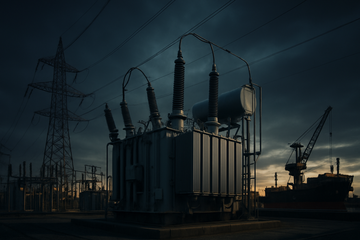
Russian strikes on October 30, 2026 cut power to more than 350,000 consumers in Dnipro and stopped the metro, trams and trolleybuses. The instinct is to treat that as another war headline. The grid is different, because every destroyed substation converts destruction into procurement — transformer orders, switchgear orders, construction contracts — and because the same strike pattern is now pushing Europe to harden a grid it thought was safe. Ukraine's own import data shows where that money lands: $1.14 billion of transformers, inductors and reactors in the first nine months of 2026, up 47.3% year on year, with 87.8% of the value coming from China.
October 30, 2026
The Blackout Was a Repair Bottleneck Before It Was a Strike
Russian strikes on October 30, 2026 cut power to more than 350,000 consumers in Dnipro and nearby settlements, and Ukrenergo, the state transmission operator, ordered emergency cuts across the city, its surrounding districts and part of the Pavlohrad district. The detail that matters for the equipment chain came later in the day: power was restored overnight and then cut again, because repair crews could not keep up with the load. A blackout caused by a repair bottleneck is a procurement problem, and procurement problems resolve into orders.
Consumers cut in Dnipro and nearby settlements
>350,000
October 30, 2026, after emergency cuts ordered by Ukrenergo
Energy equipment damaged since September
>800 pieces
From more than 350 attacks on Ukraine's energy system
Consumers cut during the October 16 outage
>1 million
Energy ministry estimate of the peak outage
Grid hardware imported, first nine months of 2026
$1.14B
Up 47.3% year on year; transformers, inductors and reactors
Energy-sector reconstruction need
~$91B
World Bank estimate published March 2026
Electrification backlog at GE Vernova
$42.2B
Up 60% year on year; third quarter 2026 results
- October 16, 2026: More than 1 million consumers were facing power cuts at some point, Ukraine's energy ministry said.
- October 19, 2026: Strikes damaged more than 10 energy facilities and cut power to at least 550,000 households.
- October 30, 2026: Dnipro lost power to more than 350,000 consumers after emergency cuts ordered by Ukrenergo.
- Since September 2026: More than 350 attacks on the energy system have damaged over 800 pieces of equipment.
- Since July 16, 2026: Russia has launched more than 2,000 strikes on Ukraine's energy infrastructure.
- October 30, 2026: Ukrainian FP-1 drones struck the Novokuibyshevsk oil refinery in Samara Oblast, in the same 24 hours.
The money
The Reconstruction Bill Is Real; the Financing Is the Bottleneck
On the World Bank's March 2026 estimates, restoring and rebuilding Ukraine's energy sector needs nearly $91 billion — more than transport, and roughly the same as housing. The money actually committed for this winter is an order of magnitude smaller: €922 million from the European Commission, a €90 million EBRD loan to Ukrenergo for rebuilding selected substations, and €10.5 billion of total EBRD wartime financing for the entire country. A financing gap, not a demand gap, sets the pace of the order book.
| Item | Figure | What it measures |
|---|---|---|
| Energy equipment damaged since September 2026 | More than 800 pieces | From over 350 attacks on the energy system |
| Strikes on the energy system since July 16, 2026 | More than 2,000 | Cumulative intensity in a single season |
| Consumers cut on October 30, 2026 | More than 350,000 | Dnipro and nearby settlements |
| Consumers cut during the October 16, 2026 outage | Over 1 million | Energy ministry estimate at peak |
| Households without power on October 19, 2026 | At least 550,000 | More than 10 energy facilities damaged |
| Transformer, inductor and reactor imports, 9M 2026 | $1.14B, up 47.3% | Ukraine's own procurement of grid hardware |
| China's share of those imports | 87.8%, about $1.0B | Where the rebuild is actually sourced |
| Energy-sector reconstruction need | Nearly $91B | World Bank estimate, March 2026 |
| EU winter 2026-27 energy package | €922M | Announced February 24, 2026 |
| EBRD loan to Ukrenergo for substation reconstruction | €90M | Ukraine Recovery Conference, June 2026 |
| Total EBRD wartime financing to Ukraine | €10.5B | Deployed as of June 2026 |
The line that matters most for equipment makers is the substation money. The EBRD's €90 million loan is explicitly earmarked for reconstructing substations, and the EU package is aimed at grid resilience alongside generation. Neither is large enough to clear the ledger, but both point the same way: the reconstruction is specified asset by asset, at substations, which is where transformer, switchgear and protection orders are written.
Supply chain
Ukraine's Grid Is Being Rebuilt With Chinese Transformers
Ukraine's transformer, inductor and reactor imports
Ukraine's own customs data. The rebuild is being bought from China, and Europe's share is shrinking.
Unit: $bn
9M 2025
First nine months of 2025
0.6
2025 full year
Up 88% on 2024
1.1
9M 2026
Up 47.3% year on year
1.1
9M 2026 from China
87.8% of the nine-month total
1
Ukraine's customs data shows the shape of the rebuild. Imports of transformers, inductors and reactors reached $1.14 billion in the first nine months of 2026, up 47.3% on the same period of 2025, after an 88% jump in 2025 to $1.12 billion. China supplied 87.8% of the 2026 total, about $1.0 billion. Germany, the largest European supplier a year earlier, fell from 5.2% of the category to 1.4%, and Turkey took2.9%.
The reason is capacity, not price. GE Vernova closed the third quarter with a $42.2 billion Electrification backlog, up 60% year on year, on a book-to-bill of about 1.4, and is committing $6.0 billion of capital between 2025 and 2028 to add manufacturing capacity — while its $9.0 billion purchase of Trench Group is not expected to close until late 2027. The Western primes cannot sell into Ukraine at any price; their production slots are already taken.
What the strikes reveal
Protecting the Grid Beats Replacing It
The most useful number Ukraine's energy ministry has published is not about damage. Denys Shmyhal said Ukraine has built a second level of physical protection for 235 transformers, and that only one protected asset has been hit by a ballistic missile in six months. His conclusion is the investable one: without that protection, restoring energy facilities at the current intensity of Russian attacks would take months.
- Protection works: Ukraine has given 235 transformers a second physical defence layer, and one protected asset was hit by a ballistic missile in six months.
- The durable spend is re-specification, not replacement: protection relays, hardened enclosures, communications and distributed generation per substation.
- For utilities outside Ukraine the same logic applies — a grid that can be attacked will be hardened before it is rebuilt.
- Equipment that survives does not need replacing, which shifts the bill from replacement capital into hardening capital that recurs.
Who gets paid
The Margin Pool Sits Upstream, and the Same Country Does Not Get the Same Price
| Company | Where it sits | Latest reported numbers | Read-through |
|---|---|---|---|
| GE Vernova | Transformers, switchgear and grid integration | Q3 2026: revenue $12.6B (+27%); orders $29.0B; backlog $197B; Electrification backlog $42.2B (+60% YoY) at a 19.1% segment EBITDA margin | Sold out for years; scarcity pricing intact |
| Hitachi | Grid systems: transformers, HVDC and grid control | FY2025 to March 2026: revenue ¥10.59T, operating income ¥1.20T (11.3% margin); about 2.0x trailing sales | Cheapest listed route to Western-grade grid hardware |
| HD Hyundai Electric | High-voltage transformers and gas-insulated switchgear | Trailing 12 months to September 2026: revenue ₩4.52T, operating margin 25.5%; Ukraine transformer partnership since 1998 | Highest margin in the chain, plus a two-decade Ukraine footprint |
| LS Electric | Switchgear, distribution and high-voltage transformers | $836.8M of secured U.S. distribution contracts; trailing operating margin 10.5% and free cash flow of about -₩189B | Order flow is real; cash conversion is not |
| China XD Electric | UHV transformers, GIS and HVDC converter valves | Trailing 12 months to September 2026: revenue ¥25.62B, operating margin 7.6% | Volume lands here; margin does not |
| Sieyuan Electric | GIS and power transformers | Trailing 12 months to June 2026: revenue ¥23.85B, operating margin 16.0% | The profitable Chinese exporter |
| Powell Industries | Custom switchgear and protection for utilities | Q3 FY2026: revenue $312M (+9%), new orders $934M (+158%), backlog $2.4B (+69%), gross margin 30.6% | High content per hardened substation |
| Quanta Services | Transmission, distribution and substation construction | Trailing 12 months to September 2026: revenue $37.29B, operating margin 6.8%, net income $1.69B | Installs the rebuild; earns volume, not margin |
Two things in that table decide the trade. First, the margin pool sits upstream: HD Hyundai Electric earns a 25.5% trailing operating margin and Sieyuan Electric earns 16.0%, while Quanta Services earns 6.8% for doing the construction. Second, the same country does not get the same price — [HD Hyundai Electric] trades at 12.0x trailing EBITDA against 29.9x for LS Electric, and the gap is cash conversion, with [LS Electric] burning roughly ₩189 billion of free cash flow over the trailing year against [HD Hyundai Electric]'s ₩669 billion inflow.
Upstream of the reconstruction sit the manufacturers — GE Vernova, the grid unit of Hitachi, HD Hyundai Electric, LS Electric, China XD Electric and Sieyuan Electric — whose economics now turn on allocation rather than on demand. Downstream sit the installers and the funders: Quanta Services on the construction side, Powell Industries supplying custom switchgear and protection into utility substation build-outs, and the European Commission, the EBRD and the World Bank writing the cheques.
Horizons
Two Horizons: What Moves First, and What Breaks the Thesis
Over the next two quarters, the October 30 strike changes a tender pipeline, not an order book. The signals to watch are Ukrainian import volumes in fourth-quarter customs data, EU and EBRD tenders for substation reconstruction, and whether Western primes refill the gap left by data centres — GE Vernova's Electrification bookings fell 9% organically in the third quarter even as its backlog reached $42.2 billion.
Over one to three years the constraint flips from demand to capacity. The $6.0 billion capital programme at GE Vernova through 2028 and the late-2027 close of Trench Group deliver new high-voltage capacity after the reconstruction money does, which places Ukraine's equipment orders in the 2027-2029 window — if the money and the peace hold. That same window is when new U.S. capacity at HD Hyundai Electric and LS Electric meets a European grid that has decided to spend on hardening.
- A ceasefire freezes the reconstruction order book and removes the pricing-power narrative, though not Europe's own grid capital cycle.
- Data-centre demand absorbs the same manufacturing slots as grid hardening, so war-driven orders are not additive to the backlog.
- Ukraine's fiscal capacity, not its need, is the limit: a nearly $91 billion energy-sector bill against a €922 million EU package and €10.5 billion of total EBRD wartime financing.
- Chinese share gains cap Western pricing: Germany's share of Ukraine's transformer imports already fell from 5.2% to 1.4% in nine months.
Synthesis
The Grid Is the Target; the Money Is Elsewhere
The facts: more than 350,000 consumers cut in Dnipro on October 30; more than 800 pieces of energy equipment damaged since September; a nearly $91 billion energy-sector reconstruction need; and transformer imports up 47.3% with China at 87.8%. The inference: manufacturing allocation and financing, not demand, set the pace of the rebuild. The speculation: that European utilities, having watched a neighbour's grid come apart under missile fire, will treat hardening as a cost of doing business rather than a discretionary upgrade — the one part of this thesis that cannot be settled with the data in hand.
The investable expression: upstream scarcity, downstream volume
- A $42.2 billion Electrification backlog, up 60% year on year, with segment EBITDA margin at 19.1%, means grid-hardening demand lands on a franchise already earning scarcity pricing.
- The $9.0 billion Trench Group purchase closes only in late 2027, so added high-voltage capacity arrives after this winter's emergency demand.
- Near term, Electrification orders fell 9% organically; watch whether grid-hardening bookings refill that gap.
- Over one to three years, the $6.0 billion 2025-2028 capital programme converts a $197 billion backlog into shipped equipment.
- A record $2.4 billion backlog, up 69% year on year on $934 million of quarterly orders, underwrites growth before any war-related work arrives.
- Bull case: a hardened substation carries more switchgear and protection content per site, and a 30.6% gross margin shows the pricing.
- Bear case: one data-centre order above $400 million drove the quarter's bookings, so no war-related order is visible in the backlog yet.
- Near term, earnings track data-centre timing; grid-hardening orders would show up in bookings, not revenue, over 2027-2028.
- Trailing revenue of $37.29 billion and $9.56 billion in the June 2026 quarter give Quanta the installation capacity the reconstruction bill eventually consumes.
- A 6.8% trailing operating margin means grid-hardening volume converts into earnings far more slowly than it does for equipment makers.
- Near term, Ukraine contributes nothing to the order book; the catalyst is European interconnection and US utility resilience budgets.
- Over one to three years, EBRD- and World Bank-funded substation and line work is tendered, and the transmission arm is the beneficiary.
- A 1998 technical partnership with Ukraine's transformer industry covering 765 kV transformers and 154 kV gas-insulated switchgear is a two-decade-old foothold in the one market now rebuilding.
- A 25.5% trailing operating margin on ₩4.52 trillion of revenue earns its keep on equipment scarcity, not on volume growth.
- Near term that margin holds while transformer slots stay sold; over one to three years, new U.S. capacity adds volume at lower price.
- Trades at 12.0x trailing EBITDA against 29.9x for LS Electric, the widest valuation gap in the chain.
- $836.8 million of secured U.S. distribution-equipment contracts show where spare capacity goes while transformer slots stay sold.
- Leads Korea's distribution-equipment order flow, with HD Hyundai Electric behind it on orders topping ₩100 billion.
- Trailing free cash flow of about -₩189 billion against a 10.5% operating margin means order growth is not yet cash.
- Over one to three years, Ukrainian-type orders would arrive only through European tenders after 2027.
- China supplied 87.8% of Ukraine's transformer, inductor and reactor imports in nine months, roughly $1.0 billion, and that volume lands with Chinese exporters.
- Neither China XD Electric nor Sieyuan Electric discloses Ukraine revenue separately, so the customs data is the read-through, not company disclosure.
- A 7.6% trailing operating margin on ¥25.62 billion of revenue means the same volume arrives at a fraction of the Western margin.
- Over one to three years, China's volume share holds while Western capacity arrives in late 2027; the risk is price, not demand.
- Gas-insulated switchgear to 1,100 kV and power transformers match the product mix European utilities are shifting toward as new-build grids move to GIS substations.
- Bull case: a 16.0% trailing operating margin on ¥23.85 billion of revenue makes it the best-positioned of the Chinese exporters in this chain.
- Bear case: with China at 87.8% of Ukraine's imports, share gains come from export pricing, and no Ukraine revenue is disclosed.
- Near term the swing factor is European GIS tender share, not Ukrainian orders.
- Hitachi's grid unit in India posted first-quarter FY27 orders up 26.1% year on year, led by HVDC, grid connections and transformers, with data centres the largest end market.
- Bull case: about 2.0x trailing sales for a group earning an 11.6% operating margin is the cheapest listed route to Western-grade grid hardware.
- Bear case: with China at 87.8% of Ukraine's transformer imports, none of the Ukrainian volume reaches the group directly; the exposure is European and NATO hardening.
- Near term the catalyst is European grid tenders; over one to three years, the grid unit's capacity additions set the price.