
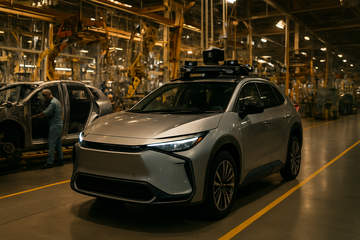
On October 30, 2026, Toyota said it will build the 2027 bZ4X at its Takaoka plant in Aichi Prefecture and install Waymo's autonomous-driving hardware on the same production line, with a validation fleet in Japan in 2027 and the United Kingdom to follow. That decision turns the robotaxi bottleneck from software into industrial hardware — and it lands in the two right-hand-drive markets where the ceiling is set by permits and licensed operators, not by driving ability. The numbers explain the timing: Waymo wants to go from roughly 4,000 vehicles to 20,000 by the end of 2027 on $5 billion of new debt, while Alphabet's Other Bets segment earned $372 million and lost $2.05 billion in the September quarter alone.
Waymo fleet target, end-2027
20,000 vehicles
From about 4,000 vehicles in October 2026; funded with $5 billion of debt raised that month
Alphabet Other Bets revenue, Q3 2026
$372M
0.3% of group sales, against an operating loss thatwidened to $2,047M from $1,426M a year earlier
Toyota operating income, Q1 FY2027
¥1,063.5B
Three months to June 30, 2026: down 8.8% year on year even as revenue rose 10.4% to ¥13,525.4B
Hyundai IONIQ 5 robotaxi order
~50,000 units
For Waymo by 2028, about $2.5 billion and roughly $50,000 a vehicle, built in Georgia
Mobileye EV/sales
2.0x
From 9.0x at fiscal 2024 year-end, even as revenue grew 21% to $2,004M on a trailing basis
Lucid trailing gross margin
-96.6%
A $1,494M gross loss on $1,547M of revenue in the twelve months to June 30, 2026
Toyota–Waymo, October 30, 2026
What Actually Got Signed, and What Did Not
Toyota is not simply shipping finished cars to a fleet operator. Its Takaoka plant will assemble the bZ4X and take delivery of Waymo's autonomous driving hardware on the same line — under one roof, as both companies put it — so the vehicle and the self-driving system leave as one product. The partners also opened a second front: autonomous driving for personally owned Toyota vehicles, and how vehicles can talk to traffic infrastructure. Renting factory time and homologation to a software company short of right-hand-drive capacity is what the agreement actually is.
| Term | What was announced |
|---|---|
| Vehicle | 2027 Toyota bZ4X, custom-fitted as a robotaxi |
| Manufacturing site | Takaoka plant, Aichi Prefecture |
| Integration | Base vehicle assembly and Waymo hardware installation under one roof |
| First market | Japan — test and validation of an autonomous bZ4X fleet in 2027 |
| Stated goal | Japan's first domestically manufactured fully autonomous ride-hailing service |
| Next markets | United Kingdom and other Waymo-serviced markets, in the following years |
| Fleet size | Not disclosed; Toyota's chief technology officer said initial operations involve a small number of vehicles |
| Vehicle features | Automatic doors, power liftgate, ambient lighting, extra rear legroom |
| Safety claim | Waymo says its driver is up to 20 times safer than human drivers on serious crash injuries |
| Also on the table | Autonomy for personally owned Toyotas; vehicle-to-infrastructure integration |
- The line the companies drew matters: Toyota builds and certifies the car, Waymo supplies the system that drives it, and the two are assembled together rather than retrofitted in sequence.
- Toyota's chief technology officer Hiroki Nakajima said initial operations will involve a small number of vehicles, and Waymo co-CEO Dmitri Dolgov said there were no other countries or timelines to share — leaving the programme sized like a pilot rather than a contract.
- Waymo is keeping its existing options open: it still tests Jaguar I-PACE vehicles in Japan and plans a 2027 pilot with them, and Toyota separately confirmed its bZ4X for Japan is the 2027 model.
- The arrangement extends the April 2025 preliminary agreement, which covered a new autonomous vehicle platform and personally owned vehicles, into a scheduled production programme.
We'll start with the right-hand drive markets in Japan and the UK.
Why Japan and the United Kingdom first
In These Two Markets, the Licence Is Scarcer Than the Algorithm
Japan does not let an unknown software company run passenger transport. Uber's own announcement of its rival Tokyo pilot states that passenger transport services must be operated by authorised taxi companies, with the authorised operator responsible for fleet management, and it names Hinomaru Kotsu in that role. Waymo's route runs through Nihon Kotsu and the GO taxi app, with an initial Tokyo fleet expanding toward about 100 vehicles in 2027. Makes the licensed operator, not the driver, the scarce asset in Japan.
| Waymo (2027) | Uber–Wayve (late 2026) | Pony AI (China, 2026) | |
|---|---|---|---|
| Vehicle | Toyota bZ4X | Nissan LEAF | Toyota bZ4X built by the GAC Toyota joint venture |
| Autonomy software | Waymo's own stack | Wayve AI Driver | Pony.ai Gen-7 |
| Compute | Not disclosed | NVIDIA DRIVE Hyperion | Not disclosed |
| Fleet operator | Nihon Kotsu | Hinomaru Kotsu | Pony.ai in tier-one cities |
| Booking | GO taxi app and Waymo app | Uber app | Pony.ai app |
| Status | Validation from 2027, about 100 vehicles at launch | Safety operators first, driverless later; London live since September 3, 2026 | More than 1,000 Gen-7 bZ4X robotaxis planned for 2026 |
- Waymo's 2027 Tokyo start is deliberately small — roughly 100 vehicles expanding across neighbourhoods — against about 4,000 vehicles and 15 US metros today, so it is a licensing exercise before it is a volume exercise.
- Uber is not waiting. Its Wayve partnership put autonomous rides into London on September 3, 2026 in a Ford Mustang Mach-E, and a Tokyo pilot using Nissan hardware on NVIDIA compute is due to start in late 2026 with safety operators aboard.
- With a licensed operator, a locally homologated car and a driverless permit all required, the manufacturer that can assemble, certify and service a right-hand-drive car becomes the gatekeeper — and that is the position Toyota has just bought.
Fleet math and where the cash goes
The Bottleneck Is a Factory, Not an Algorithm
Waymo has told Semafor it plans to double its fleet to about 8,000 vehicles by the end of 2026 and reach 20,000 by the end of 2027, financed with $5 billion of debt raised in October. Alphabet's consolidated capital expenditure ran $51,355 million in the September quarter alone, more than double a year earlier, while Other Bets turned $372 million of revenue into a $2,047 million operating loss and the shares fell nearly 10% in after-hours trading. Puts the vehicle, not the algorithm, in the critical path — and makes the roughly $50,000 unit price Hyundai reportedly agreed the decisive cost line.
Waymo's stated fleet path
Vehicles, as reported by Waymo and Semafor in October 2026.
Unit: vehicles
Fleet, Oct. 2026
4,000
Target, end-2026
8,000
Target, end-2027
20,000
- Hyundai's reported 50,000-unit IONIQ 5 programme — about $2.5 billion, roughly $50,000 a vehicle, built at Hyundai's Georgia plant — is the clearest published price tag on a robotaxi, and the yardstick Toyota's undisclosed bZ4X deal must clear.
- Bringing Chinese-built bodies into the United States is expensive: Zeekr has supplied Waymo with thousands of vehicles for its American fleet, and one trade estimate puts 102.5% tariffs on China-made chassis, lifting an estimated $103,000 of hardware cost per vehicle.
- Against that, Lucid tried to own the whole robotaxi vehicle — Uber's $300 million and more than 20,000 Gravity SUVs over six years — and produced a $1,494 million trailing gross loss doing it.
- Scale check on Alphabet: $372 million of segment revenue per quarter against roughly 4,000 vehicles is about $93,000 per vehicle per quarter, an upper bound since Other Bets also contains Verily and other units.
The value chain, named
Who Actually Monetises the Fleet
The October 30 agreement is one node in a chain that already spans four continents and roughly $3 billion of committed vehicle purchases. Mapping it is the fastest way to see why the Toyota deal matters more than its undisclosed volume suggests: the same chassis now runs under three different autonomy stacks, and the layer that keeps the margin sits above the layer that carries the capital.
| Layer | Who is there | The evidence |
|---|---|---|
| Chassis and integration | Toyota in Aichi Prefecture; Hyundai Motor in Georgia | Toyota builds the bZ4X and fits Waymo's hardware on the same line; Hyundai reported to supply 50,000 IONIQ 5 units by 2028 from Georgia |
| China-built bodies | Zeekr | Thousands of vehicles ordered for Waymo's US fleet; 102.5% tariffs on China-made chassis |
| Autonomy software | Waymo; Pony AI | Waymo integrates its own stack at the plant; Pony.ai's Gen-7 runs on the bZ4X in China |
| Compute | NVIDIA | DRIVE Hyperion powers the Uber–Wayve Nissan LEAF program in Tokyo |
| Upfit and integration | Magna International | Upfitting Hyundai IONIQ 5s for Waymo from the fourth quarter of 2026; robotaxi integration at Mesa, Arizona |
| Licensed operation | Nihon Kotsu; Hinomaru Kotsu | Both markets require passenger transport to be run by authorised taxi operators |
| Booking and demand | GO Inc; Uber | Waymo's unmanned Tokyo rides book through the GO taxi app; Uber's Japan and UK rides book through its own app |
- Upstream of the fleet: Toyota at Takaoka, Hyundai Motor in Georgia, Zeekr in China for American bodies, and Magna International for upfit and Mesa integration.
- Compute and software: Waymo's in-house stack, NVIDIA DRIVE Hyperion inside the Uber–Wayve program, and Mobileye licensing where an automaker wants a bolt-on rather than its own system.
- Downstream of the vehicle: authorised operators — Nihon Kotsu for Waymo, Hinomaru Kotsu for Uber — and the apps, where GO Inc's GO taxi app books Waymo's unmanned trips while Uber books its own.
- In China, Baidu, which reported ¥31.2 billion of revenue and ¥3.0 billion of operating income in the June quarter, has the balance sheet to self-fund a competing stack in the tier-one cities Pony AI's bZ4X fleet is entering.
- Where the value settles: the vehicle and the licence capture the volume, while software and compute keep the margin — the inverse of how the industry was originally sold.
Fundamentals
Toyota's Numbers Say Optionality, Not Earnings
| Toyota Motor | Q1 FY2027 | Q1 FY2026 | Change |
|---|---|---|---|
| Net revenues (¥ bn) | 13,525.4 | 12,253.3 | +10.4% |
| Operating income (¥ bn) | 1,063.5 | 1,166.1 | -8.8% |
| Operating margin | 7.9% | 9.5% | -1.7 pts |
| Net income attributable (¥ bn) | 1,477.0 | 841.3 | +75.6% |
| Trailing twelve-month revenue (¥ bn) | 51,957 | — | — |
| FY2027 operating income plan (¥ bn) | 3,766.2 | — | — |
Revenue rose 10.4% in the June quarter while operating income fell 8.8%, and management still guides to ¥3,766.2 billion of consolidated operating income for the full year against roughly ¥52 trillion of trailing revenue. A Japanese robotaxi pilot is rounding error at that scale, so the value of the deal is not line-item revenue — it is converts the bZ4X from a hard-to-sell mass-market battery EV into a three-stack robotaxi platform: Waymo in Japan and the United Kingdom, Pony AI's Gen-7 in China, and, if the companies get their way, autonomous versions of personally owned Toyotas.
Horizons
Days to Quarters, Then One to Three Years
- Late 2026: the Uber–Hinomaru Kotsu Tokyo pilot begins with safety operators aboard, setting the regulatory pace Waymo must match in 2027.
- Fourth quarter of 2026: Waymo's stated 8,000-vehicle goal, and Alphabet's December quarter, where Other Bets revenue has to climb well beyond $372 million to justify a $2,047 million quarterly loss.
- Early November 2026: Toyota's second-quarter FY2027 results, the first print in which any robotaxi capex, unit commitment or homologation timetable could surface.
- 2027: Japan's commercial launch, starting near 100 vehicles and expanding across Tokyo neighbourhoods — the first genuine test of whether the Takaoka line can produce and certify at volume.
- 2027 onward: the United Kingdom, where Waymo's bZ4X meets an Uber–Wayve operation already carrying paying riders in London since September 3, 2026.
- 2028: the 50,000-unit Hyundai IONIQ 5 programme completing, which will reveal whether roughly $50,000 per robotaxi is the industry's clearing price rather than a one-off.
- Beyond: whether a globally certified Toyota robotaxi chassis becomes the default platform, which would strip Pony AI of the chassis advantage it currently holds and leave it competing on autonomy software alone.
| When | Catalyst | What it settles |
|---|---|---|
| Early Nov. 2026 | Toyota second-quarter FY2027 results | Whether any robotaxi capex or unit commitment is disclosed |
| Late 2026 | Uber–Hinomaru Kotsu Tokyo pilot | Who gets the first Japanese operating rights, and on what terms |
| End-2026 | Waymo's 8,000-vehicle goal | Whether the 20,000-vehicle plan is a build schedule or a press release |
| Q4 2026 | Alphabet's December quarter | Whether Other Bets revenue scales before the $2,047 million loss does |
| 2027 | Japan validation and commercial launch | Whether Takaoka can build and certify a right-hand-drive robotaxi at pace |
| 2027-2029 | United Kingdom deployment | Whether an OEM-backed fleet beats an installed aggregator operation |
| 2028 | Hyundai's 50,000 IONIQ 5 units delivered | Whether ~$50,000 per vehicle is the industry's structural price |
Two things are true at once: Waymo's autonomy stack is still the best asset in the business, and it is no longer the scarce input. Once the vehicle, the homologation and the operating licence come from three different parties, the profit pool splits between compute and software at the top of the stack and a roughly 17% gross margin at the vehicle layer, with everything in between squeezed. The October 30 agreement makes the factory, the homologation and the licence the real moat — which is why Toyota and Hyundai Motor gain at the same moment that Mobileye and Lucid lose the argument that somebody else would own the vehicle.
The investable read
- Toyota becomes the right-hand-drive gatekeeper: it builds the bZ4X at Takaoka and fits Waymo's hardware on the same line, so homologation and volume accrue to the automaker.
- The platform already runs under Pony AI's Gen-7 stack in China, with personally owned Toyota vehicles still under discussion, giving the bZ4X a second demand curve.
- Near term the payoff is optionality, not revenue: Toyota earned ¥1,063.5 billion of operating income in Q1 FY2027 against a robotaxi pilot of undisclosed size.
- Over one to three years, watch whether the 2027 Japan campaign and UK rollout convert the chassis into volume; until a unit count appears it is a right, not a revenue line.
- Hyundai holds the largest published robotaxi body order — 50,000 IONIQ 5 units for Waymo by 2028, about $2.5 billion, roughly $50,000 a vehicle, built in Georgia — so Hyundai, not Toyota, owns the scale contract.
- Toyota now holds the right-hand-drive franchise in Japan and the United Kingdom, which Hyundai cannot supply, leaving Hyundai's robotaxi volume US-only.
- The economics are thin rather than transformative: at roughly $50,000 a vehicle there is little room above vehicle cost.
- Over the next 12 months, watch for the first IONIQ 5 robotaxi shipments from Georgia, and 2028 for delivery of the full 50,000 units.
- Pony AI is the only operator mass-producing robotaxis on a Toyota chassis: more than 1,000 Gen-7 bZ4X units planned for 2026 and a fleet target above 3,000 by year-end, which validates the platform Pony chose first.
- The same chassis now runs under Waymo's stack in Japan and the UK, so platform scarcity — Pony's main edge — is worth less with every new Toyota customer.
- Cash is the constraint: a trailing operating loss of $267.9 million on $125.2 million of revenue means each added vehicle consumes more cash than the fleet generates.
- Watch 2027, when a price floor set by Hyundai's IONIQ 5 contract meets a chassis Toyota can now supply to anyone holding a permit.
- Other Bets earned $372 million and lost $2,047 million in the September quarter, so the autonomy platform is still funded by the ad business, not by robotaxi fares.
- Outsourcing vehicles to Toyota and Hyundai moves capital intensity onto the OEM's balance sheet, but it does not shrink Alphabet's $51,355 million of quarterly capital expenditure.
- The funding question is live: 20,000 vehicles on $5 billion of new debt plus continuing segment losses is a financing issue investors now price every quarter.
- Catalyst: the December quarter and the 2027 Japan launch — watch Other Bets revenue per vehicle, not fleet headlines.
- Uber keeps demand and hedges hardware: $300 million into Lucid for 20,000-plus Gravity SUVs, Wayve on Nissan hardware in Tokyo and NVIDIA compute, which lets it price a robotaxi without owning the platform.
- Against that, Waymo's direct-to-operator Japan route — Nihon Kotsu and the GO app, with no aggregator in between — takes the market Uber entered with a late-2026 pilot.
- Uber's cash generation is why this is not bearish: $2,078 million of operating income on $14,191 million of revenue in the June quarter funds experiments Waymo cannot run in parallel.
- Watch whether Uber's London operation, live since September 3, 2026, keeps fares while Waymo's bZ4X arrives in the UK.
- The multiple has done the work: EV/sales fell from 9.0x at fiscal 2024 year-end to 3.5x a year later and 2.0x now, even as revenue grew 21%, so autonomy software is priced as a component, not a platform.
- Waymo integrating its own stack on an automaker's line, and Uber buying a turnkey NVIDIA-stack program, both point the same way: the vehicle supplier keeps integration and margin.
- Mobileye's 48.6% trailing gross margin is still the best of the vehicle-adjacent layer, but $1,104 million of R&D at 55% of revenue against a $360 million operating loss leaves no room to be wrong.
- Over one to three years, watch for another automaker to integrate in-house, which would confirm the repricing direction.
- Lucid is the counter-example: a $1,494 million trailing gross loss on $1,547 million of revenue shows owning robotaxi hardware outright destroys value at the vehicle layer.
- Uber's $300 million and 20,000-plus Gravity SUVs are the order book, and they now face a roughly $50,000 IONIQ 5 and a platform-priced bZ4X.
- Second-quarter revenue of $405.3 million came with a $426.7 million gross loss and a $1,082.2 million operating loss, so gross margin must turn before scale helps.
- Watch whether a robotaxi partner for Lucid replaces or renews the Uber program; without it, the equity has no route to the fleet.
- The GO taxi app is where Waymo books unmanned Tokyo trips from 2027 alongside conventional taxis, so GO Inc. becomes the toll booth on Japan's first driverless fleet.
- Launch volume is small — Waymo's initial Tokyo fleet expands toward about 100 vehicles — so the near-term revenue effect is limited.
- Watch for disclosure: whether GO Inc. breaks out autonomous-trip volumes and take rates once the 2027 service scales past the pilot fleet.
- Horizon: the 2027 launch and the 2028-2029 expansion decide whether the app is a genuine robotaxi toll booth or a directory listing.