
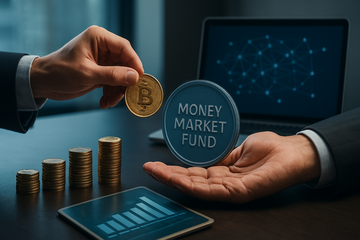
Start with what was actually announced, because the framing matters. Uber bought a Franklin Templeton tokenized money market fund on a Thursday using HSBC tokenized deposits, traded on Tradeweb and settled on the Canton Network through Fireblocks' delivery-versus-payment plumbing. It redeemed the position on a Sunday and captured about 1.5 extra days of yield that a Friday settlement would have left idle. No consumer feature was announced, no rider or driver was involved, and nothing in Uber's reported Q2 2026 balance sheet refers to the pilot. The distribution channel on display is not a gig-economy app; it is the corporate treasury desk, and that changes who captures the economics.
Extra yield captured
~1.5 days
Fund bought Thursday, redeemed Sunday, pilot announced Oct 30, 2026
Uber cash and short-term investments
$5.39B
As of Jun 30, 2026, per Uber's Q2 2026 Form 10-Q
Value of one weekend cycle at full deployment
~$0.82M
Estimated: 1.5/365 x 3.71% applied to $5.39B
Annualized weekend prize at full deployment
~$43M
Estimate at 52 weekend cycles a year, before fees
Share of Uber trailing net income
0.45%
TTM through Jun 30, 2026; 0.65% of trailing pre-tax income
Tokenized U.S. Treasury market
$14.32B
Across 119 products, data as of Oct 31, 2026
Tokenized Treasury seven-day yield
3.71%
As of Oct 31, 2026
Holders of tokenized Treasury products
85,645
Asset holders, up 1.71% in seven days to Oct 31, 2026
The October 30 Pilot
Five Parties, One Trade, and No Consumer in Sight
The mechanics are the announcement. Uber's funding leg was HSBC tokenized deposits — digital claims on HSBC's own balance sheet — used to buy shares of a Franklin Templeton tokenized money market fund on Tradeweb's venue. Tradeweb supplied execution and price discovery, while Fireblocks supplied delivery-versus-payment settlement on Canton, a public network, so the cash token and the fund share changed hands at the same moment rather than across a multi-day window. Uber sold part of the position on Sunday, ahead of the Monday open, and that is where the extra accrual came from. Tradeweb and Canton describe the exercise as the first on-chain liquidity and settlement solution on a public network.
- HSBC tokenized deposits funded the purchase, which makes the cash leg bank money rather than a stablecoin.
- Franklin Templeton supplied the product through the Benji platform, the first US-registered tokenized money market fund, integrated on Canton since November 2025.
- Tradeweb provided execution and price discovery, and priced and matched the fund purchase on its own venue.
- Fireblocks delivered the delivery-versus-payment settlement on Canton, removing the unsecured gap between the two legs.
- Uber supplied the cash and the redemption risk, and kept the yield.
The pilot in facts
Announced
Oct 30, 2026
Tradeweb and Canton network releases
Network
Canton
Public network; operated by Digital Asset
Funding leg
[HSBC](0005.hk) tokenized deposits
1:1 claim on the bank's balance sheet
Asset bought
[Franklin Templeton](ben) tokenized money market fund
Benji platform, live on Canton since Nov 2025
Venue
[Tradeweb](tw)
Execution and price discovery
Settlement
Fireblocks, delivery-versus-payment
Atomic exchange on Canton
Trade pattern
Bought Thursday, sold Sunday
Redemption ahead of the Monday open
Extra yield
~1.5 days
Reported by the pilot parties
Amount deployed
Not disclosed
No release quantified the position
Dollar value of extra yield
Not disclosed
Only the day count was given
Two gaps matter more than the gaps in most pilots. The amount Uber deployed was not disclosed and the dollar value of the extra yield was not disclosed, so any size estimate is an assumption rather than a fact. And the announcement arrived through the network and the venue rather than through an Uber filing: the Q2 2026 Form 10-Q reports cash of $4.87 billion and short-term investments of $521 million, with no tokenization line item anywhere in the balance sheet. Read it as a capability demonstration with an undisclosed balance sheet behind it.
The Arithmetic
What 1.5 Days of Weekend Yield Is Actually Worth
Tokenized U.S. Treasury products were yielding 3.71% on a seven-day basis as of October 31, 2026, so 1.5 extra days of accrual is worth about 1.5/365 of 3.71%, or roughly 1.5 basis points of whatever balance sits in the fund. Applied to Uber's entire $5.39 billion of cash, cash equivalents and short-term investments, one weekend cycle is worth about $820,000, and 52 cycles a year is worth about $43 million. The assumptions are explicit: full deployment every weekend, today's fund yield, and no fee leakage. Uber actually deployed an undisclosed amount, so the real figure is smaller — the order of magnitude is the point.
| Line | Value | Basis |
|---|---|---|
| Extra accrual from a Thursday-to-Sunday hold | ~1.5 days | Pilot announcement, Oct 30, 2026 |
| Seven-day APY on tokenized U.S. Treasury products | 3.71% | RWA.xyz, Oct 31, 2026 |
| Uber cash, equivalents and short-term investments | $5.39B | Uber Form 10-Q, Q2 2026 |
| Value of one weekend cycle at full deployment | ~$0.82M | Calculated: 1.5/365 x 3.71% x $5.39B |
| Annualized at 52 weekend cycles | ~$43M | Calculated |
| Share of Uber trailing net income ($9.58B) | 0.45% | Calculated from Uber quarterly filings |
| Share of Uber trailing pre-tax income ($6.62B) | 0.65% | Calculated from Uber quarterly filings |
| Same calculation across the whole $14.32B tokenized Treasury market | ~$114M a year | Calculated |
| Amount Uber actually deployed | Not disclosed | No company release quantified the position |
Scale the same arithmetic across the market and it gets sharper, not softer. Apply 1.5 extra days at 3.71% to all $14.32 billion of tokenized U.S. Treasury assets outstanding and the industry's entire weekend prize is about $114 million a year. What Uber is really buying in a pilot like this is not yield: it is the ability to stop pre-funding a weekend liquidity buffer, because a tokenized money market fund can be redeemed when a conventional fund cannot. The scarce commodity is redemption on a non-business day, not accrual.
The Distribution Question
Nobody Pays a Platform: Uber Is the Customer, Not the Channel
| Party | Role in the pilot | How it monetises | Evidence |
|---|---|---|---|
| Uber | Treasurer: funded the purchase and took the redemption risk | Pays, and keeps the yield | Tradeweb release, Oct 30, 2026 |
| HSBC | Issued the tokenized deposits that funded the purchase | Balance-sheet economics on a tokenised deposit service | HSBC release, Apr 13, 2026 |
| Franklin Templeton | Issued the tokenized money market fund shares | 41.0 bps effective fee rate on $1.79T of AUM | Form 10-Q, Q3 FY2026 |
| Tradeweb | Executed the trade and set the price | Volume-based revenue at a 43.3% operating margin | Form 10-Q, Q3 2026 |
| Fireblocks | Delivered delivery-versus-payment settlement on Canton | Custody and settlement fees, not disclosed | Generation Infinity, Oct 30, 2026 |
| Canton Network | Ran the public network hosting liquidity and settlement | Network economics, not disclosed | Generation Infinity, Oct 30, 2026 |
| DTCC | Parallel channel for tokenized securities and Treasuries | Post-trade infrastructure, not disclosed | DTCC release, May 4, 2026 |
The answer to the distribution question is that no platform gets paid. In this structure the corporate treasurer is the customer and the counterparties are the suppliers: the deposit issuer earns on the bank balance sheet behind the token, the manager earns its fee on the fund share, the venue earns on matched volume, and the settlement provider earns on the atomic exchange. No app take rate, no revenue share and no distribution fee is disclosed anywhere in the chain. Uber is the customer, not the channel, which is exactly why tokenized cash economics look like wholesale asset management rather than like consumer fintech.
Cash pools compared ($ billions)
Point-in-time balances, except Uber's trailing four-quarter free cash flow through Jun 30, 2026. Uber's cash book alone is about 38% of the entire tokenized U.S. Treasury market.
Unit: $ billions
Tokenized U.S. Treasury market (Oct 31, 2026)
14.3
Uber trailing free cash flow
10.1
Uber cash and short-term investments (Jun 30, 2026)
5.4
Franklin Templeton Benji suite (Apr 29, 2026)
2
The fee pool that structure creates is worth sizing for the incumbents. Franklin Templeton disclosed an effective investment management fee rate of 41.0 basis points on $1.79 trillion of assets for the June 2026 quarter, and Tradeweb earned a 43.3% operating margin on $584.5 million of third-quarter 2026 revenue. A channel that reaches billions of dollars of idle corporate cash is worth real money to both, and neither of them can buy it with advertising spend.
Supply Chain and Backstop
Upstream, Downstream, and the Question Nobody Asked
Upstream of the trade sit the balance-sheet and network providers. HSBC issued the funding leg, and its Tokenised Deposit Service now spans Hong Kong, Singapore, Luxembourg, the UK and, since April 13, 2026, the United States, in euro, pound, Hong Kong dollar, Singapore dollar and US dollar, with 24/7 transfers inside the tokenized deposit network. Fireblocks supplied the settlement engine, and Canton Network, operated by Digital Asset, supplied the public network and its privacy model. Running alongside is DTCC's build: more than 50 firms, including BlackRock, Franklin Templeton, HSBC, Tradeweb and Circle, are enrolled in the DTC tokenization working group.
- Downstream of the fund: corporate treasurers, and the payment obligations they must fund on a Saturday and a Sunday.
- Downstream of the venue: Tradeweb captures execution economics on a market that now trades when no one else is open.
- Downstream of the deposit token: HSBC keeps the client relationship and the cash balance the token represents.
- Downstream of the settlement layer: Fireblocks sells atomic settlement to every institution that wants to stop carrying unsecured settlement risk.
That is also why the redemption question deserves more attention than the yield. Money market funds earn their keep by holding Treasury bills that mature on the day the holder redeems, so a Sunday redemption cannot be funded by maturing paper; it has to be funded by the manager's liquidity arrangements and the sponsor's credit. The parties did not disclose who stood behind the Sunday redemption, which is the single most important unpriced detail in the pilot. It also explains the asymmetry in the structure: DTCC's October 2026 launch covers tokenized securities and Treasuries, but it does not manufacture bank money, so a corporate treasurer who wants cash on a Sunday still needs a bank's token.
Fireblocks expects hundreds of companies to adopt similar models within 18 months.
Two Stacks
Tokenized Cash and Tokenized Equities Are Running at Different Speeds
| Dimension | Cash and fund stack | Equity and trading stack |
|---|---|---|
| Rulebook | SEC-registered funds and bank balance-sheet law | Five-year SEC exemption for tokenized stock trading platforms, Sept 17, 2026 |
| Settlement | Delivery-versus-payment, 24/7, bank deposit token | Exchange-style matching with dealer-registration relief |
| Cash leg in 2026 deals | HSBC tokenized deposit, Oct 30, 2026 pilot | USDCx, in Tradeweb's Jul 1, 2026 Treasury transaction |
| Public proof point | Uber corporate treasury pilot, Oct 30, 2026 | New venues listing tokenized shares through 2026 |
| Where the fee lands | Management fees on tokenized share classes | Take rates on tokenized equity volume |
| Main risk | Redemption backstop on non-business days | Take-rate compression as venues pile in |
The distinction matters because the two stacks are running at different speeds under different rules. On the equity side, the SEC's five-year exemption of September 17, 2026 frees platforms that facilitate tokenized stock trading from many of the rules that apply to the listed exchanges, and gives liquidity providers relief from dealer registration, subject to dividend and voting rights parity and a ban on synthetic tokens. On the cash side there is no such relief and no need for it: the market is governed by registered-fund rules and banking law, which is why the first institutional proof point arrived as a treasury operation rather than as a trading venue.
Take-rate compression shows up first where volumes are already falling. Coinbase reported $1.216 billion of net revenue in Q3 2026 against $1.869 billion a year earlier, with consumer crypto spot volume down 59% and institutional spot volume down 53%. Transaction revenue was $590.2 million of the total, and the growth engine inside the rest of the business was stablecoin revenue of $306.9 million, which the company said rose $84.6 million on higher average USDC balances and fell $52.8 million on lower average interest rates. The pressure lands on trading revenue first, and tokenized equities put more venues into a business already losing volume.
- Volume is shrinking: Coinbase's consumer spot volume fell 59% and institutional spot volume fell 53% year over year in Q3 2026.
- New entrants can list tokenized shares under the five-year exemption, skipping most of the rulebook that protects incumbent exchange economics.
- The consumer-app channel for tokenization already exists, but it sells equities and crypto trading rather than corporate cash: Robinhood reported $1.308 billion of Q2 2026 revenue and $574 million of operating income and sits in DTC's tokenization working group.
- Tokenized cash is a separate fight: it substitutes for a deposit, so the competitor is a bank's funding cost rather than another venue's take rate.
Fund Economics
Franklin Templeton's Fee Engine Sits Under the Pilot
Franklin Templeton, key figures
Total assets under management (Jun 30, 2026)
$1,791.6B
Up 11% year over year
Cash management assets
$80.5B
At Jun 30, 2026
Cash management net outflows
$7.0B
June 2026 quarter
Effective investment management fee rate
41.0 bps
Annualized, excluding performance fees
Sales, distribution and marketing expense
$555.4M
June 2026 quarter
Benji tokenized suite (Apr 29, 2026)
$1.98B
About 0.11% of total AUM
Fiscal Q3 2026 revenue
$2.36B
Quarter ended Jun 30, 2026
Fiscal Q3 2026 operating income
$215.8M
Quarter ended Jun 30, 2026
Here is the awkward part for the asset manager. Franklin Templeton's Benji suite held $1.98 billion of assets as of April 29, 2026, about 0.11% of the firm's $1.79 trillion, so the tokenized channel is an option rather than a revenue line, and the firm's own cash management book was shrinking with $7.0 billion of net outflows in the June quarter. A tokenized share sold to a treasurer settles around the clock; a retail fund share does not. The channel competes on settlement convenience rather than on price, which caps what a manager can charge for it and pushes distribution economics toward scale rather than margin.
Horizons
What to Watch, and What Would Break the Thesis
- Uber's Q3 2026 results in early November, guided to $58.25-$60.25 billion of gross bookings and $0.84-$0.88 of adjusted EPS, are the first chance to explain what was deployed and whether the model repeats.
- Tradeweb's monthly activity reports will show whether money market and on-chain volumes appear as separate lines; that disclosure is what turns a pilot into a franchise.
- The SEC's tokenized-stock exemption is five years long and rolling out now: watch which venues list tokenized shares first and which liquidity providers attach to them.
- Franklin Templeton reports fiscal fourth-quarter and full-year results in November 2026, where a first disclosure of Benji assets on the Canton route would reveal whether corporate treasury money is actually flowing.
- If weekend and holiday redemption becomes standard, corporate idle cash stops being a deposit problem and becomes a fund-accessibility problem, shifting balance-sheet economics toward whoever owns the tokenized share.
- DTCC's channel and the bilateral Canton route will converge or diverge, and the outcome decides whether network and wallet economics survive or get commoditized.
- The wrapper fight moves from cash to credit and then to equities, where the fee pool is large enough to attract serious take-rate competition.
- For Coinbase, Circle and Robinhood, the question is whether on-chain cash and tokenized equities become revenue lines or become features that carry no fee.
So the next distribution channel for tokenization does not look like a crypto exchange, and it does not look like a rideshare app either. It looks like the treasury function of a large company buying a registered money market fund with bank money that settles when the world's markets are closed. The fee pool sits with the deposit issuer, the fund manager and the venue; the yield sits with the corporate and is worth less than half a percent of earnings. Investors should favour the owners of the rail and the client relationship over any would-be app, and the single most useful datapoint to watch is who sells the second Uber-style trade.
Stocks with a verified link to the pilot
- Q3 2026 results in early November are the catalyst: a recurring, disclosed deployment turns a pilot into treasury policy.
- At full deployment the weekend prize is about $43M a year, 0.45% of trailing net income, so the earnings impact is immaterial either way.
- Option value sits in a $5.39B cash book earning yield around the clock instead of idling across weekends.
- Execution and price discovery for tokenized cash now sit with Tradeweb: two landmark on-chain treasury trades of 2026 ran through its venue.
- Q3 2026 revenue of $584.5M rose 14.9% year over year at a 43.3% operating margin, funding the build-out.
- Horizon: monthly activity report disclosure of on-chain volume would confirm a franchise; without it, revenue impact stays nil.
- The prize is a channel Franklin lacks: corporate treasury cash, now proven to settle on a Sunday.
- Benji's $1.98B is 0.11% of Franklin's $1.79T AUM, so tokenization is a distribution option with almost no revenue attached yet.
- Risk: cash management AUM fell to $80.5B with $7.0B of quarterly outflows, and a tokenized share cannot carry a retail-equivalent fee.
- Its tokenized deposits funded the pilot, and the Tokenised Deposit Service now spans five markets and five currencies with 24/7 transfers.
- Every future institutional tokenized-cash pilot needs a deposit token, and HSBC owns the balance sheet that makes weekend redemption credible.
- Horizon: this is a franchise and deposit-balance story, not a near-term earnings event; tokenized Treasury assets are only $14.32B market-wide.
- BlackRock sits in DTC's tokenization working group, so it can bring ETF-grade distribution to a corporate cash channel.
- The first large corporate treasury pilot went to Franklin Templeton's fund instead, showing that ETF incumbency does not transfer to on-chain mandates.
- Q3 2026 revenue of $7.75B and operating income of $2.33B give it room to fight for mandates with no near-term earnings risk.
- Q3 2026 net revenue fell to $1.216B from $1.869B, with consumer spot volume down 59% and institutional down 53%.
- The September 17, 2026 five-year exemption lets new venues list tokenized shares outside the incumbent rulebook, pressuring take rates.
- Offset: stablecoin revenue of $306.9M grew $84.6M on higher USDC balances while transaction revenue kept shrinking.
- Circle is in DTC's tokenization working group, and stablecoins remain the incumbent tokenized cash for crypto-native venues.
- The pilot's cash leg was a bank deposit token, not USDC, and deposit tokens win where weekend settlement credibility matters.
- Margin is thin by design: Q2 2026 revenue of $701.3M produced just $45.9M of operating income as reserve income largely passes through.
- Robinhood already owns the consumer-app distribution channel in tokenization, and it sits in DTC's tokenization working group.
- Q2 2026 revenue of $1.308B and operating income of $574M fund a push into tokenized equities under the September 17 exemption.
- Catalyst: whether tokenized equity volume converts into transaction revenue within two to four quarters.