
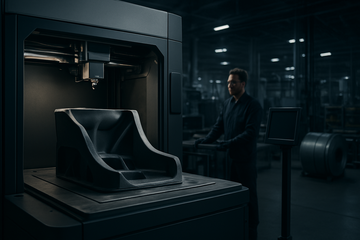
Printers at Ford
200+
Program machine count; 3D labs at more than 23 plants expected by year-end 2026 (CNBC, Oct 31, 2026)
Rivian printing machine spend
$5M+
Plus about $1.7 million a year of print materials; machines typically pay back within a year (CNBC, Oct 31, 2026)
Hot-rolled coil spot price
$1,270/st
Nucor consumer spot price for the week of Oct 26, 2026, up $15 from $1,255 (Steel Market Update)
Rivian automotive gross loss
$(80)M
Q3 2026 on 19,248 deliveries — about $4,157 a vehicle, derived from the reported figures
Stratasys consumables
$66.3M
Record quarterly consumables revenue, Q2 2026, on $137.6 million of total revenue
Global AM market
$24.2B
2025 industry revenue, up 10.9% year over year (Wohlers Report 2026)
The Event
Additive Manufacturing Just Became a Detroit Operating Variable
The Oct 31, 2026 CNBC report on Ford, Rivian and General Motors marks the point where additive manufacturing stops being a prototype curiosity and becomes plant equipment. Ford runs more than 200 machines, has printed thousands of tools, and expects 3D labs at more than 23 plants by year-end; Rivian has installed a machine bay in Normal, Illinois that any employee can walk up to. The commercial point is not the printing itself. It is that a part that used to arrive in weeks now arrives in days or hours, which collapses lead times from weeks to days — a scheduling gain, not a materials gain.
- Ford: torque bit sockets, hood jackers, hand tools for smoothing adhesive, and a machining wheel printed to keep a plant running until a permanent replacement arrived (CNBC, Oct 31, 2026).
- Rivian: electric-motor models for fluid testing, screw guides for tooling, stamping-press inserts, trim pieces for early builds, and new flexible silicone printers (CNBC, Oct 31, 2026).
- General Motors: 135 printed components on the Cadillac Celestiq, plus a manual-shifter medallion on the Blackwing sedan, as GM expands its industrial Stratasys printer footprint (CNBC, Oct 31, 2026).
- Cost of entry: industrial Stratasys systems run into the hundreds of thousands of dollars per machine, before training and certification (CNBC, Oct 31, 2026).
| Program | Scale | What gets printed | Stated payoff | Not disclosed |
|---|---|---|---|---|
| Ford | 200+ machines; labs at 23+ plants by year-end 2026 | Tools, jigs, fixtures, low-volume F-150 parts | Lower cost, faster delivery, a plant kept running | Annual dollar savings; savings per plant |
| Rivian | $5M+ of machines; about $1.7M a year of materials | Jigs, fixtures, motor models, trim pieces, silicone parts | Machines typically pay for themselves within a year; savings 'well in the millions' | Dollar savings, cost per printed part, machine count |
| General Motors | Expanding industrial Stratasys install base; 135 printed components on the Celestiq | Bespoke low-volume components and trim | Standardize, then scale — the Stratasys framing | Volume, unit cost and content of printed components |
The Arithmetic
The Machines Pay Back in a Year. The Margin Never Notices.
Size the prize with Rivian's own numbers: more than $5 million of machines that 'typically pay for themselves within a year,' plus $1.7 million a year of materials. If payback is inside twelve months, the implied annual benefit is at least the capital spent — call it $5 million-plus — spread over guidance of 67,000 to 70,000 vehicles, or roughly $73 a car. Against that, Rivian's Q3 2026 automotive gross loss of $80 million on 19,248 deliveries works out to about $4,157 a vehicle, and the R2 ramp added roughly $120 million of cost of revenues in the quarter. Additive manufacturing is buying weeks, not dollars per vehicle: the ramp cost is about 96 times the program's implied quarterly benefit.
Printing Is a Rounding Error Next to the Ramp It Is Meant to Protect
Reported figures come from Rivian's Q3 2026 results release and CNBC, Oct 31, 2026. The $1.25 million quarterly benefit is implied from the statement that more than $5 million of machines typically pay for themselves within a year.
Unit: $ million
- Speed: 86% of Rivian's additive requests in the fourth quarter of 2025 were completed in five days or less, using standard materials and standard machines (Additive Manufacturing Media, Jan 29, 2026).
- Tooling lead time: a large-format pull-force jig that traditionally needed up to two years of design and machining took 26 hours to print (Additive Manufacturing Media, Jan 29, 2026).
- Throughput: Rivian's polymer powder room can print up to 10,000 parts in a few days, and there is an additive part every 15 feet inside the Normal building (Additive Manufacturing Media, Jan 29, 2026).
- Crash work: printed bumpers already serve as core safety fixtures in Rivian's crash testing — tooling and test hardware, not structure (Additive Manufacturing Media, Jan 29, 2026).
Materials
Steel at $1,270 Raises the Cost of Everything Except the Print
Nucor lifted its consumer spot price for hot-rolled coil from $1,255 a short ton in the week of Oct 19 to $1,270 in the week of Oct 26, with its West Coast joint venture at $1,340 and mill lead times of three to five weeks (Steel Market Update, Oct 19 and Oct 26, 2026). That is the price of stamped steel, not of printed polymer tooling, so rising coil tightens the cost of the parts printing competes with while doing nothing for the cost of the print itself. Nucor's own quarter shows the transmission: steel mills product sold at an average $1,233 a ton in Q3 2026, with fourth-quarter guidance of higher realized pricing offset by seasonally lower volumes and higher costs.
The Coil Bid Has Risen Twice in Three Weeks
Nucor consumer spot price for hot-rolled coil, as reported by Steel Market Update on Oct 19 and Oct 26, 2026. The West Coast price set by California Steel Industries reached $1,340 a short ton in the Oct 26 week.
Unit: $ per short ton
Hot-rolled coil spot, week of Oct 19, 2026
1,255
Hot-rolled coil spot, week of Oct 26, 2026
1,270
- Ford: Q3 2026 revenue of $49,526 million and adjusted EBIT of $2,658 million, but Ford Blue EBIT of $1,392 million and Ford Pro EBIT of $1,665 million both carried higher commodity prices and temporary sourcing costs tied to the Novelis aluminum supply disruption — the loudest metals headline of the quarter was aluminum, not steel (Ford 10-Q, Q3 2026).
- General Motors: about $2 billion of commodity inflation expected for 2026 with gross tariff costs at the low end of a $2.5 billion to $3.5 billion range, set against $50.0 billion of quarterly revenue and $4.1 billion of adjusted EBIT (CNBC, Oct 20, 2026).
- Rivian: the R2 ramp added roughly $120 million of cost of revenues in Q3 2026, partly offset by an IEEPA tariff refund receivable; printing savings are an order of magnitude smaller than either item (Rivian Q3 2026 release).
- Tariff offset in progress: Ford's Q3 2026 filing points to roughly $2.2 billion of expected tariff reimbursements from federal and supplier sources, including about $500 million in the third quarter, which is the offsetting valve for any input-cost spike (Ford 10-Q, Q3 2026).
Where the Metals Shock Landed: Ford's Q3 2026 Segment EBIT
Ford's Q3 2026 Form 10-Q segment results. Neither a $1,270-a-ton coil price nor a 200-machine printing fleet changes the shape of these numbers: the loss-making EV segment and the commodity-driven squeeze in the truck and pro businesses dominate.
Unit: $ million
Ford Pro
1,665
Ford Blue
1,392
Ford Credit
803
Model e
-1,058
Supply Chain
The Toll Booth Sits One Link Above the Printer
If printing is a fixed-cost and consumables story, the vendor that sells the machine and the powder gets paid first. Stratasys launched its F870 factory-floor system on Sept 9, 2026 and named the two customers that define this thesis: Toyota Motor Production Engineering in Georgetown, Kentucky and Rivian in Plymouth, Michigan, both adopting it for factory-floor tooling, fixtures, assembly tools and inspection gauges ahead of commercial availability. Stratasys also agreed to buy MarkForged for $42.5 million in cash in May 2026, adding carbon-fibre composite printing to a portfolio purpose-built for plant work.
| Layer | Company | Evidence of linkage | What it means for the trade |
|---|---|---|---|
| Upstream — machines and powder | Stratasys | F870 adopted by Rivian and Toyota Motor; General Motors expanding industrial install base; MarkForged acquired for $42.5M | Recurring consumables annuity attached to every installed machine |
| Upstream — metal systems | Nikon SLM Solutions | Printed a complete V8 engine block in AlSi10Mg on an NXG XII 600 at Bosch's Nuremberg solution centre — 'no tooling, no castings' (VoxelMatters, July 3, 2026) | Casting replacement is the first large end-use prize for metal printing |
| Upstream — equipment and powder | Xi'an Bright Laser Technologies | 2025 revenue of RMB 1.85 billion, up 39.7%; 223 machines sold; 20 sets of brake calipers delivered to BYD for the Yangwang U9X and completed a Nürburgring test | Chinese competition on machine price and on powder cost |
| Upstream — materials | Nucor | Hot-rolled coil consumer spot price at $1,270 a short ton in the week of Oct 26, 2026 | Sets the cost of the stampings that printing is chosen against |
| Midstream — tier 1 and tier 2 | Bosch | 60% to 80% of a finished vehicle's components come from tier 1 and tier 2 suppliers (VoxelMatters, July 3, 2026) | Additive manufacturing scales through suppliers, not only through the three Detroit OEMs |
| Downstream — OEMs | Ford, Rivian, General Motors, Toyota Motor | Plant labs, machine bays, printer fleets and bespoke printed components | Fixed-cost and lead-time capture; no per-vehicle prize yet |
- Every machine that reaches a plant converts into recurring powder revenue: Stratasys posted record consumables of $66.3 million in Q2 2026 on $137.6 million of quarterly revenue, with 2026 revenue guidance of $565 million to $575 million and non-GAAP operating margins of only 0.7% to 1.5%.
- Aerospace, not autos, is where Stratasys has already priced: aerospace and defense revenue grew 17% year over year in Q2 2026, so automotive adoption is an option rather than a growth engine.
- Scale is global and state-backed: Xi'an Bright Laser Technologies grew 2025 revenue 39.7% with equipment gross margin of 44.7%, which is the price floor Western printer vendors now face.
- The whole industry is small next to one OEM quarter: global additive-manufacturing revenue of $24.2 billion in 2025 is roughly half of Ford's $49.5 billion of quarterly revenue, and Stratasys's $565 million to $575 million guidance is about 2% of it.
The Bottleneck
Qualification, Not Printer Capacity, Is the Gate on Production Parts
The most important fact in the Oct 31 report is a negative: Rivian has no plans to include 3D-printed parts on the R2 production line (Additive Manufacturing Media, Jan 29, 2026). Printing has won the factory — jigs, fixtures, trim, crash-test hardware — and lost the vehicle. General Motors's 135 printed components live on a hand-built Celestiq, where a printed part is trivial next to a six-figure price tag, and Bosch's printed V8 block in AlSi10Mg is a demonstrator rather than series production. End-use printed parts stay unproven at mass volume, and that qualification step, not machine supply, is what separates this from a materials revolution.
What the public record does not show
Dollar savings from printing
Not disclosed
Neither Ford nor Rivian publishes an annual additive-manufacturing savings figure
Cost per printed part
Not disclosed
No OEM has published a printed-versus-machined unit-cost comparison
Rivian machine count
Not disclosed
Machine spend and annual materials are known; fleet size is not
Printed parts on the R2 line
No plans
Stated position as of Jan 29, 2026 reporting
Qualification date for safety-critical printed parts
Not disclosed
No target date for a printed structural or crash-rated part on a mass-volume line
Horizons
Two Clocks: Factory Tooling Now, Printed Castings Later
- Next weeks — Stratasys reports Q3 2026 on Nov 12, 2026; with Q2 consumables at a record $66.3 million, that print is the first hard read on whether adoption converts into powder rather than one-off hardware orders.
- Next quarters — Ford expects 3D labs at more than 23 plants by the end of 2026, from more than 200 machines today, the fastest measurable expansion in the programme and the clearest test of whether the fleet tracks part volume or programme churn.
- Next quarters — the input clock is Nucor: $1,255 then $1,270 a short ton in consecutive October weeks, with fourth-quarter guidance of higher realized pricing offset by lower volumes and higher costs, which sets the 2027 stamping-cost squeeze.
- Next quarters — Rivian's guidance of 67,000 to 70,000 deliveries makes the printing programme a ramp-schedule question: jigs that arrive in days instead of weeks are what protect a launch year, against $7.1 billion of pro forma liquidity.
- One to three years — printed castings are the first place printed parts could touch a bill of materials: Nikon SLM Solutions and Bosch have already built a complete V8 block in AlSi10Mg with no casting tooling.
- One to three years — General Motors is the natural proving ground for bespoke printed content, because 135 printed components on a hand-built flagship can carry margins that a mass-volume truck cannot.
- One to three years — Chinese equipment scale sets the price floor: Xi'an Bright Laser Technologies sold 223 machines in 2025 and grew revenue 39.7%, so Western printer economics stay thin unless they take share.
- One to three years — the decisive milestone is a disclosed printed-parts saving at an OEM, because until then the cost case remains an argument rather than an audited number.
| Date | Event | What it would prove |
|---|---|---|
| Nov 12, 2026 | Stratasys Q3 2026 results | Whether OEM adoption converts into record consumables or only into hardware orders |
| Year-end 2026 | Ford 3D labs at more than 23 plants | Whether the fleet scales with part volume or with programme churn |
| Q4 2026 | Nucor guidance: higher realized pricing, lower volumes | Whether the stamping-cost squeeze persists into 2027 model-year sourcing |
| 2027 and beyond | A disclosed printed-parts saving at any OEM | Whether additive manufacturing becomes a cost line rather than a scheduling tool |
Synthesis
Own the Fixed-Cost Annuity, Not the Per-Vehicle Story
Here is the uncomfortable arithmetic. The entire global additive-manufacturing industry was worth $24.2 billion in 2025 — roughly half of one quarter of Ford's revenue — and Rivian's entire printing programme is worth about $73 a vehicle against a $4,157-per-vehicle automotive gross loss. Steel at $1,270 a short ton makes the case for printing tooling, because stampings got dearer and steel lead times got longer, but it does not make the case for printing cars, and it does not touch Ford's $1,058 million Model e loss or General Motors's roughly $2 billion commodity-inflation bill. The trade is the fixed-cost annuity and the material cycle, not the assembly plant's per-vehicle cost.
So the position is a barbell. Own Stratasys for the consumables annuity that follows every machine into every plant, own Nucor for the material cycle that is squeezing stamping costs right now, and keep Ford, Rivian and General Motors on the list of names whose cost curve printing eventually bends. The bull case for additive manufacturing is real and it is arriving — the evidence is the 200-plus machine fleets, the 23-plus plant labs and the F-870 deployments. It simply is not a per-vehicle cost story yet, and a steel headline is not what turns it into one.
Who the printed-parts shift actually touches
- Printing cuts tool lead times, not input costs: more than 200 machines and 3D labs at 23-plus plants keep the F-150 line running, while the $1,058 million Model e loss and Novelis-driven commodity costs decide 2026 earnings.
- Near term: labs at more than 23 plants by year-end 2026 are the fastest measurable expansion; the dollar savings are not disclosed.
- Long term: a printed part on a mass-volume F-150, or a published savings figure, would be the first evidence that printing changes Ford's cost structure rather than its schedule.
- The printing programme's implied $5 million-plus annual benefit equals about $73 a vehicle against a $4,157-per-vehicle automotive gross loss, so it cannot carry the equity story on its own.
- Near term: jigs delivered in days instead of weeks are what protect a launch year, with guidance of 67,000 to 70,000 deliveries and $7.1 billion of pro forma liquidity.
- Long term: the R2 line is where printed end-use parts would matter, and Rivian says it has no plans to include printed parts on that line.
- Bespoke printing is where General Motors can monetise it: 135 printed components on the hand-built Celestiq carry pricing power no mass-volume program has.
- Near term: $4.1 billion of Q3 2026 adjusted EBIT and 2026 guidance of $14.5 billion to $15.5 billion leave room to fund printing without an earnings debate.
- Long term: about $2 billion of 2026 commodity inflation and tariff costs at the low end of $2.5 billion to $3.5 billion make GM a cost story first and a printing story second.
- Every installed machine converts into recurring powder revenue: record consumables of $66.3 million in Q2 2026 on $137.6 million of quarterly revenue.
- Near term: Q3 2026 results on Nov 12, 2026 are the first read on whether the F870 adoption by Rivian and Toyota Motor converts into orders rather than evaluations.
- Long term: with 2026 non-GAAP operating margin guidance of 0.7% to 1.5% and Chinese equipment at 44.7% gross margin, Stratasys must take share to earn a normal margin.
- Nucor raised its consumer spot price to $1,270 a short ton in the week of Oct 26, 2026 after $1,255 the week before, and Q3 2026 delivered $11.2 billion of net sales and $5.80 of diluted EPS.
- Near term: the weekly consumer spot price is the cleanest read on the stamping-cost squeeze facing Ford and Rivian in 2027 model-year sourcing.
- Long term: fourth-quarter earnings are guided only in line with or modestly higher than Q3 as volumes fall seasonally, so a peak coil price is the risk to the trade.
- Nikon SLM Solutions printed a complete V8 engine block in AlSi10Mg on an NXG XII 600 at Bosch's Nuremberg solution centre — no tooling, no castings — the first credible casting-replacement economics in autos.
- Near term: there is no order and no date; a series-production casting decision at a tier-1 supplier is the catalyst that would turn metal printing into an automotive volume business.
- Long term: with 60% to 80% of a finished vehicle's components coming from tier 1 and tier 2 suppliers, the route to volume runs through suppliers rather than the three Detroit OEMs.
- Xi'an Bright Laser Technologies grew 2025 revenue 39.7% to RMB 1.85 billion and sold 223 machines, with 20 sets of brake calipers delivered to BYD for the Yangwang U9X.
- Near term: BYD's automotive programs are the evidence that Chinese metal printing is scaling inside the world's largest electric-vehicle factory.
- Long term: equipment and accessories revenue of RMB 686 million at 44.7% gross margin, plus RMB 113 million of raw materials at 44.1% gross margin, show the powder annuity now sits in China as well as the United States.
- Toyota Motor Production Engineering in Georgetown, Kentucky is adopting the Stratasys F870 for factory-floor tooling, fixtures and inspection gauges ahead of commercial availability, making it the first non-Detroit OEM to qualify a factory-floor printing platform publicly.
- Near term: the dated catalyst is Stratasys' Q3 2026 report on Nov 12, 2026, which could confirm F870 conversions beyond fixtures.
- Long term: Toyota's adoption only matters if printed parts move from gauges to end-use parts, and no such part has been announced.