
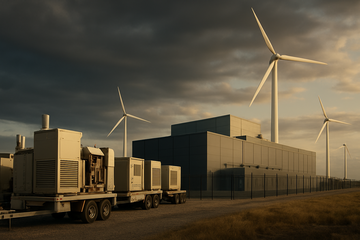
SpaceX won the permit fight and lost the courtroom. On Oct. 30, 2026, Judge Debra M. Brown of the U.S. District Court for the Northern District of Mississippi denied the motion to dismiss a Clean Air Act citizen suit filed by the NAACP against xAI and its affiliate MZX Tech, which accuses them of running the gas turbines that power the Colossus 2 data center in Southaven, Mississippi without the air permits a stationary source requires. Nothing in the ruling finds a violation, sets a penalty or shuts anything down. It does hand plaintiffs the discovery record showing which turbines ran, for how long and with what controls.
Unpermitted turbines at Southaven
46
Mississippi Department of Environmental Quality count, May 6, 2026
Capacity named in the April 2026 complaint
495 MW
27 turbines targeted in the citizen suit
Capacity permitted for permanent units
1.2 GW
41 turbines, Mississippi air permit issued Mar. 10, 2026
Announced behind-the-meter capacity
130+ GW
U.S. data-center colocated generation, Rabobank review, May 6, 2026
The ruling
The Ruling Removes the Exit, Not the Risk
The judge's reasoning was narrow and it settled the defense's best argument. xAI argued that Clean Air Act citizen suits are unconstitutional because they let private parties enforce federal law; Judge Brown answered that citizen-suit plaintiffs sue on their own behalf seeking penalties to redress their own injuries, so they are not exercising federal executive power. Twelve days earlier, on Oct. 19, the same court allowed the Justice Department to intervene but refused to let it dismiss the case, and the Fifth Circuit called the government's appeal premature. What survives is not a verdict but a lawsuit, and the cheapest exit from the Memphis claims was a dismissal that is now gone.
- Discovery, not judgment. Plaintiffs will seek the turbine list, operating dates, fuel records and emissions-control configurations for the Southaven fleet — the paper trail that decides who was a stationary source.
- The injunction is still live. The NAACP moved for a preliminary injunction on May 6, 2026 to stop the unpermitted turbines, Mississippi filed an amicus brief against that motion, and SpaceX opposed it, so a court-ordered shutdown of the 495 MW fleet stays on the table.
- The state permit is a separate front. The NAACP appealed the March 10, 2026 Mississippi permit for 41 permanent turbines on April 9, 2026, so the same plant is now being litigated through an administrative board and a federal court at the same time.
Mechanism
The Flaw Was in the Label, Not the Emissions
The turbines are not exotic hardware. They are trailer-mounted gas engines, and Mississippi's environmental regulator treats a unit on wheels as mobile, allowing it to run without an air permit for up to a year. The NAACP's theory is that a turbine dedicated to powering one fixed data center is a stationary source regardless of what it is bolted to. That is why the fleet kept growing: the Department of Environmental Quality confirmed 46 unpermitted units at the Southaven site in May 2026, up from 18 when xAI arrived, including 19 added between March 25 and May 2. Having already won the permit for 41 permanent turbines, the operator still added 19 more unpermitted units.
Unpermitted turbines claimed at the Southaven site
Counts as claimed or confirmed at successive dates: 18 on arrival per the state regulator, 27 named in the April 2026 complaint, 33 in the NAACP's injunction papers, and 46 confirmed by the Mississippi Department of Environmental Quality on May 6, 2026.
Unit: turbines
On arrival, mid-2025
Per the state regulator's account
18
Named in complaint, Apr. 14, 2026
495 MW of capacity
27
NAACP injunction papers
Count before state confirmation
33
State-confirmed, May 6, 2026
Includes 19 units added Mar. 25-May 2
46
The complaint puts the emissions at more than 1,700 tons a year of nitrogen oxides, up to 180 tons of fine particulate matter, up to 500 tons of carbon monoxide and up to 19 tons of formaldehyde. Those are the plaintiffs' estimates, not agency findings, and state regulators argue the units carry control technology to limit emissions. That disagreement is precisely what discovery is for: the case lets a court decide whose emissions estimate to believe. The plants also sit next to a third campus xAI is planning in Southaven, which is why the claim reaches beyond the megawatts already running.
The model
The Shortcut Was the Product, and It Was the Permit
Behind-the-meter gas exists because the grid cannot keep up with AI. Interconnection now takes 36-84 months while campuses are built in 12-24, so operators bought their own turbines and parked them on land next to the racks. Memphis is that strategy in miniature — fast, modular and, until now, beyond the reach of a private plaintiff. Time-to-power was the product, and time-to-permitted-power is now the constraint.
| Option | Time to power | Named suppliers |
|---|---|---|
| Heavy-duty turbine or combined cycle | 36-84 months | GE Vernova, Siemens Energy, Mitsubishi Heavy Industries |
| Reciprocating engines, aeroderivatives, small frame turbines | 12-24 months | Caterpillar, Wärtsilä, INNIO Jenbacher — 18.3 GW announced |
| Fuel cells | About 90 days | Non-gas; lightest air-permitting burden |
| Grid interconnection | 36-84 months | Incompatible with a 12-24 month build cycle |
Behind-the-meter power: announced versus realistic (GW)
U.S. data-center colocated generation announced, against the 22-32 GW that Rabobank's May 6, 2026 review expects to be deployed by 2030 after screening for permits, firm equipment orders, secured fuel contracts and realistic phasing.
Unit: GW
U.S. data-center projects announced
Planned capacity
160
Colocated energy announced
Gas is more than 80% of it
130
Realistic on-site deployment by 2030 — high end
After permit and order screening
32
Realistic on-site deployment by 2030 — low end
About a quarter of new capacity
22
Who pays
Nobody Is There to Take the Bill
A regulated utility builds a plant, files a rate case and spreads the cost across ratepayers. A behind-the-meter plant has no ratepayer, no rate case and no regulator willing to approve cost recovery — that is the point of the model, and it is why the bill lands whole on the operator. SpaceX's filings show what that balance sheet looks like: $54.96 billion of capital expenditure in the trailing twelve months, negative $39.27 billion of free cash flow and $102.97 billion of net stock issuance, with the AI segment taking $39.995 billion of the $48.07 billion spent in the first nine months of 2026. Equity-funded capital spending carries a per-day liability with no ratepayer behind it.
| Party | What it is exposed to | Where the exposure is documented |
|---|---|---|
| SpaceXAI entities and MZX Tech | Named defendants: per-day civil penalties, an injunction against the unpermitted fleet, and control retrofits | Motion to dismiss denied Oct. 30, 2026 |
| SpaceX | Carries the claim in its legal proceedings while financing the build with equity issuance | SpaceX 10-Q, quarter ended Sept. 30, 2026 |
| Turbine makers | Discovery into which units ran where, and with what emissions controls | Doosan Enerbility DGT6-class order for Colossus; GE Vernova units at Colossus 1 |
| Regulated utilities | Rate-case and prudence scrutiny of their own behind-the-meter build | Entergy–Meta Platforms 2.5 GW deal under a 15-year contract |
| AI tenants | Delivery risk on capacity priced as if it were firm | Microsoft lead tenant at a 2 GW behind-the-meter campus |
Capital
Follow the Capital, and Then Follow the Paperwork
SpaceX capital expenditure by quarter, 2026 ($B)
SpaceX capital expenditure by quarter. The AI segment absorbed $39.995 billion of the $48.069 billion nine-month total, or 83%.
Unit: $B
Q1 2026
AI segment capex $7.7 billion
10.1
Q2 2026
AI segment capex $15.8 billion
18.4
Q3 2026
AI segment capex $16.4 billion
19.6
- GE Vernova's Power segment did $6.07 billion of Q3 2026 revenue at a 21.4% segment EBITDA margin, and Caterpillar did $20.68 billion at a 20.4% operating margin — the equipment cycle is not waiting on the courtroom.
- Doosan Enerbility booked its first U.S. data-center turbine orders in late 2025 — 12 DGT6-class units for the xAI Colossus expansion — putting a Korean turbine maker inside the discovery perimeter of the Memphis site.
- Mitsubishi Heavy Industries sits in heavy-duty turbines, where the delivery clock runs 36-84 months, so its data-center revenue sits outside the 2026-27 permitting squeeze.
- Microsoft spent $39.37 billion of capital expenditure in its September 2026 quarter against $92.28 billion of revenue, showing which side of the power queue can afford to wait for permits.
The transmission into the supply chain is not the turbine order; it is the file that came with it. Once a court will hear a citizen suit on whether trailer-mounted units are stationary sources, the buyer of a turbine starts asking the maker for a permitting dossier — control packages, certification and proof of intended use. Makers that can hand that over sell faster; makers that cannot have their fastest-selling product put under a microscope. That is an inference drawn from the docket, not a disclosed fact: no turbine maker is a party to the case.
Short horizon
Days to Quarters: The Calendar That Matters
Nothing in the next two quarters requires anyone to win this case; it requires the operators of the power queue to price it. Courts and commissions now set the pace of AI power, and the events that will set prices are dated.
- The preliminary injunction is the fastest binary event. A granted order would idle the 495 MW the complaint targets and force a retrofit or a bridge to grid supply.
- Nov. 18, 2026: Shelby County commissioners postponed votes on a 12-month data-center moratorium and a companion regulatory ordinance to that date, after Memphis' city council rejected its own moratorium on Oct. 20, 2026.
- The government's Sept. 18, 2026 appeal of the intervention ruling was thrown out as premature on Oct. 19, 2026; the Oct. 30 dismissal denial opens a fresh appeal window on the strongest of the two rulings.
- The state permit continues separately. The NAACP's April 9, 2026 appeal of the 41-turbine, 1.2 GW Mississippi permit can still be lost, and the regulator's treatment of mobile turbines is unresolved.
Long horizon
One to Three Years: Permits Stop Being an Afterthought
Today the sequence is build first, permit later, litigate if a community complains. A citizen suit that survives dismissal inverts it. A surviving claim makes the permit the first gate rather than the last formality, and that reshapes who can build, what they buy and how they finance it.
- Local rules become templates: the data-center ordinances now advancing in Memphis and Shelby County, which attach conditions to new large campuses, become templates other counties copy.
- Equipment mix shifts toward what permits fastest — engines and aeroderivatives at 12-24 months, fuel cells at roughly 90 days — and away from heavy-duty turbines at 36-84 months.
- The burden of proof moves onto the builder: one discovery record sets the template, and proving a plant was lawfully permitted becomes a cost of the operator rather than a formality of the regulator.
Falsification
What Would Break This Thesis
This is not a story about demand for AI power, and it should not be read as one. The power is needed; the questions are who pays for the electrons, who carries the permitting risk, and who gets to build first. The thesis fails if the case collapses on procedure, if the injunction is refused and the plants keep running, or if operators simply buy the permits and the controls and keep building at the same pace.
Who the Memphis ruling actually touches
- Discovery now reaches the power supply for a segment that spent $16.4 billion of capex in Q3 2026 alone, putting the case on the balance sheet that funds the build.
- No violation and no penalty have been found, but the pending injunction on46 unpermitted turbines could cap on-site capacity at the 495 MW named in the complaint.
- Trailing-twelve-month free cash flow of negative $39.27 billion and $102.97 billion of net stock issuance leave little cushion if civil penalties are assessed per day of violation.
- Over one to three years, a court-tested rule on mobile turbines would let SpaceX price permitted megawatts into the schedule instead of litigating them.
- Power-segment revenue of $6.07 billion at a 21.4% segment EBITDA margin in Q3 2026 shows the AI gas cycle is intact, and permit scrutiny shifts mix toward controlled units rather than killing demand.
- GE Vernova equipment powers the Colossus 1 campus, so Memphis discovery reaches its installed base once plaintiffs seek turbine identity and control packages.
- Aeroderivative units deploy in 12-24 months against 36-84 for heavy-duty, so the litigation lands on the fastest-moving part of the order book first.
- Reciprocating engines are the fastest-to-permit gas option at 12-24 months, and Caterpillar's engine franchise captures the shift away from unpermitted turbine workarounds.
- Q3 2026 revenue of $20.68 billion at a 20.4% operating margin shows the franchise is not dependent on any single AI campus.
- Over one to three years, engine-heavy behind-the-meter projects get shorter build cycles and less permitting exposure than the 36-84 month heavy-duty alternative.
- Its first U.S. data-center orders — 12 DGT6-class units for the xAI Colossus expansion — put a Korean turbine maker inside the discovery perimeter of the Memphis site.
- Aeroderivative deployments of 12-24 months are the quickest heavy-duty-adjacent route to power, supporting continued U.S. order growth as operators seek permitted fast power.
- The risk is documentation rather than demand: a court scrutinising what was sold and how it ran raises the value of turbines shipping with permitting and emissions-control packages.
- The agreement covering 2.5 GW of behind-the-meter gas under a 15-year contract puts the air permits with a regulated utility instead of the data-center operator.
- Trailing revenue of $13.48 billion and commission approval let Entergy absorb slower permitting, at the cost of a thinner return on each megawatt.
- Over one to three years, if permit-skipping is ruled unlawful, more behind-the-meter gas migrates into regulated structures where cost recovery is possible.
- As lead tenant of a 2 GW behind-the-meter campus with over 1 GW of Caterpillar engines, Microsoft has the most to gain or lose from whether courts treat permit-free power as deliverable.
- September-quarter capex of $39.37 billion against $92.28 billion of revenue shows hyperscalers can fund a slower, permitted power path if they must.
- Catalyst: the ruling on the preliminary injunction filed May 6, 2026, the fastest test of whether mobile turbines can keep running unpermitted.
- Prometheus is served by 400 MW of dedicated behind-the-meter gas and the Entergy deal adds 2.5 GW, exposing the largest AI tenants to the same permit question.
- Meta's structure differs from Memphis in one way that matters: a partner utility holds the permits, so litigation risk migrates from the tenant to the regulated counterparty.
- Over one to three years, an industry standard of permit-ready generation means paying more per megawatt while avoiding the shutdown risk now hanging over 495 MW at Colossus 2.
- Heavy-duty turbines, where Mitsubishi Heavy Industries sits, take 36-84 months to deliver, placing its data-center revenue outside the 2026-27 permitting squeeze.
- Grid-connected combined cycle, not trailer-mounted engines, is where heavy-duty units land, and that is the segment with the deepest corporate balance sheets behind it.
- Watch item: whether states rewrite data-center air permitting in a way that favours combined-cycle plants over behind-the-meter engines.