
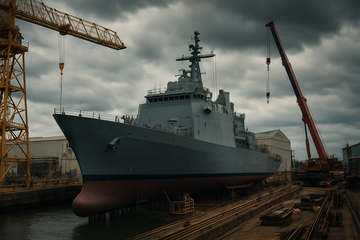
The headline number is $269 million, and it is the least interesting thing in the award. That figure covers one Medium Landing Ship, while the Navy's fiscal 2027 request for six more works out to roughly $315 million per vessel — so the winning yard was priced below the Navy's own budget assumption for the class. Hanwha did not win by importing cheap labor. It won by building in a 118-acre Philadelphia yard staffed by about 1,500 people, half of them non-union, and by taking the first slot in a procurement model built to spread hull work across more yards. The genuinely new fact is not the contract. It is that Hanwha now controls 60% of the yard that won it.
Hanwha's first U.S. Navy hull contract
$269M
One Medium Landing Ship at Hanwha Philly Shipyard, with options for three more; TOTE Services announcement, Oct. 30, 2026
Navy's implied per-vessel cost, FY2027 request
$314.6M
$1,887.5 million requested for six additional Medium Landing Ships, Navy FY2027 budget request
Ships in the planned LSM fleet
35
Navy and Marine Corps fleet plan; initial production tranche covers up to eight hulls
Headcount at the winning yard
~1,500
50% union and 50% non-union, on 118 acres in the Philadelphia Navy Yard; 2024 sustainability report
Huntington Ingalls' unfunded backlog
$48.3B
Against $37.9 billion funded and $86.2 billion total, as of Sept. 30, 2026
Price for 60% of the winning yard
$237.6M
Hanwha Systems' disposal of its Philly Shipyard stake, roughly 322.9 billion won, reported Sept. 2026
The award
One Firm Hull, Three Options, and a Program With 27 Ships Still Unallocated
| Yard | Position in program | Contracted value | Status |
|---|---|---|---|
| Hanwha Philly Shipyard | First shipyard selected under the vessel construction manager model; 1 firm hull plus options for 3 | $269M for the firm hull | Construction starts Q4 2027; first vessel expected 2030 |
| Fincantieri Marinette Marine | Directed by the Navy for construction of 4 hulls | $30M for materials procurement and engineering, April 2026 | Construction as early as Q4 2026 |
| Bollinger Shipyards | Lead ship: long-lead procurement and lead ship engineering design | $9.5M, September 2025 | Lead ship in program |
| TOTE Services (prime) | Vessel construction manager; up to 8 hulls under the base contract, with award strategy for up to 3 more | $2.2B VCM contract, July 2026 | Discussions with Bollinger and Fincantieri Marinette Marine continue |
| Unallocated | Balance of the planned 35-ship fleet | Not disclosed | Funding follows in later fiscal years |
There is an arithmetic tell in the option structure. The Navy's July award directed one hull to Bollinger Shipyards, four to Fincantieri Marinette Marine, and left up to three more for the manager to place. Hanwha took one firm hull and holds options on three. One plus three plus one plus four is nine, one more than the eight hulls the base contract covers — so by arithmetic alone, at least some of those options reach into the 27 ships still unallocated in the 35-ship plan. That is where the value sits, not in the $269 million.
The other tell is a slipped date. When the Navy named TOTE Services as vessel construction manager in July 2026, it said the first landing ship would arrive in the fall of 2029. The Oct. 30 award release says the first vessel is expected in 2030. A procurement model sold as accelerating delivery has already moved its lead hull a year to the right.
The cost curve
The Cost Curve Broke in 2024, Not in 2026 — and Hanwha Inherited the Fix
Per-hull cost anchors for the Medium Landing Ship class
Scope differs by figure: the custom-design figure is an early industry bid, the budget figure is a Navy appropriation average, and the Hanwha figure is a negotiated construction price for one hull. Sources below.
Unit: $ millions per hull
Custom Light Amphibious Warship design bids
Early industry bids exceeded $350 million per hull; the Navy pivoted away from custom design
350
Navy FY2027 request, per vessel implied
$1.8875 billion for six additional vessels
314.6
Hanwha Philly Shipyard award, per hull
One hull firm, options for three more
269
The class's cost problem was solved before Hanwha arrived. The program began as the Light Amphibious Warship, and early industry bids for a purpose-built hull came in above $350 million. In 2024 the Navy pivoted to a commercial off-the-shelf design to cut cost and speed production, and in December 2025 it selected Damen's LST 100 as the technical basis for what is now the McClung class. Standardizing the hull, not repricing labor, is what moved this program from impossible to fundable — and every yard building it now inherits that lower curve.
- Design did the heavy lifting before the yards were ever selected
- The $30 million Fincantieri Marinette Marine award covers materials and engineering for four hulls, not construction
- The $9.5 million Bollinger award covers long-lead procurement and lead ship engineering design
- Hanwha's $269 million is the first price that covers construction of a complete hull
The labor question
Where the Labor-Cost Wedge Actually Sits: 118 Acres in Philadelphia
The yard that won is not a Korean yard. Hanwha Philly Shipyard occupies 118 acres in the Philadelphia Navy Yard, and its own 2024 sustainability report puts its workforce at about 1,500 people, split exactly 50% union and 50% non-union. Half the workforce sits outside union coverage — the practical mechanism that lets a Philadelphia hull price below the Navy's budgeted rate without importing anyone.
Hanwha Philly Shipyard: the asset behind the contract
Site
118 acres, Philadelphia Navy Yard
At the confluence of the Delaware and Schuylkill rivers
Workforce
~1,500 personnel, 50% non-union
2024 sustainability report; tuition reimbursement covers union and non-union staff alike
Backlog
$1.7 billion
As disclosed in the 2024 sustainability report
Entry price
$100 million, December 2024
Acquired from Aker; a $5 billion infrastructure plan followed in August 2025
Federal work now booked
LSM hull plus missile range vessels
Missile Defense Agency range vessels worth about $2 billion, up to three hulls, first due 2030
Compare that with the incumbent yard complex. Huntington Ingalls ran a record third quarter of 2026 with $3,537 million of revenue and $5.48 of earnings per share, and it booked $32.4 billion of new awards in the quarter alone. But its total backlog of $86.2 billion includes $48.3 billion that Congress has not yet funded. The domestic yards are not short of orders. They are short of funded, priced, and on-schedule capacity.
Upstream, the demand lands on plate steel. Nucor runs three plate mills it describes as strategically located near major shipyards, and says it can produce over 99% of the annual plate tonnage the American military buys, with 1.2 million tons of annual plate capacity. Cleveland-Cliffs is the largest flat-rolled steel provider in North America. The House's Shipbuilding Investment and Workforce Act, introduced July 23, 2026, ties renewed American shipbuilding directly to domestic steel.
Downstream, the customer is not one ship. TOTE Services holds the $2.2 billion vessel construction manager contract and is the counterparty for the Navy, the Marine Corps, and the Missile Defense Agency, while the design licensor for the class is Damen. Huntington Ingalls via Bollinger Shipyards and Fincantieri Marinette Marine are the other two builders, and TOTE says talks with both continue.
The ownership chain
The Real News Is a 60% Transfer That Moves the Shipyard Up Into the Defense Group
Hanwha bought the Philadelphia yard in December 2024 for $100 million, with Hanwha Systems holding 60% and Hanwha Ocean 40%. In September 2026 Hanwha Systems agreed to sell that 60% stake for about $237.6 million, roughly 322.9 billion won, to Hanwha Defense USA Shipbuilding, a joint venture led by Hanwha Defense USA with Hanwha FutureProof. Hanwha Ocean keeps its 40%. The yard that won the Navy contract now sits inside the listed entity that owns the U.S. defense franchise, with Hanwha Systems out of shipbuilding and Hanwha Aerospace holding the exposure.
The capital is moving too. In August 2026 Hanwha Aerospace put $149 million into Hanwha Defense USA as part of $299 million going into U.S. defense subsidiaries. Hanwha Systems is raising $2.56 billion for integrated air defense and military AI. And Hanwha Defense USA has a non-binding offer of $1.05 billion to $1.2 billion outstanding for Austal's U.S. shipbuilding operations, which its parent confirmed was still under discussion as of Oct. 15, 2026.
The incumbents
A Public Price Reference Now Exists, and It Sits Below the Budget Line
Huntington Ingalls backlog: what is funded versus what is not
Total backlog of $86.2 billion at Sept. 30, 2026. Newport News carries the bulk of the unfunded balance. Source: Huntington Ingalls Form 10-Q.
Unit: $ billions
Unfunded backlog
$42.2 billion of it at Newport News Shipbuilding
48.3
Funded backlog
$16.7 billion at Ingalls, $18.6 billion at Newport News, $2.6 billion at Mission Technologies
37.9
The strategic problem for domestic primes is not that they lost a contract. It is that a price reference now exists. Bollinger Shipyards keeps the lead ship, Fincantieri Marinette Marine holds four hulls' worth of long-lead work, and TOTE Services says discussions with both continue. But for the first time there is a published, transaction-tested number for a landing ship built in America, and it came in under what the Navy budgeted. Every future hull in the 35-ship plan now has a price floor set by a yard the incumbents did not build — on a schedule that has already slipped a year.
- Huntington Ingalls guided2026 shipbuilding revenue to $10.5–10.7 billion at a 6%–6.5% operating margin
- That margin band leaves little room to absorb a competitor priced below the appropriation rate
- Newport News holds $42.2 billion of unfunded backlog, so conversion depends on appropriations, not orders
- General Dynamics lost the Constellation class and the follow-on frigate went to Huntington Ingalls' Ingalls Shipbuilding
The policy backdrop makes this structural rather than incidental. The White House's Aug. 13, 2026 fact sheet says foreign shipbuilders that invest in U.S. shipyards and train an all-American workforce will be temporarily permitted to build up to two ships in their parent yards. That is the route Korean and Japanese yards are now on, and Congress is already fighting it: the Senate Armed Services Committee sought in June 2026 to strip the waiver authority that allows offshore construction. Hanwha's Philadelphia hull is the version of this policy that survives both courts.
Horizons
Two Clocks: What Moves by Year-End, and What Decides the Rest of the Fleet
- Days to quarters: the Navy's November 2026 decision on Japanese, South Korean and Turkish frigate designs
- Days to quarters: whether TOTE places the next hulls and whether any of Hanwha's three options are exercised
- Days to quarters: closing of Hanwha Defense USA's bid for Austal's U.S. operations, still under discussion
- Days to quarters: first steel and hiring at Hanwha Philly Shipyard, with construction starting in Q4 2027
Over one to three years the questions are harder and the money is bigger. Twenty-seven of the planned 35 landing ships have no yard and no appropriation. The VCM model either proves it can deliver a fleet at a price the appropriations process will fund, or it returns to the two-prime structure that already failed. And the question the award actually answers — can a foreign-owned, largely non-union American yard build a Navy hull on time and on budget — will be settled by the 2030 delivery, not by the announcement.
- One to three years: appropriations converting the $48.3 billion unfunded backlog into funded work
- One to three years: the rollout of the VCM model to the next-generation logistics ship and sealift recapitalization programs
- One to three years: whether the first Hanwha hull lands in 2030 as the shipyard has promised
- One to three years: whether Congress keeps or strips the authority to build ships overseas
The synthesis
A First Hull Won on Cost Discipline, Not on Wage Arbitrage
The most durable read of this award is not that Hanwha can build American warships more cheaply than American shipyards. It is that a foreign-owned yard with a deliberately mixed labor base, bought for $100 million in2024 and modernized with a $5 billion plan, can hold a price below the Navy's own budget assumption for a class the Navy could not previously afford. That validates the vessel construction manager model, which lets the Navy qualify more yards instead of bargaining with two.
For the Hanwha complex, the cash and the consolidation are worth more than the contract. Hanwha Systems converted a capital-hungry shipbuilding stake into roughly $237.6 million at about four times its entry cost and is redirecting that into defense electronics. Hanwha Aerospace absorbed the yard, the $269 million hull, and the options into its own accounts. Hanwha Ocean kept 40% of the upside without consolidating it. And the pricing reference now embedded in the program is a threat to Huntington Ingalls and General Dynamics that no contract award to either of them will resolve.
This selection is a significant step forward for the Hanwha Philly Shipyard as it supports Navy and Marine Corps efforts to rebuild U.S. shipbuilding.
Where the Award Actually Lands
- Consolidates the first U.S. Navy shipbuilding contract at a unit owned by Hanwha Aerospace through Hanwha Defense USA
- Shipbuilding adds no measurable revenue before the Q4 2027 construction start
- Q3 operating profit of KRW 452 billion, down 46% with a net loss, is the nearer-term driver of the share price
- Over one to three years, three hull options and 27 unallocated hulls sit behind the contract
- Monetizes shipbuilding at roughly four times the 2024 entry cost with about $237.6 million received for its 60% stake
- Proceeds land on a balance sheet carrying 6.9 times net debt to EBITDA and 0.25 times book
- Capital is rotating into integrated air defense and military AI, with a $2.56 billion raise
- Over one to three years, the shipbuilding cycle risk leaves the income statement, and so does the upside
- Keeps 40% of a yard that just won a $269 million Navy hull and a $5 billion build plan without consolidating it
- Trailing operating income of KRW 2,041 billion on KRW 15,505 billion of revenue, at 10 times EBITDA and 7.9 times earnings
- Korean yards face Navy requests for information on destroyers and tankers, a bigger prize than one landing ship
- Over one to three years, a minority stake inside a group subsidiary means no control over yard priorities
- Strongest Korean naval franchise and net cash, at 7.2 times EBITDA on KRW 23,195 billion of trailing revenue
- Without a U.S. yard it cannot use the invest-here-build-two-abroad route Hanwha just turned into booked work
- The July 2026 destroyer and tanker request for information is its best near-term channel into U.S. Navy work
- Watch whether it answers with a U.S. yard, or watches a Korean rival take the premium auxiliary contracts
- Bollinger won the lead landing ship and keeps a $9.5 million long-lead award, with TOTE talks continuing
- Now faces a public $269 million reference below the Navy's own $315 million per-vessel budget rate
- Near term, $32.4 billion of quarterly awards and $5.48 of EPS argue against a disruption narrative
- Longer term, 56% of the $86.2 billion backlog is unfunded, making price discipline existential at 6%–6.5% margins
- Constellation was cancelled and the follow-on frigate went to Huntington Ingalls's Ingalls Shipbuilding
- The Navy now evaluates Japanese, South Korean and Turkish frigate designs, with a decision due by November 2026
- Three times book and 15 times EBITDA already assume the surface franchise keeps its pricing power
- Submarines remain the cushion; the surface and auxiliary book is where the new yard competition bites
- Three plate mills near major shipyards and over 99% of military plate tonnage make Nucor the upstream beneficiary of more hulls
- A 35-ship landing ship fleet plus the Navy's $65.8 billion fiscal 2027 shipbuilding request pulls domestic plate
- Near term, steel is a spread business, so hull-driven volume beats hull-driven price
- Over one to three years, the Shipbuilding Investment and Workforce Act links renewed shipbuilding directly to domestic steel
- Mitsubishi Heavy Industries's Mogami class sits in the Navy frigate evaluation concluding by November 2026
- The Finland-model route lets a foreign builder that invests in a U.S. yard build up to two vessels at home
- Counterweight: Japan's own industry is pulling back from a U.S. Navy frigate deal
- Watch the November 2026 design decision and any Japanese yard investment in the United States