
The announcement
Axios reported a name change; the permit map explains why it is not a name change
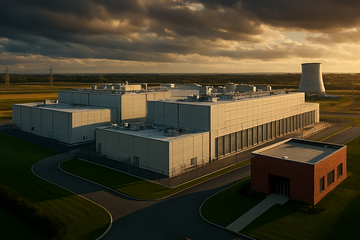
Axios reported on Nov. 1 that OpenAI will launch a policy and public-relations blitz right after the Nov. 3 midterms, rebrand its data centers as “AI compute campuses,” and try to set an industry standard through proposed state legislation giving residents “a meaningful say” in how projects are built and what benefits they receive. OpenAI chief global affairs officer Chris Lehane called the vote “an electoral portal from one era to the next” and said AI will be the issue in 2028. The same package carries mandatory “speed limits” for the most powerful models and new community compacts for future sites. Read as strategy rather than branding, the campaign times a vocabulary push to the moment state lawmakers write the rules.
- OpenAI will rebrand data centers as “AI compute campuses”, an “intentionally provocative” relabel, per Axios.
- It will publish new community compacts and commitments for future data-center sites, extending the model already written into the Ohio deal.
- It will push state legislation giving residents a “meaningful say” in how projects are built and what benefits they receive, aiming to set an industry standard.
- It will promote mandatory “speed limits” for the most advanced AI systems, framed as keeping human beings in control.
- Lehane's pitch is to “inform the moment via the power of ideas” — with a new Congress seated Jan. 3, 2027 and 267 state data-center bills considered in 2025 alone.
Communities should hold companies responsible and accountable so they really and truly get a transformative benefit from these projects.
The constraint
Opposition has industrialized, which is why the vocabulary is the weapon
Opposition has industrialized. Data Center Watch counted 843 local opposition groups across 49 states by mid-2026, more than double the 396 recorded at the end of 2025. The second quarter of 2026 alone blocked or delayed $68 billion of US projects, on top of at least 75 projects worth about $130 billion in the first quarter, and 142 AI data-center protests ran simultaneously across 42 states in July. For a company that needs power contracts, water and rate approvals before a single rack is installed, that arithmetic turns site selection into the binding constraint on deployment.
Local opposition groups
843
Across 49 states at mid-2026, against 396 at the end of 2025
Projects blocked or delayed, Q2 2026
$68B
45 US projects, per Data Center Watch
Projects blocked or delayed, Q1 2026
~$130B
At least 75 US projects in the first quarter
Large-load tariffs approved in 2025
29
Against 14 in 2018–2024; 77 pending or in place across 36 states
Campus capacity at PORTS-Pike
8 GW-IT
20-year lease to OpenAI; first 800 MW due in 2028
Anthropic compute obligations
$417B
Disclosed in the S-1 filed Oct. 26, 2026
US data center project value blocked or delayed by local opposition, 2026
Quarterly figures reported separately by Data Center Watch; the half-year tally covers roughly 120 projects.
Unit: $ billions of announced project value
Q1 2026
At least 75 projects blocked or delayed
130
Q2 2026
45 projects blocked or delayed
68
- Santa Fe County, New Mexico, adopted the first preemptive moratorium: 18 months of pause before any permit application.
- Superior, Wisconsin, paused a year and Harpersville, Alabama, six months — with no project in hand at all.
- Independence County, Arkansas, will not approve data centers until 2031, citing water supply.
- Jefferson, Texas, voted unanimously against new development after a statewide pause on grid connections.
- Denver's council imposed a one-year moratorium on new data center construction in May 2026.
The regulatory instrument
Wisconsin wrote the template: a compact turns a ratepayer fight into a rate case
The Wisconsin order is the template worth copying, and it is the reason a naming campaign has economic content. When a commission approves a dedicated rate in which the developer underwrites 100% of the power infrastructure, a campus stops being a subsidy debate and becomes a ratepayer-neutral project. OpenAI's Stargate Community plans already commit to funding dedicated power and storage, operating campuses as flexible load during grid stress, and reporting annually on hiring, community investment, water use and project energy use — precisely the evidentiary package a hostile commission demands. Naming the category lets the compact become a standard tariff wrapper.
| Body | Action | Date | What it means for a campus |
|---|---|---|---|
| Wisconsin Public Service Commission | Approved a Very Large Customer rate for We Energies, WEC Energy Group's utility subsidiary, but materially rewrote it to protect existing customers | Apr. 24, 2026 | The developer funds the grid; the utility earns without a residential fight |
| WEC Energy Group | Raised its 2027–2031 capital plan to $47.5 billion, up $10 billion, on roughly 1 gigawatt of new forecast electric demand | Q3 2026 earnings | Rate base grows only where cost allocation is already settled |
| State regulators (SEPA tally) | 29 large-load tariffs approved in 2025 versus 14 in 2018–2024; 77 pending or in place across 36 states | Mar. 31, 2026 | Shifting grid costs onto the load is becoming the default rule |
| US Congress | GRID Act, Ratepayer Protection Act, POWER Up Act and Power for the People Act would push interconnection and grid costs onto large loads | 2026 lame-duck window | Federal interconnection money is running into state resistance |
| Denver City Council | One-year moratorium on new data center construction | May 18, 2026 | Even fast-build sites need a legal category to exist before they need a permit |
The federal layer is moving in the opposite direction from the label. Once a category exists in statute and in commission orders, the fight shifts from whether the campus is allowed to whether the campus is charged fairly, and that is a fight utilities can win. The state with the compact gets a rate base; the state without one gets a moratorium and a ratepayer revolt. makes the compact a competitive asset rather than a favor
The value chain
Nobody in the campus stack is a landlord in the ordinary sense
The stack behind one OpenAI campus has an unusual shape. SB Energy builds, owns and operates the Ohio site and leases it to OpenAI for 20 years; NVIDIA invests $1.5 billion in SB Energy and provides credit support for the land, power and shell tied to the first 4.25 IT-GW; Oracle develops sites in Texas, New Mexico and Wisconsin; AEP's existing transmission carries the first 800 megawatts. The developer carries construction risk, the chip supplier carries credit risk, and the tenant carries the lease. moves construction and credit risk off the balance sheet that wants the compute
| Layer | Who is in it | Evidence from filings and announcements | Read-through |
|---|---|---|---|
| Compute | NVIDIA and OpenAI | At least 10 GW of NVIDIA systems committed, with up to $100 billion of staged NVIDIA investment; first gigawatt on Vera Rubin in the second half of 2026 | Chips are the last unconstrained input |
| Developer, owner and landlord | SB Energy, a SoftBank Group company, and Oracle | SB Energy builds, owns and operates PORTS-Pike under a 20-year lease to OpenAI; Oracle develops sites in Texas, New Mexico and Wisconsin | Long leases with credit support make long-dated power contracts bankable |
| Equipment | Vertiv | Q3 2026 net sales of $4.313 billion, 61% above a year earlier, on AI power and thermal demand | The order book follows energization, not announcements |
| Host utilities | WEC Energy Group and DTE Energy | Dedicated rates and project-financed battery storage in Michigan; a $47.5 billion five-year plan at WEC Energy Group | Rate base grows only where cost allocation is settled |
| Transmission | AEP | Existing AEP infrastructure is expected to carry the first 800 megawatts at PORTS-Pike | Near-term energization rides incumbent wires |
| Tenant capacity | CoreWeave and Oracle | About $22.4 billion of CoreWeave contract value with OpenAI; CoreWeave Q2 revenue of $2.575 billion at a 65.9% gross margin | Demand is contracted; financing is the constraint |
The credit angle
NVIDIA's own filing shows the campus category is now a credit instrument
The most consequential disclosure of the year sits inside a hardware vendor's quarterly filing. NVIDIA reported data center revenue of $89.0 billion for the quarter ended July 26, 2026, up 117% year over year at a 75.0% gross margin, and disclosed that it has guaranteed leases at the PORTS Technology Campus with SB Energy, where OpenAI is the tenant: if OpenAI fails to perform or becomes insolvent, the guarantee can be triggered. A campus financed by a landlord's balance sheet is a different credit from one financed by the chip vendor's balance sheet. puts OpenAI's tenant credit on NVIDIA's books
- NVIDIA's quarterly filing states the guarantees relate to PORTS leases with OpenAI as tenant, and that non-performance could trigger them — tying the campus label to a credit event.
- The credit support is sized to the first 4.25 IT-GW with an option on the remaining 3.75 IT-GW, so exposure scales with deployment rather than with announcement.
- Horizon: watch the first 800 megawatts energizing in 2028; guarantee drawdown risk scales one site at a time, not in a single step.
Vertiv quarterly net sales
Power and thermal equipment is the most visible read on how fast campuses are actually being energized.
Unit: $ millions
Q3 2025
Net sales
2,675.8
Q4 2025
Net sales
2,880
Q1 2026
Net sales
2,649.5
Q2 2026
Net sales
3,274.3
Q3 2026
Net sales, +61% year over year
4,312.8
The disclosure angle
The first public prospectus to use the label will set the terms for the second
The label is worth more to a public-company reader than to a private one. OpenAI confirmed a confidential draft S-1 in June 2026 and has not set timing, while its chief financial officer told employees the company will be a public company in 2027 or sooner, at a private valuation of $852 billion. Anthropic went first with a public filing on Oct. 26, disclosing roughly $417 billion of future compute obligations — contracts running from under a year to 20 years — plus another $125 billion to $150 billion for 2028–2031 delivery, against $16.29 billion of first-half 2026 revenue and an $80.7 billion first-half net loss. Whoever lists next inherits that template. lets the first prospectus define how the next obligation reads
| Company | Filing status | Compute commitments | What the filing shows |
|---|---|---|---|
| OpenAI | Confidential draft S-1 submitted; no timing set, public listing guided to 2027 or sooner | Stargate program of $500 billion and 10 GW; up to $100 billion of staged NVIDIA investment; 8 GW-IT leased at PORTS-Pike | Private valuation of $852 billion; a confidential prospectus can still choose its vocabulary |
| Anthropic | Public S-1 filed Oct. 26, 2026, with a Nasdaq listing planned for mid-November | About $417 billion of future compute obligations, plus $125 billion to $150 billion more for 2028–2031 delivery | $16.29 billion of first-half 2026 revenue and an $80.7 billion first-half net loss |
Horizons
The fight ahead is procedural, and the document that matters is a compact
In the days and quarters ahead the contest is procedural rather than technological. The post-election lame-duck period opens Nov. 9 and the new Congress takes office Jan. 3, 2027, while state legislatures enter another drafting cycle in which more than 40 states considered 267 data-center bills in 2025. OpenAI has chosen to land its terminology while those bills are still being drafted. A name written into an operative clause travels further than a name written into a press release. puts vocabulary into draft state statute
- First test: watch for the label inside 2027 bills — does any draft statute or commission order use a compute-campus category in its operative text?
- Second test: does another commission approve a rate built on a community compact, the way Wisconsin approved one for WEC Energy Group's utility subsidiary?
- Third test: does the first 800 megawatts at PORTS-Pike energize on schedule in 2028 on existing AEP infrastructure?
- Fourth test: does Anthropic's mid-November listing price an operating campus category, and does OpenAI's public filing then follow the same vocabulary?
In one to three years everything hinges on one document class, the community compact, because that is where the jobs, the water, the taxes and the ratepayer protection get committed in public. OpenAI has already committed to 10 GW of NVIDIA systems, a $500 billion Stargate program and a 20-year lease at a single 8 GW-IT campus in Ohio, where the first 800 megawatts are expected in 2028 and the build runs through 2032. If the compact holds, utilities add rate base, landlords add contracted rent and equipment makers convert backlog; if it fails, 843 opposition groups keep the queue shut and the naming becomes a liability in a prospectus. makes local consent the binding input on a 10 gigawatt pipeline
- What breaks the thesis, first: the compact's job math. The Ohio campus carries 35,000 construction roles and 2,500 permanent ones — delivery on that gap decides whether the label holds.
- What breaks it, second: states keep choosing moratoria over tariff categories, leaving utilities with generation they cannot monetise.
- What breaks it, third: OpenAI's tenant credit weakens, and the lease guarantees NVIDIA disclosed become a live liability rather than a footnote.
The investable consequence: permits, power and credit
- Data center revenue reached $89.0 billion in the quarter ended July 26, 2026, up 117% year over year at a 75.0% gross margin.
- NVIDIA's guarantee of SB Energy's PORTS-Pike leases, where OpenAI is the tenant, makes the campus category financeable.
- Horizon: the first gigawatt of the 10 gigawatt program lands in the second half of 2026 on Vera Rubin; permit speed, not chip supply, is the gate.
- Net sales of $4.31 billion in Q3 2026 ran 61% above Q3 2025 as AI power and thermal demand hit the order book.
- A 38.1% gross margin shows the equipment layer converting demand without pricing giveback.
- Horizon: revenue tracks energization schedules, so a permitting truce in 2027 matters more than any single contract announcement.
- Oracle develops Stargate sites in Texas, New Mexico and Wisconsin and leases capacity to OpenAI, so the upside is contracted but the build is self-funded.
- Trailing capital expenditure of $75.7 billion against $46.9 billion of operating cash flow makes exposure a cash-flow question first.
- Horizon: permitting slippage delays occupancy of assets already under construction, pressing returns before revenue arrives.
- About $22.4 billion of OpenAI contract value makes CoreWeave the clearest listed read on OpenAI training demand outside the campus owners.
- Q2 2026 revenue of $2.575 billion at a 65.9% gross margin still came with a $626 million net loss and 11.5 times net debt to EBITDA.
- Horizon: watch who signs first after the naming campaign, as new capacity and new contracts land in the same window.
- Raised the 2027–2031 capital plan to $47.5 billion, up $10 billion, on about 1 gigawatt of new demand largely from data centers.
- The Wisconsin rewrite lets the developer underwrite 100% of power infrastructure, so rate base grows without a residential fight.
- Horizon: WEC expects roughly 15% of its asset base to serve data centers and other very large users by 2030, and the compact is what regulators will cite to approve it.
- Michigan's project-financed battery storage keeps the campus off residential bills, the condition DTE's large-load pipeline depends on.
- A $30 billion 2026–2030 electric plan and $7.59 to $7.73 of 2026 EPS guidance show a utility already leaning into large-load growth.
- Horizon: Michigan is the first test of whether compact language survives a state commission that has already fought one data-center rate case.
- Existing AEP infrastructure is expected to carry the first 800 megawatts at the Ohio campus, making near-term energization an incumbent-wires story.
- Q3 2026 revenue of $6.832 billion and $1.812 billion of operating income give the balance sheet room to fund the connection.
- Horizon: bulk transmission and interconnection remain federal and state political questions that no naming campaign can settle.
- SB Energy, a SoftBank Group company, will own the 8 GW-IT Ohio campus and lease it to OpenAI for 20 years.
- The economics sit inside SB Energy rather than in disclosed group lines, so this is an option on OpenAI credit rather than booked earnings.
- Horizon: watch first 800 megawatt energization in 2028 and how the group discloses SB Energy funding and its OpenAI stake after listing.