
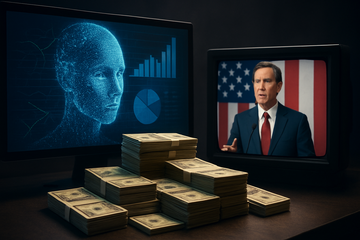
On the eve of the Nov. 3 midterms, AI-generated political advertising had become a mass-market campaign format rather than a novelty: $187 million across at least 289 counted ads, up from $137 million and 220 ads two weeks earlier. Platforms answered with certification gates for synthetic ads and pushed the cost onto the advertiser, which is why the money that mattered rotated into broadcast inventory that never needs an AI label.
AI political ad spend
$187M+
Cycle through Oct. 29, 2026 (Wesleyan Media Project); grew 36% in two weeks
Counted AI-generated or AI-assisted ads
289
As of Oct. 29, 2026, against 220 counted on Oct. 15
AI ads carrying a disclaimer
27%
Wesleyan count through Oct. 29, 2026; barely $50,000 of AI ad spend in 2024
Federal laws mandating AI disclosure in political ads
0
As of Nov. 3, 2026; roughly 30 state laws, four blocked in court
Fox's record midterm political haul
$350M+
Across the Fox portfolio, per its Q1 FY2027 earnings call, Nov. 2, 2026
Premium CTV CPM at the October peak
$43
Up from a $34-35 range earlier in the cycle (Digiday, Oct. 25, 2026)
The facts
The rulebook arrived mid-flood, and the flood accelerated
The Wesleyan Media Project, which tracks political advertising, counted more than $187 million across at least 289 unique AI-generated or AI-assisted ads through Oct. 29, 2026. Two weeks earlier the same count stood at $137 million and 220 ads, so spending rose 36% and the ad count rose 31% in the final stretch before Election Day — while roughly 30 state disclosure laws and three platform labeling systems were already fully in force.
AI political ad spending, cycle-to-date snapshots
Wesleyan Media Project counts of AI-generated and AI-assisted political ads; the flood grew fastest in the last fortnight before the vote
Unit: $ millions
Oct. 15, 2026
220 ads counted
137
Oct. 29, 2026
At least 289 ads counted
187
- Only 27% of counted AI ads carried any AI disclaimer, so roughly three-quarters of the flood ran unlabeled.
- More than 90% of AI political ad spend came from Republican candidates, Republican party committees and Republican-leaning groups.
- The 2024 baseline was barely $50,000 of AI political ad spend; the 2026 count is more than 3,700 times larger.
- The whole AI political ad market is about 1.6% of the $11.6 billion projected for the cycle and less than a quarter of one percent of one quarter of Alphabet's Google Ads revenue.
Liability
Platforms wrote the rules and sent the liability down the stack
The response to synthetic ads arrived as platform policy, not statute. Alphabet requires advertisers to flag synthetic or digitally altered content in election ads through the 'Altered or synthetic content' setting and to clear an election-ads verification process; Meta Platforms labels ads it detects were built with third-party AI tools and froze new US political, electoral and social-issue ads from 12:01 AM PT on Oct. 27 to 11:59 PM PT on Nov. 3; Reddit demands a candidate AMA before any political placement and human-reviews every political ad; TikTok accepts no political advertising at all; and X states that responsibility for compliance sits with the advertiser, not with the platform.
| Platform | The gate built for AI political ads | Who carries the risk |
|---|---|---|
| Meta Platforms | June 2026 'AI info' label for ads detected as made with third-party AI tools; Ad Library holds more than 18 million US entries; no new US political, electoral or social-issue ads from Oct. 27 to Nov. 3 | Advertiser and agency; the freeze cuts platform exposure to new political creative |
| Alphabet | Election ads must clear a verification process and carry 'paid for by' disclosure; synthetic or digitally altered content must be self-declared | Advertiser, with platforms acting as secondary enforcers |
| An AMA before any political placement, human review of every political ad, mandatory labeling of AI-generated content | Advertiser and campaign; the lowest platform exposure of the group | |
| X | Advertisers must comply with applicable law; the platform assigns responsibility to the advertiser | Advertiser, and the platform disclaims the compliance risk |
| TikTok | No paid political advertising of any kind | No exposure and no political revenue |
The industry's own framework says where the liability lands. The IAB's AI Transparency and Disclosure Framework, published in August 2026, states that advertisers — brand or agency — 'bear ultimate responsibility for disclosure assessments' and that accountability 'cannot be delegated,' while platforms are named as 'secondary enforcers' who apply labels from metadata and declarations. The sharpest line: even when a platform fails to render a compliant label, the advertiser stays accountable. Platform labeling is not a legal shield; it is a new certification surface, and the party that signs the disclosure is the party that holds the paper.
Where the money went
Political money rotated to broadcast, where no label is required
Attention did not vanish; it changed medium. In the week beginning Oct. 11, political clients spent $149 million on YouTube and Meta against $34 million in the final week of July, with $97 million of that going to Google and 95% of it on YouTube video. AdsMom's tracker puts total political spend on the two platforms at at least $752 million since Oct. 1 — $256 million Democratic-side and $200 million Republican-side — which still comes to under 1% of Alphabet's $82.0 billion of quarterly Google Ads revenue. Slopaganda is a rounding error for the platforms and a revenue line for broadcast.
- Fox Corporation took more than $350 million of political advertising across its portfolio, a record for a midterm cycle, with $250 million-plus on local stations, about $50 million targeted on Tubi and $50 million-plus national.
- Nexstar Media Group posted record quarterly net revenue of $1.99 billion in Q2 2026 with $147 million of political revenue, and had taken $416 million of broadcast political buys through Aug. 25.
- Broadcast TV is set to take 48% of political ad spending, or $5.6 billion, with total cycle spending projected at $11.6 billion.
- Premium CTV and streaming CPMs moved from a $34-35 range to $43 during the run-up; Texas linear CPMs rose 10-15%, with some programming up 30-50%.
- Displaced regional advertisers went dark or moved to streaming inventory where political ads are not allowed — including Netflix, Amazon's Prime Video and Disney — pushing prices up there as well.
Premium CTV and streaming CPM during the 2026 midterm run-up
Political demand repriced streaming inventory; broadcast spots needed no AI label and no verification queue
Unit: US$ CPM
Pre-run-up average
US$34-35 range
34.5
October peak
Premium CTV and streaming
43
The asymmetry is structural, not coincidental. A broadcast spot carries no AI disclosure requirement, no verification queue and no platform label; a social ad carries all three. Platforms also pushed cost outward — Meta delayed new business-account terms after publishers objected to web-scraping language, which shows where the friction and the leverage now sit.
Supply chain
Three layers pay for certification, and none of them is the voter
Follow a political ad backwards and three bill-raisers appear. Upstream sit the compute and generation layers that make synthetic creative nearly free; the midstream is the platform machinery that detects, labels and verifies; downstream are the agencies, campaigns and measurement vendors that sign for what the ad says.
- NVIDIA sold $96.2 billion of compute in the quarter ended July 26, 2026, and Alphabet spent $51.4 billion on property and equipment in Q3 2026 alone — the same buildout that floods politics with cheap creative and powers the detection services platforms need to police it.
- HeyGen and Synthesia dominate the commercial avatar-video class agencies now buy, with HeyGen's published entry-tier API rate of 200 personalized videos a month for $1,440 a year — roughly $0.60 per generated video.
- The politics turned on the buildout itself: the AI buildout is now itself a political target, with a Pew Research Center analysis of Meta's Ad Library published Oct. 29, 2026 finding political ads on Facebook and Instagram increasingly critical of data centers.
Neither platform books the compliance cost. Alphabet ended September with $265.1 billion of cash and short-term investments; Meta generated $32.8 billion of operating cash flow while spending $33.9 billion on property and equipment. The bill for certifying a political ad is nowhere on those balance sheets — it sits in the advertiser's budget, which is exactly why the ads kept coming.
- Agencies hold the desk: the IAB framework lets agency and client share advertiser responsibility, and demands an AI disclosure lead within 60 days, governance within six months and scaled automation within 24 months.
- Omnicom reported Q3 2026 core revenue of $6.0 billion, up 7.2% organically, with adjusted EBITA of $1.1 billion at an 18.2% margin — while eliminating 15,000 jobs toward a $1.5 billion synergy target after the Interpublic Group deal.
- Nielsen's all-cash agreement to buy DoubleVerify for $13.60 per share, about $2.15 billion of enterprise value and a 30% premium to the 60-day average as of Aug. 5, 2026, pulls the verification layer out of public markets, with closing expected by the first quarter of 2027.
Put the layers together and the economics invert. Creative cost has fallen to fractions of a dollar and the media behind each counted ad averages roughly $647,000, so the only input that does not scale down is the fixed cost of certifying what an ad says: a human materiality call, a provenance record and a signed disclosure per advertiser. That fixed cost turns political advertising into a scale business, which is how 289 ads and a 27% disclosure rate can coexist — the marginal campaign cannot afford to be right about provenance.
Horizons
What Nov. 3 leaves behind
- Meta's freeze lifts at 11:59 PM PT on Nov. 3, and the first campaigns to relaunch political creative will re-enter the label and disclaimer queue in the post-election window.
- Nexstar Media Group reports Q3 2026 results on Nov. 5 — the first clean post-election read on 2027 broadcast political pricing.
- Federal pre-emption is not close: the bipartisan Protect Elections from Deceptive AI Act and the Democrats-led AI Ads Act have not cleared committee, and Rep. Shontel Brown's Oct. 21 bill would mandate labels instead.
- DoubleVerify shareholders still have to approve Nielsen's deal before it can close by the first quarter of 2027.
- If labels become standard practice, the cost advantage moves to scaled agencies and to inventory with no provenance requirement, while platforms keep the certification role and the exposure that comes with it.
- Broadcast political pricing resets higher into 2027: a record midterm at $350 million for Fox Corporation and $43 premium CTV CPMs become the baseline for a cycle with no presidential contest.
- A single federal disclosure standard would compress the advantage that separate gates create today; until one exists, separate gates keep scaled platforms ahead of smaller ad rails.
The regulatory docket ahead is crowded rather than settled: Meta agreed to roughly $18 billion with 47 states over youth harms in August, and no comprehensive federal disclosure law existed on Election Day, so private gates remain the operative rules for 2028.
Synthesis
The trade the midterms actually repriced
The investable conclusion is uncomfortable for the headline. There is no platform earnings line called AI political advertising: the entire $187 million market is less than a quarter of one percent of one quarter of Alphabet's Google Ads revenue, and Meta's $64.6 billion of quarterly revenue does not depend on it either. What the midterms repriced was the price of political attention in broadcast inventory and the identity of the party who has to sign for the creative. Own the mediums that need no label; treat platform disclosure programs as cost centers, not revenue lines.
The names this cycle actually touches
- Fox Corporation captured a record $350 million midterm political haul, $250 million-plus of it on local stations, with advertising revenue up 47% year over year.
- Meta Platforms's Oct. 27 ad freeze and the label gates push marginal political dollars into broadcast, where no AI disclosure is required.
- Over one to three years, the 2027 political CPM base resets higher: premium CTV CPMs reached $43 and a record midterm becomes the floor.
- Risk: political is a one-cycle revenue, so Q2 2027 laps the comparison and Tubi's 35% revenue growth carries more of the load.
- Nexstar Media Group booked $147 million of political revenue on record $1.99 billion of Q2 2026 net revenue.
- It had taken $416 million of broadcast political buys through Aug. 25 in a market where broadcast buys had passed $6.1 billion.
- Next catalyst: Q3 2026 results on Nov. 5, the first post-election read on 2027 broadcast political pricing.
- Over one to three years, a second consecutive record political cycle would compound the pricing base before 2028.
- YouTube's political take is noise against $82.0 billion of quarterly Google Ads revenue — one week of $97 million political spend is about 0.1% of that.
- The disclosure regime is a cost, not a revenue line: election-ads verification and synthetic-content declaration push compliance work onto advertisers.
- What moved the stock was search: Q3 revenue of $127.6 billion missed the $128.2 billion estimate and shares fell about 10% after the print.
- Over one to three years, political inventory stays immaterial; search and AI-answer monetization, not disclosure policy, sets the multiple.
- Runs the largest synthetic-ad labeling program in politics, then froze the market — no new US political ads from Oct. 27 to Nov. 3.
- The freeze converts exposure into a hard stop: with $64.6 billion of quarterly revenue, political inventory is immaterial to results either way.
- The certification role adds to a crowded docket: Meta agreed to roughly $18 billion with 47 states over youth harms in August.
- Over one to three years, disclosure infrastructure is a moat against smaller ad rails, but it remains a cost center rather than a revenue stream.
- Imposes the strictest political gate in the group — an AMA before any placement, human review of every political ad, mandatory AI labeling.
- Q3 2026 advertising revenue of $847 million grew 54% on total revenue of $895 million, so the political slice is a rounding error.
- Company-reported AI detection cut user exposure to spam and inauthentic content by 20%, which matters more to brand safety than the political rules.
- Over one to three years, a gate only large campaigns can clear narrows competition for political inventory, but the revenue base is too small to move the model.
- Sells the inference that makes synthetic ad creative cost roughly $0.60 a video, on $96.2 billion of quarterly revenue.
- Alphabet alone spent $51.4 billion on property and equipment in Q3 2026; the same buildout powers generation and the detection that polices it.
- Over one to three years, inference for real-time ad personalization and AI-detection services is a second durable pull on the same silicon.
- Political advertising itself is immaterial to the model: $187 million of AI political spend against data-center scale.
- Holds the compliance desk the IAB framework assigns — agencies share advertiser responsibility and must name an AI disclosure lead within 60 days.
- Q3 2026 core revenue of $6.0 billion grew 7.2% organically at an 18.2% adjusted EBITA margin, with full-year organic guidance near 5%.
- The counterweight is internal: 15,000 job cuts toward a $1.5 billion synergy target can absorb political work into existing desks rather than price it.
- Over one to three years, scaled agencies win share as per-campaign compliance becomes a fixed cost smaller shops cannot carry.
- Trades to a fixed $13.60 cash outcome, a 30% premium to the 60-day average as of Aug. 5, 2026, with closing expected by the first quarter of 2027.
- Catalyst: shareholder approval and regulatory clearances — the spread to $13.60, not operating growth, is the trade.
- The strategic signal matters more: Nielsen's plan to fuse audience measurement with delivery verification says the compliance layer is consolidating into private hands.
- Over one to three years, a private Nielsen-DoubleVerify competes for political verification budgets with no public comparable left.