
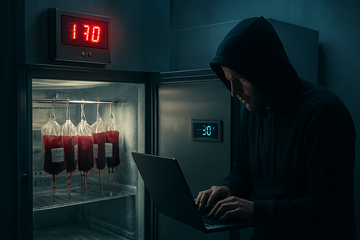
Hackers did not break into a hospital network in Europe this month. They went through the refrigeration contractor that keeps the freezers running, and they reprogrammed cold rooms holding blood products and plasma from minus 30 degrees Celsius toward 110. The blood service, France's national blood operation, confirms three sites were affected and that no blood products were lost, because alarm systems flagged the change and an on-call technician intervened.
That near miss is the most useful thing that has happened in this story, because it prices the risk precisely: cold-chain loss is a function of detection latency, not of attacker sophistication. Everything else follows from that arithmetic.
Blood service sites affected
3
EFS cold rooms at three French sites, incident of Nov. 2, 2026
Cold-room target temperature
110°C
Rooms normally held at minus 30°C; temperature and defrost thresholds raised to very high levels
Blood products lost
None
EFS incident statement, Nov. 3, 2026
Exposed refrigeration services
12,976
Across 6,017 public addresses in 99 countries; Forescout Vedere Labs, Oct. 22, 2026
Plasma delivered by EFS in 2025
922,605 litres
EFS 2025 activity report; 2,544,971 blood product bags delivered to health establishments
What actually happened
The Attack Surface Moved From Servers to Refrigerators
The path in was physical. A cyberattack hit the refrigeration contractor serving France's national blood service, and the supervision and control installations for cold rooms at three sites had their temperature and defrost thresholds pushed to very high levels. Rooms that normally sit at minus 30 degrees were programmed to climb toward 110, and what they held was blood products, plasma bags destined for transfusion and for medicine manufacturing, plus biobank samples.
EFS says it was not the intended target and that the route ran through a third-party refrigeration provider. The blood service's own monitoring and alarm systems identified the anomalies quickly, affected equipment was either brought under control or neutralised, and stored product was transferred to other sites preventively. The loss was zero because someone was watching the temperature, not because the equipment was secure.
- Oct. 11-12: About 350 French supermarkets lost refrigeration as Danfoss supervisory controllers were driven into defrost, units ran hot, and some stores reported fires. The Paris prosecutor's estimate of roughly 700 affected stores ran higher.
- Oct. 13: France's CERT-FR widened its advisory to Copeland and Dixell XWEB controllers, confirming the second vendor family named by the French agency.
- Nov. 1-2: The contractor serving the blood service was compromised through a third-party component in its remote-monitoring software, according to the contractor's own account. Cold rooms at three sites were reprogrammed.
- Nov. 2: The retail wave returned across seven European countries, with 40 stores hit in Belgium and Luxembourg and smaller numbers in Sweden, Ireland, the Netherlands, Estonia and Finland.
- Nov. 3: The UK's cyber security centre said an AI-powered ransomware attack on critical infrastructure is now highly likely within two years, describing the refrigerator attacks as the foothills.
- No group has claimed responsibility. Sophos analysts point to state signalling or a lone actor; Sentinel Labs calls Russian involvement one credible hypothesis and cautions against assuming a single campaign.
No health impacts have been identified and no losses of blood products have been reported.
The exposed fleet
Europe's Cold Chain Runs on 12,976 Internet-Reachable Refrigeration Services
Forescout's Vedere Labs counted 12,976 internet-exposed refrigeration service observations across 6,017 public addresses in 99 countries and territories, spread over ten product families. The concentration is extreme: Copeland and Dixell's XWEB supervisory platform accounts for 7,075 exposed services, Danfoss StoreView for 4,697, and no other vendor family exceeds 551.
Two weaknesses explain why no malware was needed. First, authentication: of 513 exposed Carel pCOWeb endpoints, only 287 returned an authorisation challenge at all. Second, stale firmware on hardware nobody can patch. An estimated 3,762 of the exposed Danfoss endpoints, 80% of that family, run firmware older than 4.3.1, the level that fixes the 2025 CVEs affecting the AK-SM 800A, and the AK-SM 800 itself has been end-of-life since May 2021.
Exposed refrigeration services by product family
12,976 internet-exposed refrigeration service observations across 6,017 public addresses in 99 countries and territories. Forescout Research (Vedere Labs), Oct. 22, 2026.
Unit: Exposed service observations
Copeland / Dixell XWEB
Named by CERT-FR as compromised in the French wave
7,075
Danfoss StoreView
AK-SM 800 end-of-life since May 2021
4,697
Copeland Site Supervisor
E3 firmware below 2.31F01 carries known flaws
551
Carel pCOWeb
Only 287 of 513 enforce authentication
513
Other six product groups
Long tail of smaller supervisory platforms
140
| Platform | Owner | Exposed services | Known weakness | Remedy available to the owner |
|---|---|---|---|---|
| Copeland / Dixell XWEB | Copeland, majority-owned by Blackstone since 2023 | 7,075 | 23 known vulnerabilities in XWEB Pro below firmware 1.13 | Replacement of a discontinued controller generation |
| Danfoss StoreView (AK-SM / AK-SC) | Danfoss, privately held | 4,697 | 2025 CVEs on the AK-SM 800A; AK-SC255-355 phased out in 2016 | Migration off end-of-life hardware |
| Copeland Site Supervisor / E3 | Copeland, majority-owned by Blackstone | 551 | Frostbyte10 vulnerabilities below E3 firmware 2.31F01 | Firmware upgrade or unit swap |
| Carel pCOWeb | Carel, privately held | 513 | 11 known vulnerabilities; 226 endpoints with no authentication enforced | Enforce authentication, segment remote access |
| Contractor remote monitoring layer | Coolworld and peers, privately held | Not disclosed | Third-party component compromise reached customer sites | Contractual controls, not product patches |
The attack surface is not exotic. Danfoss provided the supervisory system ICA uses in Sweden, some Co-op cabinets in France were reachable over 4G mobile networks, and Belgium's Sabcobel began patching cabinets after the October wave, which limited how far the damage spread. Meanwhile Forescout has tracked more than 20 claimed attacks on refrigeration systems since January, with one group claiming ten of them on a single day in April.
Forescout's researchers also flag the exposure explicitly for hospitals and pharmaceutical sites, not only for food retail. The vulnerable fleet is the same fleet that sits behind blood banks, vaccine stores and hospital pharmacy refrigerators, and nothing in the European attack waves was specific to supermarkets.
The coverage gap
Property Policies Exclude Cyber, and Cyber Policies Exclude the Cold
Nobody has priced this loss, because the insurance market is structured to exclude it from both directions. Lockton, the broker that placed specialist cover after the October attacks, notes that nearly all property policies exclude losses caused by cyber events, while conventional cyber policies typically exclude physical damage and the business interruption that follows. The spoiled stock falls between two policies that each assume the other has it.
The first claims evidence is already arriving. Intermarché, part of Les Mousquetaires, told AFP its insurance did not cover this type of incident, and Thierry Cotillard, the group's president, put the nationwide cost at tens of millions of euros. Coverage for cyber-caused spoilage exists, but it is a new product with thin capacity, not an extension of what policyholders already buy.
| Event | Who held the value | Who bore the loss | Cover status |
|---|---|---|---|
| French supermarkets, Oct. 11-12 | Retailers in roughly 350 stores | Retailers' own P&L | Intermarché says its policy did not respond; property cover excludes cyber-caused loss |
| European retail wave, Nov. 2 | 40 stores in Belgium and Luxembourg plus single-digit counts in five other countries | Retailers' own P&L | Property policies exclude the cyber causation; cyber policies exclude physical damage |
| French blood service, Nov. 2 | Blood products, plasma bags for transfusion and medicine making, biobank samples | No loss; EFS absorbed prevention and verification cost | Not applicable, because nothing was written off |
| Pharmaceutical distributor, illustrative loss | Stock that became non-certifiable after monitoring data was lost | Distributor's P&L | Canopius cyber spoilage policy now responds to this trigger |
| Cold-chain logistics, illustrative loss | Temperature-sensitive inventory after a control-system compromise and fire | Operator's P&L | Cyber property damage and spoilage cover available up to a £650m limit |
Regulators have started to close part of the gap, but only the reporting half. Since Sept. 11, 2026, manufacturers must report actively exploited vulnerabilities and severe incidents affecting products with digital elements: an early warning within 24 hours, a full notification within 72 hours, a final report within 14 days of a corrective measure for exploited vulnerabilities, and a final report within a month of the 72-hour notification for severe incidents, all filed through ENISA's single reporting platform.
What that does not do is make anyone fix anything. ENISA told The Record that reporting obligations continue to apply to end-of-life products still in use, while the duty to fix issues and issue free security updates applies only during the manufacturer's support period. Controllers placed on the market before December 2027 are therefore not required to be remediated, and the revised Product Liability Directive does not reach back to existing equipment. Europe now mandates disclosure of an exploit while leaving the unpatchable hardware in place, which converts a silent liability into a documented one without converting it into a controlled one.
Who carries the loss
The P&L Sits Where the Cold Inventory Sits
Losses land on the balance sheet that holds the most refrigerated product for the longest time, which is not the medical distributor. Distributors turn inventory in weeks: McKesson carried 23 days of inventory and Cardinal Health 26 days in their latest fiscal years, and both run gross margins near 4%, so a spoiled batch is a rounding error against revenue but a visible hit to operating profit.
Fractionators are the opposite. Grifols carried 259 days of inventory at a 4.9 times net leverage ratio, GC Biopharma 224 days at 6.0 times and a 26.9% gross margin, Takeda 231 days, and Shanghai RAAS 420 days of inventory against a 10.1% revenue decline in 2025. Between 224 and 420 days of plasma-derived product is a cold chain that no policy currently covers, and that is where an unpriced loss would land.
Days of inventory on hand, most recent fiscal year
Days of inventory computed from reported inventory and cost of sales in each company's latest annual filing. Distribution economics versus manufacturing economics in the cold chain.
Unit: Days of inventory
Shanghai RAAS
55 owned plasma collection centers across 11 provinces
420
Grifols
Europe's largest plasma collection network
259
Takeda
More than 20 plasma-derived brands
231
GC Biopharma
Net loss widened in 2025; ABO Plasma added in the US
224
Haemonetics
Blood center and plasma equipment plus blood bank software
189
Cardinal Health
Radiopharmaceutical network serves hospitals directly
26
McKesson
Plasma and Biologics specialty distribution
23
| Company | Listing | What it holds in the cold chain | Days of inventory | Gross margin | Net debt/EBITDA |
|---|---|---|---|---|---|
| McKesson | US (NYSE) | Plasma-derived products, biologics and specialty therapies to health systems and specialty pharmacies | 23 | 3.6% | 0.9x |
| Cardinal Health | US (NYSE) | 12 million patient-specific radiopharmaceutical doses a year from 130 nuclear pharmacies | 26 | 3.8% | 1.5x |
| Grifols | US ADR (Nasdaq) | Europe's largest plasma collection network plus fractionation capacity | 259 | 35.7% | 4.9x |
| Haemonetics | US (NYSE) | Blood center collection systems and the SafeTrace Tx blood bank information system | 189 | 55.7% | 3.6x |
| Takeda Pharmaceutical | Japan (Tokyo) | Plasma-derived therapies across more than 20 brands and owned collection sites | 231 | 51.1% | 3.2x |
| GC Biopharma | Korea (KOSPI) | Plasma fractionation products of ₩560.2bn in 2025 plus a new US collection network | 224 | 26.9% | 6.0x |
| Shanghai RAAS | China (Shenzhen) | 55 owned plasma donation centers across 11 provinces, six production bases | 420 | 36.6% | 1.4x |
- The EFS near miss was expensive in labour, not in product. The blood service absorbed the cost of verifying every cold room it owns, moving stock twice, and coordinating with France's national cyber agency and health ministry.
- Retailers paid the cash instead. French grocery losses ran to tens of millions of euros, and the insurers who wrote the policies declined to respond.
- The vendor response confirms the hardware problem. Copeland acknowledged the vulnerability sat in a discontinued, end-of-life generation of controllers, and Danfoss has been phasing product lines out since 2016, which means the exposed fleet cannot be fixed by an update, only replaced.
- Replacing a controller fleet is capital expenditure with a long tail. The exposed estate is roughly 13,000 supervisory services worldwide, each tied to a cabinet, a site and a service contract, and the replacement cycle lands on whoever owns the site.
For US investors the transmission is narrower than the headlines suggest and more specific. McKesson's Plasma and Biologics operation distributes plasma-derived products, biologics and specialty therapies to health systems and specialty pharmacies with 99.8% pack-out accuracy and next-day delivery across the country. Cardinal Health's nuclear pharmacy network dispenses 12 million patient-specific radiopharmaceutical doses a year, reaching 95% of hospitals within three hours, and plans to invest more than $150m over three years expanding its cyclotron network for PET products.
Those are the two listed operations where a refrigeration compromise converts directly into clinical supply failure rather than into a margin problem. A radiopharmaceutical dose cannot be replaced from a warehouse, and a delayed plasma shipment is a missed dose date, not a delayed box.
Upstream
No Listed Industrial Owns the Broken Controllers
The reason this has produced no earnings event anywhere is that the exposed control layer is not held by listed companies. Danfoss and Carel are privately held. Copeland, the owner of the XWEB platform behind 54% of all exposed services, was Emerson's Climate Technologies business until Blackstone funds took a majority stake in May 2023, and Emerson then sold its remaining 40% non-controlling interest to those funds for $1.5bn in August 2024, taking equity-method losses of $125m and $177m in the two prior years.
Refrigeration hardware itself sits in a similar gap. Thermo Fisher Scientific sells the Thermo Scientific TSB series of blood bank refrigerators built to AABB requirements, but the controller and supervisory layer inside or beside those cabinets is what was exploited. So the replacement cycle that this attack wave creates has no listed home, and the liability it creates sits with sponsors and private firms that do not publish the numbers.
- Blackstone now controls the largest exposed supervisory platform, 7,075 of 12,976 services, and that exposure travels with remediation cost inside a portfolio company rather than appearing as a product line in any listed issuer's accounts.
- Emerson Electric has already exited: it sold its last stake in Copeland for $1.5bn and booked equity-method losses while it held them, which is a clean illustration of how this exposure travels off balance sheet.
- Thermo Fisher Scientific is the listed supplier of AABB-grade blood bank refrigeration, and the replacement of compromised cold storage is a modest, durable demand stream against a $47.3bn revenue base.
- The contractor layer is where the November attack actually landed. Coolworld said the incident involved remote monitoring software and a component from a third-party supplier outside its direct control, which is a supply-chain design problem that no product patch can solve.
Downstream
Downstream, the Tightest Cold Chains Are the Least Insured
The downstream list is long and mostly private or public-sector, which is precisely why the loss is unowned. A national blood service, its contractor, a set of supermarket chains, a Dutch group that also runs Stop & Shop and Giant Food in the United States, UK food suppliers, hospital blood banks, and every plasma collection centre in Europe, Asia and the Americas all sit inside the same exposed controller estate.
Against that, the listed beneficiaries are the companies that sell proof and the companies that sell the new policy. Haemonetics sells the blood bank information system, SafeTrace Tx, that records which unit of product came from which donor, and it also sells the plasma collection platforms that generate the product. Chubb and peers write the emerging cyber property damage and spoilage class; Willis Towers Watson's cyber practice is already working the claim-wording questions raised by the French cases.
One more thing makes this a services story rather than a hardware story. The UK cyber security centre's assessment that an AI-powered ransomware strike on critical infrastructure is highly likely within two years means the controllers are the easiest entry point for the next wave. Detection and verification are the products that scale with the threat, because the hardware replacement cycle is finite and the attacker population is not.
Horizons
Two Quarters of Paperwork, Three Years of Hardware Replacement
- Next two quarters: mandatory reporting starts generating a public incident record. Early warnings at 24 hours and full notifications at 72 hours will name controller families, and the first filings will tell investors which platforms are actually being attacked.
- Next two quarters: insurers reprice. The 2027 renewal cycle for food, pharma and healthcare accounts is where cyber property damage and spoilage cover gets written, attached or declined, and Intermarché's and Les Mousquetaires' treatment sets the European reference point.
- Next two quarters: EFS and ANSSI complete their review of the contractor, and the French health ministry's conclusions will shape how other blood services audit their own refrigeration contractors.
- Next two quarters: US cold-chain operators get their first exposure. No US blood bank or hospital incident has been reported, but the same controller estate is installed in US hospitals and pharmacy freezers.
- One to three years: the end-of-life refresh. Controllers phased out in 2016 and 2021 are replaced rather than patched, which is a capital-expenditure cycle across thousands of sites, priced into no one's guidance.
- One to three years: the blood-bank audit standard hardens. Continuous monitoring and alarm capability become a procurement condition rather than a technical preference, following the AABB's 35th edition standards.
- One to three years: plasma supply security becomes a geopolitical input. Egypt and Indonesia approvals, collection-centre consolidation at Grifols and the new US network at GC Biopharma all widen the number of nodes where a compromised freezer can stop a medicine supply chain.
Falsifiers
What Would Break This Thesis
- If the contractor-supplied remote monitoring layer is quickly hardened through contractual access controls, the exposure is an implementation problem rather than a structural one, and the replacement cycle shrinks.
- If Europe's reporting obligations are read to cover remediation for end-of-life hardware after all, the gap closes faster and the timing of the replacement cycle moves forward.
- If blood services and plasma fractionators prove their monitoring and alarm layers are as good as EFS's, the loss function for the healthcare cold chain is smaller than for retail, and the insurance class stays narrow.
- If US hospital and pharmacy cold storage turns out to be segmented away from the internet by contract and by design, the US read-through largely disappears.
- If insurers write broad cyber property damage cover at prices that asset owners accept without changing behaviour, the cost of securing cold chain stays a line item rather than a capital programme.
Cold chain: who owns the loss, who sells the fix
- Plasma and Biologics distributes plasma-derived products and specialty therapies to US health systems with 99.8% pack-out accuracy and next-day delivery, so cold-chain assurance sits inside the service promise.
- Fiscal 2026 revenue of $403.4bn on a 3.6% gross margin leaves no cushion for spoilage, and the 13% Apollo stake in Medical-Surgical Solutions moves that P&L to a new owner.
- Its balance sheet is the strongest in the group, so McKesson can absorb a cold-chain loss that would wipe out a fractionator's quarter.
- Over one to three years, cold-chain security spending moves into the separated Medical-Surgical entity's cost base, not McKesson's.
- Nuclear and Precision Health dispenses 12 million patient-specific radiopharmaceutical doses a year from 130 nuclear pharmacies, reaching 95% of hospitals within three hours.
- Standard property and cyber policies exclude this loss from both sides, so an unrecoverable dose write-off lands in operating results with no insurance offset.
- Cardinal has no insurance market for time-critical radiopharmaceutical inventory with no substitute dose, the exposure the November attack demonstrated.
- Watch the 2027 property renewal cycle, where the first cyber-spoilage attachment rate on radiopharmacy cold chain prices the gap.
- Grifols is Europe's largest plasma collection network and expects US collection volume to grow even after closing 29 centers, which expands the number of cold-chain nodes it must defend.
- Fiscal 2025 revenue of €7,524m with €402m group profit and 4.9x net debt to EBITDA makes a single uninsured spoilage event material.
- Blood plasma scarcity lifts fractionation volumes, but plasma that thaws is plasma donors cannot quickly replace, so collection-site security is a supply asset, not an IT line item.
- Over one to three years, collection sites face the same audit and certification regime as blood banks, and 2027 is when that cost shows up.
- SafeTrace Tx and BloodTrack are the blood bank information systems that log chain of custody, and the verification budget released by incidents like this lands with the installed base.
- First-quarter fiscal 2027 revenue rose 5.6% to $339.4m, with Plasma up 7.2% and Blood Management Technologies up 8.6%, and full-year guidance was raised to 5-8%.
- Every blood service forced to re-verify what was in which freezer at what temperature needs a system of record to prove it, and Haemonetics sells that system.
- Over one to three years, chain-of-custody software becomes a procurement condition for plasma collection contracts rather than an optional module.
- Cyber property damage and spoilage is now a written class with up to £650m of capacity, and Chubb's commercial property and casualty business already includes cyber risk.
- Insurers that write the class early capture a market that did not exist before October, but the same controller family can hit many policyholders at once.
- Correlated aggregation is the unmodelled exposure: one compromised platform can trigger hundreds of simultaneously claimed spoilage losses.
- Over one to three years, pricing for physical loss from cyber will decide whether the class stays profitable.
- Fiscal 2025 sales of ₩1.99tn and operating profit of ₩69.1bn came with a widened net loss of ₩4.67bn and net debt to EBITDA of 6.0x, the thinnest cushion among plasma peers.
- The newly acquired ABO Plasma network adds US collection sites, and therefore cold-chain nodes, to a balance sheet with the least headroom in the group.
- A fractionator carrying 224 days of inventory at a 26.9% gross margin cannot self-insure a spoiled plasma lot, and no policy responds.
- Over one to three years, verification and certification spending is a cost line a loss-making operator cannot defer.
- The group operates 55 owned plasma collection centers across 11 provinces and six production bases, the largest owned cold-chain footprint among listed peers.
- Revenue fell 10.1% to ¥7.35bn in 2025 with net profit down about 28%, while inventory days stand at 420.
- ¥4.83bn of average inventory held in cold chain for 420 days means a single compromised freezer becomes a write-off no policy pays.
- Over one to three years, Haier integration brings capital for cold-chain hardening; until then the operating decline takes priority over security spend.
- The plasma-derived therapies portfolio spans more than 20 brands, and a new plasma donation center is expected to open in Indonesia in 2027, extending owned collection.
- Owning collection means owning the freezer: a compromised site removes plasma that cannot be sourced on demand.
- The balance sheet can absorb a single event, but recovery runs on donor visits rather than on inventory, so the clock is slow.
- Over one to three years, collection-center security standards in Japan are likely to follow the blood-bank rules being written now.