
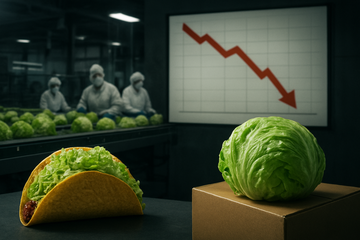
This was never a kitchen-hygiene event. It was a traceback event: the pathogen entered the food supply in central Mexico and moved through one supplier's iceberg lettuce into both restaurant kitchens and retail refrigerators across the country. The CDC's own food-safety alert warned that symptoms typically begin about a week after infection and can last a month or longer without treatment, which is why the case count kept climbing for weeks after the recall began.
The market read this as a traffic story. The structural read is about ownership. Yum! Brands absorbed the headline, Chipotle harvested a windfall, and an estimated $162 million of the loss landed on the franchise operators who own the restaurants.
Outbreak size
12,883
Illnesses across 21 states; CDC final count, Sept. 11, 2026
Hospitalizations and deaths
570 / 2
CDC final count, Sept. 11, 2026; last illness onset Aug. 17, 2026
Taco Bell U.S. same-store sales
-4%
Q3 2026, reported Nov. 3, 2026; down from +7% in Q2 2026
Lost restaurant sales
~$172M
4% of $4,292M Taco Bell division system sales, Q3 2026
Yum's revenue share of that loss
~$10M
$245M of franchise and property revenue on $4,292M of system sales
Franchisee system absorption
~$162M
Franchisees absorb roughly 17 times Yum's loss before any brand support arrives
Peak traffic decline
-31%
Daily traffic two days after July 15, 2026, against the Jan. 1–July 6 average
Fourth-quarter recovery
+3%
Taco Bell same-store sales, four weeks ended Oct. 30, 2026
Consumer / healthcare
One Grower, One SKU, 12,883 Cases — and No Proven Route
The CDC issued a health advisory on July 14, 2026: 1,645 confirmed domestically acquired cases since May 1, with more than 5,100 suspected. Three days later the agency's food-safety alert named shredded iceberg lettuce served at Taco Bell locations in Indiana, Kentucky, Michigan, Ohio and West Virginia, and the FDA's traceback converged on a single supplier — Taylor Farms de Mexico, whose recalled iceberg was distributed by Taylor Fresh Foods.
Taco Bell completed removal of the affected lettuce from its restaurants on July 17, the same day the recall began. The final count, published when the CDC declared the outbreak over on September 11, was 12,883 illnesses, 570 hospitalizations and two deaths across 21 states. Nationally, the CDC counted 20,996 confirmed cyclosporiasis cases in 2026 as of October 19 — roughly eighteen times the 1,180 reported the prior year.
- July 14, 2026: CDC health advisory on domestically acquired cyclosporiasis — 1,645 confirmed cases since May 1.
- July 16–17, 2026: CDC and FDA publish the food-safety alert; traceback converges on Taylor Farms de Mexico; the supplier begins a voluntary removal of all central-Mexico iceberg.
- July 17, 2026: Taco Bell completes removal of the affected lettuce from its restaurants; Sysco withdraws the same product and runs a voluntary recall.
- August 17, 2026: Last illness onset in the outbreak. Cases were still appearing more than a month after the recall.
- September 11, 2026: CDC declares the outbreak over at 12,883 illnesses, 570 hospitalizations and two deaths.
- October 2, 2026: FDA releases final sample results from its Mexico inspections and closes the investigation.
Consumer
The Bill Was Structured Before It Was Issued
Taco Bell is a brand of a company that does not own most of its restaurants. At December 31, 2025 the Taco Bell division counted 9,030 units, 93% of them franchised, inside a system of more than 61,000 franchised units operated by roughly 1,500 franchisees. That structure decides who absorbs a demand shock, and it did so with unusual clarity in the third quarter of 2026.
In that quarter, Taco Bell division system sales were $4,292 million and same-store sales fell 4%. Yum's franchise and property revenue for the division was $245 million — 5.7 cents of every sales dollar the brand generated. Apply the 4% decline and roughly $172 million of restaurant sales disappeared. Yum's share of that loss was about $10 million. The franchisee system absorbed the remaining $162 million.
| Who absorbs the loss | Position in the chain | What the outbreak cost | Primary document |
|---|---|---|---|
| Taco Bell franchisees | Own roughly 8,400 of about 9,000 units; run the stores, staff them, discount the menu and carry the suits | ≈$162M of lost sales and most of the store-level profit, before brand support | Yum! Brands FY2025 Form 10-K; third-quarter 2026 earnings release |
| Yum! Brands | Owns the brand, the advertising fund and the standards; books 5.7% of system sales | ≈$10M of revenue; named the July 2026 outbreak in its own forward-looking risk language | Third-quarter 2026 earnings release, Nov. 3, 2026 |
| Taylor Farms de Mexico | Grew and processed the recalled iceberg; distributed it through Taylor Fresh Foods | Recalled all central-Mexico iceberg, suspended Mexican sales and set a 2027 exit from the May–August window | FDA outbreak investigation page; The Wall Street Journal, Oct. 9, 2026 |
| Sysco | Largest U.S. foodservice distributor; moved the product into restaurant kitchens | Withdrew all Taylor Farms Mexican iceberg, then stopped buying Mexican iceberg entirely on Aug. 4 | Reuters, Aug. 4, 2026 |
| Walmart and Kroger | Sold the same grower-cropped lettuce under private-label brands in retail refrigerators | Multi-state pull of Marketside iceberg salad and shredded lettuce, plus an Aug. 19, 2026 notice covering Kroger's Dillons, Baker's and Gerbes banners | Taylor Farms recall notice; Kroger recall alerts |
Consumer
Four Points of Sales Erase a Third of Store Profit
Taco Bell U.S. same-store sales: the outbreak quarter and the recovery
The cyclospora shock hit the third quarter of 2026 and unwound within weeks.
Unit: %
Q2 2026
Reported in the Form 10-Q filed Aug. 5, 2026
7%
Q3 2026
Reported Nov. 3, 2026
-4%
Q4 2026 to date
As of the Nov. 3, 2026 results
1%
Four weeks ended Oct. 30, 2026
Outpacing the QSR industry
3%
Traffic is the visible number, and it was violent. Daily traffic fell more than 18% by July 15 and was down nearly 31% two days later against the January-to-July 6 average. Same-store sales were down 2% quarter-to-date through July 27 before closing the quarter at negative 4%.
The damage to profit was far larger than the damage to sales, because restaurant costs do not fall with a bad week. Yum's own Taco Bell U.S. company-owned restaurants ran a 20.5% restaurant margin in the quarter, and management guided store-level margins down to a 19%–21% range for the third quarter from roughly 26% in the second, against a 24%–25% full-year guide issued in February. The arithmetic is unforgiving: at a low-teens store margin, four points of sales removes roughly a third of store-level profit. That is why the franchisee, not the brand, felt this first and hardest.
- The franchisee funded the recovery: a $1 Enchirito on July 22 and a $1 Mexican Pizza on July 28, both priced at participating locations, with discounts landing on store-level gross profit.
- Taco Bell voluntarily pulled ingredients that could transmit the parasite, so the lost menu was wider than the one recalled SKU.
- Franchisees absorbed the write-offs, the extra labor for removal and remakes, and the customer service load, none of which appears in the corporate revenue line.
- Yum's Form 10-K flags exactly this asymmetry: the company is exposed to food-borne illness risk, relies on third-party suppliers and distributors, and carries risk from franchisee noncompliance with health and safety standards.
Supply chain
The Chain Is One Farm Deep — and It Is Not a One-Year Story
| Node | Link to the outbreak | What it did |
|---|---|---|
| Independent iceberg grower, central Mexico | Second positive environmental sample, from a drainage ditch on a farm operating as an independent grower for Taylor Farms | Unknown; FDA said it could not determine how contamination occurred |
| Taylor Farms de Mexico, Guanajuato | Supplier of the recalled iceberg; first positive environmental sample from the wastewater tank at its processing facility | Voluntary removal of all central-Mexico iceberg, July 17, 2026; suspended Mexican iceberg sales |
| Taylor Fresh Foods | Distributor whose recall notice covered both retail and foodservice product | Issued the recall covering27 states; withdrew the affected product from the U.S. market |
| Sysco | Largest U.S. foodservice distributor; withdrew all Taylor Farms Mexican iceberg in mid-July at the supplier's request and ran a voluntary recall | Stopped buying iceberg lettuce from Mexico and from Taylor Farms entirely by Aug. 4, 2026; shifted sourcing to U.S.-grown product |
| Taco Bell | Served the recalled lettuce at affected locations; completed removal from restaurants on July 17, 2026 | Ran $1 promotions on July 22 and July 28; recovered to plus 1% same-store sales by early fourth quarter |
| Walmart and Kroger | Sold the same crop under private labels; Marketside iceberg salad and shredded lettuce with best-by dates from July 18 to Aug. 3, 2026 were recalled | Pulled product across the retail footprint; Kroger's recall page logged an Aug. 19, 2026 notice for its Dillons, Baker's and Gerbes banners |
The distributor is where a crop becomes a supply chain. Sysco's chief executive said the company could not simply turn Mexican iceberg lettuce off overnight because of the size of the supplier it was replacing — a plain admission that one company, one origin and one SKU had been carrying a national menu item. It found replacement U.S.-grown volume only because the outbreak destroyed demand for lettuce. That is the cheapest possible outcome, and it was available by accident.
The concentration is also not new. The same supplier's onions were identified as the likely source of the 2024 E. coli outbreak linked to McDonald's Quarter Pounder, and the company recalled salad kits across 25 states in 2025 for undeclared ingredients. A grower that has now produced the largest recorded cyclosporiasis outbreak, a multi-state onion recall and a salad-kit recall in three years is not a bad-luck story.
Healthcare
Federal Traceability Enforcement Starts in 2028
The rule that would have mapped this chain is the FDA's Food Traceability Rule under FSMA Section 204. Its compliance date was set for January 20, 2026, then pushed out 30 months to July 20, 2028. Congress barred the FDA from using fiscal 2026 appropriations to implement or enforce it, and a coalition of consumer groups asked lawmakers in August 2026 to reverse the delay, pointing directly at this outbreak as the cost of the gap.
That is the enforcement hole. In a supply chain where the contamination entered at the field and the processor and moved through three intermediaries before reaching a plate, the ability to pull data back from a restaurant to a farm in hours is the entire defense. On July 20, 2026 the FDA also had to withdraw an earlier positive lettuce sample as a false positive. The agency opened and closed the largest food-safety investigation of the year on evidence it could not stand behind.
- FDA will publish an Outbreak Investigation Report on imported shredded iceberg lettuce before the 2027 growing season, and update the Cyclospora Prevention, Response and Research Action Plan.
- CDC and FDA are standardizing Cyclospora genotyping so traceback rests on one replicable method, and FDA will expand foreign supplier verification inspections.
- Mexico's Ministry of Agriculture, COFEPRIS and SENASICA will get training and laboratory capacity to test samples in-country instead of shipping them out.
- Expert panels will examine worker hygiene, water and wastewater monitoring — the exact conditions the two positive environmental samples pointed at.
- What is missing is the binding part: the 2027 and 2028 growing seasons run without mandatory traceability data for high-risk foods.
Liability
Liability Lands on the Name on the Door, Not the Farm in the Field
Food claims do not require proof of negligence. Under strict liability, which applies in most states, a plaintiff does not have to show the restaurant or supplier was careless — only that the food was defective when it entered commerce and that the defect caused the illness. Within days of the July 2026 alert, plaintiffs' firms had filed in federal court in Ohio against Taco Bell and unnamed suppliers, and in Ohio state court over a case in Youngstown.
The first federal filing named the franchise operating company that ran the restaurant where the plaintiff ate, not only the brand. That is the mechanism the franchise structure was designed for. The consumer's claim lands on the entity holding the restaurant licence; the operator's recourse is a claim up the supply chain, negotiated against a grower, a distributor and an indemnifying brand behind the franchise agreement.
- The brand carries the reputation and the headline; the operating company carries the complaint, the defence cost and the settlement cheque.
- Prior cyclospora claims were settled by one plaintiff's lawyer for between $25,000 and more than $1 million, depending on severity.
- A class has not been certified, so the exposure is still open-ended; the first consolidation decisions over the next two to three quarters set the settlement range.
- Where the brand funds the defence and the marketing response, it makes the restaurant operator a defendant before any fault is established.
Sales declines have moderated materially.
Horizons
The Comp Heals by Year-End; the Supply Risk Does Not
Over the next two quarters the demand story is largely done. Taco Bell's same-store sales were up about 1% quarter-to-date in the fourth quarter and up 3% in the four weeks ended October 30, with light and medium customers back to roughly 95% of prior levels and heavy users fully recovered. The third quarter's negative 4% sits in the base from February2027 onward.
What does not heal is the input. Iceberg lettuce was not expensive when the outbreak hit — it was collapsing. Average retail prices ran $2.012 a pound in June 2026, $1.753 in July and $1.471 in August, a 27% fall in two months. The franchisee's problem was never the cost of lettuce; it was the number of people willing to eat it.
Average retail price of iceberg lettuce, June–August 2026
Demand for lettuce collapsed faster than it had inflated: a 27% fall from June to August.
Unit: US$ per pound
June 2026
Bureau of Labor Statistics average price per pound
2
July 2026
Month of the recall and the peak traffic decline
1.8
August 2026
Last illness onset in the outbreak
1.5
- Next12 months: Yum's fourth-quarter and full-year prints, reported in February 2027, are the clean read on whether the -4% was an event or a trend; Walmart reports in November 2026 and Kroger in December 2026, the first retail prints with post-outbreak produce demand.
- Next 12 months: the same-store sales base gets progressively easier, but franchisee store-level profit has already reset lower, and unit growth of 3% to 9,102 Taco Bell units depends on that profit pool.
- One to three years: Taylor Farms' 2027 exit from Mexican iceberg between May 1 and August 31 shrinks the seasonal import supply for the exact window when demand peaks, which lifts input costs for every chain that puts lettuce on a menu.
- One to three years: with FSMA Section 204 enforcement barred until July 2028, the same one-farm concentration stays free to repeat, and the FDA's prevention plan remains a plan rather than a rule.
- What would break this thesis: a repeat outbreak is by no means certain, and if the franchisee systems have been financially supported by the brand rather than absorbing the loss alone, the $162 million figure overstates the burden. The size of any brand-level support has not been disclosed.
Investable conclusion
Who Felt It, Who Did Not, and What It Is Worth
| Company | Documented link to the outbreak | Latest reported operating metric |
|---|---|---|
| Yum! Brands | Taco Bell served the recalled lettuce; U.S. same-store sales -4% in Q3 2026 | Q3 2026 revenue $2,054M; adjusted EPS $1.56 against $1.49 expected |
| Chipotle | None — it sells no shredded iceberg lettuce and sources romaine and Supergreens outside Mexico | Q3 2026 comparable sales +2.1%; transactions +0.8%; restaurant margin 23.3% |
| Wendy's | None — the company said it was not affected by the outbreak | Q2 2026 revenue $571M; operating income $79M |
| Sysco | Withdrew all Taylor Farms Mexican iceberg; stopped buying Mexican iceberg entirely | Q1 FY2027 revenue $21,744M; operating margin 3.3% against 3.8% a year earlier |
| Walmart | Marketside iceberg salad and shredded lettuce recalled across the retail footprint | Q2 FY2027 revenue $187,937M; operating margin 5.0% against 3.7% a year earlier |
| Kroger | Recall notice logged Aug. 19, 2026 for its Dillons, Baker's and Gerbes banners | Q2 FY2026 revenue $34,621M; gross margin 22.7% |
The cleanest read from this outbreak is not about parasites. It is that operating structure determines who pays for a supply-chain failure. Chipotle, which owns its restaurants, sells no shredded iceberg lettuce and reported +2.1% comparable sales with positive transactions in the same quarter, captured the traffic shift in full. Yum! Brands, whose franchisees own 93% of Taco Bell, booked roughly $10 million of the roughly $172 million loss and ended up naming the outbreak in its own risk language.
Retail and distribution carried exposure without carrying cost. Sysco executed the recall and walked away from an entire origin; Walmart and Kroger pulled private-label product and saw no trace of it in their margins. The regulatory repair that would have made this chain legible — mandatory traceability — is unfunded until July 2028, and the largest supplier in the chain has already scheduled its own exit from the riskiest four months of the year.
Where the outbreak actually shows up in the numbers
- Franchise and property revenue of $245M on $4,292M of division system sales in Q3 2026 means Yum collects only 5.7 cents of every lost sales dollar.
- Taco Bell U.S. same-store sales were -4% in Q3 2026 but +1% quarter-to-date in the fourth quarter, so the demand shock is already reversing.
- With 93% of 9,030 units franchised and the outbreak named in Yum's own risk language, franchisee store health becomes the binding constraint on unit growth.
- Unresolved strict-liability suits naming franchise operating companies leave a liability tail that has not yet reached reported results.
- Comparable sales rose 2.1% with transactions up 0.8% in Q3 2026 while Taco Bell fell four points, so Chipotle keeps the traffic Taco Bell lost.
- It sells no shredded iceberg lettuce and sources romaine and Supergreens outside Mexico, so the recall never touched its menu.
- Company-operated stores keep all incremental margin rather than splitting it with a royalty, so the same traffic shift converts fully into operating profit.
- Restaurant-level margin slipped to 23.3% from 24.5%, so the volume upside still has to clear a cost problem.
- It withdrew all Taylor Farms Mexican iceberg in mid-July and stopped buying Mexican iceberg by Aug. 4, losing the origin it could not replace overnight.
- It found U.S.-grown supply only because lettuce demand collapsed, so the same event cut its replacement costs and shrank its category.
- Q1 FY2027 operating margin fell to 3.3% from 3.8%, though the company never tied the decline to the outbreak.
- With federal traceability enforcement barred until July 2028, single-origin concentration in a core SKU stays unmanaged.
- Its Marketside iceberg salad and shredded lettuce were recalled across the affected footprint, putting a private-label produce relationship on the record.
- Q2 FY2027 operating margin rose to 5.0% from 3.7%, so no produce-scare damage is visible in the retailer's numbers.
- Iceberg retail prices fell 27% from June to August 2026, and that deflation flows straight into a fresh-food gross margin.
- Q3 FY2027 results in November 2026 are the first full print with post-outbreak produce demand, making them the test of whether consumer fear outlasted the headlines.
- Its own recall page logged a Taylor Farms notice on Aug. 19, 2026 for the Dillons, Baker's and Gerbes banners, putting the grocer on the recall map.
- Q2 FY2026 revenue of $34.6B carried a 22.7% gross margin, so the direct financial cost of a produce recall is immaterial.
- Hannaford and Kroger stores also received recalled Taylor Farms product, widening the footprint beyond a single banner.
- Q3 FY2026 results in December 2026 are the first print after the recall, and they test whether fresh-food loyalty held.
- It said it was not affected by the outbreak while Taco Bell lost four points of same-store sales, leaving it with the insulated comp.
- That contrast shows the shock was supplier-specific rather than a sector-wide de-rating, and it caps read-through from Taco Bell to peers.
- Q2 2026 operating income of $79M on $571M of revenue leaves little cushion if a peer scare ever reaches its supply chain.
- The next comparable-sales print, due in November 2026, confirms or breaks the insulation claim.