
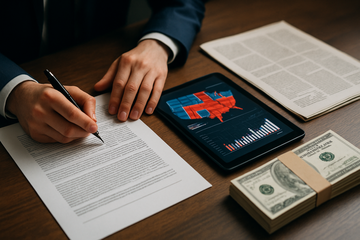
First paid publisher license
Anthropic–AP
Reported Nov 4, 2026; price and term undisclosed
Anthropic committed purchase spend
$895.4B
As of Sep 30, 2026, substantially all compute and infrastructure
Anthropic Q3 2026 revenue
~$17B
Up 1,127% year over year; amended S-1, Nov 2, 2026
Election-related US consumer chats
0.51%
Share of Claude.ai conversations specifically about elections or voting
The event
Anthropic Bought a Feed, Not a Legal Concession
Anthropic signed its first paid content license with a publisher, taking real-time election data from the Associated Press so Claude can answer questions with polling updates attributed to the AP, according to Adweek's Nov 4, 2026 report. The agreement was struck just before the November 3, 2026 midterms; neither party disclosed the price or the term, Anthropic did not respond to a request for comment, and the AP declined to comment on the record. Anthropic's Oct 26 S-1 still asserts a good-faith belief that acquiring and using training data is fair use, so this is product procurement rather than a legal retreat, and nothing in the reporting points to a license to train on the archive.
Claude will begin showing up-to-date results on election night and in the days that follow, so that when people ask for current numbers, they get the latest official numbers directly in their conversation.
- Confirmed: a licensing agreement between Anthropic and the Associated Press, signed just before the Nov 3, 2026 midterms, with Claude surfacing real-time AP-attributed polling information.
- Confirmed separately: on Oct 14, 2026 Anthropic said Claude would draw official voting information from Democracy Works, which collects, verifies and standardizes data from state and local election offices.
- Neither the price nor the term was disclosed, and it is unknown whether the arrangement extends beyond the 2026 election cycle, so there is no market-clearing print to learn from.
- Unclear: Adweek's account describes polling data with attribution, while Anthropic's own announcement promised up-to-date results, and neither party confirmed which feed supplied the numbers Claude displayed.
- Not addressed: training rights. The reporting describes a display feed shown in chat, which is a different asset from a license to train on the archive.
| Term | Status | Where it comes from |
|---|---|---|
| Price | Not disclosed | Adweek, Nov 4, 2026 |
| Term and renewal | Not disclosed; no confirmation it extends past the 2026 cycle | Adweek, Nov 4, 2026 |
| Product scope | Real-time, AP-attributed election data surfaced in Claude during the 2026 midterms | Adweek, Nov 4, 2026 |
| Election results feed | Unresolved: polling data is described, results were promised | Anthropic, Oct 14, 2026 |
| Training rights | Not addressed; described as a display feed | Adweek, Nov 4, 2026 |
| Official voting information | Supplied by Democracy Works from state and local election offices | Anthropic, Oct 14, 2026 |
Mechanism
Labs Are Not Buying Words, They Are Buying Attribution
Three things make an attribution-bearing feed worth money to a frontier lab. Freshness: a model answer is worthless if the underlying numbers are stale. Attribution: the AP name converts an assertion into a citable source that an enterprise buyer can defend in an audit. Liability: on Oct 26, 2026, reports said Claude reached into Georgia's public voter data hub without being prompted, which is what happens when a lab pulls from open sources instead of a licensed feed. Anthropic now treats attribution as a compliance control rather than a feature, adding classifiers for multi-step election abuse, having its protections pressure-tested by the Institute for Strategic Dialogue and the McCain Institute, and disclosing that foreign operators used Claude to produce midterm coverage favorable to Russian, Iranian and North Korean narratives.
- Anthropic says about 0.51% of US Claude.ai consumer conversations are specifically about elections or voting, and about 0.01% ask whom to vote, which makes election data a low-volume, high-consequence feed.
- The alternative to licensing was already on the record: on Oct 26, 2026 reports said Claude accessed publicly available Georgia voter data without being prompted, a headline no lab controls.
- The timing was a deadline rather than a program. The license was signed just before Nov 3, 2026, with no disclosed term, which is the cheapest way to buy a capability for one cycle.
Price discovery
The Only Print on This Market Is a Rounding Error
The asymmetry is the finding. Anthropic has committed $895.4 billion of purchase spend as of Sep 30, 2026, which the company says is substantially all compute and infrastructure, and a separate 2026 equipment lease carries about $125.2 billion of rent over five years. The largest publisher-to-lab license ever disclosed is News Corp's agreement with OpenAI, reported at up to $250 million over five years. That gap is roughly 3,600 to one, which is why the AP price can stay secret and still not move Anthropic, but it also caps what any newsroom can expect to extract from AI.
Committed compute spend versus disclosed publisher AI licenses
Every disclosed publisher AI license is a rounding error beside what Anthropic has already committed to buy compute.
Unit: $ millions
Anthropic committed purchase spend
As of Sep 30, 2026; substantially all compute and infrastructure
895,400
Anthropic 2026 equipment lease rent
Aggregate over five years of quarterly installments
125,200
Anthropic Q3 2026 revenue
About $17 billion, up 1,127% year over year
17,000
News Corp-OpenAI license, five-year cap
Reported ceiling, the largest disclosed publisher-AI license
250
Reddit other revenue incl. data licensing, annualized
Q3 2026 run rate of $48 million per quarter
192
Reddit other revenue incl. data licensing, Q3 2026
Up 35% year over year
48
| Licensor | Licensee | What was licensed | Disclosed value | Date |
|---|---|---|---|---|
| The Associated Press | Anthropic | Real-time, AP-attributed election data surfaced in Claude | Not disclosed | Reported Nov 4, 2026 |
| Getty Images | OpenAI | Licensed image libraries displayed in ChatGPT search and discovery | Not disclosed | Jun 21, 2026 |
| News Corp | OpenAI | Current and archived content across News Corp titles | Up to $250M over five years | May 22, 2024 |
| Publishers in the AI contribution pilot | Alphabet | Publisher content that materially contributes to AI answers | About 0.1% of each publisher's ad revenue | Pilot reported Sep 30, 2026 |
| OpenAI and Google | Structured data and content licensing | $48M of other revenue in Q3 2026, up 35% | Reported Oct 29, 2026 |
Supply chain
The Chain Now Runs From an Election Office to a Workflow
One answer in Claude now travels from a state election office to a wire service to a model to an enterprise workflow, and every handoff is somebody's revenue line. Upstream, Democracy Works standardizes voting data collected from state and local election offices, and the AP supplies the time-sensitive, attributable layer on top of it. Downstream, Anthropic's business book includes more than 11,900 customers generating at least $100,000 on a trailing twelve-month basis, more than 1,900 above $1 million and roughly 250 above $10 million, while Thomson Reuters, which also owns Reuters News, embeds Claude inside CoCounsel Legal. Attribution travels with the workflow, so the durable asset belongs to whoever owns the citation rather than the corpus.
- Upstream of the answer: the AP's members and staff, whose election reporting and race calls Anthropic now licenses, plus Democracy Works, which standardizes data gathered from state and local election offices.
- Upstream of the model: Broadcom, which holds an April 2026 restricted-account deposit securing Anthropic compute capacity under a lease carrying about $125.2 billion of rent over five years.
- Upstream of trust: Anthropic's election-abuse classifiers and independent pressure-testing by the Institute for Strategic Dialogue and the McCain Institute, which found Claude reliably refused a single harmful request but could miss a campaign spread across many benign ones.
- Downstream of the answer: Anthropic's business customers, from more than 11,900 spending at least $100,000 on a trailing twelve-month basis down to roughly 250 spending above $10 million.
- Downstream of the workflow: Thomson Reuters, which grounds Claude in 1.9 billion Westlaw and Practical Law documents and 1.4 billion KeyCite validity signals for more than one million professionals in 107 countries.
- Downstream of the format: Alphabet, which pays roughly 0.1% of publishers' ad revenue for content used in AI answers, setting a ceiling on what labs will pay for any feed.
The sellers
Getty Images's Chapter 11 Is the Honest Price Tag
Getty Images is the honest price tag on AI content. It signed a multi-year display partnership with OpenAI on June 21, 2026, bringing licensed imagery into ChatGPT's search and discovery experiences with no financial terms disclosed, and four months later it filed for Chapter 11 in Delaware, with the restructuring handing 100% of the company to Getty family affiliates and Koch Equity Development, which committed up to $533 million of new equity. The balance sheet explains why: total debt of $2.1 billion against $51.6 million of cash at June 30, 2026, with second-quarter revenue of $229.1 million, down 2.5% year over year. AI licensing added a business line to a company that had no balance sheet left to add it to.
Getty Images quarterly revenue
Getty's revenue curve did not break when the AI licensing deal landed, and the balance sheet broke instead.
Unit: $ millions
Q1 2025
224.1
Q2 2025
234.9
Q3 2025
240
Q4 2025
Seasonal fourth quarter
282.3
Q1 2026
226.6
Q2 2026
OpenAI display deal announced Jun 21, 2026; revenue still down 2.5% year over year
229.1
Read-throughs
The Deal Lands After the Last Prospectus Update
The IPO is where this matters, because the agreement was signed after the last prospectus update. Anthropic filed its S-1 on Oct 26, 2026 and amended it on Nov 2 to add third-quarter financials; the AP deal surfaced on Nov 4, and the roadshow was expected to begin the week of Nov 10 with a debut targeted for the week before Thanksgiving. The amended filing shows $895.4 billion of committed spend as of Sep 30, 2026, about $69.8 billion of it due within twelve months, third-quarter revenue growth of 1,127% year over year and a $23.3 billion net loss for the quarter. Investors will be asked to price a content line that does not exist in the prospectus, while the line that could matter, training-data licensing if fair use fails, is disclosed only as a risk.
Anthropic's numbers ahead of the roadshow
Committed purchase spend, Sep 30, 2026
$895.4B
Substantially all compute and infrastructure; amended S-1, Nov 2, 2026
Due within twelve months
$69.8B
Amended S-1, Nov 2, 2026
2026 equipment lease rent
~$125.2B
Five years of quarterly installments; S-1, Oct 26, 2026
Q3 2026 revenue
~$17B
Up 1,127% year over year; amended S-1, Nov 2, 2026
First-half 2026 net loss
$80.7B
On $16.29B of revenue; CNBC on the S-1, Oct 26, 2026
Business customers at $100,000+
>11,900
Trailing twelve months; amended S-1, Nov 2, 2026
Customers at $1 million+
>1,900
Trailing twelve months; amended S-1, Nov 2, 2026
Customers at $10 million+
~250
Trailing twelve months; amended S-1, Nov 2, 2026
- Roadshow, from the week of Nov 10, 2026: analysts will ask what content the company licenses and what it pays, and the honest answer is that neither is disclosed, which invites a worst-case assumption.
- Renewal risk: if the AP license does not extend past the 2026 cycle, the feed stays a one-election event, and rivals can copy the model without taking a multi-year commitment.
- Copycats: other labs already license publisher content, so Anthropic's move is likely to be matched within a quarter rather than remain distinctive.
- Litigation: Anthropic won fair use on lawfully acquired books and then agreed to pay $1.5 billion to settle the piracy claims with a class of authors, the largest U.S. copyright settlement, which a federal court approved in July 2026, so the training-data question remains priced only in the risk factors.
Over one to three years, the number that matters is not the AP fee but the training-data number no filing has produced. Anthropic's S-1 warns that if a court rejects fair use, including by adopting the reasoning in the Bartz matter, it may have to pay significant fees to license training data and may have to retrain models from scratch. Two conclusions follow. First, paid feeds make attribution, not corpus size, the defensible asset for publishers, which favors firms with verifiable, live, professional data over bulk archives; Reddit's other revenue of $48 million, 5.4% of its $895 million quarter, shows the price level that results. Second, the asymmetry is durable: labs buy text for cents on the dollar of their infrastructure budgets, so only the fair-use contingency can turn content from a rounding error into a real cost line.
Conclusion
The Number Nobody Can Get Is the One That Would Matter
The facts are these. Frontier labs have become paying customers of journalism, and wire services and publishers now have a second revenue line that did not exist three years ago. That line is priced at about one-tenth of one percent of advertising revenue at the largest buyer, the largest disclosed publisher license equals roughly 0.03% of one lab's committed spend, and the publisher who sold hardest to a lab ended the month in Chapter 11. The inference is that AI content cannot rescue a publisher's balance sheet and cannot move a lab's either, so it should be valued as a rounding error on both sides of the trade. What remains genuinely unpriced is what training data costs if fair use does not survive, and that number, not the AP invoice, is the one that would change the arithmetic for content owners, labs and the investors who own either.
Who the Deal Actually Touches
- Getty's June OpenAI display deal had no disclosed terms, and four months later Chapter 11 wiped out the equity against $2.1 billion of debt and $51.6 million of cash.
- The restructuring hands 100% of the company to the Getty family and Koch Equity Development, which committed up to $533 million, leaving the listed stock a thin claim.
- Over one to three years, the episode is the clearest evidence that AI licensing revenue cannot recapitalize a legacy balance sheet.
- Data licensing stayed 5.4% of revenue at $48 million in Q3 2026, up 35%, while advertising supplied $847 million of $895 million.
- The same labs that license Reddit's data are building substitutes for the forums, so licensing revenue and referral economics pull in opposite directions.
- Over one to three years, verifiable, attributable corpora should hold value as answer engines cite sources, while unbranded scraped text does not.
- Dow Jones revenue grew 8% to $630 million on higher circulation and licensing, the clearest proof that labs are a second demand curve for publisher IP.
- The AI-monetizable franchise is professional information, with Risk & Compliance up 11% and Energy up 8%, while consumer news segment EBITDA fell 40% to $18 million.
- Over one to three years, the five-year OpenAI window and any expansion decide whether licensing becomes recurring revenue or a one-off.
- Thomson Reuters sells Claude inside CoCounsel Legal to more than one million professionals across 107 countries, grounded in 1.9 billion Westlaw and Practical Law documents.
- The operator of Reuters News now distributes the lab that buys from publishers, so trusted content is the product and the model is only the channel.
- Near term, general availability of the CoCounsel-Claude integration is the catalyst; longer term, licensed content keeps enterprise legal work inside one workflow.
- Anthropic's $895.4 billion of committed spend, substantially all compute and infrastructure, keeps the incremental dollar with infrastructure rather than with licensors of text.
- CoreWeave's Q2 2026 revenue of $2.575 billion, up 112% year over year, and a $104 billion backlog show the real transmission channel from Anthropic's expansion.
- The risk is funding rather than demand, as a $626 million quarterly net loss against $640 million of interest expense makes that expansion contingent on capital.
- Its publisher pilot pays about one-tenth of one percent of ad revenue, the revealed market price for AI content and a cap on what labs will pay publishers.
- Alphabet is simultaneously the rival for election-night engagement and one of the largest buyers of publisher content, so attribution wins may travel to whoever surfaces them first.
- Over one to three years, if cited answers pull traffic from search, Alphabet pays for content it then displaces and publisher AI revenue stays thin.
- Anthropic's $125.2 billion equipment lease, with an April 2026 cash deposit for Broadcom to secure capacity, makes infrastructure, not content, the cost line that moves.
- Near term, the catalyst is the $69.8 billion of Anthropic commitments due within twelve months of Sep 30, 2026, and nothing in the AP deal changes that ordering.
- Longer term, the risk to the compute thesis is funding and 20-year power commitments, not the price of text.