
The Event
600,000 Chips, One Missing Signature
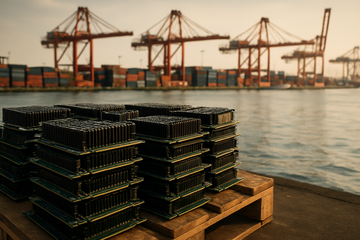
On Nov 5, 2026, Reuters reported that roughly 600,000 Nvidia AI chips — reported as H200 units — are stored in Hong Kong, awaiting mainland import approval that Beijing has not granted. These are not unshipped orders: the parts were built, licensed for export by Washington and physically delivered to Hong Kong. What they are missing is a Chinese customs signature. Some chips have cleared in recent months, with major Chinese internet firms each receiving about 10,000 H200s, and total approvals reportedly may fall below 200,000 units.
- The stock itself: about600,000 Nvidia chips are stored in Hong Kong awaiting mainland import approval, according to Reuters on Nov 5, 2026.
- The price tag: at the roughly $27,000 per-chip level Reuters reported in January 2026, the queue is worth about$16.2 billion of hardware.
- The street price: an eight-card H200 server was offered for more than 6 million yuan (about $900,000) in mainland China by end-October 2026, about three times its price a year earlier.
- The rule change: Beijing told officials the H200 is 'not permitted', told domestic firms not to buy without necessity, and pushed inference workloads toward Chinese processors.
- What remains undisclosed: who owns the Hong Kong inventory, how much of it Nvidia still carries on its own books, and whether Beijing will set a quota at all.
Chips parked in Hong Kong
~600,000
Reuters report, Nov 5, 2026
Queue value at official China pricing
~$16.2B
600,000 units at about $27,000 each
Queue value at mainland street quotes
~$67.5B
Implied by a 6 million yuan eight-card server offer
Hopper shipments to China
<1%
Of $89.0B Data Center revenue, Q2 FY2027
China data-center compute in guidance
None
Q3 FY2027 outlook, Aug 26, 2026
Nvidia's China data-center AI chip share
34%
First half of 2026, IDC data
| Line item | Figure | Source and date |
|---|---|---|
| Chips stored in Hong Kong | About 600,000 | Reuters, Nov 5, 2026 |
| Official China chip price reported for H200 | About $27,000 each | Reuters, Jan 14, 2026 |
| Mainland offer for an eight-card H200 server | More than 6 million yuan (about $900,000), roughly 3x a year earlier | Reuters, Nov 5, 2026 |
| Mainland offer for a server using Blackwell | More than 20 million yuan apiece | Reuters, Nov 5, 2026 |
| H200 units cleared into China recently | About 10,000 per major Chinese internet firm | Reuters, Nov 5, 2026 |
| Total approvals possibly granted | Fewer than 200,000 chips | The Information via Reuters, Jul 8, 2026 |
| H200 units ordered by Chinese firms in early 2026 | More than 2 million at about $27,000 each | Reuters, Jan 14, 2026 |
Mechanism
Two Gates, and Only One of Them Is in Washington
Washington opened the door in January 2026 and priced it. The Commerce Department moved the H200 and AMD's MI325X from presumption of denial to case-by-case licence review, conditioned on independent third-party testing in the United States, purchaser export-compliance procedures, and no loss of capacity for U.S. customers. Beijing then closed the door on the other side: customs agents were told the H200 was not permitted to enter, and officials told domestic firms not to buy unless necessary. Both conditions must hold, so the binding constraint is now the one Beijing controls.
| Date | Gate | Holder | Outcome |
|---|---|---|---|
| Jan 13-15, 2026 | Export licensing for H200 and MI325X | U.S. Commerce | Case-by-case review allowed, conditional on third-party U.S. testing |
| Jan 14, 2026 | Import into mainland China | Chinese customs | H200 'not permitted'; domestic firms told to hold off |
| Jan 16, 2026 | Component output | Nvidia supply chain | Parts suppliers paused H200 production to avoid write-offs |
| Mar 5, 2026 | Wafer allocation | Nvidia and TSMC | China-bound H200 output halted, capacity refocused |
| Mar 18, 2026 | Import approval | Beijing | H200 sales approved in principle; manufacturing restarted |
| May 14, 2026 | Import approval | Beijing | About 10 firms cleared for 75,000 chips each; no deliveries yet |
| Jul 8, 2026 | Import approval | Beijing | Approvals possibly under 200,000 chips; inference steered to local chips |
| Oct 20, 2026 | Compliant alternative supply | Nvidia | Over 3 million RTX PRO 5500 ordered; fill rates of 5% to 10% |
| Nov 5, 2026 | Physical inventory | Hong Kong | About 600,000 chips awaiting mainland approval |
- The sequence matters more than any single decision: US approval in January, then a customs block days later, then a partial Beijing nod in March, then a cap in July — so the flow has been throttled by one signature ever since.
- Every approval since March has been a trickle rather than a policy: about 10 firms cleared for 75,000 chips each in May, with not one delivery made as of that date.
- Nvidia's own response was to move the goalposts rather than the chips: a lower-ASP, export-compliant workstation card became the sanctioned route, shifting Chinese demand one tier down the product ladder.
Pricing
The Same Card, Two Prices, and a $51 Billion Wedge
The clearest read on how tight Chinese compute has become is the gap between what the chips officially cost and what buyers in China are being asked to pay. Reuters put the official China price of an H200 at about $27,000 in January 2026. By the end of October, an eight-card H200 server was on offer in mainland China for more than 6 million yuan, about $900,000, and servers running Blackwell — which Chinese buyers cannot legally be sold at all — were quoted above 20 million yuan each.
| Price reference | Level | Per H200 card | Date |
|---|---|---|---|
| Official China contract price reported by Reuters | About $27,000 per chip | About $27,000 | Jan 2026 |
| Mainland resale offer, eight-card server above 6 million yuan | About $900,000 per server | About $112,500 | End-Oct 2026 |
| Mainland resale offer, server using Blackwell | Above 20 million yuan per server | Not comparable, no lawful channel | End-Oct 2026 |
| Sanctioned compliant alternative, RTX PRO 5500 sticker | About $11,400 per card | Workstation class, not a datacenter part | Oct 2026 |
The same H200 card, two prices
Official China contract price versus the implied per-card value of a mainland resale offer, from figures Reuters reported in January and November 2026.
Unit: US$ per H200 card
Official China price, Jan 2026
Reuters, Jan 14, 2026
27,000
Implied by mainland eight-card server offer, end-Oct 2026
About $900,000 for eight cards
112,500
Multiply that spread across 600,000 chips and the prize Beijing now holds is about $51 billion — the difference between what the official price implies and what the street is quoting. This is an arithmetic illustration of scarcity value, not a realizable gain: the resale market for 600,000 cards at those prices does not exist, and Reuters describes offers, not completed transactions. What the arithmetic does show is scale. A decision worth tens of billions of dollars to Chinese buyers is now being made by ministries that declined to comment.
Fundamentals
Nvidia's Own Filings Already Assume China Is Gone
The striking detail in Nvidia's own disclosures is that the stranded queue barely registers. In the Form 10-Q for the quarter ended July 26, 2026, the company booked a $0.4 billion charge tied to H200 excess inventory and purchase obligations as demand diminished, and recorded $985 million of inventory and excess purchase-obligation provisions in the quarter ($2.1 billion across the first half). Its CFO commentary for the same quarter states that Hopper shipments to China were under 1% of Data Center revenue, and that the Q3 FY2027 outlook of $108.0 billion assumes no China data-center compute revenue at all.
| Disclosure | Figure | Document |
|---|---|---|
| H200 charge for excess inventory and purchase obligations | $0.4B | Form 10-Q, Q2 FY2027 |
| Inventory and excess purchase-obligation provisions | $985M in the quarter; $2.1B in the half | Form 10-Q, Q2 FY2027 |
| Hopper shipments to China | Under 1% of Data Center revenue (under roughly $890M on $89.0B) | CFO commentary, Aug 26, 2026 |
| China data-center compute assumed in guidance | None | CFO commentary, Aug 26, 2026 |
| Tariff on licensed H200 shipments | 25% on U.S. importation; not passed on to customers | Form 10-Q, Q2 FY2027 |
| China plus Hong Kong revenue | $7.88B in Q2 FY2027 against $3.99B; $12.43B in the half against $13.64B | Form 10-Q, Q2 FY2027 |
| Inventory balance | $31.6B at July 26, 2026, up from $25.8B | CFO commentary, Aug 26, 2026 |
- The downside is already in the numbers: with the $0.4 billion H200 charge taken and no China compute in guidance, the queue cannot break the near-term print.
- The tariff is a second, quieter drag: licensed H200s are inspected in the United States and take a 25% duty that Nvidia says it cannot pass to customers, so roughly $6,750 of each $27,000 chip is absorbed rather than collected.
- China revenue is no longer the same business: China plus Hong Kong was $7.88 billion, or 8.2% of quarterly revenue, yet Hopper was under 1% of Data Center revenue — what now clears Beijing is not the flagship.
- A reopening is upside, not downside: any batch approval above the roughly 200,000-chip ceiling converts about $16.2 billion of parked hardware into shipments at the official price.
Supply Chain
Upstream Was Paid Either Way
The clearest test of whether this is a demand event or a policy event is what happened to the companies that make the parts. Nothing. Nvidia halted China-bound H200 output in March and refocused the TSMC capacity elsewhere; TSMC's fourth-quarter guidance went up, not down. And the HBM sitting inside the stranded cards was bought and paid for before the queue existed — a customs pause delays a delivery, it does not cancel a wafer or a memory stack.
| Company | Latest reported numbers | Read-through |
|---|---|---|
| TSMC | Q3 2026 revenue $46.72B, up 41.2% year over year; gross margin 66.4%; Q4 guide $52.3B-$54.3B | China-bound H200 capacity was refocused, not written off; the foundry's constraint is allocation and U.S. licensing, not Beijing |
| SK hynix | 3Q26 revenue KRW 104.6T; operating profit KRW 83.3T, an 80% margin; shortages projected through 2030; long-term agreements cover more than half of 2027-28 capacity | HBM for the parked cards was sold and paid for; memory scarcity, not Chinese approval, sets the ceiling on global AI compute |
| Micron Technology | Fiscal Q4 2026 revenue $54.23B; GAAP net income $37.7B | Second HBM supplier; the binding limits are wafer and packaging capacity, not customs |
- Refocused, not lost: Nvidia moved TSMC capacity away from China-bound H200 in March 2026, and TSMC's fourth-quarter guide still rose to $52.3-$54.3 billion, with gross margin at 66.4% in the September quarter.
- The memory is sunk cost, not pipeline: SK hynix has shortages projected through 2030 and long-term agreements on more than half of 2027-28 capacity, so a stalled card is a deferred 2027 delivery rather than a cancelled one.
- Upstream risk runs through Washington, not Beijing: U.S. licensing and packaging capacity are what TSMC and the memory suppliers actually face, which is why their guidance improved through the blockade.
Demand
The Buyers at the End of the Rope Are Chinese
Demand is the part that is clearly intact. ByteDance, Alibaba and Tencent together ordered more than 3 million RTX PRO 5500 workstation GPUs at a combined sticker price above $35 billion, and Chinese orders in total exceed 6 million cards. What changed is supply and price. Nvidia told partners they might receive only 5% to 10% of the quantities requested, and said it could produce no more than roughly 3 million of those cards globally in 2027. The approved alternative is rationed, and the unapproved original is quoting multiples of list.
| Buyer | Demand evidence | Constraint |
|---|---|---|
| Alibaba Group | June-quarter capital expenditure RMB 67.7B, up 75% year over year, against a RMB 380B three-year AI plan; AI cloud revenue RMB 48.4B, up 45% | Net income down about 75% to RMB 8.9B; trailing free cash flow negative RMB 77.5B |
| Tencent Holdings | Q2 2026 capital expenditure RMB 52.8B, up 176% year over year, on revenue of RMB 204.8B | Net cash RMB 58.2B, down 22% year over year; allocation capped at 5% to 10% of orders |
| ByteDance and other AI firms | More than 3 million RTX PRO 5500 cards ordered alongside Alibaba and Tencent, above $35B at sticker | Roughly 3 million cards of global 2027 supply against more than 6 million ordered |
| Chinese AI labs broadly | About 10,000 H200s each received recently; fewer than 200,000 chips possibly approved in total | Mainland resale at about four times official pricing; Blackwell without a lawful channel |
- The order book is real and enormous: more than 3 million cards and over $35 billion at sticker from three buyers alone, so the constraint is allocation and permission, not appetite.
- The squeeze shows up in two prices at once: fill rates of 5% to 10% on approved cards, and roughlyfour times the official chip price for anything that moves in the mainland market.
- The spending response is already visible in the numbers: Alibaba's capex rose 75% year over year and Tencent's 176%, with both reporting deteriorating profit and cash conversion.
- A national investment plan is the demand anchor: roughly 2 trillion yuan of planned data-center buildout over five years, which is why compute scarcity translates into scarcity rent rather than cancelled orders.
Substitution
The Symptom Is the Queue; the Disease Is Substitution
IDC's first-half 2026 shipment data show where the blocked demand is going. Nvidia shipped 678,000 AI accelerators into China, down 44% year over year, while Huawei shipped 572,000, up from more than 300,000. GPU shipments across China fell 26% to 991,000 units, but non-GPU accelerators rose nearly 80% to 1.016 million. Beijing is not banning compute; it is re-routing it. Bernstein, cited by TrendForce, sees Chinese firms lifting domestic silicon from 30% to 46% of accelerator budgets over the next twelve months and Nvidia's share of China's high-end AI chip market falling to about 8% in 2026 from roughly 40% in 2025.
China AI accelerator shipments, first half of 2026
Thousands of units shipped in China, per IDC data cited in October 2026 reporting. Non-GPU designs now outnumber GPU designs in the market.
Unit: thousand units, H1 2026
All GPU accelerators shipped in China
Down 26% year over year
991
All non-GPU accelerators shipped in China
Up nearly 80% year over year
1,016
Nvidia accelerators shipped to China
Down 44% year over year, 34% share
678
Huawei accelerators shipped to China
Up from more than 300,000, 28% share
572
- The landing point for displaced demand is domestic: Cambricon Technologies revenue rose 104% year over year to RMB 3.53 billion in the September quarter, with nine-month revenue of RMB 9.53 billion and net profit of RMB 1.40 billion, up about 148%.
- Policy, not preference, is doing the work: Beijing told major firms to prioritise Chinese processors for inference, and domestic silicon is set to take 46% of budgets, which is the mechanism that turns a customs pause into permanent share loss.
- Huawei has said it has already overtaken Nvidia in China, and the non-GPU segment in China is consolidating around Huawei, Alibaba's T-Head, Kunlunxin and Cambricon, which together held 95% of it in the first half.
- The substitute is not self-funding yet: Cambricon's trailing operating cash flow is negative RMB 202 million while it builds capacity, so the winner's balance sheet is still being financed by someone else.
Horizons
Two Horizons, One Binary Gate
The next quarter is about a single number — how many chips Beijing releases — and the next three years are about who supplies Chinese inference once the decision is embedded in procurement plans. Nvidia reports third-quarter results on Nov 17, 2026, and Tencent's board meets Nov 17 with results due Nov 18. Both prints matter more than usual, because they show whether the compute constraint is showing up in capex discipline or in allocation.
- Nov 17, 2026: NVIDIA's third-quarter results, where the test is whether the $108.0 billion guide survives and whether any China line reappears in the outlook.
- Nov 18, 2026: Tencent Holdings's third-quarter results, where the test is whether capex growth of 176% year over year is being funded from net cash of RMB 58.2 billion or from earnings.
- Alibaba's September-quarter report, where the test is whether a75% capex increase is still converging on the RMB 380 billion three-year plan.
- Any MIIT or NDRC announcement: a batch approval materially above the roughly 200,000-chip ceiling would reprice both the hardware and the substitute within a session.
- The resale market rather than the headlines: the 6 million yuan eight-card H200 offer and the 20 million yuan Blackwell offers are the fastest read on how tight Chinese compute really is.
- Memory is the ceiling on global AI compute, not Chinese approvals: SK hynix projects shortages through 2030 with long-term agreements over half of 2027-28 capacity, so no customs decision changes how much silicon exists.
- The China franchise becomes a price story rather than a volume story: 13% of Nvidia revenue once, against a current China plus Hong Kong line of 8.2% of quarterly revenue that is no longer Hopper-led, with the flagship capped near $16.2 billion of parked hardware.
- Inference moves first, because that is where Beijing pointed the policy: the sanctioned workload is the one domestic chips can serve, which compounds into training schedules over one to three years.
- A reopening reprices rather than rescues: releasing600,000 chips at the official price hands back about $16.2 billion of shipments, while the roughly $51 billion street-value spread goes to whoever holds the import right.
| When | What to watch | What it changes |
|---|---|---|
| Nov 17, 2026 | Nvidia third-quarter results and fourth-quarter guide | Whether a China compute line returns to guidance |
| Nov 17-18, 2026 | Tencent board meeting and third-quarter results | Whether AI capex is funded from earnings or from net cash |
| Q4 2026 | Alibaba September-quarter report | Capex discipline against the three-year plan |
| Any time | MIIT and NDRC batch approvals | The size of the queue and the street premium |
| Ongoing | Mainland resale quotes for H200 and Blackwell servers | The real price of Chinese compute, updated daily |
| 2027 | Nvidia's production of the compliant alternative card | Whether roughly 3 million units can cover China's 6 million-card order book |
Falsification
What Would Prove This View Wrong
- A batch MIIT approval materially above the roughly 200,000-chip ceiling in the fourth quarter of 2026, which would collapse the scarcity premium and reverse the substitution trade.
- Alibaba or Tencent cutting capital expenditure, which would mean the blockade is destroying demand rather than re-routing it and would break the intact-demand leg of the argument.
- A China data-center compute line appearing in Nvidia's Q3 FY2027 print, which would show approval was already flowing and the reported queue was stale.
- Fill rates on the compliant alternative rising materially above 10%, which would mean the queue is no longer the binding constraint on Chinese compute.
- A sustained fall in mainland resale quotes toward official pricing, which would signal the scarcity rent is being competed away before the approvals arrive.
For most of the AI cycle the question was whether Washington would let Nvidia sell to China. It is now whether Beijing will let China buy, and at what price. The first question has an answer — licences exist, shipments are small, and the queue in Hong Kong is the residue. The second question is worth roughly $51 billion of spread on 600,000 chips, and the premium accrues to the holder of the import right rather than to the seller of the silicon. That is why the trade here is not a US chip-multiple trade: upstream is paid either way, the listed beneficiaries of substitution sit in Shanghai, and the risk in global AI multiples is a slow fade of Chinese order flow into domestic silicon — plus a narrow, dated and binary catalyst on the other side of the gate.
Who actually carries this risk
- Q3 FY2027 guidance of $108.0 billion assumes zero China data-center compute, so the stranded queue cannot break the near-term print.
- Hopper shipments to China were under 1% of $89.0 billion Data Center revenue, and the $0.4 billion H200 charge was already taken in the first half.
- Horizon: China plus Hong Kong revenue of $7.88 billion is 8.2% of quarterly revenue and no longer Hopper-led, so this is a price story, not a volume story.
- Upside case: a batch Beijing approval above roughly 200,000 chips converts about $16.2 billion of parked hardware into shipments at about $27,000 each.
- Third-quarter 2026 revenue rose 41.2% to $46.72 billion at a 66.4% gross margin, with fourth-quarter guidance of $52.3-$54.3 billion, so China's import desk never reached the order book.
- Nvidia refocused TSMC capacity away from China-bound H200 output in March 2026; the wafer was redirected, not written off.
- Horizon: foundry exposure runs through U.S. licensing and packaging capacity, which cuts the opposite way from Beijing's gate.
- Third-quarter revenue of KRW 104.6 trillion and operating profit of KRW 83.3 trillion put operating margin at 80%, with shortages now projected through 2030.
- HBM inside the parked cards was bought and paid for, so a customs pause defers a delivery rather than cancelling a memory stack.
- Horizon: long-term agreements cover more than half of 2027-28 capacity, so memory scarcity rather than Chinese approvals sets the ceiling on global AI compute.
- Fiscal fourth-quarter revenue of $54.23 billion and GAAP net income of $37.7 billion show the HBM cycle running independently of Chinese import policy.
- As the second HBM supplier, the binding limits are wafer and packaging capacity rather than customs.
- Horizon: H200 volume stalled in Hong Kong is deferred 2027 memory demand, not lost demand.
- MI325X sits in the same case-by-case U.S. licence regime as the H200, so AMD faces the identical Beijing gate on its China accelerator option.
- Data Center revenue of $8.55 billion in the September quarter, up 97% year over year, is almost entirely non-China.
- Horizon: Bernstein sees the combined Nvidia and AMD share of China's high-end AI chip market at about 8% in 2026, so both lose the same market.
- June-quarter capital expenditure of RMB 67.7 billion, up 75% year over year, against net income down about 75% to RMB 8.9 billion,means AI capex is now destroying reported profit.
- Trailing free cash flow of negative RMB 77.5 billion shows the gap between spending and operating cash generation widening.
- Horizon: at 5% to 10% fill rates on approved cards and street quotes near four times official pricing, each incremental unit of Chinese compute costs more and delivers less.
- Second-quarter capital expenditure of RMB 52.8 billion, up 176% year over year on revenue of RMB 204.8 billion, pays up for compute Beijing is rationing.
- Net cash of RMB 58.2 billion, down 22% year over year, is the buffer absorbing that spending.
- Horizon: with the compliant alternative at 5% to 10% fill and roughly 3 million cards of global 2027 supply, the AI roadmap is set by allocation, not ambition.
- Third-quarter revenue of RMB 3.53 billion, up 104% year over year, with nine-month revenue of RMB 9.53 billion, is the visible landing point for displaced Chinese demand.
- Net profit rose about 148% to RMB 1.40 billion as Beijing's inference priority pushed buyers toward domestic silicon.
- Horizon: domestic silicon is set to take 46% of Chinese accelerator budgets over the next twelve months; the main risk is Beijing reversing course.