
F-150 Lightning US sales, October 2026
0 units
Down from 1,543 a year earlier; year-to-date 4,770 vs. 24,577
Ford Model e segment EBIT, Q3 2026
-$1.06B
On $1.2B of revenue, down 31% year over year
Ford 2027 cost headwind
~$2.0B
Commodity, memory and logistics costs, on top of ~$2.5B of 2026 commodity headwind
Ram 1500 US sales, Q3 2026
+73%
Total pickup sales +34% while the US industry fell 0.8%
Tesla quarterly capital expenditure, Q3 2026
$4.73B
Up 110% year over year as Austin retools toward Cybercab
Battery-grade lithium carbonate, Q3 2026
-20.8%
To RMB127,750 per tonne, EXW China
The unit data
Two Flagship Electric Pickups Ended in the Same Week
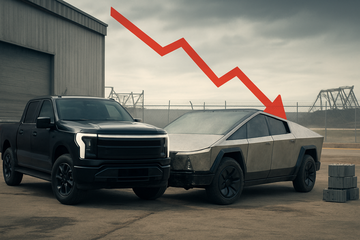
Within eight days, the two electric pickups that were supposed to carry electrification both ended. Ford's US sales release on Nov 4, 2026 shows the F-150 Lightning at zero units, against 1,543 a year earlier and 4,770 versus 24,577 for the year to date. On Nov 6, 2026, Elon Musk said Tesla will wind down Cybertruck production at Gigafactory Texas around the middle of next year to make room for Cybercab, after the truck sold 20,237 units in the US last year, down 48% from 38,965 in 2024.
| Ford US sales, October | 2026 units | 2025 units | Change |
|---|---|---|---|
| F-150 Lightning (electric) | 0 | 1,543 | -100.0% |
| F-Series (all powertrains) | 73,482 | 67,930 | +8.2% |
| Mustang Mach-E | 1,239 | 2,906 | -57.4% |
| E-Transit | 116 | 260 | -55.4% |
| Transit (mainline, incl. E-Transit) | 14,169 | 13,146 | +7.8% |
Tesla's own Q3 2026 delivery report shows how small the truck had become: 486,532 vehicles delivered, of which 8,295 were \"other models\" — the Cybertruck line alongside the Cybercab and Semi. With installed Cybertruck capacity of more than 125,000 units a year and Cybercab capacity of more than 125,000 at the same plant, the wind-down is a capacity decision rather than a verdict on trucks: the Austin line switches from a low-volume product to a robotaxi program that entered the fleet in Austin on Sept 3.
Tesla will be winding down production of the Cybertruck at Gigafactory Texas around the middle of next year to make room for Cybercab.
The margin math
The Pickup Died on Cost, Not on Appeal
The numbers that killed the segment were not unit-share numbers. Model e generated $1.2B of revenue in Q3 2026, down 31%, and lost $1.06B at an 86.5% negative margin; management left the full-year loss estimate unchanged at about $4.0B and kept breakeven dated to 2029. Meanwhile the same company flagged that commodities, memory and logistics together will be a roughly $2.0B year-over-year headwind in 2027, layered on a 2026 commodity headwind approaching $2.5B. A truck cannot be repriced when the content inside it is getting more expensive every quarter — and the content getting more expensive is memory.
- Ford named memory alongside commodities and logistics in its roughly $2.0B 2027 headwind, up from a $2.0B commodity-only framing of 2026, while promising $1.0B of material and warranty cost reductions this year.
- Model e losses are unchanged at about $4.0B for 2026, but the profit step-up is now dated to the first half of 2028 as the extended-range F-150 and Ford Energy ramp — a two-year hole in the segment that was supposed to fund the transition.
- Ford's F-150 inventory ran near 49 days coming out of September with a year-end target of the low-50s to low-60s, and the new F-150 changeover adds production downtime next year.
- The only pickup volume left in the Ford electric portfolio is the extended-range Lightning nameplate, which Ford says will keep the badge alive with a gasoline generator.
Memory contract prices and cloud capex tilt
TrendForce estimates published Aug 25, 2026
Unit: %
Server DRAM contract prices, cumulative 2026
After +64% in 2H 2025
270%
Enterprise SSD NAND prices, cumulative 2026
After +35% in 2H 2025
235%
DRAM + NAND share of major cloud capex, 2027
Up from 47% in 2026
68%
DRAM + NAND share of major cloud capex, 2026
Cloud capex itself up 98% in 2026
47%
| Ford Model e | Q3 2026 | FY2026 guidance | Versus prior year |
|---|---|---|---|
| Revenue | $1.2B | — | down 31% from $1.8B |
| Segment EBIT | -$1.06B | about -$4.0B | loss narrowed 25% |
| EBIT margin | -86.5% | — | FY2025 segment loss was $4.8B |
| Path to profit | breakeven targeted for 2029 | first-half 2028 step-up | losses unchanged this year |
The second-order effect matters more than the first. If the pickup died on cost, the cost did not go away with the truck — it moved into every other vehicle Ford builds, and it made the segment's remaining volume more expensive to serve. That is also why the read-through for memory makers runs opposite to the one most investors assume: the collapse of electric pickups does not remove the memory bill, it removes the highest-priced truck that could carry it. Micron's automotive and embedded business did $6.82B of revenue in fiscal Q4 2026 at an 84% gross margin, because ADAS and cockpit content rides on every powertrain, combustion included.
Where the profit pool went
Hybrids and Gas Trucks Absorbed the Demand
The truck buyers did not disappear; they changed powertrain. Stellantis sold 324,277 vehicles in the third quarter against an industry down 0.8%, with Ram 1500 volume up 73%, total pickup sales up 34% and brand sales up 29%. General Motors has indefinitely shelved next-generation Silverado EV and Sierra EV programs while continuing to sell the current ones. Toyota is the same story at scale: hybrids passed 50% of North American sales in its fiscal first quarter, and Cox data put hybrids at 16.3% of the US market. The demand that would have been a $70,000 electric truck is now a $45,000 hybrid pickup with fewer moving parts and no battery.
- Ford hybrid pickups set a third-quarter record of 27,793 units, up 59.6%, with 74,300 through September; F-150 Hybrid alone reached 34,527 in the first nine months.
- F-Series output of 266,777 trucks in Q3 2026 was up 4.5%, and October F-Series sales of 73,482 were up 8.2% in the same month the Lightning sold zero.
- The Ford truck franchise is now the cash engine that funds a shrinking EV book: FY2026 guidance is Ford Blue EBIT of about $5.5B and Ford Pro of about $7.0B against Model e losses of about $4.0B.
- Stellantis Ram 1500 volume of 76,650 light-duty pickups in Q3 2026 versus 44,349 a year earlier is the clearest read on where segment share went — to combustion, at full price point.
Battery materials
The Lithium Chain Loses Volume and Keeps the Capacity
The battery-materials consequence shows up in price, not yet in volumes. Benchmark Mineral Intelligence tracked a 20.8% fall in battery-grade lithium carbonate EXW China during Q3 2026, ending the quarter at RMB127,750 per tonne, after a volatile decline, an August rally and a September reversal that erased the quarter's gains. Supply was part of the story — CATL's Jianxiawo mine was suspended again and its 2026 mined output forecast cut nearly in half — but so was sentiment, with cathode output plans slowing and Chinese authorities pausing approvals for new energy-storage and EV cell capacity.
| Albemarle FY2026 scenario | Net sales | Adjusted EBITDA |
|---|---|---|
| At $10 per kg LCE | $4.1-4.3B | $0.9-1.0B |
| At $20 per kg LCE | $5.7-6.0B | $2.4-2.6B |
| At $30 per kg LCE | $7.5-7.8B | $4.2-4.4B |
| Q3 2026 actual | $1.55B | $645.5M |
- Albemarle realized $20.02 per kg LCE in Q3 2026 against $10.28 a year earlier, so realized prices are still catching a spot market that fell a further 25% in the month to Nov 6 — and management guided Q4 energy storage sales, EBITDA and margins all down sequentially.
- The volume shock lands on cell makers with Ford exposure: CATL signed agreements to supply LFP packs for Ford's North American Mustang Mach-E and F-150 Lightning, the two nameplates now falling 57% and 100% year over year in October.
- Offsetting that, CATL is the direct upstream link and the direct beneficiary of the pivot: its mine disruption tightened concentrate supply in a quarter when Chinese approvals for new cell capacity were paused.
- Ford's own guidance is that battery plants built for trucks now supply the grid, and it plans about a third of a roughly $2B energy investment this year and two-thirds next year, with 20 GWh of annual capacity online by the end of next year.
Tesla is doing the same arithmetic from the other end. Storage deployments reached 13.7 GWh in Q3 2026, up 10% year over year, and Megafactory Texas started production with a planned 50 GWh. The trucks that stopped selling did not take their cell and grid demand with them; they moved it. That is why the battery chain is a volume story with a price floor — the same capex that built the electric pickup is now being pointed at the grid.
Fundamentals
Who Actually Earns the Margin Now
| Company | Revenue | Gross margin | Net income (loss) |
|---|---|---|---|
| Ford, Q3 2026 | $49.5B | 14.9% | $2.05B |
| Tesla, Q3 2026 | $28.0B | 19.6% | $0.79B |
| General Motors, Q3 2026 | $50.0B | 18.6% | $3.31B |
| Stellantis, Q3 2026 | EUR43.5B | 11.0% | EUR0.27B |
| Rivian, Q3 2026 | $2.16B | 8.2% | -$0.91B |
| Micron, fiscal Q4 2026 | $54.2B | 86.8% | FY2026 GAAP net income $85.0B |
The spread is the point. The company that sold the most trucks in the segment, Ford, earned a 14.9% gross margin on $49.5B of revenue and $2.05B of net income in the quarter, with $3.14B of free cash flow and $2.29B of capital spending. The company that tried to build the segment's future, Tesla, converted $28.0B of revenue into $0.79B of net income while spending $4.73B on capital in three months. And the last listed pure play on electric pickups, Rivian, produced an 8.2% gross margin, burned $1.12B of free cash flow in the quarter and ended with $3.51B of cash against a trailing twelve-month cash burn of $4.19B. The pickup segment's economics are now a funding question for the weakest balance sheets in it, not a demand question for the strongest.
The cost stack of the segment that just ended
Ford Model e EBIT, Q3 2026
-$1.06B
On $1.2B of revenue
Ford 2027 commodity, memory, logistics headwind
~$2.0B
2026 commodity headwind was ~$2.5B
Tesla capital expenditure, Q3 2026
$4.73B
Up 110% year over year
Micron automotive and embedded revenue, fiscal Q4 2026
$6.82B
84% gross margin
Battery-grade lithium carbonate, Q3 2026
-20.8%
To RMB127,750 per tonne, EXW China
New EV days' supply, September 2026
68 days
Up 64.2% year over year
Horizons
What Breaks Next, and When
- Days to quarters: Ford's 2027 guide is the first test — profitability is targeted roughly in line with 2026 while expenses rise, so a $2.0B cost headwind has to be offset by mix and savings.
- Days to quarters: Tesla's Q4 deliveries and the first Cybercab units off the retooled Austin line decide whether the wind-down reads as discipline or as one product traded for another.
- Days to quarters: Micron's fiscal Q1 2027 guide of $61.5B of revenue at roughly 86% gross margin, and SK hynix's HBM4 ramp in Q4, set the memory cost base that automakers will carry into 2027.
- Days to quarters: Albemarle's Q4 print is guided down sequentially on lower market pricing, and the gap between its $10 and $30 per kg scenarios is now the widest lever in the lithium complex.
- One to three years: Model e breakeven dated 2029 with the profit step-up only in the first half of 2028 means Ford's electric truck losses are a three-year, not a one-year, drag on the segment's biggest profit pool.
- One to three years: the used-EV correction arrives as off-lease EVs return, and the first visible crack will be residual values on lease returns rather than used listing prices.
- One to three years: grid storage is the absorbing capacity — 20 GWh at Ford Energy by the end of next year and 50 GWh planned at Tesla's Megafactory Texas — which keeps cell and lithium assets employed even as truck volumes vanish.
- One to three years: for the weakest balance sheet in the segment, financing comes before scale. Rivian's $3.51B of cash against a $4.19B trailing free cash outflow is the constraint that decides how long the last electric pickup can be sold.
Stocks this collapse actually touches
- Ford F-Series volume rose 8.2% in October while the Lightning sold zero, and FY2026 adjusted EBIT guidance was raised to $10.5-11.0B.
- Model e still loses about $4.0B in 2026 with breakeven dated 2029, capping what the hybrid mix shift is worth to the equity.
- The roughly $2.0B 2027 commodity, memory and logistics headwind lands against a flat 2027 profitability guide, and that is the earnings risk, not EV volume.
- Near term: the January 2027 guide and whether $1.0B of material and warranty savings offsets memory inflation.
- Killing Cybertruck frees Austin capacity for Cybercab, and automotive gross margin excluding credits already reached 18.1% in Q3 2026.
- Capital expenditure of $4.73B in Q3 2026 was up 110% year over year against $0.79B of quarterly net income — the robotaxi bill arrives before the revenue.
- Other models, including Cybertruck, were just 8,295 of 486,532 deliveries, so the pickup was already a rounding error.
- Long term: the Cybercab ramp on freed Texas capacity decides whether the segment exit was value-accretive.
- Ram 1500 sales jumped 73% in Q3 2026 and total pickup sales rose 34% while the US industry fell 0.8%.
- That is the clearest evidence the electric pickup's demand went to the gas pickup rather than to no truck at all.
- Near term: incentive discipline as Ram 1500 supply tightens, with Q3 adjusted earnings per share still at minus $0.01.
- Long term: Stellantis is buying share in the segment Ford exited, at the cost of its own European EV programs.
- Toyota's hybrids passed 50% of North American sales in its fiscal first quarter, the mix Ford and Tesla are leaving behind.
- But April-June operating income fell to Y1.063T from Y1.166T a year earlier, so US hybrid share gains are not yet a group-level earnings story.
- Near term: the full-year operating profit forecast is the swing factor for the shares.
- Long term: Toyota is the hedge on the outcome — it wins if trucks stay combustion and gives up little if electrification returns.
- Rivian remains the last listed pure play on electric pickups, and Q3 2026 gross margin was 8.2% on $2.16B of revenue.
- Trailing free cash flow of -$4.19B against $3.51B of cash means financing comes before the R2 ramp scales.
- Near term: 2026 delivery guidance of 65,000-70,000 with Q3 deliveries up 46% year over year — the R1 pickup is no longer the driver.
- Long term: if the segment resets, R1 residual values follow used EV prices into 2028.
- Automotive and embedded revenue reached $6.82B at an 84% gross margin in fiscal Q4 2026, and content per vehicle rises whatever the powertrain.
- Fiscal Q1 2027 guidance of $61.5B of revenue at roughly 86% gross margin puts the memory bill squarely on automakers' margins, not on memory volumes.
- Long term: TrendForce expects 2027 server DRAM and HBM bit supply up about 27%, the main risk to the pricing behind those margins.
- SK hynix earned KRW83.3T of operating profit on KRW104.6T of revenue in Q3 2026, an 80% operating margin, with HBM4 mainstream from Q4.
- Management expects the memory shortage to persist through 2030, which is why Ford's memory headwind is a multi-year problem.
- Near term: HBM4 should pass HBM3E on both volume and revenue in Q4 2026, setting the 2027 cost base for automakers.
- Q3 realized lithium price of $20.02 per kg LCE sits well above a spot market down 25% in a month, and Q4 energy storage sales, EBITDA and margins are all guided lower.
- FY2026 capex was trimmed to $300-350M from about $500M, so management is treating the demand scare as structural.
- The FY2026 scenario range spans $0.9-1.0B of adjusted EBITDA at $10 per kg LCE to $4.2-4.4B at $30 per kg.
- Long term: grid storage demand is the only offset if EV truck battery demand keeps shrinking.