
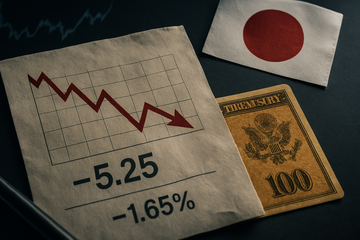
Quarterly investment loss
−¥5.25 trillion
July–September 2026, reported Nov 6, 2026; first loss in six quarters
Quarterly return
−1.65%
Not annualized; +8.20% in the April–June quarter
Assets under management
¥314.4 trillion
As of Sept 30, 2026, down ¥3.37 trillion from June 30
Foreign bond return
−6.52%
July–September 2026; worst quarterly foreign-bond return since fiscal 2020
Japan's Treasury holdings
$1.07 trillion
As of Aug 2026, down $35.6 billion from July
Price component of the loss
≈¥6.55 trillion
Mark-to-market after ¥1.30 trillion of interest and dividend income
What actually happened
The Loss Was a Rates Shock, Not a Yen Shock
GPIF reported a ¥5,253.3 billion loss for the July–September 2026 quarter on November 6, a return of −1.65% and its first loss in six quarters. The cause was not an AI-driven equity unwind and not a weak yen: equities rose modestly over the quarter, and the yen strengthened roughly 3% against the dollar, from 160.86 on June 30 to 156.19 on September 30, helped by coordinated US-Japan intervention. What broke was the bond book. The Bank of Japan, the Federal Reserve and the ECB all raised rates in September, and sovereign yields rose across the curve at home and abroad — marking down a portfolio that is 50.5% bonds.
Yields at the peak of the September 2026 shock
10-year and 30-year sovereign yields at the September peak — US Treasuries on Sept 23, Japanese government bonds on Sept 24. The 10-year Treasury yield had not printed higher since July 2007.
Unit: %
US 30-year (Sept 23)
Highest since June 2007
5.4
US 10-year (Sept 23)
Highest since July 2007
5.1
Japan 30-year (Sept 24)
Up nearly 7bp on the day
4.1
Japan 10-year (Sept 24)
Highest since August 1996
3.1
- Foreign bonds: lost 6.52% — the first negative foreign-bond quarter in six and the worst since fiscal 2020.
- Domestic bonds: negative, as the 10-year JGB yield rose 8 basis points to 3.055% and the 30-year reached 4.134%.
- Foreign equities: rose in local currency but translated into a loss in yen, the drag from a roughly 3% yen appreciation.
- Domestic equities: positive, with technology leadership decelerating but the broader market still higher.
- Carry: interest and dividend income of ¥1,296.7 billion kept accruing, which puts the price component of the loss at roughly ¥6.55 trillion.
Mechanism
A Stronger Yen and Higher Yields Removed the Reason to Own Dollar Duration
Hedging is what makes a Japanese saver's foreign bond book comparable to a domestic one, and a strong yen cuts both ways. It gains on hedged dollar positions and loses on unhedged ones, which is exactly why GPIF's foreign equities were negative in yen terms in a quarter when they rose in local currency. It also cuts the yen cost of buying a dollar portfolio back home: at 156.19 a dollar, Japan's $1,068.3 billion of Treasuries were worth about ¥167 trillion, some ¥5 trillion less than at the June 30 rate of 160.86.
| Metric | Apr–Jun 2026 | Jul–Sep 2026 |
|---|---|---|
| Investment return | +¥24,089.5bn | −¥5,253.3bn |
| Return rate (not annualized) | +8.20% | −1.65% |
| Interest and dividend income | ¥1,977.0bn | ¥1,296.7bn |
| Total assets, period end | ¥317,759.6bn | ¥314,387.6bn |
| Cumulative return since fiscal 2001 | ¥221,020.1bn | ¥215,766.9bn |
| Annualized since fiscal 2001 | 4.95% | 4.83% |
Who collects
The Same Shock Paid the Banks Everyone Blames for Selling Treasuries
The rate move that marked down a sovereign saver's bond book did the opposite for the banks that hold the same assets at scale. Mitsubishi UFJ Financial Group reported net revenues of ¥3,907.5 billion for April–June 2026 against ¥3,253.9 billion a year earlier, with interest income of ¥2,336.7 billion against ¥2,022.6 billion and profit attributable to owners of parent of ¥809.4 billion against ¥546.1 billion. In the United States, JPMorgan Chase's revenue net of interest expense rose 6.0% to $76.2 billion with net interest income up 12.8% to $27.0 billion, and Goldman Sachs net revenues jumped 17.3% to $37.7 billion while its credit valuation adjustment swung to a $152 million gain from a $49 million loss. The same curve that hurt the fund paid the intermediaries.
| Company | Quarter | Revenue | Net interest income | Profit |
|---|---|---|---|---|
| Mitsubishi UFJ Financial Group | Apr–Jun 2026 | ¥3,907.5bn, +20.1% YoY | ¥2,336.7bn interest income, +15.5% YoY | ¥809.4bn, +48.2% YoY |
| JPMorgan Chase | Jul–Sep 2026 | $76.2bn, +6.0% YoY | $27.0bn, +12.8% YoY | $14.9bn net income, +6.4% YoY |
| Goldman Sachs | Jul–Sep 2026 | $37.7bn, +17.3% YoY | — | $5.1bn net earnings, +32.7% YoY |
| Bank of America | Jul–Sep 2026 | $47.8bn | $16.4bn (Q2: $16.0bn) | $6.5bn net income (Q2: $8.7bn) |
The policy backdrop behind the quarter
Bank of Japan policy rate
1.25%
Raised from 1.00% on Sept 18, 2026, a 31-year high, in a 7-2 vote
Bank of Japan bond purchases
Taper paused
About ¥2 trillion a month from April 2027
10-year US Treasury
5.29%
Sept 30, 2026; down to 4.90% by Nov 4
10-year JGB
3.055%
Sept 24, 2026, the highest since August 1996
30-year JGB
4.134%
Sept 24, 2026
USD/JPY
156.19
Sept 30, 2026, against 160.86 on June 30; 157.78 on Nov 5
US 10-year at Oct 30
+76bp vs end-2025
End-2025 level was 4.18%
The allocation question
Repatriation Capacity Is Capped, So the Signal Is Political
The mandate limits the damage. GPIF's policy mix is 25% each in domestic bonds, foreign bonds, domestic equities and foreign equities, with deviations of five percentage points permitted, and the fund already sat at 26.49% in domestic bonds and 24.05% in foreign bonds at September 30. Santander calculates that it could sell as much as $62 billion of US Treasuries inside that band, and Goldman Sachs puts a shift from foreign bonds into JGBs at about $80 billion — against a $232.1 billion Treasury position and $1,068.3 billion of Japanese holdings. That makes a Japanese Treasury fire sale a rounding error while keeping the marginal bid price-sensitive.
| Sleeve | Market value | Actual | Policy | Deviation |
|---|---|---|---|---|
| Domestic bonds | ¥84.71tn | 26.49% | 25% | +1.49pp |
| Foreign bonds | ¥76.90tn | 24.05% | 25% | −0.95pp |
| Domestic equities | ¥79.29tn | 24.80% | 25% | −0.20pp |
| Foreign equities | ¥78.88tn | 24.67% | 25% | −0.33pp |
| Alternatives | ¥5.50tn | 1.72% | Cap of 5% | — |
Japan is still the largest foreign holder of US Treasuries
Major foreign holders of US Treasury securities, August 2026. Japan's position fell $35.6 billion in a single month, and $47.7 billion since June.
Unit: $ billions
Japan
$1,103.9bn in July
1,068.3
United Kingdom
$998.3bn in July
1,009.5
China
$618.0bn in July
590.7
Horizons
What Moves Next: Days to Quarters, Then Years
Three checks arrive within months, and the first of them already points the other way: the rate shock that produced the loss is unwinding. The 10-year Treasury yield has fallen from 5.29% on September 30 to 4.90% by November 4, Japanese banks report the September quarter in mid-November, and the Ministry of Finance sets its issuance plan for the coming fiscal year in late November.
- The 10-year Treasury yield has fallen from 5.29% on September 30 to 4.90% by November 4, which should lift GPIF's October–December mark above the July–September one.
- Japanese megabanks report the September quarter in mid-November; spread income and unrealized losses on government bond holdings pull in opposite directions.
- The Ministry of Finance's fiscal 2027 JGB issuance plan, typically set in late November, is the near-term catalyst for the long end.
- The Bank of Japan's next meeting after the September hike is the policy test; a third increase would widen the gap between domestic and hedged foreign carry.
Over one to three years the question is whether the gap between a hedged Treasury and a JGB widens enough to force the allocation question onto the agenda. Lifting domestic bonds to 30% would require roughly ¥16 trillion of yen buying, and that yen buying would cut the yen value of Japan's $931 billion of foreign assets.
- A 30% domestic bond weight needs roughly ¥16 trillion of yen buying, which would strengthen the yen and cut the yen value of Japan's $931 billion of foreign assets.
- Japan's Treasury holdings fell from $1,116 billion in June to $1,068.3 billion in August; at that pace the marginal foreign buyer keeps thinning.
- Most of the book sits in index funds, so flows follow benchmark weights rather than conviction — the flow changes only if the target changes.
- The offsetting force is price: at 4.90% the 10-year Treasury is no longer a compelling substitute for a domestic saver who can buy 3% JGBs.
Risks
What Would Break This Thesis
- The loss may already be stale: with the 10-year Treasury at 4.90% on November 4, the September quarter could be the worst print of the year rather than the start of a trend.
- GPIF's decisions are made in Tokyo, not in the market: the fund's own committee did not discuss the allocation in September, so the loss is a symptom, not a decision.
- Official holdings data cannot separate selling from price: part of Japan's $35.6 billion August decline is simply the mark on a book that shrank as yields rose.
- A weaker yen would raise the yen cost of selling dollar assets and restore the case for holding hedged Treasuries, undoing the repatriation case quickly.
Where this shows up in listed stocks
- Interest income of ¥2,336.7 billion in the June 2026 quarter, up 15.5% year on year, converts the JGB repricing that hurt GPIF into bank revenue.
- Profit attributable to owners of parent rose 48.2% to ¥809.4 billion, the cleanest expression of a steeper domestic curve.
- Near term: the September-quarter results in mid-November test whether spread income survives unrealized losses on government bond holdings.
- Over one to three years, a 3.055% 10-year JGB keeps pulling deposits into term products while the 1.25% policy rate caps funding costs.
- Net revenues of $37.7 billion in the September quarter, up 17.3%, with credit valuation adjustment swinging to a $152 million gain, shows the intermediaries are paid for the volatility.
- The same dislocation lifts client flow in JGBs and Treasuries, the two markets where the Japanese allocation decision is settled.
- Near term: a repeat of the September shock in the October–December quarter keeps fixed-income revenue elevated into the January report.
- Over one to three years, a capped repatriation of $62–80 billion is a trading opportunity for dealers, not a flow event.
- Net interest income rose 12.8% to $27.0 billion, while weak indirect demand at the 5-year Treasury auctionsignals a thinning bid beneath the yield.
- Revenue net of interest expense rose 6.0% to $76.2 billion, with net income up 6.4% to $14.9 billion.
- Near term: distribution stress appears first in auction tails and secondary depth, not in headline revenue.
- Over one to three years, a higher front end helps the margin while a steeper long end pressures securities marks.
- Net interest income edged up to $16.4 billion in the September quarter, yet net income fell to $6.5 billion from $8.7 billion as the rate gain was already being offset.
- Revenue of $47.8 billion in the quarter leaves little cushion if the long end keeps steepening.
- Near term: December-quarter securities marks and deposit costs are the swing factors for consensus estimates.
- Over one to three years, the outcome depends more on where the Fed stops than on where Japanese flows go.