
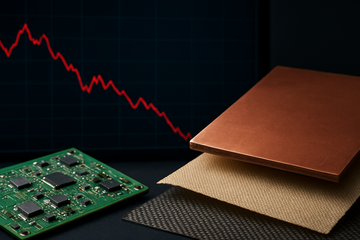
Resonac share price
¥10,530
Close on Nov 7, 2026; 48.6% below the ¥20,495 52-week high and down 7.1% on the day
Segment core operating margin, FY2026 guidance
29.2%
Semiconductor and Electronic Materials, against 21.4% in FY2025; forecast revised Aug 6, 2026
FY2026 core operating profit guidance
¥196.0bn
Raised 40% from ¥140.0bn on Aug 6, 2026; group operating profit raised to ¥160.0bn
Copper-clad laminate price increase
+30%
All laminate and prepregs, for shipments from March 1, 2026
Global laminate share in semiconductor packages
37%
Prismark Partners 2025 results, as cited in the 2026 integrated report
Substrate capacity committed by Ibiden
¥500bn
FY2026–FY2028 plan approved Feb 3, 2026, targeting 2.8x 2024 AI substrate capacity
The 2019–2020 Deal
The $8.8 Billion Purchase Put Resonac in the Middle of the Stack
Showa Denko paid about US$8.8 billion — roughly ¥960 billion, and more than double its own market value — for Hitachi Chemical in 2019–2020. The purchase handed the business that became today's Resonac the circuit board materials franchise, the semiconductor packaging materials business and a key compound used to polish silicon wafers. Management told The Business Times in January 2023 that chip materials would reach 45% of group sales by 2030, up from 31% in 2021.
- Resonac now sits in the middle of the AI stack: it buys copper foil and glass cloth, sells laminate to board makers, and sells packaging laminate to substrate makers.
- Its own January 2026 price notice blamed copper foil and glass cloth for a 30% increase, passing the cost shock straight back to board makers.
- The second leg was consolidation — Resonac merged Showa Denko with Showa Denko Materials in 2023 and called the integration a second founding.
- The stated prize was mix: chip materials at 45% of sales by 2030, and a position as a pivotal supplier to TSMC and Samsung Electronics, both expanding in the United States.
Where The Money Landed
The Margin Landed at the Laminate Layer, and It Was Large
| Metric | FY2025 actual | FY2026 forecast (revised Aug 6, 2026) | Change vs Feb 13, 2026 forecast |
|---|---|---|---|
| Segment revenue | ¥506.3bn | ¥668.0bn | +¥161.7bn (+31.9%) |
| Segment core operating profit | ¥108.4bn | ¥195.0bn | +¥86.6bn (+79.9%) |
| Segment core operating margin | 21.4% | 29.2% | +7.8 percentage points |
| Group core operating profit | — | ¥196.0bn | raised 40.0% from ¥140.0bn |
| Group operating profit | — | ¥160.0bn | raised 52.4% from ¥105.0bn |
| Profit attributable to owners | — | ¥112.5bn | raised 46.1% from ¥77.0bn |
First-half 2026 results confirm the direction. Revenue rose 5.4% to ¥676.9 billion, operating income jumped to ¥87.9 billion from ¥34.5 billion, and net profit rose 146.5% to ¥48.5 billion. That is operating leverage, not accounting. It is also why the market reaction since August is so violent: the fundamentals kept improving while the share price went the other way.
Where the margin sits across the AI materials chain
Trailing operating margin to each company's latest reported quarter, except the Resonac segment bar, which is FY2026 company guidance for segment core operating profit over segment revenue. Company-reported results.
Unit: %
NVIDIA — AI accelerator
Trailing twelve months to July 2026
65.2%
Resonac — semiconductor and electronic materials segment
FY2026 guidance
29.2%
Shengyi Technology — laminate
Trailing twelve months to September 2026
23.5%
Kingboard Laminates — laminate
Trailing twelve months to June 2026
21.1%
Nittobo — glass cloth
Trailing twelve months to June 2026
19.7%
Ibiden — substrate and printed circuit boards
Trailing twelve months to September 2026
18%
Samsung Electro-Mechanics — substrate, capacitors
Trailing twelve months to September 2026
12.4%
Ajinomoto — ABF build-up film
Trailing twelve months to June 2026, group level
11.4%
Resonac — group consolidated
Trailing twelve months to June 2026
8.1%
Upstream
The Scarcer Monopoly Sits Above the Middleman
Ajinomoto controls more than 95% of the global ABF build-up film market, and in May 2026 it told substrate makers it would raise prices about 30% from the third quarter. Its capacity ran at full load in the June quarter at roughly two million square metres a month. The result appears in its own numbers: first-quarter FY2026 Functional Materials sales reached 154% of the prior year and business profit 177%, and the company lifted its FY2026 business profit forecast to ¥202.0 billion.
- Ajinomoto raised ABF film prices about 30% effective the third quarter of 2026, on a base where capacity was already fully loaded.
- The ABF substrate shortfall runs at roughly 10% in the second half of 2026, widening to beyond 40% by 2028.
- Substrate area demand is projected to compound at about 39% a year from 2025 to 2028, with Ibiden's semi-additive processing load index going from 1.0 in 2024 to a projected 2.5 times by 2028.
- Advanced AI packages consume roughly ten times the ABF of a conventional design — eighteen build-up layers against six, on about 3.5 times the board area.
- Ajinomoto is folding Ajinomoto Fine-Techno into the parent from April 1, 2027 to solidify growth in the ICT business.
Nittobo shows what the market thinks of upstream scarcity rent. Its gross margin of 41.7% is the best in the chain and trailing return on equity is 27.3%. Yet the shares are 64.7% below their 52-week high and fell 12.7% on November 7 alone. Strip the ¥37.8 billion of non-operating income that flattered the year to March 2026 and the headline 9.8 times earnings multiple becomes roughly 17 times trailing operating profit.
Downstream
The Substrate Layer Is Buying Volume, Not Margin
| Company | Commitment | Size | Timing | Where it lands |
|---|---|---|---|---|
| Ibiden | High-performance IC package substrates for AI servers | About ¥500bn across FY2026–FY2028, with a first phase of about ¥220bn at the Gama Plant | Mass production from FY2027 | 2.8 times 2024 AI substrate capacity by 2028 |
| Samsung Electro-Mechanics | FCBGA substrate capacity for AI servers | KRW 6.78tn in total: KRW 4.27tn at Sejong and KRW 2.51tn in Vietnam | Sejong mass production September 2028; Vietnam by June 2030 | Largest single-product investment in company history |
| Unimicron | ABF substrate capital spending | NT$34bn for 2026 | During 2026 | Adds to the non-Japanese substrate base |
| Kinsus | Substrate capacity | NT$23.5bn over three years | About 25% higher monthly output by 2027 | Incremental, not transformative |
Capital is not margin. Samsung Electro-Mechanics earned a 12.4% trailing operating margin on KRW 13.3 trillion of revenue while committing KRW 6.78 trillion to capacity that does not reach mass production until September 2028. LG Innotek runs a trailing operating margin near 4% on a gross margin of 8.0%. Board makers were simply paying more: Samsung Electro-Mechanics and LG Innotek both reported laminate purchase prices up in the low-to-mid teens year on year in the third quarter of 2025, and gold plus laminate together account for close to half of printed circuit board raw material cost. Comparable price increases came from Mitsubishi Gas Chemical alongside Resonac.
The Contest
The Rent Is Not Japanese
| Company | Period | Revenue | Operating margin | Prior-year margin |
|---|---|---|---|---|
| Shengyi Technology | Three months to September 30, 2026 | CN¥14.18bn | 30.4% | 17.6% |
| Resonac — semiconductor and electronic materials segment | FY2026 guidance | ¥668.0bn | 29.2% core operating | 21.4% in FY2025 |
| Kingboard Laminates | Six months to June 30, 2026 | HK$14.90bn, up 55.4% | 26.0% | 12.0% |
Shengyi Technology, the world's second-largest laminate maker, posted a 30.4% operating margin in the September 2026 quarter — above the 29.2% core operating margin Resonac guides for its entire semiconductor and electronic materials segment. Its trailing return on equity is 39.5%, and first-half net profit rose about 130% to CN¥3.29 billion on revenue of CN¥19.03 billion. Kingboard Laminates did nearly as well: first-half operating income more than tripled to HK$3.87 billion, lifting operating margin from 12.0% to 26.0%. The margin did not accrue to Japan. It accrued to whoever owned qualified laminate capacity.
- What Resonac owns is qualification, not nationality: 37% of the global laminate market for semiconductor packages.
- It is responding the way incumbents do — expanding laminate facilities in Japan, China and Taiwan from FY2027 and doubling capacity by 2030 against 2024.
- But that expansion lands where Shengyi Technology and Kingboard Laminates already build, in a segment where the approved-supplier list is the real gate.
- At 23.2 times trailing earnings and a 39.5% return on equity, Shengyi Technology trails the Chinese laminate maker on neither margin nor valuation.
The Repricing
What the Market Actually Repriced
| Company | Price | Session move | 52-week high | Below high |
|---|---|---|---|---|
| Kingboard Laminates | HK$30.40 | -7.0% | HK$107.20 | -71.6% |
| Nittobo | ¥2,321 | -12.7% | ¥6,580 | -64.7% |
| Samsung Electro-Mechanics | KRW 870,000 | -7.8% | KRW 2,417,000 | -64.0% |
| Shengyi Technology | CN¥73.87 | -10.0% | CN¥191.88 | -61.5% |
| Resonac | ¥10,530 | -7.1% | ¥20,495 | -48.6% |
| Ibiden | ¥8,045 | -3.8% | ¥13,740 | -41.4% |
| NVIDIA | $185.75 | +2.3% | $243.37 | -23.7% |
| Ajinomoto | ¥5,128 | +0.2% | ¥6,340 | -19.1% |
The correlation is the story. On November 7 the whole materials complex fell between 3.8% and 12.7% while the company whose demand creates the shortage rose 2.3%. Ajinomoto, the actual monopoly, was the only name in the chain to close higher. Meanwhile LME copper fell 3.2% to $13,883 a tonne, a three-month low, as the AI-stock rout weakened the outlook for data-centre materials demand. The chain is being re-priced off copper and AI sentiment, not off contract prices.
Consolidation
The Consolidation Wave Is Passing Resonac By
On November 5, 2026 The Japan Times reported that Mitsui Chemicals is examining a deal to buy JSR from Japan Investment Corporation for more than ¥1 trillion, with Reuters putting the figure above ¥1.3 trillion. JIC took JSR private for about ¥900 billion in 2024 and had said it wanted to reorganise Japan's semiconductor materials industry around that company. Resonac studied JSR in February 2025 and walked away. It is now a seller rather than a buyer in its own home market: Crasus Chemical was spun off in October 2026, adhesives operations in Japan, China and Taiwan were agreed for sale to Sika on October 21 with an immaterial earnings impact, and the resin moulding components business went to Moriroku in April.
- State capital is driving Japanese materials consolidation, not Resonac: JIC bought JSR for about ¥900bn in 2024 and is now selling it for more than ¥1 trillion.
- Resonac spent 2026 shrinking rather than consolidating — Crasus Chemical deconsolidated in October, adhesives to Sika in October, resin moulding to Moriroku in April.
- The balance sheet limits the alternative: net debt stands at 3.2 times trailing EBITDA and debt at 1.2 times equity, while FY2025 return on invested capital was 6.2% against a 10% target.
- Mitsui Chemicals is the acquirer in this cycle; Resonac is the seller, and the adhesives disposal does not complete until sometime in 2027.
Horizons
Two Horizons, One Falsifiable Test
- Next two quarters: Resonac reports third-quarter FY2026 results in November 2026, the first clean test of whether segment core operating margin holds near 29% once the March 2026 increase annualises.
- Ajinomoto reports the quarter ended September 30, 2026 on November 9, 2026 — the read on whether the ABF price rise is holding at 95% share.
- The March 2027 contract reset is the second test: laminate prices set in March 2026 renew against a lower copper curve, and if they hold, the laminate layer keeps the difference.
- A hyperscaler capital spending pause, not a laminate order cut, is the risk that matters most: Samsung Electro-Mechanics has customer funding and multi-year volume guarantees behind its KRW 6.78tn, and NVIDIA has agreed dedicated substrate capacity in Sejong and Busan with supply running from 2026.
- One to three years: substrate capacity is the clock. Ibiden's 2.8 times target lands by 2028 and Samsung Electro-Mechanics's Sejong line only reaches mass production in September 2028.
- The ABF substrate shortfall is expected to peak beyond 40% in 2028 — the year new capacity and peak shortage coincide.
- Resonac's own answer is supply: a new laminate line at the Shimodate Plant enters mass production in the fourth quarter of this fiscal year, with a doubling of capacity by 2030 against 2024.
- The test the company set itself is the one to watch: getting return on invested capital from 6.2% toward the 10% target, which only works if the rent persists through the 2028 capacity wave.
Facts: laminate margins expanded across every layer in 2026, and the materials complex has been de-rated 41% to 72% from its highs while the AI chip supplier rose. Inference: the market is discounting the durability of a scarcity rent set by upstream monopolies and competed for at the laminate layer, not the demand for AI racks. Speculation: if the substrate capacity arriving in 2028 meets the demand the 2026 price increases were built on, the rent resets and 29% is a peak rather than a plateau. The cash flow is real and the moat is thinner than a 37% share suggests.
The AI materials chain, by investable layer
- Segment core operating margin guides to 29.2% for FY2026 from 21.4%, with core operating profit raised 40% to ¥196.0bn on Aug 6, 2026.
- Fell 48.6% from its ¥20,495 high while guidance rose, leaving the de-rating unexplained by reported fundamentals.
- Near term: third-quarter FY2026 results due in November 2026 test whether the 29% margin survives the March 2026 price rise annualising.
- Longer term: 6.2% FY2025 return on invested capital against a 10% target, with net debt at 3.2 times EBITDA, limits the ability to outbid consolidators.
- ABF film share above 95% and a roughly 30% price rise effective the third quarter of 2026 give it the only contracted price hike in the chain.
- Functional Materials business profit ran at 177% of the prior year, the cleanest margin capture anywhere in AI materials.
- Only 19.1% below its 52-week high on 14.5 times EV/EBITDA, the least de-rated large materials name in the group.
- Longer term: a substrate shortfall widening beyond 40% by 2028 keeps both the film price and the volume commitments firm.
- A 41.7% gross margin and 27.3% trailing return on equity are the best profitability structure anywhere in the chain.
- The headline 9.8 times earnings multiple flatters the shares: strip ¥37.8bn of non-operating income and it trades near 17 times trailing operating profit.
- Down 64.7% from its ¥6,580 high and down 12.7% on Nov 7, 2026, the market has already called the upstream rent cyclical.
- Longer term: joining the High Density Packaging User Group in October 2026 puts it in the qualification queue for next-generation packaging.
- About ¥500bn of substrate capital spending for FY2026–FY2028 targets 2.8 times its 2024 AI substrate capacity by 2028, into a shortfall beyond 40% that year.
- Net cash and an 18.0% trailing operating margin let Ibiden fund scarcity without leaning on shareholders.
- Down 41.4% from its ¥13,740 high on 18.1 times EV/EBITDA, the smallest de-rating among the Japanese substrate names.
- Near term: the first ¥220bn phase at the Gama Plant, with mass production from FY2027, converts an order book into revenue.
- KRW 6.78tn of FCBGA capacity is the largest single-product investment in company history, with customer funding and volume guarantees attached.
- A 12.4% trailing operating margin on KRW 13.3tn of revenue leaves little cushion for a build of that size.
- Near term: operating margin doubled to 18.4% in the September 2026 quarter, yet the shares sit 64.0% below their high.
- Longer term: Sejong mass production only starts in September 2028 and Vietnam in June 2030, after the shortage is expected to peak.
- First-half operating margin doubled to 26.0% and operating income more than tripled to HK$3.87bn on revenue up 55.4%.
- Receivables now equal 172 days of sales, so the captured margin is only worth as much as the credit standing behind it.
- The shares are 71.6% below their HK$107.20 high on 21.7 times trailing earnings after repeated price hikes through 2026.
- Longer term: upstream integration into copper foil, glass fabric and epoxy resin is a cost hedge that laminate peers do not hold.
- A 30.4% operating margin in the September 2026 quarter exceeds the 29.2% Resonac guides for its entire semiconductor materials segment.
- Trailing return on equity of 39.5% at 23.2 times earnings, 61.5% below its high, is the cheapest expression of laminate pricing power.
- First-half net profit rose about 130% to CN¥3.29bn on revenue of CN¥19.03bn, up 50.05%.
- Longer term: capital spending at 7.4 times depreciation, the highest in the chain, shows the capacity is already being built.
- Trailing revenue of $302.97bn at a 65.2% operating margin is the demand every price increase in this chain is built on.
- Trading on 23.0 times trailing and 12.7 times forward earnings while Resonac pays 33 times for an 8.1% operating margin.
- Near term: 3.2 million Blackwell GPU packages shipped through end-2025, each on an ABF substrate, anchor the volume.
- Longer term: dedicated substrate capacity agreed with Samsung Electro-Mechanics underwrites supply well beyond the 2028 capacity wave.