
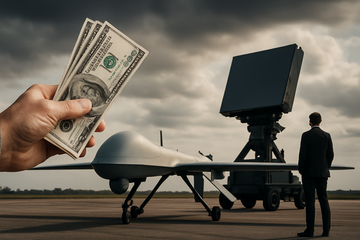
Shield AI agreed on Nov 5, 2026 to buy Kirkland-based Echodyne, whose software-defined MESA radar detects and tracks drones, for a transaction valued at $5.3 billion, and raised $2.5 billion alongside it at a $28.8 billion post-money valuation. The striking number is not the price but the currency: Shield issued equity at roughly 53 times sales to buy a sensor company last marked at $485 million, while the listed primes that build the systems that radar cues trade at two to three times sales.
Deal value announced Nov 5, 2026
$5.3B
$4.8B in cash and equity at closing, plus up to $500M contingent on performance targets
Shield AI post-money valuation
$28.8B
Series H raised Nov 5, 2026, alongside $1.0B of Blackstone structured equity and $500M of JPMorgan-led debt
Implied multiple on Shield's 2026 revenue
~53x
On the more than $540M projected for 2026, reported by Fortune, Mar 26, 2026
Echodyne's federal contract ceiling
$250M
JIATF-401 Domestic Shield IDIQ awarded Sept 30, 2026 with a 36-month ordering period
The asset
The Purchase Is a Sensor Bet, Not an Airframe Bet
Shield did not buy an airframe. It bought the layer autonomy runs on: a compact, solid-state radar with no moving parts, sold into more than 40 countries and into platforms built by Anduril, Axon, Moog and Northrop Grumman. The price prices scarcity rather than a contract book: Echodyne's federal vehicle was a $250 million IDIQ ceiling awarded on Sept 30, 2026, the second-smallest award in the very programme it now belongs to.
| Term | Detail |
|---|---|
| Announced | Nov 5, 2026 |
| Headline value | $5.3B |
| Paid or issued at closing | $4.8B in cash and equity |
| Contingent earnout | Up to $500M on Echodyne performance targets |
| Financing | $2.5B: $1.0B Series H, $1.0B Blackstone structured equity, $500M JPMorgan-led debt |
| Shield post-money valuation | $28.8B |
| Echodyne's last private mark | $485M, per PitchBook cited by GeekWire |
| Step-up from that mark | 10.9x the last mark, and 21x the $250M IDIQ ceiling |
| Price versus buyer's own revenue | 9.8x the more than $540M Shield projected for 2026 |
| Expected close | Early 2027, subject to regulatory approval |
- The technology is the MESA metamaterials electronically scanned array: solid-state, no moving parts, and sold at the lowest size, weight and power in its class.
- A new Washington State plant, a $40 million investment, scales output past 30,000 radars a year and adds 100 to 200 jobs.
- Echodyne is primary radar provider for Trust Automation's Small UAS Detection System under a $490 million U.S. Air Force IDIQ, giving it a second federal channel alongside JIATF-401.
- Echodyne stays a business unit inside Shield's Mission Systems segment; chief executive Eben Frankenberg stays on, with no planned workforce reductions or relocation.
- Both companies expect triple-digit revenue growth this fiscal year, which is what makes the $500 million earnout meaningful rather than cosmetic.
The money
The Award Map Decides Who Gets Paid First
The Pentagon is buying counter-drone capability through one new vehicle: JIATF-401's Domestic Shield multi-award IDIQ. On Sept 29, 2026 the Army disclosed ten awards carrying $4.15 billion of base ceilings between them, and Echodyne received the second-smallest of them at $250 million, above only SmartShooter at $150 million.
| Awardee | Base ceiling | Product focus |
|---|---|---|
| L3Harris (WESCAM) | $500M | Electro-optical and sensor systems |
| Allen Control Systems | $500M | Drone detection and defeat |
| Digital Force Technologies | $500M | Counter-UAS systems |
| DroneShield | $500M | Detection and defeat |
| Napatree Technology | $500M | Counter-UAS systems |
| RADA Technologies | $500M | Detection and defeat |
| SRC Inc. | $500M | Counter-UAS systems |
| Echodyne | $250M | Software-defined MESA radar |
| PVP Advanced EO Systems | $250M | Electro-optical sensing |
| SmartShooter | $150M | Defeat systems |
| Total announced | $4.15B | Ten awardees under one multi-award IDIQ |
- Ceilings are permission, not orders: AeroVironment's first Domestic Shield task order was $80.5 million, covering a Titan multi-sensor system with electro-optical and infrared payloads plus counter-UAS radars at Air Force Global Strike Command sites.
- Book-to-bill is the real read: AeroVironment booked $2.7 billion in fiscal 2026 at 1.4x, lifting funded backlog 65% to $1.2 billion at Apr 30, 2026.
- Leonardo DRS took a separate $500 million ceiling for tactical expeditionary sensing on Oct 14, 2026, the same sense-first priority expressed in a different contract vehicle.
- Kratos won a roughly $156 million sole-source IDIQ from the Department of Energy for mobile counter-drone systems on July 21, 2026.
- The budget tailwind is real: the FY2026 request put $3.187 billion against counter-unmanned systems, up from $2.247 billion enacted for FY2025, and global counter-UAS spending is projected at $12.6 billion in 2026 rising to $24.1 billion by 2030.
The valuation gap
53x Private Marks Against 3x Listed Multiples
Here is the tension the deal exposes. Shield's $28.8 billion mark is roughly 53 times the more than $540 million of revenue it projected for 2026 — a projection made in March 2026, before the radar deal, so a stronger year lowers the multiple and is exactly what the earnout pays for. Listed primes with funded contract books trade at two to three times sales, and three of the largest have lost a quarter or more of their market value since the spring.
Listed defense multiples against the private mark
Trailing enterprise value to sales for listed primes, computed from each company's most recent filing and market values on Nov 7, 2026. Shield AI's private mark of $28.8 billion implies roughly 53x.
Unit: x trailing sales
The private layer the stock market cannot reach
Shield AI post-money valuation
$28.8B
Series H, Nov 5, 2026
Shield AI valuation
$12.7B
Series G, Mar 26, 2026
Shield AI valuation
$5.3B
$240M round, Mar 2025
Echodyne last private mark
$485M
PitchBook, cited by GeekWire
Zipline post-money valuation
$21.5B
$1.5B round, Nov 5, 2026
Fal post-money valuation
$16B
$1.3B round for AI inference, Nov 2026
| Company | Then | Nov 7, 2026 | Change |
|---|---|---|---|
| AeroVironment | $18.4B (Nov 1, 2025) | $5.7B | -69% |
| Kratos | $15.2B (Sep 28, 2025) | $6.6B | -57% |
| L3Harris | $66.5B (Apr 3, 2026) | $48.8B | -27% |
| Northrop Grumman | $96.9B (Mar 31, 2026) | $74.6B | -23% |
| Leonardo DRS | $11.8B (Mar 31, 2026) | $9.1B | -23% |
| RTX | $246.7B (Dec 31, 2025) | $255.8B | +4% |
| Shield AI (private) | $12.7B (Mar 26, 2026) | $28.8B (Nov 5, 2026) | +127% |
Supply chain, upstream
Upstream: Who Already Earns a Toll on Autonomy
The first cash in this chain does not go to the acquirer. It goes to the sensor and effector primes that already hold funded backlog, and to the subsystem houses that sell into them. Autonomy content is being monetised upstream of the platform, which is why the same budget cycle that produced a 53x private mark also produced steady order books at the primes.
- RTX's Advanced Technology team supplies the radar and electronic-warfare suite for the X-BAT, announced Oct 27, 2026, converting Shield's airframe wins into prime sensor revenue.
- Leonardo DRS took a $500 million ceiling IDIQ for tactical expeditionary sensing on Oct 14, 2026 and was separately selected for the Army's Enduring High Energy Laser production programme.
- L3Harris collected a $500 million base ceiling through WESCAM in the Sept 29, 2026 Domestic Shield announcement, putting electro-optical content into the same pool.
- Northrop Grumman markets a layered sensing-to-intercept counter-drone portfolio and took an $18.8 million Army propulsion contract for extended-range C-UAS on Sept 29, 2026.
| Company | Latest quarter | Revenue | Gross margin | EV/sales (TTM) |
|---|---|---|---|---|
| RTX | Q3 2026 (Sep 30) | $24.97B | 23.3% | 2.97x |
| Northrop Grumman | Q3 2026 (Sep 30) | $11.12B | 21.1% | 2.01x |
| L3Harris | Q3 FY2026 (Oct 2) | $6.06B | 26.6% | 2.46x |
| Leonardo DRS | Q3 2026 (Sep 30) | $1.07B | 24.7% | 2.34x |
| AeroVironment | Q1 FY2027 (Aug 1) | $480.5M | 25.9% | 3.15x |
| Kratos | Q3 FY2026 (Sep 27) | $471.8M | 22.5% | 3.30x |
Supply chain, downstream
Downstream: The Merchant Supplier Becomes a Rival
The merger changes the deal for integrators. Echodyne sold radar as a merchant supplier into platforms built by Anduril, Axon, Moog and Northrop Grumman; after the close, the supplier those integrators buy from is owned by a company that competes with them and is marked at roughly 53 times revenue.
- Kratos won a roughly $156 million sole-source IDIQ from the Department of Energy for mobile counter-drone systems on July 21, 2026 and grew Q3 FY2026 revenue 35.7% to $471.8 million.
- AeroVironment booked $2.7 billion in fiscal 2026 orders at a 1.4 book-to-bill, yet its market value still fell 69% over twelve months — the same year the theme it sells was repriced in private.
- Northrop Grumman, Moog, Axon and Anduril all embed Echodyne radar, so supplier margin on those platforms migrates from a merchant to a private competitor.
- Ondas is the clearest listed casualty: $83.8 million of revenue in its June quarter, an $88.6 million net loss, and a $3.1 billion market capitalization with no funded government ceiling of scale.
Cross-border
Korea Is Building a Second Supply Base
Export competition is the part of this story the US primes do not control. Hanwha's anti-drone radar export line led Korea's overseas push through the first half of 2026, with a first deal possible by year-end, and the group showcased a multi-layered air-defence line covering low-altitude drones at MSPO 2026. A second supply base now competes for the same Western demand pool that just repriced merchant radar IP.
- The export pipeline is early but credible, and adds a second supply base to the pool that Shield and Echodyne now serve.
- Scale check on Hanwha Aerospace: trailing sales of ₩29.6 trillion and enterprise value at 1.4 times sales mean the counter-drone line is immaterial to the group, so the read-across is thematic, not earnings-moving.
- Korea's domestic procurement is contested too: LIG D&A is challenging a two-year bidding ban tied to a $92 million counter-drone project, reported Oct 26, 2026.
- For US primes the practical implication is pricing: a second export supplier weakens the argument that merchant sensing IP is scarce enough to justify a 53x mark.
Near term
Days to Quarters: What Resolves the Bet
- December 2026: AeroVironment's Q2 FY2027 print — the first test of whether a 1.4 book-to-bill converts into revenue at a 25.9% gross margin.
- February 2027: Kratos' Q4 FY2026 results, and the first evidence of whether the Department of Energy counter-drone ceiling is drawing orders.
- Early 2027: the Shield AI closing, subject to regulatory approval, with up to $500 million of the $5.3 billion contingent on Echodyne's performance.
- Late 2026 into 2027: X-BAT flight testing, the trigger for the next tranche of the $400 million committed to the programme, of which $150 million is Shield's own capital and $150 million is a Navy other-transaction modification.
- Watch the earnout terms, not the headline: $500 million of the price is tied to delivery, which is the tell for whether a 53x mark survives contact with production.
Long term
One to Three Years: What the Bet Requires
- Procurement architecture: JIATF-401 already spread $4.15 billion of ceilings across ten vendors, so the buyer wants multi-vendor sensing rather than one vertically integrated stack.
- Organisation: the Pentagon's four-star Autonomous Warfare Command, announced Oct 9, 2026, and the unmanned-systems acquisition office created in July 2026 concentrate procurement around autonomy and autonomy software.
- Budget: counter-unmanned systems funding rises from $2.247 billion enacted in FY2025 to $3.187 billion requested in FY2026, with global counter-UAS spending projected to reach $12.6 billion in 2026 and $24.1 billion by 2030.
- Risk to the thesis: the mark itself. At roughly 53 times revenue, a listing or a down round resets the price of every private autonomy asset and forces the listed multiples to be tested against that print.
- Risk to the buyers: concentration. A single private buyer now controls merchant US radar IP for counter-drone, so regulators and allied customers are left with one supplier to approve, replace or squeeze.
Autonomous systems can only act on what they can sense, and superior sensors lead to superior systems and outcomes.
Where this deal actually lands on a portfolio
- Holds the counter-drone prime slot: $2.7B of fiscal 2026 orders, a 1.4 book-to-bill and $1.2B funded backlog at Apr 30, 2026.
- Grew revenue just 5.7% to $480.5M in Q1 FY2027 while market value fell 69% in a year — the market is not paying for the counter-drone story.
- Its first Domestic Shield task order was $80.5 million, mixing its own sensors with counter-UAS radars in one package.
- Near term: the December 2026 Q2 FY2027 print on backlog conversion and gross margin.
- Q3 FY2026 revenue rose 35.7% to $471.8M at a 22.5% gross margin, on $1.65B of trailing sales.
- Trades at 3.3x sales while growing revenue 36% — the cheapest growth among listed counter-drone names.
- Won a roughly $156M sole-source IDIQ from the Department of Energy for mobile counter-drone systems on July 21, 2026.
- Over one to three years, counter-UAS and target drones should widen the mix beyond hypersonics.
- Q3 2026 revenue of $1.07B and $115M of net income, on $3.89B of trailing sales at 2.3x EV/sales.
- Won a $500M ceiling IDIQ for tactical expeditionary sensing on Oct 14, 2026 — the layer Echodyne just sold.
- Also selected for the Army's Enduring High Energy Laser production programme, extending sensing into defeat.
- Catalyst to watch: conversion of that ceiling into funded backlog through 2027.
- Took a $500M base ceiling through WESCAM in the Sept 29, 2026 Domestic Shield multi-award.
- Earns a 26.6% gross margin on $6.06B of Q3 FY2026 revenue at 2.5x sales.
- Market value fell 27% from April 2026 even as counter-drone content grew, leaving the multiple undemanding.
- One to three years: electro-optical content per node is the lever as counter-drone becomes a standing requirement.
- Advanced Technology supplies radar and electronic warfare for the X-BAT, announced Oct 27, 2026.
- Earns content on every Shield airframe — upstream of the stack that private consolidation cannot absorb.
- Q3 2026 revenue of $24.97B at a 23.3% gross margin; EV/sales 2.97x and EV/EBITDA 17.0x.
- Near term: Shield's flight-test milestones convert directly into radar and electronic-warfare orders.
- Q3 2026 revenue of $11.12B with $1.12B of net income, on $43.6B of trailing sales at 2.0x EV/sales.
- Buys merchant radar that a private competitor now owns, eroding supplier margin on platforms it also builds.
- Keeps a layered sensing-to-intercept portfolio and took an $18.8M Army C-UAS propulsion award on Sept 29, 2026.
- Mixed: cheap on sales with a $74.6B market value, but the merchant sensor margin has migrated.
- June-quarter revenue of $83.8M at a 43.1% gross margin, but an $88.6M net loss.
- Carries a $3.1B market capitalization while losing $88.6M a quarter, the classic listed casualty of private consolidation.
- No funded government ceiling of scale to offset primes that now hold their own sensing and defeat content.
- Watch quarterly cash burn rather than order headlines.
- Leads Korea's anti-drone radar export push, with a first overseas deal possible by year-end 2026.
- Adds a second supply base to the same Western demand pool that just repriced merchant radar IP.
- The line is immaterial to group numbers: ₩29.6T of trailing sales and 1.4x enterprise value to sales.
- Catalyst: the first anti-drone radar export award, due by end-2026.