
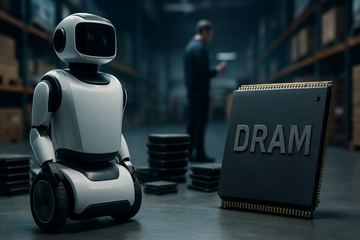
Amazon has quietly assembled a home-robotics team and is hiring for a \"new-to-world robot product,\" according to a November 8, 2026 CNBC analysis of the company's own job postings. That is the trigger. The trade it creates is not a robotics trade. Consumer robots are too small to move memory demand and too exposed to memory prices to be a good business — so the money flows to the memory makers and the risk sits with everyone trying to build the robot.
4Q26 conventional DRAM contract prices
+10–15% QoQ
TrendForce contract price forecast, Sep 30, 2026
Roborock FY2025 gross margin
42.4%
FY2025 results, down 7.98 points year on year
The announcement
Amazon's Third Bet on a Robot That Lives in the House
Amazon has tried this twice before. The pending acquisition of iRobot was terminated in January 2024, and the household robot Astro was retired the same year, with its small-business units switched off in September. What is different this time is the seed: Fauna Robotics, the New York startup behind Sprout, which Amazon confirmed it had acquired on March 24, 2026, adding roughly 50 staff and a $50,000 bipedal humanoid to a new division the company calls the Personal Robotics Group.
| Attempt | Asset | Price point | Outcome |
|---|---|---|---|
| iRobot (2022–2024) | Acquisition of the U.S. robot-vacuum leader | Not applicable | Terminated January 2024 |
| Astro (2021–2024) | Wheeled household robot with video calling | Above $1,000 at launch | Business units switched off in September 2024 |
| Fauna / Sprout (2026–) | 42-inch bipedal humanoid developer platform | $50,000 | Acquired by Amazon on March 24, 2026 |
| New-to-world product (2026–) | Consumer robot, still unnamed | Not disclosed | Team formed; hiring under way |
- A \"Field Support Engineer\" posting for the Fauna Robotics support team, based in Sunnyvale, California, covers customer support and on-site repair of robots.
- A \"Principal UX Designer\" role is being hired to define what it feels like to live with a Fauna robot — how it earns trust and communicates intent.
- A \"Senior Applied Scientist\" posting for Fauna Robotics in Sunnyvale and Bellevue asks for vision-language-action and reinforcement-learning work on consumer-grade hardware.
- The Amazon careers page for Consumer Robotics still describes the team as \"the team behind Astro\" and lists two open roles, so the organisation is being rebuilt under a new name.
The hiring pattern matters more than the hardware. Support, repair and in-home interaction design are the roles being filled first, and these are the roles you staff when robots are already in people's houses rather than in a lab. The org chart is being drawn for a shipped product, not for a research platform.
The category
There Is No Category War. There Is a Category Rebuild.
Before calling this a category war, look at what happened to the category leader. iRobot, the company Amazon tried to buy, entered a pre-packaged Chapter 11 in December 2025 and was delisted from Nasdaq. The plan became effective on January 23, 2026 and the cases closed on February 25, 2026, with the business now 100% owned by Shenzhen Picea Robotics and Santrum Hong Kong — its own secured lender and contract manufacturer. iRobot's common shareholders were cancelled outright with no recovery.
- The restructuring was pre-arranged, not improvised: Picea took 100% of the equity through the court-supervised process announced on December 14, 2025.
- The Nasdaq listing was cancelled, so the category's benchmark brand now carries no public valuation and no public funding base.
- The gap was filled fast: Roborock grew fiscal 2025 revenue 56.51% and SharkNinja lifted fiscal 2025 operating income 43%, both taking share from the vacuum category's former benchmark.
The cost base
The Robot Is an Edge Computer, and Edge Computers Are Bought in Memory
Here is what makes the story investable. Robots are sold on autonomy, and autonomy runs on memory sitting on the robot rather than in a data centre. Micron's own robotics engineering guidance puts humanoids at 16–128GB of LPDDR5 or LPDDR5X with 1–4TB of NVMe storage, and service robots at 4–64GB of LPDDR with 32GB of eMMC. Memory content per robot has become a design constraint, not a footnote.
| Robot class | DRAM | Storage | NOR flash |
|---|---|---|---|
| Cobots and factory robots | 8–64GB DDR4/DDR5 | 8–32GB eMMC/UFS | 1–2Gb |
| Autonomous mobile robots | 4–16GB LPDDR4/5, plus 2–8GB DDR3/4 | 64GB eMMC/UFS | 1–2Gb |
| Service robots | 4–64GB LPDDR4/5/5X | 32GB eMMC | 1–2Gb |
| Humanoid robots | 16–128GB LPDDR5/5X | 1–4TB NVMe SSD and 128GB UFS | 1–2Gb |
Memory costs have already reached consumer hardware prices
J.P. Morgan Global Research estimates DRAM prices rose more than 400% from the start of 2024 to the end of 2026. The producer and import price indices show the pass-through into finished hardware. Measurement windows differ: the DRAM estimate runs start-2024 to end-2026, the indices from end-2024.
Unit: %
DRAM price, start-2024 to end-2026
J.P. Morgan Global Research estimate, more than 400%
400%
Storage-device producer prices, since end-2024
Producer price index for storage devices
23%
Computer and peripheral import prices, since end-2024
Import price index for computers, peripherals and parts
37%
And the inflation has not stopped. TrendForce expects conventional DRAM contract prices to rise a further 10–15% quarter on quarter in the fourth quarter of 2026 and NAND flash 15–20%, with consumer DRAM still rising, just more slowly than the rest of the market. A robot designed today gets built with memory bought at 2027–2028 prices rather than today's — and those prices are already largely committed.
Robots are edge computers with bodies. Intelligence is moving to the edge to support real-time autonomy, and DRAM and NAND requirements are skyrocketing.
The demand side
Consumer Robots Cannot Move Micron's Numbers, Which Is the Point
This is where the obvious read goes wrong. The tempting argument is that a consumer robotics category war creates a second demand channel for edge AI silicon and memory. Run the arithmetic and it does not. In Micron's fiscal fourth quarter, the business unit that contains every smartphone and PC on earth — Mobile and Client — produced $13.1 billion of revenue, 24% of the company total. Consumer robots consume too few bits to move a supplier that has already sold 2027 and 2028.
| Business unit | Revenue | Share of company |
|---|---|---|
| Core Data Center | $18.0B | 33% |
| Cloud Memory | $16.3B | 30% |
| Mobile and Client | $13.1B | 24% |
| Automotive and Embedded | $6.8B | 13% |
The flip side is the one that matters for portfolios. Memory makers do not need consumer robots. Micron has signed 26 supply agreements representing more than 35% of revenue through 2030, and SK hynix has long-term agreements with 14 major customers covering more than half of its 2027 and 2028 capacity, with agreed price bands. The robot business does not rescue a memory maker — it simply raises the bill for everyone else trying to build consumer hardware.
The price template
Amazon's Own Price Template Caps What the Robot Can Be
Amazon has already shown how it prices consumer hardware, because it does it the same way every time: cheap device, recurring subscription. The Bee Frontier launched on October 15, 2026 at $74.99, the Bee Eclipse at $99.99, and the service layer on top at $11.99 a month, with both devices wired into Alexa+ and Amazon.com. Whatever the home robot is, it will be priced against a $75 wearable rather than against a $50,000 humanoid platform.
| Device | Price | Subscription | Implication |
|---|---|---|---|
| Bee Frontier wearable | $74.99 | Bee Pro $11.99/month | Hardware is the funnel; the profit sits in the subscription and in Amazon.com |
| Bee Eclipse phone clip | $99.99 | Bee Pro $11.99/month | Same monetisation, no new device economics |
| Astro household robot | Above $1,000 at launch | None disclosed | Priced like a premium appliance, retired within three years |
| Sprout humanoid platform | $50,000 | Deployed to outside researchers | A developer platform, not a consumer product |
| Amazon home robot (new) | Not disclosed | Not disclosed | Must clear sub-$1,000 hardware economics in a memory market rising double digits per quarter |
That last row is the constraint. A sub-$1,000 device cannot carry the compute stack of a $50,000 platform — Sprout's onboard brain is an NVIDIA Jetson AGX Orin with 64GB of memory — and it cannot carry a human-class memory bill into a retail price that has to clear Amazon's hardware margins. On the company's own template, the most probable first product is a low-memory, sensor-and-voice appliance rather than an AI humanoid. That is an inference from the price ladder, not a disclosed product, and it is why the read-through to edge AI silicon and to memory bit demand is weaker than the job postings imply.
The scoreboard
Who Wins and Who Bleeds
The scoreboard follows from the cost structure. Memory makers are running at extraordinary margins: Micron's fiscal fourth quarter gross margin was 86.8% on $54.2 billion of revenue, SK hynix's third-quarter operating margin was 80%, and Samsung Electronics posted an all-time-high quarterly revenue and operating profit for Memory on capacity constraints and higher prices across all applications. Every incremental consumer device in the world now buys memory from a market with no slack in it.
| Segment | Evidence from this cycle | Position |
|---|---|---|
| Memory suppliers | Micron FQ4 2026 gross margin 86.8%; SK hynix Q3 2026 operating margin 80%; Samsung Electronics record Memory quarter on capacity constraints | Winners regardless of the robot |
| Scaled consumer brands | Apple fiscal 2026 gross margin 48.8% and operating margin 33.0% through the shock; SharkNinja fiscal 2025 operating income up 43% to $921 million | Can absorb and pass through |
| Robot-category specialists | Roborock fiscal 2025 revenue up 56.51% but gross margin down 7.98 points to 42.4%, with growth decelerating to 23.31% in Q1 2026 | Bleeding margin |
| The category benchmark | iRobot equity cancelled in Chapter 11, delisted from Nasdaq, assets owned by its own contract manufacturer | Gone as an investable brand |
| The hyperscaler | Amazon Q3 2026 revenue $201.9 billion and a $220 billion 2026 capital-expenditure plan, but trailing free cash flow of minus $42.4 billion | Optionality, not a driver |
Note what the hyperscaler row says. Amazon can fund a robot out of an AWS segment that generated $46.0 billion of revenue and $17.8 billion of operating profit in the September quarter, and it can use Prime, Alexa+ and Amazon.com to subsidise the hardware. But a consumer robot is not an Amazon earnings story in any horizon that matters to the share price, and with trailing free cash flow at an outflow of $42.4 billion and $215.2 billion of net capital expenditure over the last twelve months, the company has far bigger uses for capital than a $75 robot.
Horizons
What to Watch, and When
- Watch what the first Amazon-branded home robot is priced at and how much memory it carries — a sub-$1,000 device with LPDDR rather than a Jetson-class stack confirms the low-memory read; anything else invalidates it.
- Micron's fiscal first-quarter 2027 report in December 2026, guided to $61.5 billion of revenue at roughly 86% gross margin, and whether Mobile and Client holds its record $13.1 billion.
- TrendForce's first-quarter 2027 contract price guidance in February 2027, and whether consumer DRAM keeps rising more slowly than the rest of the market.
- Whether Roborock defends gross margin or prices for share as a hyperscaler-funded entrant arrives, and whether SharkNinja keeps its lead in U.S. robot vacuums.
- Whether consumer robotics ever becomes a real third demand channel for memory. On Micron's own guidance a humanoid carries 16–128GB of LPDDR and up to 4TB of NVMe — meaningful per unit, but still tiny next to a mobile and client business that was only 24% of company revenue.
- Whether hyperscaler long-term agreements, which already cover more than half of SK hynix's 2027 and 2028 capacity, leave any consumer memory at all. If not, a robot maker is buying into a closed market at any price.
- Whether Amazon's home robot is sold as a subscription rather than a device. The Bee template is an $11.99 monthly fee, and a robot monetised as a service changes the memory-bill arithmetic entirely because lifetime value per unit goes up.
The investable read-through
- The home-robot team is optionality, not earnings: Q3 2026 revenue of $201.9 billion makes a sub-$1,000 device immaterial to the model.
- Trailing free cash flow of minus $42.4 billion keeps the robot push subordinate to AI infrastructure spending for the next several quarters.
- Watch the first product's price and memory specification over the next year; a Jetson-class bill of materials would signal a very different strategy.
- FQ4 2026 revenue of $54.23 billion at an 86.8% gross margin, with fiscal 2026 DRAM revenue above $100 billion.
- Twenty-six supply agreements covering more than 35% of revenue through 2030 remove the need for consumer robot demand to justify the cycle.
- FQ1 2027 guidance of $61.5 billion at roughly 86% gross margin; consumer robotics is upside optionality, not the thesis.
- Q3 2026 revenue of 104.6 trillion won and operating profit of 83.3 trillion won, an 80% operating margin.
- Long-term agreements with 14 customers covering more than half of 2027–2028 capacity lock in price rather than volume risk.
- HBM4 becomes the mainstream product from the fourth quarter; consumer robots do not move these numbers over any horizon.
- Q3 2026 consolidated operating profit of 107.4 trillion won, with Device Solutions at 106.5 trillion won on capacity constraints.
- Memory set an all-time high for quarterly revenue and operating profit on higher prices across all applications.
- Samsung is both a memory supplier and a robot-vacuum maker, so it captures the cost pass-through in one business and pays it in the other.
- Sprout's onboard compute is a Jetson AGX Orin 64GB, the reference stack for the humanoids Amazon just acquired.
- A consumer robot priced near the $74.99 Bee devices cannot carry a Jetson-class module, capping the consumer robotics opportunity.
- The humanoid platform standard matters more than Amazon's first device; wait for the price tier before sizing any Jetson upside.
- FY2025 revenue rose 56.51% to RMB 18.695 billion, but gross margin fell 7.98 points to 42.38% under price competition.
- Growth decelerated to 23.31% in Q1 2026 while memory costs kept rising double digits per quarter.
- A hyperscaler-backed entrant with Prime distribution raises the odds of a price war against a specialist already compressing margin.
- FY2025 revenue of $6.40 billion, gross profit of $3.14 billion and operating income of $921 million, up 43% year on year.
- Brand strength and multi-category scale are what let an appliance maker keep margins in a category whose benchmark brand went bankrupt.
- Memory inflation on a $3.26 billion cost of revenue base plus a new Amazon-backed entrant are the two things to watch through 2027.
- Fiscal 2026 revenue of $478.8 billion with a 48.8% gross margin and a 33.0% operating margin through the memory shock.
- Scale and pricing power absorbed a DRAM shock that upended subscale hardware economics.
- Apple is the read-across for what Amazon's robot will need: the ability to pass a rising memory bill through to the customer.